
A potential 18-day strike at South Korean semiconductor giant Samsung Electronics, involving over 45,000 workers, has escalated into a major concern for the government, rattled foreign investors, and cast a shadow over global supply chains. At the heart of this brewing labor dispute lies a fundamental question: how should the immense profits generated by the artificial intelligence (AI) boom be shared? The walkout, slated to begin on May 21st, threatens to disrupt the production of memory chips, critical components for AI data centers, smartphones, and laptops, as the company and its union remain at an impasse over bonus payouts.
Samsung Electronics, having reaped substantial profits from a global shortage of memory chips, has proposed significant bonus packages for its employees. However, the core of the disagreement lies in the proposed distribution. The company intends to offer memory chip employees, numbering around 27,000, bonuses at least six times larger than those allocated to workers in its logic chip design and manufacturing divisions. This proposal has ignited a firestorm within the union, which represents approximately 23,000 workers across these other businesses.
The union argues that these logic chip employees, responsible for manufacturing AI chips for industry giants like Tesla and Nvidia, should not be overlooked. Many of these workers operate in the same facilities as their memory chip counterparts and are instrumental in developing the foundational components for cutting-edge AI technology. Despite facing billions in losses in recent years as the foundry business struggled, the union contends that these employees deserve equitable compensation, especially given their crucial role in Samsung’s broader semiconductor strategy.
Roots of the Dispute: Divergent Profitability and Strategic Ambitions
The current conflict is deeply intertwined with Samsung’s ambitious strategy to become the world’s sole semiconductor company offering a comprehensive "one-stop" solution, encompassing diverse chip types and services. This contrasts with more specialized competitors like Micron Technology and Taiwan Semiconductor Manufacturing Company (TSMC). The company’s Device Solutions Division comprises three primary business units: memory, system LSI (logic chips), and foundry services. The current AI surge has dramatically skewed the profitability across these units. While Samsung reigns as the world’s leading memory chip manufacturer by sales, its system LSI and foundry operations have historically faced greater volatility and financial challenges.
Internal wage negotiation transcripts, reviewed by Reuters, alongside interviews with over a dozen workers, including union leaders and sources close to the discussions, reveal deep divisions within Samsung. These internal discussions and the resulting employee departures have not been previously reported and threaten to undermine Samsung’s overarching goal of becoming a fully integrated semiconductor powerhouse. The stark disparity in proposed bonuses highlights a fundamental disagreement about how to reward contributions in a rapidly evolving market where AI has become a significant profit driver for certain segments of the company.
A Timeline of Mounting Tensions

The seeds of the current labor unrest were sown last year when rival SK Hynix announced the abolition of its 10-year pay cap. This move resulted in bonuses for SK Hynix employees that were more than three times higher than those offered to Samsung workers, prompting a talent drain from Samsung to its competitor.
In March of this year, Samsung attempted to address this competitive disadvantage by proposing bonuses for its memory chip workers that would exceed even those offered by SK Hynix, potentially reaching 607% of their annual salary. This proposal marked a departure from previous bonus structures where memory and logic chip businesses received similar compensation plans. However, the new proposal stipulated that employees in other businesses, primarily focused on logic chips essential for AI processors, would receive bonuses ranging from a mere 50% to 100% of their annual salary.
Union officials have warned that this significant bonus gap could incentivize logic chip employees to either transfer to the more lucrative memory division within Samsung or seek employment with other companies. This potential exodus, they argue, could cripple Samsung’s ambitions in the logic chip market, a sector where Chairman Jay Y. Lee has publicly declared his goal to achieve "clear No. 1" status by 2030.
"If the memory division gets 500 million won while the foundry division only gets 80 million won, what motivation would those employees have to keep working?" lamented union leader Choi Seung-ho during negotiation sessions, as documented in the transcripts. The union’s demands include the abolition of Samsung’s bonus cap of 50% of annual salaries and the allocation of 15% of annual operating profit to a bonus pool distributed among all workers.

The Specter of a Talent Drain
The sentiment of discontent is palpable among Samsung employees, with many reporting that an exodus of talent is already underway. A foundry engineer, who identified himself by his surname Lee, shared that his team in Pyeongtaek has significantly shrunk over the past two years, with several colleagues migrating to Samsung’s memory division and to SK Hynix. Two other employees, who requested anonymity, corroborated these accounts, stating that many of their colleagues are actively applying for positions at SK Hynix and other competing firms.
Samsung negotiators, however, maintain that performance bonuses should be awarded based on merit and profitability. Kim Hyung-ro, a Samsung executive and negotiator, argued during the transcripts that the logic chip business has incurred losses in the trillions of won. He asserted that if not for the financial support from the memory business, these divisions might have ceased to exist. "So how can you justify giving performance bonuses?" he questioned, emphasizing that the company’s investments in facilities for these struggling divisions are being funded by the profits generated from the memory sector.
In a formal statement, Samsung Electronics reiterated its commitment to the logic chip business, describing it as "a strategically significant business which we have continuously invested in, guided by our long-term vision." The company further stated its intention to "offer its employees the best compensation in the industry" through its latest proposal. However, Samsung also issued a stark warning: a failure to deliver products due to a strike would lead to "a complete loss of trust" from its customers.

Economic Ramifications and Broader Implications
The potential strike at Samsung is not merely an internal labor dispute; it carries significant economic weight and has drawn the attention of the South Korean government and international financial institutions. JPMorgan has estimated that the strike could impact Samsung’s operating profit by 21 trillion to 31 trillion won (approximately $14.08 billion to $20.79 billion), with potential sales losses reaching around 4.5 trillion won.
Samsung’s top leadership has expressed deep concern over the potential repercussions. An internal memo circulated earlier this month by the company’s chairman highlighted fears of business disruptions, capital outflows, a decline in tax revenue, and a weakening of the South Korean won.
The South Korean government has also weighed in, with President Lee Jae Myung remarking in late April that some unions were making "excessive demands." These remarks were widely interpreted as a veiled reference to the ongoing negotiations at Samsung, signaling the government’s unease about the potential economic fallout.

The American Chamber of Commerce in Korea has voiced its own concerns, stating that labor uncertainty could erode confidence in South Korea’s reputation as a reliable partner in global manufacturing and supply chains. Analysts are closely monitoring the dispute, viewing it as a potential barometer for labor-management relations across the country.
"If Samsung sets a precedent in which union demands are pushed through by means of a strike, companies could find themselves in a very unfavorable bargaining position in the future," warned Park Ji-soon, a law professor at Korea University.
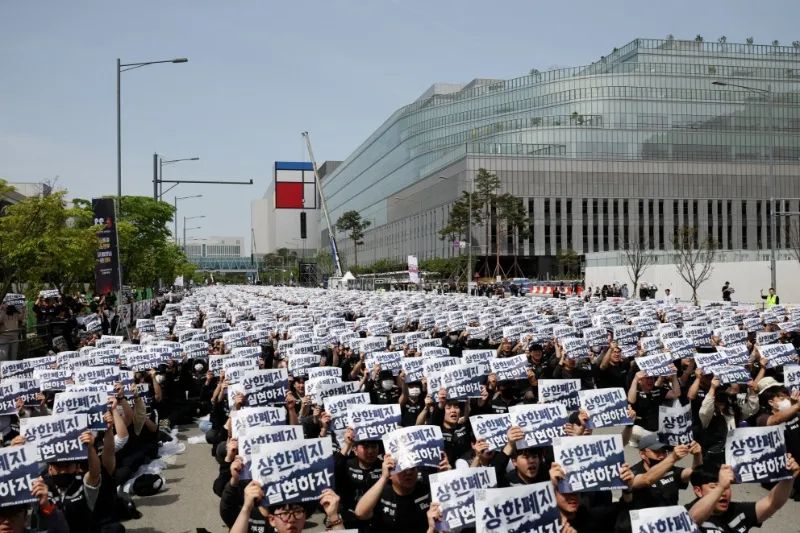
Protesting workers articulate a deep sense of frustration, arguing that Samsung has failed to adequately recognize their contributions to the company’s ascent to global leadership. One chip researcher with three decades of experience, who attended a recent rally of approximately 40,000 workers, stated that many of his colleagues have already left for other companies, and he himself has applied for a position at Micron. "I attended the rally because I am infuriated," he expressed, adding, "I can’t just sit in the office and work. I no longer have pride in Samsung."
The unresolved dispute underscores the delicate balance required between rewarding employees for their contributions and ensuring the long-term financial health and strategic objectives of a global technology giant. As the May 21st deadline approaches, the world watches to see if Samsung can navigate this complex labor landscape and prevent a disruption that could reverberate far beyond its manufacturing floors, impacting the very foundations of the AI revolution it helps to power. The outcome of this standoff will likely set a significant precedent for labor relations within South Korea’s vital semiconductor industry and beyond.