The Evolution of Experiential Learning in a Digital Context
The release of this eBook marks a significant milestone in the maturation of digital pedagogy. For decades, corporate training was characterized by a "content-first" approach, where the primary objective was the delivery of information. However, empirical data from the last decade has consistently shown that information retention does not equate to behavioral change. The "Know-Do Gap"—the disconnect between what a learner knows and what they actually do in a high-pressure workplace environment—remains one of the most expensive challenges for modern enterprises.
Scenario-based learning (SBL) has emerged as the primary solution to this gap. By placing learners in a simulated environment that mirrors their actual job roles, SBL forces the application of knowledge in real-time. The specific focus of the new iSpring Solutions guide—branching scenarios—adds a layer of complexity and realism that linear scenarios lack. In a branching scenario, every decision made by the learner triggers a unique consequence, leading to different paths and outcomes. This mimics the "butterfly effect" of workplace decisions, where a single interaction with a client or a specific technical choice can determine the success or failure of a project.
Chronology of Instructional Design: From Linear to Branched
The path to the current state of scenario-based learning has been shaped by technological advancements and shifting psychological insights.
In the early 2010s, eLearning was largely synonymous with "page-turners"—PowerPoint-style slides followed by a multiple-choice quiz. By 2018, the industry saw a surge in the use of video and gamification, which improved engagement but often lacked deep cognitive involvement. The period between 2020 and 2024, accelerated by the global shift to remote work, forced a realization that training must be more than engaging; it must be effective in isolation.
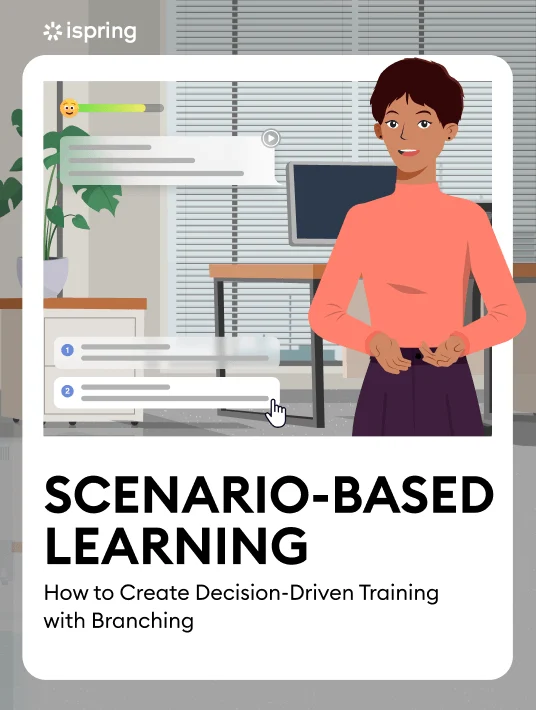
By 2025, the L&D market began to consolidate around the idea of "Safe Failure." This concept, which is central to the new eBook, allows learners to make mistakes in a controlled environment where the only cost is a "Game Over" screen rather than a lost contract or a safety violation. The launch of "Scenario-Based Learning: Decision-Driven Training With Branching" represents the culmination of this chronological shift, providing a standardized framework for creating these complex interactions without the need for extensive coding or massive production budgets.
![Scenario-Based Learning: How To Create Decision-Driven Training With Branching [eBook Launch]](https://cdn.elearningindustry.com/wp-content/uploads/2026/09/shutterstock_2637057583.jpg)
Supporting Data: The Efficacy of Decision-Driven Training
The move toward branching scenarios is supported by a growing body of quantitative research. According to industry benchmarks cited by L&D analysts, scenario-based training can increase knowledge retention rates by up to 75% compared to traditional lecture-based methods. Furthermore, a 2025 study on workplace performance indicated that employees who engaged in branching simulations were 40% more confident in handling "difficult conversations" and 30% faster at troubleshooting technical errors than those who received standard training.
The economic implications are equally significant. While the initial development time for a branching scenario can be 20-30% higher than a linear course, the long-term Return on Investment (ROI) is realized through a reduction in "on-the-job" errors and a decrease in the time required for new employees to reach full productivity. iSpring Solutions’ new guide specifically addresses the "complexity trap," providing methodologies to keep development times manageable while maintaining high pedagogical value.
Strategic Implementation and the "Safe Failure" Model
One of the core tenets explored in the eBook is the design of authentic workplace challenges. Experts in instructional design argue that the most effective scenarios are not those that test factual knowledge, but those that test judgment. This requires a departure from the "One Right Answer" philosophy. In many of the scenarios outlined in the guide, learners are presented with multiple "good" options, each with different trade-offs, forcing them to weigh priorities such as speed, cost, and quality.
The eBook details several use cases for this approach:
- Sales and Negotiation: Learners practice handling objections and navigating complex procurement processes.
- Compliance and Ethics: Moving beyond "yes/no" questions to nuanced situations where ethical boundaries are blurred.
- Technical Troubleshooting: Simulating equipment failure or software bugs where the cause is not immediately apparent.
- Leadership Development: Practicing conflict resolution and performance reviews in a low-stakes environment.
By focusing on these high-impact areas, the guide provides a roadmap for L&D professionals to align their training programs with the strategic goals of the C-suite.
Industry Responses and Expert Perspectives
The launch has garnered attention from various sectors of the educational technology community. Analysts suggest that the democratization of branching scenario tools—moving them from the realm of specialized programmers to instructional designers—is a game-changer.
![Scenario-Based Learning: How To Create Decision-Driven Training With Branching [eBook Launch]](https://cdn.elearningindustry.com/wp-content/uploads/2026/09/shutterstock_2637057583-768x431.jpg)
"The challenge has never been the ‘why’ of scenario-based learning; it has always been the ‘how,’" noted one senior instructional strategist during the launch event. "Most designers get lost in the ‘spaghetti logic’ of branching paths. This resource provides a disciplined structure to ensure that every branch serves a learning objective, rather than just adding complexity for the sake of it."
Furthermore, representatives from iSpring Solutions emphasized that the guide was developed in response to user feedback. Many organizations reported that while they wanted to implement decision-driven training, they lacked the internal framework to script and storyboard these experiences effectively. The eBook is intended to serve as that missing framework, offering templates and best practices that can be applied across various authoring platforms.
Broader Impact and Future Implications for the L&D Landscape
The implications of this launch extend beyond the immediate availability of a new PDF. It signals a broader trend toward the "simulation-first" era of corporate education. As Artificial Intelligence (AI) becomes more integrated into eLearning authoring tools, the ability to generate dynamic, branching scenarios will likely become automated. However, the underlying principles of instructional design—identifying the "critical decision points" and mapping the "consequence logic"—will remain human-centric tasks.
Moreover, the focus on decision-driven training aligns with the rise of the "Skills-Based Organization." In an era where job descriptions are fluid, the ability to demonstrate sound judgment in ambiguous situations is the ultimate competitive advantage. Companies that adopt the methodologies outlined in the iSpring guide are likely to see a more resilient and adaptable workforce.
As the industry moves toward 2027, the standard for "effective" training will continue to rise. No longer will a completion certificate be sufficient proof of competence. Instead, organizations will look for data-driven insights from branching scenarios to identify which employees possess the highest levels of situational awareness and decision-making proficiency.
In conclusion, "Scenario-Based Learning: Decision-Driven Training With Branching" is more than a technical manual; it is a strategic manifesto for the future of work. By providing the tools to turn everyday workplace challenges into structured learning experiences, eLearning Industry and iSpring Solutions are helping to define a new standard for professional development—one where the learner is not a passive recipient of information, but an active participant in their own growth. The free availability of this resource ensures that these advanced pedagogical techniques are accessible to organizations of all sizes, potentially leveling the playing field in the global race for talent and efficiency.