The global corporate landscape is currently witnessing a historic divergence between the rapid deployment of artificial intelligence and the realization of its promised economic value. While organizations across nearly every sector have integrated AI tools at a speed that dwarfs previous technological revolutions, the vast majority have yet to see these investments fundamentally alter the mechanics of how work is performed. This phenomenon, increasingly referred to as the AI adoption paradox, suggests that the primary obstacle to digital transformation is no longer a matter of software engineering, but one of human adaptation. For Chief Learning Officers (CLOs) and executive leadership, the strategic priority has shifted from the technical implementation of algorithms to the psychological and behavioral evolution of the workforce that must operate alongside them.
The Current State of Artificial Intelligence Integration
Recent data underscores the sheer velocity of the AI surge. According to a comprehensive study by McKinsey & Company, by late 2025, approximately 90 percent of organizations reported utilizing artificial intelligence regularly in at least one business function. This represents a near-total saturation of the enterprise market in less than three years since the public debut of advanced generative models. However, this enthusiasm for adoption has not translated into a corresponding increase in profitability. MIT’s Project NANDA, which analyzed more than 300 enterprise deployments, revealed a startling statistic: roughly 95 percent of generative AI pilots failed to produce a measurable impact on profit-and-loss statements.
The disconnect stems from what researchers describe as a "learning gap." While tools are being distributed to employees, the fundamental methodologies of work remain stagnant. The consensus among organizational theorists is that success in the AI era hinges on the approach to change management rather than the sophistication of the technology itself. This has led to a resurgence of the "adaptive leadership" framework, originally developed by researchers at Harvard University. This framework distinguishes between technical challenges—which can be solved with existing expertise and software—and adaptive challenges, which require individuals to adjust their behaviors, professional identities, and long-standing habits.
A Chronology of the Generative AI Transition
The journey from the initial hype of generative AI to the current era of skepticism and structural adjustment has followed a distinct timeline:
- Late 2022 – Early 2023: The Era of Awareness. The launch of high-performance large language models triggered a wave of "corporate FOMO" (fear of missing out). Organizations rushed to secure licenses and establish internal task forces.
- Mid-2023 – Early 2024: The Pilot Proliferation. Companies launched thousands of small-scale pilots, focusing on low-hanging fruit such as email drafting, basic coding assistance, and customer service chatbots.
- Late 2024 – Early 2025: The Value Realization Crisis. CFOs and boards began demanding ROI data from AI investments. The realization dawned that while individual tasks were faster, total departmental output and quality remained largely unchanged due to "bottlenecking" in the surrounding human processes.
- Present Day: The Shift to Adaptive Development. Leading organizations are moving away from "tool-first" strategies toward "mindset-first" strategies, recognizing that AI adoption skills depreciate as rapidly as the software updates themselves.
The Leadership Mindset Shift: The Flux 5 Framework
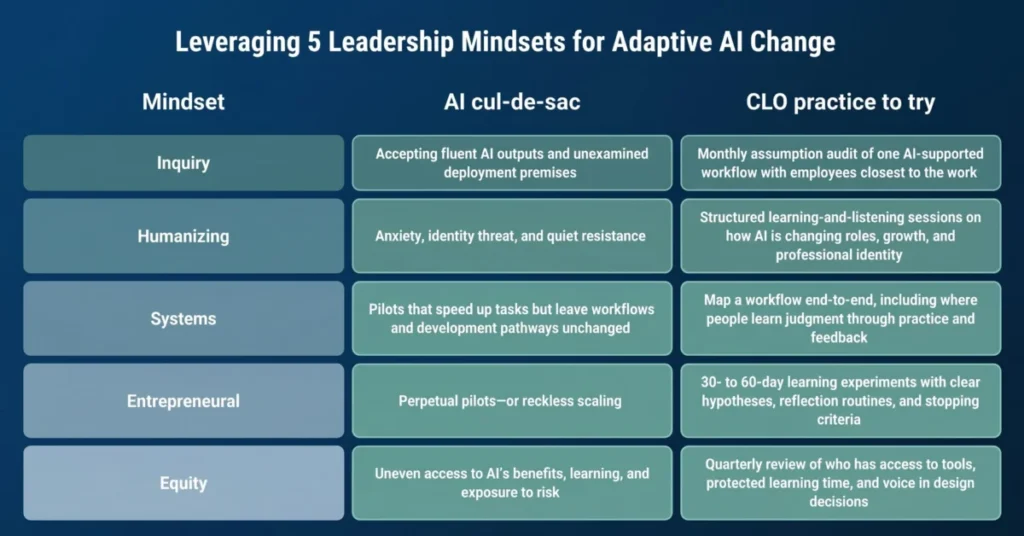
To navigate this transition, organizational leaders are increasingly adopting the "Flux 5" framework, which prioritizes five distinct mindsets: Inquiry, Humanizing, Systems, Entrepreneurial, and Equity. These mindsets are designed to prevent organizations from falling into the "AI cul-de-sac"—a state where technology is present but utility is localized and negligible.
1. The Inquiry Mindset: Beyond Prompt Fluency
In an information environment where AI-generated outputs are prone to hallucinations and logical errors, an inquiry mindset serves as a critical safeguard. This involves a commitment to questioning both the output (the specific data generated) and the premise (the underlying assumptions of the AI model).
Industry analysts suggest that "prompt engineering" is a fleeting skill, soon to be automated. The more durable capability is "disciplined discernment"—the ability to verify claims against trusted sources and identify missing context. For the CLO, this means shifting training from "how to use the tool" to "how to interrogate the tool’s logic."
2. The Humanizing Mindset: Addressing Professional Identity
The introduction of AI often triggers rational anxiety among staff regarding job security and the devaluation of their expertise. When leaders frame AI solely as a productivity lever for headcount reduction, they frequently encounter "knowledge blocking" and silent resistance.
A humanizing mindset requires leaders to protect the developmental pathways that allow junior employees to build expertise. If AI handles all foundational tasks (writing, basic analysis, feedback loops), the traditional "learning by doing" model breaks down. Organizations must intentionally redesign entry-level roles to ensure that human judgment is still being cultivated even when the heavy lifting is automated.
3. The Systems Mindset: Mapping the Ecosystem
One of the most common failures in AI deployment is "local optimization." For example, if a marketing team uses AI to produce content five times faster, but the legal department still takes two weeks to review it, the system-wide gain is zero.

A systems mindset encourages leaders to map the entire workflow before automation. This includes identifying where feedback loops might be broken and where AI-generated content might become "poisonous" input for other automated systems. The goal is to ensure that gains in one area are not absorbed by friction in another.
4. The Entrepreneurial Mindset: Disciplined Curiosity
The entrepreneurial approach focuses on "bounded experiments"—short-term (30 to 60-day) trials with clear hypotheses and threshold criteria. This prevents "pilot purgatory," where projects linger indefinitely without scaling or being decommissioned.
The entrepreneurial question shifts from "Can we use AI for this?" to "What does this moment make possible that was impossible before?" This mindset encourages frontline employees to identify friction points that leadership might overlook, turning every worker into a potential architect of the new workflow.
5. The Equity Mindset: Distributing Risk and Reward
AI does not distribute its benefits or risks evenly. Historical biases embedded in training data can lead to discriminatory outcomes in hiring, performance evaluations, and service delivery. Furthermore, access to AI training often follows existing corporate hierarchies, potentially widening the gap between different demographic groups within the company.
An equity mindset requires quarterly reviews of AI deployments to determine who is gaining capacity and who is absorbing the risk. Organizations that democratize access to AI tools and provide protected time for experimentation across all levels tend to build a more resilient and adaptable workforce.
Supporting Data and Economic Implications
The stakes for getting this transition right are high. Gartner recently projected that by 2026, 70 percent of generative AI projects that do not include a significant cultural and behavioral change component will be abandoned. Conversely, organizations that successfully integrate human-centric AI adoption are expected to see a 25 percent higher improvement in operational efficiency compared to those that treat it as a purely technical upgrade.
Furthermore, a 2024 Deloitte survey of C-suite executives found that while 79 percent expect generative AI to drive substantial organizational transformation within three years, only 22 percent believe their workers are currently "highly prepared" to work with these tools. This "readiness gap" is the primary target for the adaptive leadership strategies currently being deployed.
Official Responses and Industry Reactions
"The technology is the easy part," noted a senior executive at a Fortune 500 financial services firm during a recent industry summit. "The hard part is convincing a senior analyst who has done things a certain way for twenty years that their value now lies in their judgment of the AI’s work, not in the production of the work itself. That is a psychological shift, not a technical one."
Similarly, labor advocates have expressed concern that without a "humanizing mindset," the push for AI efficiency will lead to "algorithmic burnout," where the pace of work is dictated by the machine, leaving no room for human reflection or creativity. In response, several European labor unions have begun negotiating for "right to understand" clauses in employment contracts, ensuring that employees are educated on how AI decisions affecting their roles are made.
Broader Impact and the Future of the CLO
The evolving role of the Chief Learning Officer is perhaps the most significant structural change in the corporate hierarchy. Once relegated to managing compliance training and optional skill-building, the CLO is now becoming a central figure in strategic operations. They are the architects of the "holding environment"—the culture of safety and transparency required for adults to experiment with new technologies without fear of failure.
In the long term, AI is not a destination but a continuous process of iterative learning. The capabilities of these models will continue to shift, constantly reopening questions of identity, trust, and structure. The organizations that thrive will be those that do not just "adopt" AI, but those that build a sustained capacity for adaptation. The ultimate goal of the AI-integrated enterprise is not to replace human intelligence, but to potentiate it, using technology to remove the mundane and empower the uniquely human qualities of inquiry, empathy, and systemic vision.