The corporate learning and development (L&D) landscape is currently undergoing a significant paradigm shift, driven by a growing tension between long-term talent cultivation and immediate operational necessity. For over two decades, industry observers have noted a recurring phenomenon: two professionals can hold the same job title, manage similar budgets, and face identical pressures to prove their worth, yet their definitions of "value" remain fundamentally opposed. This divergence is not a result of varying levels of talent or effort, but rather a direct consequence of organizational reporting structures. The realization that an individual’s superior defines the metric of success has led to the identification of two distinct frameworks through which learning is viewed: the Skills Lens and the Performance Lens.
The Dual Framework of Corporate Learning
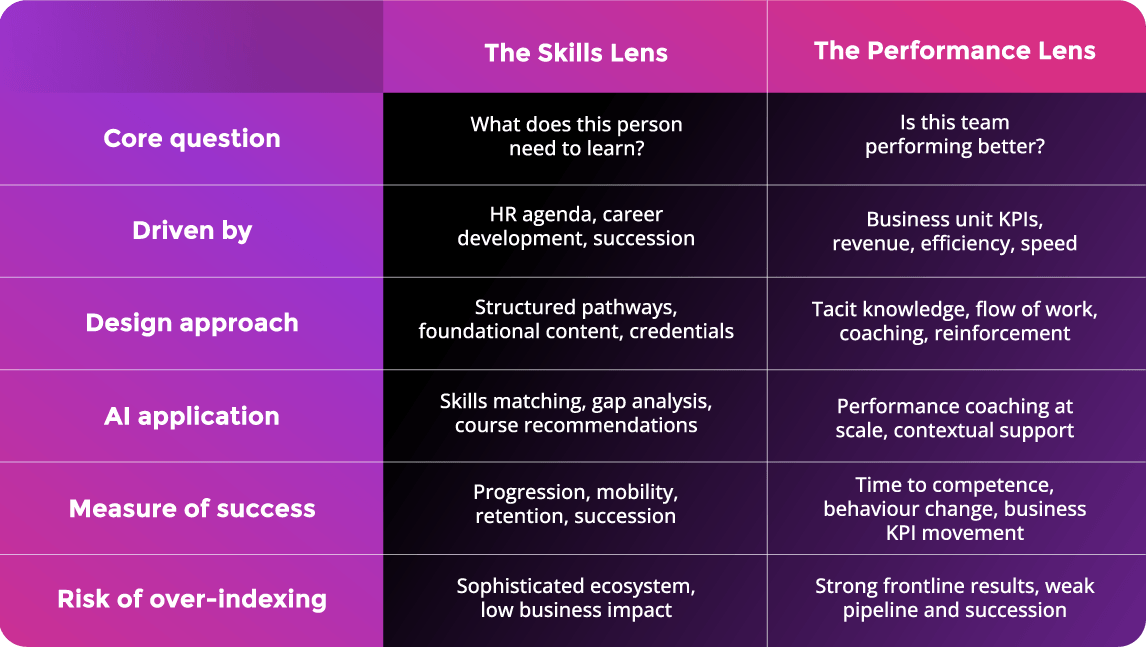
The dichotomy within the L&D sector is largely dictated by whether a learning leader reports to Human Resources (HR) or to a functional business unit, such as Sales, Retail, or Operations. When a Chief Learning Officer (CLO) reports to an HR Director, the organizational expectation typically leans toward the "Skills Lens." In this framework, success is measured by how effectively the learning function supports employee development, career pathways, and long-term succession planning. The focus is on building a foundational talent pool that the organization will require three to five years down the line.
Conversely, a learning leader embedded within a functional operation is viewed through the "Performance Lens." Here, the stakeholders—often Sales or Operations Directors—are less concerned with five-year career trajectories and more focused on immediate output. The primary questions involve revenue generation, conversion rates, and the speed at which a new hire can reach full productivity. This lens prioritizes the narrowing of the gap between average performers and top-tier executors. While both perspectives are valid and necessary for a healthy organization, they require radically different methodologies, technologies, and success metrics.
Historical Context and the Evolution of Training Methodology
To understand the current tension between these two lenses, one must look at the evolution of corporate training. Historically, the "Skills Lens" dominated the industry. In the late 20th century, corporate universities were modeled after traditional academic institutions, emphasizing classroom-based learning and broad certifications. This approach created what experts call the "50kg Backpack Problem," where employees are loaded with an immense amount of theoretical knowledge before they ever begin their actual work.
Research into the "Forgetting Curve," a theory pioneered by Hermann Ebbinghaus, suggests that without immediate application, humans forget approximately 70% of new information within 24 hours. Despite this, many organizations continued to favor front-loaded training. The transition toward the "Performance Lens" began in earnest with the rise of "Learning in the Flow of Work," a concept popularized by industry analysts like Josh Bersin. This movement argued that for learning to be effective, it must be delivered in small, relevant increments at the exact moment of need.

The "50kg Backpack" vs. The Performance Support Model
The practical distinction between the two lenses is most visible in the design phase of training programs. A Skills Lens approach utilizes a toolbox of skills gap analyses, foundational content libraries, and structured learning pathways. It is a comprehensive, often slow, process designed to transform an individual over time.
The Performance Lens, however, views the job itself as the classroom. Instead of a 50kg backpack of knowledge, the goal is to provide a "5kg backpack" containing only the essentials, supplemented by a robust support system that provides information in real-time. This model relies on capturing "tacit knowledge"—the unwritten expertise held by high performers—and making it instantly accessible to the rest of the workforce.
Key components of the Performance Lens toolbox include:
- Mobile-first, instant-access performance support systems.
- Social learning platforms that facilitate peer-to-peer knowledge transfer.
- Continuous practice and reinforcement through micro-coaching.
- Real-time updates to content to reflect shifting product lines or market promotions.
Empirical Data: Case Studies in Performance-Driven Learning
The shift toward a performance-centric model is supported by significant empirical evidence from global organizations. These entities have demonstrated that when learning is tied directly to business Key Performance Indicators (KPIs), the return on investment (ROI) becomes undeniable.
Hilti and Sales Onboarding:
Hilti, a global leader in construction tools and technology, implemented a rigorous performance-focused discipline. The learning team adopted a policy where no program would be developed unless a clear line could be drawn to a measurable business KPI. As a result, Hilti successfully reduced its sales onboarding time from 15 months to just 3 months. This drastic reduction in "time to competence" directly translated into millions of dollars in recovered productivity.
Veidec and Revenue Growth:
Veidec, a chemical products manufacturer, utilized a performance-oriented learning program to drive a 13.5% combined revenue growth across its core markets in Sweden and Denmark. In the Danish market alone, total sales increased by 19%. The focus was not on general skills, but on the specific behaviors required to close sales and maintain client relationships.
Carpetright and Average Order Value:
In the retail sector, Carpetright integrated learning so deeply into the flow of work that it generated 10,000 content views per day across its workforce. By focusing on "Average Order Value" (AOV) as the primary success metric rather than completion rates, the L&D function was able to demonstrate a direct correlation between learning engagement and store profitability.
Levy and Engagement Metrics:
Even within the Skills Lens, data-driven approaches are yielding results. Levy, a major hospitality firm, invested in a General Manager development program that resulted in a 15% increase in their Team Net Promoter Score (TNPS). This improvement in employee sentiment is directly linked to higher retention rates, which mitigates the substantial costs associated with turnover in the hospitality industry.
The Role of Artificial Intelligence in Scaling Performance
The most significant hurdle for the Performance Lens has traditionally been scalability. While content can be distributed easily, high-quality coaching—the factor that often accounts for the difference between a standard performer and a top-tier performer—is human-intensive and expensive. Industry data suggests that while high-quality content can improve performance by roughly 10%, personalized coaching can drive improvements of 40% or more.
The emergence of Artificial Intelligence (AI) is currently bridging this gap. Unlike previous iterations of L&D technology that focused on content delivery, the "AI Era" focuses on the "AI Performance Coach." These systems are designed to:
- Understand the specific context of an individual’s role and current challenges.
- Retrieve expert knowledge tailored to the immediate problem.
- Provide opportunities for practice and immediate feedback.
- Adapt the learning journey based on real-world performance data.
Through the Skills Lens, AI acts as a sophisticated recommendation engine. Through the Performance Lens, however, AI acts as a force multiplier for management, providing personalized, 24/7 coaching to thousands of employees simultaneously.
Strategic Implications for Learning Leaders
The primary challenge for modern learning leaders is to identify the "question before the question." Often, L&D professionals are tasked with proving the value of a program after it has already been deployed. To avoid this, the definition of value must be established at the outset based on the problem being solved.

If the objective is a Skills Program, the metrics must focus on internal mobility, readiness for promotion, and long-term retention. If the objective is a Performance Program, the metrics must focus on behavior change, knowledge currency, and movement in business KPIs like sales volume or customer satisfaction (CSAT) scores. If the objective is Compliance, the value equation is one of risk mitigation—comparing the cost of the training against the potential legal or financial cost of a failure.
Conclusion: Navigating the Dual Lens Reality
The future of organizational learning does not lie in choosing one lens over the other, but in the ability to operate fluently within both. For organizations where a vast majority of the workforce is on the frontline—such as manufacturing, retail, and customer service—the Performance Lens is a commercial necessity. A learning function that can demonstrably improve frontline execution becomes an indispensable part of the business operations rather than a discretionary overhead.
Simultaneously, the Skills Lens remains vital for organizational health. Employees who feel their long-term growth is being ignored are unlikely to remain with a company, leading to a "brain drain" that can cripple even the most efficient operations.
The most successful learning leaders of the next decade will be those who can speak the language of HR and the language of Operations with equal proficiency. By recognizing that the definition of value is not fixed but is instead a reflection of the organizational lens, L&D professionals can move from a position of defending their budget to one of driving the business forward. The ultimate goal is a holistic learning ecosystem where skills development feeds the talent pipeline and performance support ensures that talent is utilized to its maximum potential.