The global corporate landscape is undergoing a fundamental shift in management philosophy, moving away from traditional "deficit-based" models toward a strengths-based leadership approach. For decades, organizational development focused primarily on identifying employee weaknesses and implementing remedial training to close skill gaps. However, contemporary research in positive psychology and workplace performance suggests that this focus on "fixing" people often yields diminishing returns. Instead, a growing body of evidence from institutions such as Gallup and various academic psychological studies indicates that organizations achieve significantly higher performance, engagement, and retention when they prioritize the identification and cultivation of their employees’ natural talents.
The Historical Context and Shift in Management Theory
To understand the rise of strengths-based leadership, one must examine the evolution of management theory. Throughout much of the 20th century, the prevailing "Scientific Management" approach, pioneered by Frederick Winslow Taylor, treated employees as components of a machine. The goal was standardization; any deviation from the "ideal" worker profile was seen as a flaw to be corrected.
The paradigm began to shift in the late 1990s and early 2000s, spearheaded by the work of Don Clifton, often cited as the father of strengths-based psychology. In collaboration with Gallup, Clifton’s research posited a simple but revolutionary question: "What will happen when we think about what is right with people rather than fixating on what is wrong with them?" This led to a 40-year longitudinal study involving millions of interviews, eventually culminating in the development of the CliftonStrengths assessment. Today, this philosophy is no longer a niche psychological theory but a cornerstone of modern Human Resources (HR) and Learning and Development (L&D) strategies.
Quantifiable Benefits: Data-Driven Performance Gains
The adoption of strengths-based management is driven by compelling data. According to Gallup’s meta-analysis of 1.2 million employees across 22 countries, workgroups that received strengths-based interventions saw a 14% to 29% increase in profit and a 10% to 19% increase in sales. Furthermore, employees who use their strengths every day are six times more likely to be engaged in their jobs and three times more likely to report having an excellent quality of life.
From an organizational health perspective, the implications for retention are profound. In high-turnover industries, strengths-based cultures have seen a 26% reduction in attrition, while low-turnover industries saw up to a 72% reduction. These figures highlight that when individuals feel their natural talents are recognized and utilized, their psychological contract with the employer strengthens, leading to increased "internal mobility"—the ability for employees to move into new roles within the company that better fit their evolving skill sets.
The Four Pillars of Strengths-Based Leadership
At its core, this leadership style is governed by four distinct principles that differentiate it from traditional management.
1. The Identification of Innate Talent
Leaders must distinguish between knowledge, skills, and talents. While knowledge (factual information) and skills (the ability to perform a task) can be taught, talents are innate patterns of thought, feeling, or behavior. Strengths-based leaders use a combination of behavioral observation, structured 360-degree feedback, and psychometric assessments to map these talents. This mapping allows for a more granular understanding of the "human capital" available within a team.
2. Deliberate Development and Investment
Possessing a talent is not the same as possessing a strength. A strength is defined as the ability to provide consistent, near-perfect performance in a specific activity. This requires deliberate investment—the practice of refining a talent with skills and knowledge. For instance, a natural "relator" (talent) becomes a master negotiator (strength) only after learning conflict resolution techniques and gaining years of experience in high-stakes environments.
3. Construction of Complementary Teams
One of the most significant misconceptions in leadership is the "well-rounded" leader. Research suggests that while the best leaders are not well-rounded, the best teams are. Strengths-based leadership theory emphasizes that a leader does not need to be an expert in every domain. Instead, they should build teams where members’ strengths compensate for each other’s gaps. A visionary "Strategic Thinker" is most effective when paired with an "Executer" who excels at logistics and accountability.

4. Strategic Management of Weaknesses
Focusing on strengths does not equate to ignoring weaknesses. Rather, it involves a strategic approach to "managing around" them. If a high-performing analyst lacks public speaking skills, a strengths-based leader might provide basic communication training to ensure the weakness isn’t a "fatal flaw," but they would ultimately pair that analyst with a strong communicator to present findings, rather than forcing the analyst to spend 80% of their time on a task that drains their energy and yields mediocre results.
Leadership Competencies in a Strengths-Based Framework
To implement this model, leaders themselves must exhibit specific competencies. These are often categorized into four domains:
- Strategic Thinking: The ability to analyze information, look at the big picture, and help the team make better decisions for the future.
- Relationship Building: The "glue" that holds a team together, fostering trust and creating an environment where employees feel safe to take risks.
- Influence: The capacity to sell the team’s ideas inside and outside the organization, ensuring the group is heard and supported.
- Execution: The drive to turn ideas into reality through rigorous process management and accountability.
In the context of Instructional Design (ID), these competencies allow learning leaders to move away from "order-taking" (simply producing content) to becoming strategic partners who align learning outcomes with the specific strengths of the workforce.
A Framework for Instructional Designers and Learning Leaders
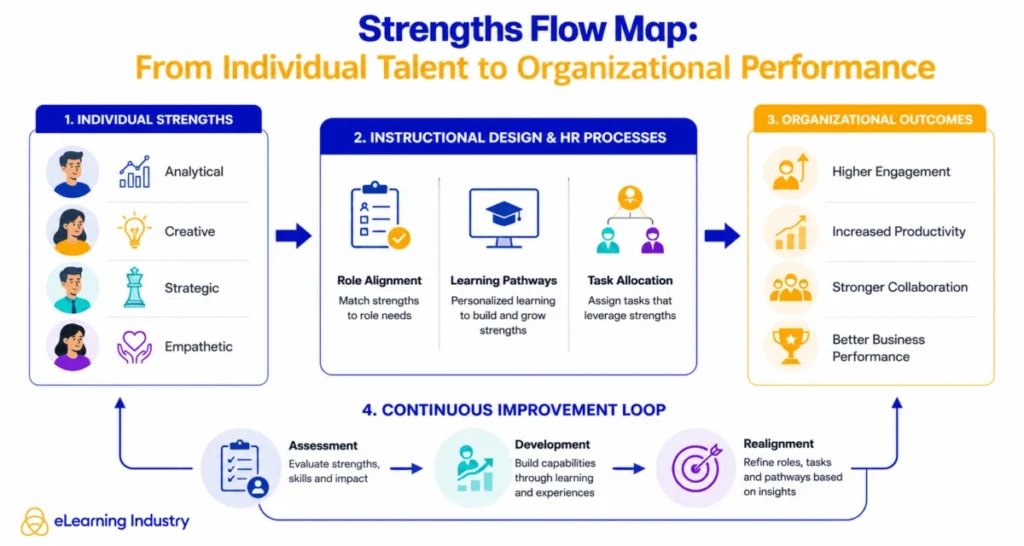
For Instructional Designers, the strengths-based approach offers a roadmap for creating more impactful learning experiences. This framework involves a five-step cycle:
- Strength Mapping: Utilizing surveys and performance data to create a "talent inventory" of the learner population.
- Role Alignment: Redesigning job descriptions and project assignments to ensure that the most demanding tasks are handled by those with the highest natural aptitude for them.
- Personalized Learning Paths: Moving away from "one-size-fits-all" training. A visually-oriented learner might receive infographic-heavy modules, while a "social learner" is placed in peer-coaching cohorts.
- Feedback Integration: Replacing the traditional annual performance review with "strengths-based coaching" conversations that focus on how an employee can apply their top talents to overcome current challenges.
- Outcome Measurement: Tracking specific Key Performance Indicators (KPIs) such as "Time to Proficiency" and "Employee Net Promoter Score (eNPS)" to validate the efficacy of the strengths-based interventions.
Industry Perspectives and Real-World Application
The practical utility of this model is echoed by industry veterans. Christopher Pappas, CEO and founder of eLearning Industry, noted that shifting the focus away from deficit-correction was a turning point for his organization. "Once we stopped focusing on fixing weaknesses and started designing around strengths, we didn’t just improve performance, but unlocked a level of engagement and innovation we hadn’t seen before across the entire company," Pappas stated.
In practice, this looks like a cross-functional project where a "Data Scientist" (Strategic Thinking) provides the insights, a "UX Designer" (Executing) builds the interface, and a "Product Manager" (Influencing) manages the stakeholders. Each individual operates within their "zone of genius," reducing friction and increasing the velocity of the project.
Broader Implications and Future Outlook
As organizations navigate the complexities of the 21st-century economy—characterized by rapid technological change, remote work, and the "Great Reshuffle"—strengths-based leadership is becoming a necessity rather than an option. The rise of Artificial Intelligence (AI) and automation is increasingly handling routine tasks, which places a higher premium on uniquely human "soft" strengths such as empathy, strategic intuition, and creative problem-solving.
Furthermore, the younger workforce (Gen Z and Millennials) increasingly demands work that is personally meaningful. A strengths-based culture directly addresses this by validating the individual’s unique contributions.
In conclusion, strengths-based leadership represents a move toward a more human-centric, efficient, and psychologically sound way of working. By shifting the organizational gaze from what is "broken" to what is "possible," leaders can foster a resilient workforce capable of sustained excellence. The goal is no longer to create a workforce of identical, average performers, but to cultivate a diverse ecosystem of specialists who are empowered to do what they do best every day.