
Digital performance management systems have fundamentally reshaped how organizations perceive, quantify, and manage employee performance. These sophisticated software solutions are streamlining the entire performance lifecycle, making it more accessible and efficient for administrators, managers, and employees alike. However, the market for performance management technology is increasingly crowded, presenting a significant challenge for businesses seeking to identify the optimal solution for their unique needs. This comprehensive guide delves into the critical evaluation criteria for selecting a performance management system and outlines how to pinpoint the most effective tools available.
Understanding the Core of Performance Management Systems
At its heart, a performance management system encompasses the processes and technological tools designed to facilitate employee feedback, foster growth, and drive continuous improvement. A robust system is instrumental in boosting both employee engagement and overall impact. It empowers managers with the insights and conversational tools necessary to effectively coach their teams through ongoing dialogue and feedback loops.
The primary objectives of employee performance management software are multifaceted, aiming to:
- Align individual contributions with organizational goals: Ensuring that employee efforts directly support strategic objectives.
- Provide clear expectations and feedback: Establishing a transparent framework for performance standards and regular, constructive input.
- Facilitate employee development and growth: Identifying skill gaps and creating personalized development plans to nurture talent.
- Enhance communication and collaboration: Creating channels for open dialogue between managers and employees.
- Recognize and reward performance: Implementing mechanisms to acknowledge and celebrate employee achievements.
- Drive business outcomes: Ultimately, linking improved individual performance to tangible organizational success.
The Imperative for Performance Management Software
In today’s competitive business environment, achieving and sustaining employee success is a paramount concern for organizations. This extends beyond mere task completion to encompass the cultivation of high-performing teams. Relying solely on outdated annual performance reviews is increasingly insufficient. The modern approach demands a shift from a perfunctory, check-the-box exercise to a streamlined, engaging, and actionable process. A continuous performance management framework fosters:

- Agility and adaptability: Enabling organizations to respond quickly to changing market demands.
- Proactive problem-solving: Identifying and addressing performance issues before they escalate.
- Continuous learning and development: Creating a culture where growth is an ongoing pursuit.
- Increased employee engagement and retention: Fostering a supportive environment where employees feel valued and invested.
A cutting-edge employee performance management system transcends being a mere evaluation tool; it serves as the foundational bedrock upon which human resources leaders and their organizations can adapt, innovate, and improve, thereby driving performance at every organizational stratum.
Key Benefits of Implementing Performance Management Systems
Leaders are increasingly recognizing the strategic importance of performance management systems for a multitude of reasons:
-
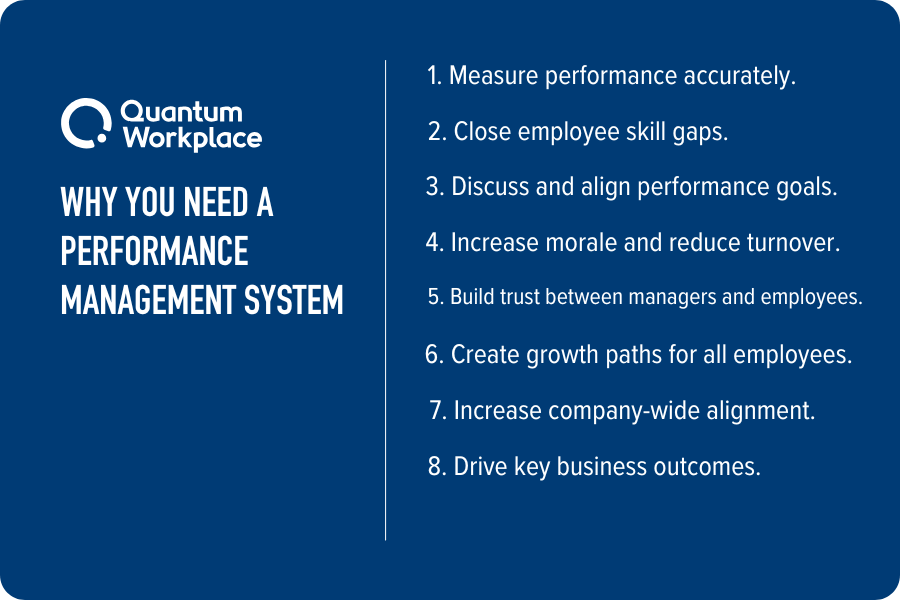
Accurate Performance Measurement: While seemingly basic, accurate performance measurement is foundational. Lighthouse Research & Advisory reports that only 36% of employees fully comprehend their job responsibilities and performance expectations. A well-implemented performance management system provides this critical clarity, aligning individual efforts with overarching organizational objectives and ensuring effective company-wide performance.
-
Bridging Skill Gaps: A significant portion of employees (50%) desire more feedback and coaching. Performance management systems equip leaders with the tools to identify and address skill deficiencies, enabling the creation of thoughtful employee development plans that empower individuals to grow and excel.
-
Goal Alignment and Engagement: Clearly defined performance goals are potent drivers of engagement, encouraging employees to actively contribute to the larger organizational vision. Research indicates that employees with individual goals are twice as likely to be engaged. Performance management systems are crucial for harmonizing personal aspirations with organizational objectives.
-
Boosting Morale and Reducing Turnover: Recognition and appreciation are deeply valued by employees. With only 20% of employees feeling adequately recognized and half desiring more appreciation, a performance management system can facilitate meaningful recognition, thereby elevating morale and curbing costly employee turnover.
-
Cultivating Manager-Employee Trust: Trust is the cornerstone of any successful workplace. Effective performance management fosters transparency and fairness, building a strong foundation of trust essential for robust working relationships. Organizations must prioritize providing employees with consistent feedback, meaningful manager connection, and clear visibility into performance metrics.
-
Creating Clear Growth Pathways: Every employee deserves a transparent path for career advancement within the organization. Performance management systems integrate crucial data points that bring talent development strategies to life, transforming talent development from an aspiration into a structured, actionable process.
-
Enhancing Company-Wide Alignment: Research from Quantum Workplace underscores the significant impact of performance management on organizational culture. Effective systems ensure that team members are intrinsically aligned with the company’s mission, purpose, and overarching goals.
-
Driving Business Outcomes: Ultimately, a performance management system is a strategic asset. Brandon Hall Group data reveals that 62% of organizations believe their current performance management processes do not effectively enhance performance. Modern systems are designed to deliver the critical outcomes and key results that are vital for business success.
Essential Elements of Superior Performance Management Software
An ideal performance management system should seamlessly support the entire performance lifecycle: planning, monitoring, reviewing, and recognizing. Each of these capabilities is critical for a holistic approach:
1. Planning: Laying the Foundation for Success
Effective performance management begins with meticulous planning. A robust platform should facilitate the definition and alignment of employee goals with strategic organizational objectives. Transparent and clearly articulated goals are essential for:
- Ensuring clarity of purpose for individual contributors.
- Promoting accountability and ownership of tasks.
- Fostering strategic alignment across teams and departments.
- Providing a benchmark for progress tracking and evaluation.
2. Monitoring: Real-Time Insights and Continuous Improvement
To effectively monitor performance, organizations require accurate, real-time data and actionable insights. The right system enables the tracking of key performance indicators (KPIs) and progress towards goals. A continuous monitoring approach empowers teams to:
- Identify and address performance challenges proactively.
- Maintain sustained productivity and momentum.
- Adapt strategies based on evolving circumstances.
- Foster a culture of ongoing feedback and improvement.
The overarching goal is to identify and address performance discrepancies promptly while simultaneously motivating sustained productivity.
3. Reviewing: Facilitating Growth and Development
The review phase is pivotal for employee development. An effective performance management system should streamline the process of conducting efficient and meaningful employee performance reviews. These reviews transcend simple appraisals, serving as a platform for managers to engage in constructive dialogues with employees. This includes:
- Discussing achievements and areas for development.
- Providing actionable feedback and coaching.
- Setting future goals and development plans.
- Recognizing contributions and impact.
Furthermore, the system should facilitate 360-degree feedback when appropriate, offering a comprehensive perspective on employee performance. The process should be simplified, encouraging open and productive conversations between managers and employees, with robust documentation capabilities to capture feedback across any timeframe.
4. Recognizing: Motivating and Appreciating Contributions
Employee recognition is a powerful catalyst for motivation and performance enhancement. The system should empower leaders to acknowledge and appreciate employees for their efforts. Effective employee recognition leads to:
- Increased employee morale and job satisfaction.
- Enhanced team cohesion and collaboration.
- Reinforcement of desired behaviors and outcomes.
- A stronger organizational culture of appreciation.
Public acknowledgment and recognition of outstanding contributions cultivate a culture of excellence and continuous improvement, reinforcing positive behaviors and fostering a sense of accomplishment.
By integrating these four core elements, performance management systems provide a comprehensive framework that supports the entire performance management cycle, ultimately streamlining processes and maximizing the potential for both employee and business success.
Key Features to Look for in Performance Management Tools
When evaluating performance management software, several key features are essential for a comprehensive and effective solution:
1. Goal Setting, Tracking, and Collaboration
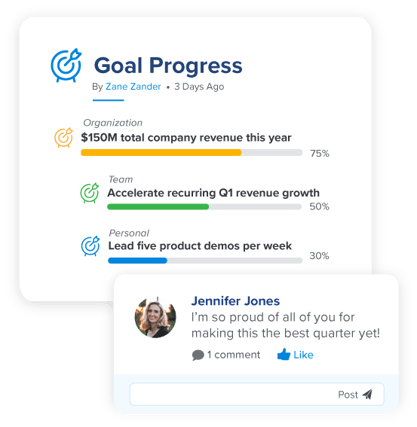
Performance goals are critical for organizational achievement, enabling teams to accomplish more, faster, and with greater efficiency. Clear, aligned, and shared goals provide direction for employees, ensuring their work remains synchronized with the organizational strategy. This fosters accountability, motivation, and strategic alignment.
Look for goal management features that include:
- Goal cascading: The ability to align individual goals with team and organizational objectives.
- SMART goal frameworks: Support for setting Specific, Measurable, Achievable, Relevant, and Time-bound goals.
- Progress tracking and updates: Features for employees to regularly update their progress.
- Collaborative goal setting: Opportunities for managers and employees to jointly define and refine goals.
- Visibility and transparency: Dashboards that provide clear insights into individual and team goal progress.
2. Ongoing One-on-One Meetings and Performance Reviews
Regular, documented performance conversations offer a comprehensive view of employee performance, directly correlating with increased engagement levels. Engagement and performance are intrinsically linked and mutually reinforcing.
-
One-on-One Meetings: Managers require support to drive performance in ways that actively engage their teams. Employee-manager one-on-one meetings are ideal for discussing performance, from informal check-ins to formal reviews. Look for one-on-one meeting software that facilitates:
- Structured agendas and note-taking capabilities.
- Action item tracking and follow-up.
- Pre-meeting preparation prompts for both managers and employees.
- Historical records of conversations for context and continuity.
- Integration with calendars for easy scheduling.
-
Performance Reviews: Performance evaluations should provide valuable context, focusing on engagement and growth. Employees often find actionable advice to be the most beneficial aspect of a review. Seek performance review software that supports accurate, straightforward, and actionable reviews with features like:
- Customizable review templates.
- Self-assessments and manager assessments.
- 360-degree feedback integration.
- Calibration tools for consistent evaluation.
- Automated reminders for review deadlines.
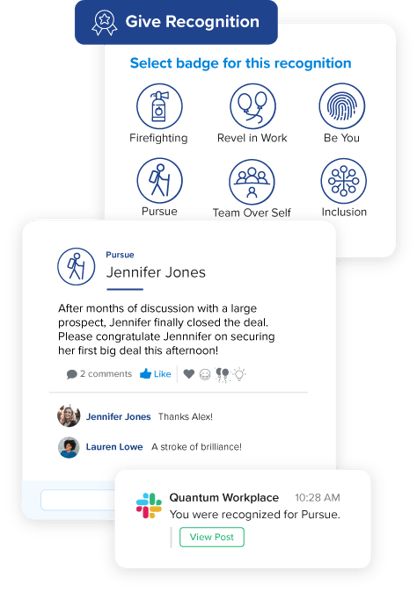
3. Facilitating Peer-to-Peer, Real-Time Employee Recognition
A significant majority of employees (69%) state they would work harder if recognized more effectively. Publicly acknowledging and praising employees yields numerous benefits, including:
- Boosting morale and creating a positive work environment.
- Reinforcing desired behaviors and achievements.
- Fostering a culture of appreciation and mutual respect.
- Increasing employee motivation and retention.
However, a substantial portion of employees (only 37% nationwide) are satisfied with recognition and appreciation at work. Recognition software can help organizations celebrate successes and engage teams across the entire company.
Look for employee recognition software that offers:
- Peer-to-peer recognition: Enabling colleagues to acknowledge each other’s contributions.
- Public and private recognition options: Allowing for different forms of appreciation.
- Integration with communication channels: Such as Slack or Microsoft Teams for seamless sharing.
- Gamification elements: Such as badges or leaderboards to encourage participation.
- Tracking and reporting: To measure the impact and frequency of recognition.
4. Collecting and Sharing Feedback
Strong companies are built on trust, and trusting cultures are cultivated through feedback. A robust feedback culture is directly correlated with a highly engaged workplace. The right software ensures teams receive the feedback necessary for success. Continuous feedback should be individualized, constructive, and unbiased.
Choose a feedback tool that helps foster a feedback culture across the organization, featuring:
.png?width=900&height=600&name=Essential-elements-of-employee-engagement-software_blog-image%20(2).png)
- Real-time feedback submission: Allowing feedback to be given and received promptly.
- Multi-directional feedback: Enabling feedback from peers, managers, and subordinates.
- Anonymous feedback options: To encourage candid and honest input.
- Feedback request features: Enabling employees to solicit feedback from specific individuals.
- Feedback aggregation and analysis: Tools to identify trends and themes in feedback.
5. Tracking Vital Talent Metrics
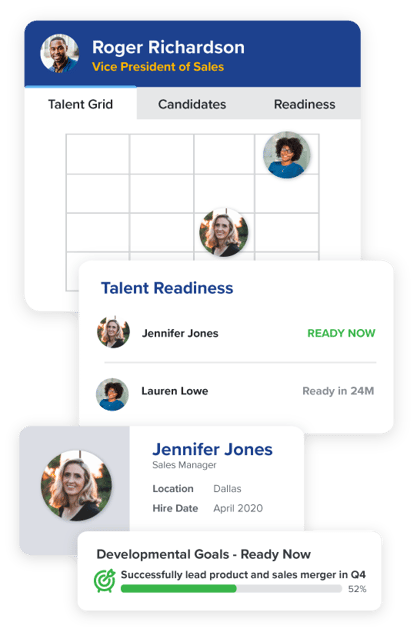
Talent reviews are essential for informed, data-driven talent decisions, utilizing critical data points. These reviews should be frequent, unbiased, and data-rooted. Leaders need to understand who is performing best, who is ready for promotion, and who might be at risk of leaving. Talent reviews help to:
- Identify high-potential employees.
- Assess readiness for leadership roles.
- Mitigate flight risks and develop retention strategies.
- Inform succession planning efforts.
Talent review tools can streamline the process of tracking talent metrics. Look for features that simplify and enhance the talent review process, such as:
- Performance data integration: Pulling performance data from various sources.
- Competency assessments: Evaluating skills and behaviors against defined standards.
- Talent mapping and visualization: Tools to graphically represent talent within the organization.
- Succession planning integration: Seamlessly linking talent data to succession plans.
- Data export and reporting: For further analysis and stakeholder communication.
6. Identifying Top Talent and Developing Successors
Proactively identifying talent gaps minimizes business disruption and cultivates a culture of growth. Visibility into critical roles and available talent is the initial step in establishing a robust succession planning strategy. This process involves:
- Identifying critical roles: Pinpointing positions essential to business continuity and growth.
- Assessing internal talent: Evaluating employees for readiness and potential to fill these roles.
- Creating development pathways: Designing targeted programs to prepare high-potential employees for future leadership.
Succession planning tools provide actionable reports on talent pipelines, readiness, and risk. When integrated with a performance management system, they offer a clear understanding of:
- Potential successors for key positions.
- Development needs for individuals in the pipeline.
- Risk associated with key role vacancies.
- The overall health of the talent pipeline.
Evaluating Performance Management Solutions: Key Questions to Ask
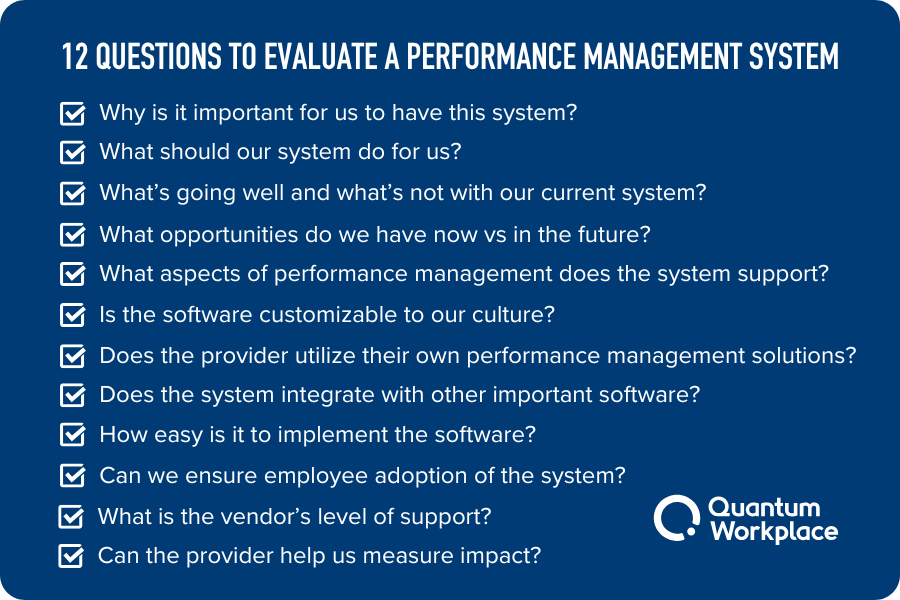
When selecting a performance management system, a thorough evaluation process is crucial to ensure alignment with organizational needs and objectives. Here are key questions to consider:

Big-Picture Evaluation Questions
-
Why is it important for us to have staff performance management software? Understanding the core drivers—whether it’s to improve employee engagement, enhance productivity, or streamline HR processes—will guide the selection. A system should organize and prioritize activities, and its purpose should be clearly articulated to stakeholders.
-
What should our performance management system do for us? Identify specific features and capabilities that directly address your organizational goals. Avoid solutions with extraneous features that don’t align with core needs. Key considerations might include:
- Streamlining administrative tasks.
- Providing actionable insights into employee performance.
- Enhancing manager effectiveness in coaching and development.
- Improving employee engagement and retention.
- Facilitating objective goal setting and tracking.
-
What’s going well with our current system, and what’s not? A candid assessment of existing processes is vital. Select a solution that addresses identified gaps while building upon successful elements. Employee engagement surveys can be a valuable tool for uncovering these insights.
-
What opportunities do we have now vs. in the future? Evaluate software for both short-term solutions (e.g., transitioning from annual to quarterly reviews) and long-term strategic benefits (e.g., building a robust succession plan, fostering a continuous feedback culture).
Software Evaluation Questions
-
What aspects of performance management does the system support? Ensure the system provides the tools managers need to effectively lead their teams. Solicit feedback from managers regarding their pain points and opportunities for improvement. The software should be a benefit, not a burden, to managers.

-
Is the performance management software customizable to our culture? While structure is beneficial, flexibility is paramount. The software should accommodate your company’s unique culture and evolving needs. Look for options to personalize:
- Workflows and processes.
- Templates for reviews and feedback.
- Branding and terminology.
- Reporting dashboards.
-
Does the developer use their own performance management software? A provider that practices what it preaches often offers a more robust and user-centric product.
-
Does the performance management software integrate with other systems? Minimizing the number of disparate systems is key. The software should ideally integrate with your HRIS to maintain up-to-date employee data. Investigate the possibility of custom integrations if needed.
Service Evaluation Questions
-
How easy is implementing the performance management system? Ease of implementation directly impacts buy-in. Look for systems with strong customer support and straightforward deployment processes, including assistance with:
- System setup and configuration.
- Data migration.
- User training and onboarding.
- Ongoing technical support.
-
Can we ensure manager and employee adoption of the system? A system that fails to be adopted by its users is an ineffective investment. Inquire about the vendor’s strategies for encouraging adoption. The best systems will be intuitive and demonstrably valuable, earning adoption organically. Consider free trials to assess user experience.

-
What is the vendor’s level of support? Beyond initial setup, reliable ongoing support is critical. Look for vendors who offer comprehensive support throughout the customer lifecycle, from sales and implementation to coaching and continued partnership. Assess the vendor’s responsiveness, expertise, and commitment to customer success.
-
Can the software provider help us measure impact? A leading performance management solution should demonstrate its value. Ensure the system can measure key metrics that align with your organizational objectives and provide clear ROI.
Comparing Performance Management Solutions
When comparing performance management solutions, it’s essential to understand the different categories available:
- HRIS Solutions: While offering broad HR functionalities, HRIS systems typically have limited depth in performance management features compared to specialized tools. They may be convenient but often lack the comprehensive capabilities required for sophisticated performance strategies.
- Point Solutions: These tools are specifically designed for performance management and offer advanced features like continuous feedback, detailed analytics, and robust goal-setting capabilities, enabling organizations to effectively monitor and enhance employee performance.
- Basic Office/Google Tools: Free and accessible, these tools are suitable for simple feedback needs but lack the comprehensive features, automation, and analytics of dedicated platforms.
- Manual Spreadsheets: Low-cost and familiar, spreadsheets are time-consuming, prone to errors, and not scalable for long-term performance tracking or uncovering actionable insights.
Leading Performance Management Systems for 2026
The market for performance management software is dynamic, with several platforms distinguishing themselves through innovation and customer satisfaction.
Quantum Workplace
Quantum Workplace offers a talent management platform designed to provide leaders with clarity and confidence in building thriving teams. It integrates critical talent signals, enabling leaders to quickly identify and address gaps in the employee experience. Their performance management tools empower managers to coach and drive business impact through features like:

- Continuous feedback: Facilitating ongoing dialogue and support.
- Goal management: Aligning individual efforts with strategic objectives.
- Performance reviews: Streamlining evaluation processes.
- One-on-one meeting tools: Enhancing manager-employee communication.
- Employee recognition: Fostering a culture of appreciation.
The company’s employee engagement suite supports a holistic employee listening strategy with surveys designed to uncover insights and improve the employee experience. Their employee development tools provide real-time insights and actionable steps for team development, aligned with learning and development strategies. With over 20 years in talent management and as the survey engine behind Best Places to Work, Quantum Workplace boasts high customer satisfaction and impressive support response times.
Key Strengths: User-friendly interface, strong customer support, comprehensive feature set, holistic approach to talent management.
Potential Challenges: Some users note navigation complexities and a desire for greater administrative control.
Lattice
Lattice is an AI-powered people platform that helps HR teams enhance manager effectiveness, streamline operations, and leverage workforce insights for business success. Users appreciate its user-friendly interface, goal tracking capabilities, and seamless integration with other systems, alongside responsive customer support.
Key Strengths: Intuitive design, robust goal tracking, strong integration capabilities, excellent customer support.
Potential Challenges: Occasional challenges with customization, OKR complexity, and reported bugs impacting privacy features.
Culture Amp
Culture Amp is a platform focused on collecting and analyzing employee feedback, developing high-performing teams, recognizing success, driving employee development, and retaining talent. Users commend its user-friendly interface, feedback analysis capabilities, and HRIS integration.
Key Strengths: Strong feedback analysis, intuitive interface, good HRIS integration.
Potential Challenges: Limitations in platform navigation and customization, translation issues, a steep learning curve for some features, and slower support response times.
15Five
15Five’s performance management platform combines generative AI, custom analytics, and human-centered principles to help businesses and employees thrive. It enables HR leaders to boost engagement, performance, and retention through features like 360 reviews, engagement surveys, goal tracking, and manager development.
Key Strengths: Comprehensive feature set, AI integration, focus on engagement and retention.
Potential Challenges: Customer support responsiveness can be an issue for some, and the platform’s breadth of features can initially feel overwhelming.
PerformYard
PerformYard is a performance management tool geared towards small businesses, emphasizing professional development and social empowerment. It serves as a centralized hub for managing reviews and processes. Users appreciate its intuitive interface, customizable options, and straightforward performance reviews.
Key Strengths: User-friendly interface, customizable options, simplified review process.
Potential Challenges: Some users have noted navigation challenges and a perception of the platform being overly generic.

Leapsome
Leapsome is a people enablement platform that connects performance management, employee engagement, and learning. It offers tools for goals and OKRs management, performance reviews, employee development, engagement surveys, feedback, and compensation. Users praise its user-friendly interface and public/private praise capabilities.
Key Strengths: Integrated approach to people enablement, strong feedback features, emphasis on anonymity.
Potential Challenges: A steep learning curve, navigation challenges, limited reporting customization, and occasional slow load times.
Moving Toward Continuous Performance Management
Performance management typically falls into two broad categories: traditional and continuous. While no single approach fits every organization perfectly, many are finding a balance between the two. Traditional methods, often involving annual or semi-annual reviews, focus on past performance within a structured framework. In contrast, continuous performance management emphasizes regular feedback and positions managers as coaches, fostering ongoing dialogue and development.
The transition to a more continuous approach doesn’t need to be an abrupt shift. Organizations can evolve gradually by:
- Embracing regular check-ins: Implementing weekly or bi-weekly brief discussions between managers and employees.
- Encouraging real-time feedback: Promoting a culture where feedback is given and received promptly, not just during formal reviews.
- Focusing on development conversations: Shifting the emphasis from evaluation to growth and skill enhancement.
- Leveraging technology: Utilizing performance management software to facilitate these continuous practices.
For many organizations, performance management is an ongoing journey of iteration and improvement. By continuously building upon successful practices and habits, companies can foster a dynamic and effective performance culture.
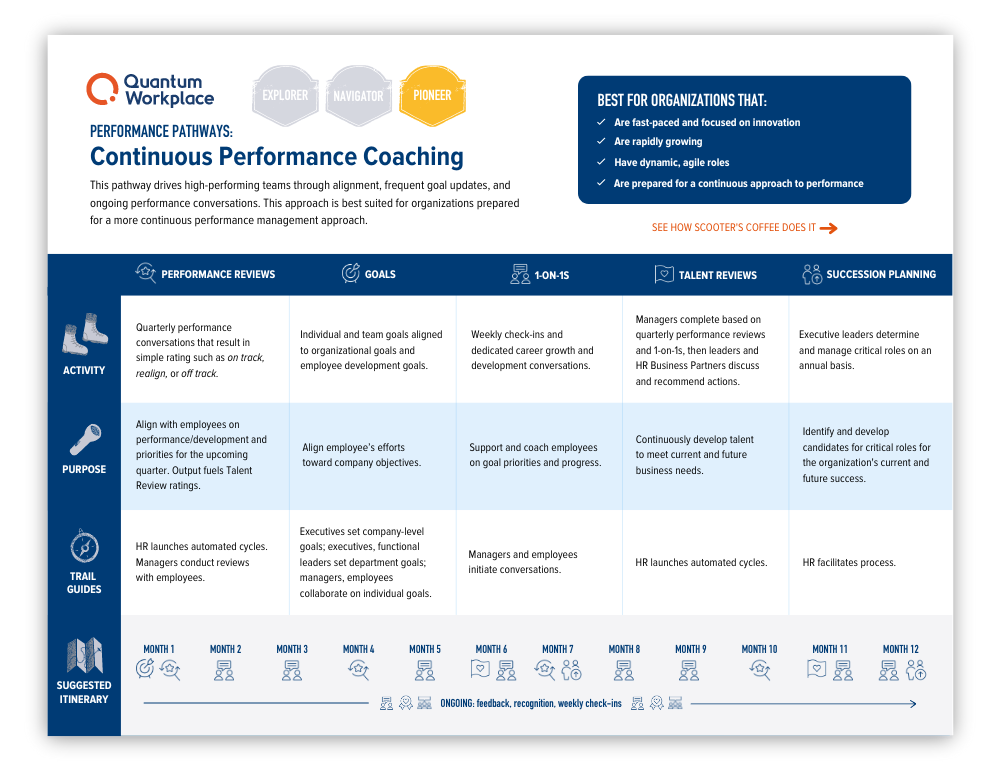
Quantum Workplace’s Performance Pathways
Recognizing that a universal approach to performance management is often ineffective, Quantum Workplace offers a solution tailored to individual organizational needs and maturity levels. Their "Performance Pathways" are customizable frameworks designed to help organizations quickly launch effective performance management programs without starting from scratch. These pathways address various organizational needs, from foundational goal setting to advanced succession planning, ensuring a tailored approach to performance management success.
In conclusion, the adoption of digital performance management systems represents a critical evolution in how organizations cultivate talent and drive success. By carefully evaluating available tools, understanding key features, and embracing a continuous improvement mindset, businesses can leverage these technologies to build more engaged, productive, and high-performing workforces.