In today’s dynamic U.S. workplaces, employee engagement is no longer a static metric but a fluid indicator that can shift rapidly. Factors such as evolving workloads, pivotal leadership decisions, impactful recognition moments, and the daily sense of support employees feel all contribute to this continuous flux. Despite this reality, many organizations continue to rely on annual employee surveys, a practice that often leaves them with feedback that is outdated by the time it is collected, failing to capture the immediate experiences of their workforce. This temporal disconnect has tangible consequences, as evidenced by the stark findings of the 2026 Engagement and Retention Report. This report revealed that a mere 29% of employees feel engaged, and an equally low 29% feel appreciated. Compounding this, more than a third of employees are actively seeking new employment or are undecided about their future with their current company. When organizations fail to implement consistent listening mechanisms, disengagement can quietly take root, significantly increasing the risk of employee turnover. To bridge this gap and stay attuned to the evolving needs of their workforce, a growing number of organizations are embracing more frequent and focused methods of gathering employee sentiment, with employee pulse surveys emerging as a key solution.
What Exactly is an Employee Pulse Survey?
An employee pulse survey is a concise, recurring questionnaire designed to provide organizations with a rapid understanding of their employees’ current feelings and perceptions at work. Unlike comprehensive annual surveys, pulse surveys are intentionally brief, focused, and repeatable, typically comprising a small number of questions. They are administered on a regular schedule – often monthly or quarterly – allowing organizations to meticulously track changes in engagement, morale, and overall sentiment over time. This approach transforms employee feedback from a yearly report card into an ongoing dialogue.
The Distinctive Nature of Pulse Surveys
An effective employee pulse survey is characterized by several key attributes:
- Brevity: Designed for speed, these surveys minimize the time commitment for employees, leading to higher participation rates and more consistent data collection.
- Frequency: Regular administration allows for the timely identification of emerging trends and issues, enabling proactive intervention.
- Focus: Each survey typically zeroes in on specific themes or drivers of engagement, providing actionable insights rather than a broad overview.
- Actionability: The questions are carefully crafted to elicit feedback that can directly inform strategic decisions and tangible improvements.
- Comparability: By maintaining a core set of consistent questions, organizations can effectively track progress and identify shifts in sentiment over time.
In essence, a pulse survey functions as a regular check-in, offering a snapshot of the current employee experience, rather than an exhaustive examination.
The Strategic Imperative for Pulse Surveys
Pulse surveys equip leaders with early indicators of what is working well, what needs improvement, and where potential issues may be brewing before they escalate into significant problems. Research consistently highlights several core benefits associated with their implementation:
- Timely Identification of Issues: By conducting frequent surveys, organizations can detect and address concerns like burnout, communication breakdowns, or leadership disconnects while they are still manageable.
- Enhanced Employee Engagement: When employees see their feedback translated into meaningful action, their engagement levels naturally rise. Research by Achievers indicates that employees surveyed more than four times a year report significantly higher levels of engagement.
- Improved Retention Rates: Pulse surveys can surface underlying dissatisfactions that might lead employees to seek new opportunities. Early detection of disengagement or frustration can provide a critical window for intervention, helping to retain valuable talent.
- Data-Driven Decision Making: The focused insights generated by pulse surveys empower leaders to move beyond assumptions and make informed decisions about people strategies.
- Fostering a Culture of Continuous Improvement: The consistent collection and analysis of feedback create a feedback loop that drives ongoing refinement of workplace practices and policies.
Despite the clear value proposition, a significant disconnect persists. Achievers’ research indicates that 43% of companies conduct surveys only once a year, even though nearly 60% of employees desire more frequent check-ins. This disparity highlights a critical gap in understanding and addressing the dynamic nature of employee engagement.
What Can Employee Pulse Surveys Measure?
The inherent flexibility of pulse surveys allows them to measure a wide array of critical aspects of the employee experience, provided there is sufficient consistency to track trends over time. This adaptability is precisely why they are effective in capturing the rapid shifts in employee sentiment driven by factors like workload, recognition, managerial behavior, and overall connection to the organization. Common themes that pulse surveys can effectively measure include:
- Engagement Levels: Gauging the overall commitment and enthusiasm employees feel towards their work and the organization.
- Recognition and Appreciation: Assessing how frequently and effectively employees feel acknowledged and valued for their contributions.
- Manager Support: Understanding the quality of the relationship between employees and their direct supervisors, including communication, feedback, and development guidance.
- Workload and Well-being: Monitoring employee stress levels, work-life balance, and overall sense of well-being.
- Connection and Belonging: Evaluating feelings of inclusivity, team cohesion, and a sense of purpose within the organization.
- Communication Effectiveness: Assessing the clarity, transparency, and timeliness of internal communications.
- Growth and Development Opportunities: Understanding employee perceptions of opportunities for learning, skill development, and career advancement.
- Leadership Trust and Confidence: Measuring employee belief in the vision and capabilities of organizational leadership.
The ability to measure these diverse themes allows organizations to gain a holistic view of their workforce’s sentiment and identify specific areas for improvement.
Translating Pulse Survey Results into Actionable Strategies
Collecting feedback is only the first step; the true value of pulse surveys lies in the ability to translate insights into meaningful change. A structured approach to acting on survey results is crucial:

- Identify Driving Patterns: Analyze survey data, looking for recurring themes in scores and qualitative comments. Focus on issues that appear consistently, such as recognition, manager support, development opportunities, well-being, purpose, or work-life balance. These patterns reveal where the employee experience is consistently strong or weak.
- Prioritize Actionable Issues: Select one or two key themes that are both important to employees and realistically addressable by leadership. The most impactful priorities are often those that employees will notice quickly, such as enhancing recognition practices, increasing manager check-ins, clarifying expectations, or addressing workload concerns.
- Develop an Action Plan with Ownership and Timelines: For each prioritized issue, assign a specific leader responsible for driving the change, define the concrete next steps, and set measurable goals. For instance, if feedback indicates inconsistent manager feedback, the action plan should clearly outline who owns the improvement, what specific changes managers will implement, when these changes will take effect, and how progress will be evaluated in subsequent survey cycles.
- Reinforce Desired Behaviors with Recognition: Utilize recognition programs to highlight and reward employees and leaders who exemplify the behaviors identified as crucial in the survey results. If collaboration or communication gaps are identified, actively recognize individuals who demonstrate strong teamwork and open dialogue.
- Communicate Changes Transparently: Inform employees about the key themes that emerged from the surveys, the priorities leadership has selected for action, and the specific steps that will be taken. This transparency closes the feedback loop, demonstrating that their input is valued and fostering continued participation in future surveys.
- Measure Progress in Subsequent Surveys: Compare results for the same drivers in subsequent pulse surveys to assess the impact of implemented actions. If the focus was on improving recognition or manager support, the next survey should indicate whether employees have perceived a tangible improvement in these areas.
Common Employee Pulse Survey Questions by Theme
Effective pulse surveys are not a random collection of questions but a focused set of prompts designed for action. Here are examples of short, clear, and actionable questions categorized by theme:
Engagement (Outcome)
- On a scale of 0-10, how likely are you to recommend this company as a place to work?
- I am proud to work for this company. (Strongly Agree to Strongly Disagree)
- I see myself working here in two years. (Strongly Agree to Strongly Disagree)
Recognition and Appreciation (Driver)
- I feel appreciated for my contributions at work. (Strongly Agree to Strongly Disagree)
- I receive regular feedback and recognition for my work. (Strongly Agree to Strongly Disagree)
- My manager acknowledges my accomplishments. (Strongly Agree to Strongly Disagree)
Manager Support (Driver)
- My manager supports my professional development. (Strongly Agree to Strongly Disagree)
- My manager provides me with regular and constructive feedback. (Strongly Agree to Strongly Disagree)
- I feel comfortable discussing challenges with my manager. (Strongly Agree to Strongly Disagree)
Workload and Well-being (Driver)
- My workload is manageable. (Strongly Agree to Strongly Disagree)
- I am able to maintain a healthy work-life balance. (Strongly Agree to Strongly Disagree)
- I feel supported in prioritizing my well-being. (Strongly Agree to Strongly Disagree)
Connection and Belonging (Driver)
- I feel a sense of belonging on my team. (Strongly Agree to Strongly Disagree)
- I feel connected to the company’s mission and values. (Strongly Agree to Strongly Disagree)
- My colleagues and I work effectively together. (Strongly Agree to Strongly Disagree)
Open-Text (Context)
- What is one thing that could be improved to make your experience at work better?
- What is one thing that is working well that you would like to see continue?
A valuable tip is to include a specific "recognition moment" question each cycle, moving beyond general engagement to ask, "What should we recognize more of?" This directly links listening to shaping a culture of appreciation.
The Ten Key Benefits of Implementing Employee Pulse Surveys
The increasing adoption of employee pulse surveys by organizations stems from a recognition of their power to drive action, build trust, and proactively address disengagement and turnover. The benefits are multifaceted:
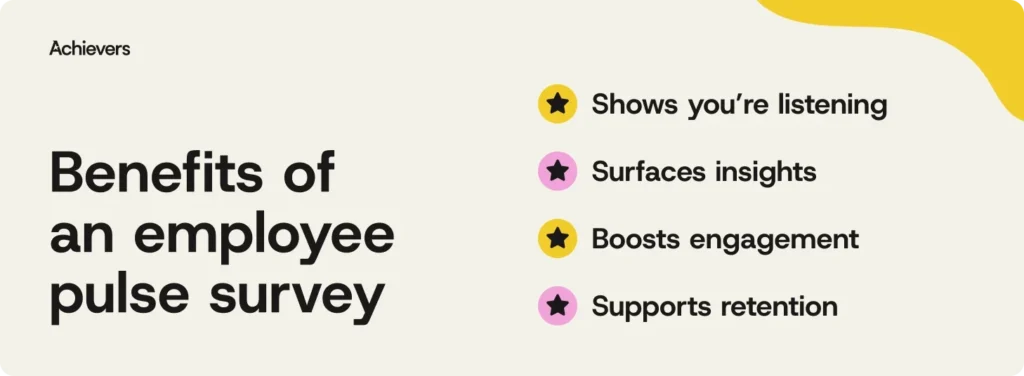
- Demonstrates Genuine Listening: Regularly soliciting feedback signals to employees that their voices are valued, fostering credibility. This credibility is sustained only through demonstrable action following feedback.
- Surfaces Insights Rapidly: The brevity and frequency of pulse surveys enable the early detection of issues, leading to higher participation, more honest responses, and faster, actionable insights.
- Boosts Employee Engagement: When employees witness their feedback leading to tangible improvements, engagement naturally increases. Achievers’ data shows a strong correlation between frequent listening and higher engagement levels.
- Supports Employee Retention: Pulse surveys can identify early warning signs of dissatisfaction, burnout, or frustration before employees consider leaving, providing an opportunity for intervention.
- Flags Issues Before Escalation: A critical advantage is the early identification of potential problems, from burnout to communication breakdowns, allowing for timely and effective management.
- Encourages Honest Feedback: Employees are often more comfortable sharing candid feedback, particularly about sensitive topics like manager performance, through anonymous surveys rather than direct conversations.
- Fuels a Culture of Continuous Improvement: The trend data generated over time from pulse surveys provides a roadmap for ongoing strategic adjustments, keeping both people and performance on track.
- Reduces Bias in Feedback: The structured, often anonymous nature of pulse surveys helps to level the playing field, providing more objective and reliable insights compared to traditional, potentially biased feedback methods.
- Informs Smarter Strategic Decisions: By providing targeted data, pulse surveys enable leaders to move from guesswork to informed action, designing initiatives that directly address identified needs.
- Drives Higher Participation Rates: Unlike lengthy annual surveys, the manageable nature of pulse surveys leads to higher completion rates, ensuring a more robust and representative feedback flow.
What Distinguishes a Pulse Survey?
Not all surveys are created equal. Pulse surveys are designed for speed, focus, and action, differentiating them from traditional surveys that may become data repositories without driving change. Key differentiators include:
- Frequency: Administered regularly (monthly, quarterly).
- Brevity: Typically 5-15 questions.
- Focus: Addresses specific themes or drivers.
- Action-Oriented: Designed to generate actionable insights.
- Trend Analysis: Enables tracking of sentiment over time.
Navigating Survey Fatigue and Ensuring Honest Responses
The concern of "survey fatigue" is a valid one. However, research suggests that fatigue is less about frequency and more about the perceived value and follow-through. To combat this and encourage honest participation, organizations should implement the following practices:
- Close the Loop Consistently: Communicate survey findings, planned actions, and even reasons for not acting on certain feedback. Transparency builds trust.
- Maintain Anchor Questions: Retain a core set of questions across surveys to enable meaningful trend analysis and demonstrate progress.
- Rotate Focus Areas: Vary the specific themes addressed in each pulse survey to keep the content relevant and prevent monotony.
- Ask Only What You Can Act On: Ensure that every question posed has a realistic potential for organizational response and action.
- Guarantee Anonymity: Clearly communicate and uphold anonymity to foster a safe environment for honest feedback.
Integrating Recognition into the Feedback Process
A powerful way to reinforce positive survey outcomes is by recognizing teams and leaders who actively respond to feedback. This practice transforms listening into a culture-shaping habit rather than a perfunctory task.
Incorporating Employee Pulse Surveys into Your Strategy
An employee pulse survey is more than a data-gathering tool; it’s a powerful method for demonstrating to employees that their voices are genuinely heard and valued. When individuals feel seen, heard, and appreciated, their engagement, motivation, and commitment to the organization are likely to increase. However, the true impact lies in what happens after the feedback is collected. The speed at which insights are translated into action, the consistency with which feedback is linked to recognition, and the clarity with which employees perceive the link between their input and tangible change are critical differentiators. Many organizations struggle with this follow-through, underscoring the importance of the right approach and, often, the right partner.
For organizations seeking an efficient and impactful way to maintain a pulse on their workforce and transform feedback into meaningful recognition and improvement, an employee pulse survey is an intelligent starting point. With integrated platforms, listening efforts are not siloed but connected to recognition, rewards, and outcomes that shape organizational culture and performance. Beginning with asking the right questions and selecting a platform that supports listening, acting, and valuing employees is a strategic step towards a more engaged and resilient workforce.
Employee Pulse Survey FAQ
What is the primary purpose of an employee pulse survey?
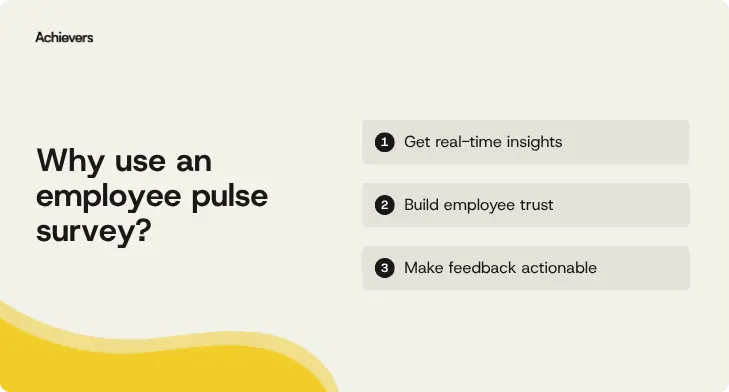
The primary purpose is to gather timely feedback on employee sentiment and engagement to identify potential issues and opportunities for improvement in real-time, rather than relying on outdated annual survey data.
How is a pulse survey different from an annual engagement survey?
Pulse surveys are shorter, more frequent, and focused on specific themes, allowing for quicker insights and more agile responses. Annual surveys are typically longer, more comprehensive, and provide a broader, less frequent snapshot.
What are the key benefits of using pulse surveys?
Key benefits include rapid issue identification, increased employee engagement, improved retention, data-driven decision-making, and fostering a culture of continuous improvement.
How frequently should pulse surveys be administered?
The ideal frequency can vary, but monthly or quarterly administration is common, allowing for regular tracking of trends without causing survey fatigue.
How can organizations ensure employees respond honestly to pulse surveys?
Ensuring anonymity, clearly communicating how feedback will be used, and demonstrating consistent action based on previous feedback are crucial for fostering honesty.
What are some common themes measured by pulse surveys?
Common themes include engagement levels, recognition and appreciation, manager support, workload and well-being, and connection and belonging.
How can organizations avoid survey fatigue?
Avoiding fatigue involves closing the feedback loop, maintaining consistent anchor questions, rotating focus areas, only asking questions that can lead to action, and ensuring clear anonymity.
What is the role of recognition in the pulse survey process?
Recognition plays a vital role in reinforcing desired behaviors identified through survey feedback and in demonstrating to employees that their input leads to positive outcomes.