
The role of the modern Chief Learning Officer (CLO) has undergone a fundamental transformation as artificial intelligence moves from a speculative technology to a core operational requirement. In a typical contemporary corporate scenario, a learning leadership team is tasked with rolling out an AI-powered copilot across multiple business units. The mandate involves building an enablement curriculum, certifying every manager, and tracking completion rates on a sophisticated digital dashboard. On paper, the initiative appears successful: every administrative box is checked, and the software is deployed. However, data from 18 months post-implementation often reveals a stark divide. While a small subset of teams successfully integrates the tool to sharpen their workflows, the majority of the workforce often treats the rollout as a bureaucratic mandate to be ignored, leaving the technology unclicked and the potential for productivity gains untapped.
The failure of such initiatives is rarely a result of poor technology or inadequate funding; rather, it stems from a breakdown in how knowledge moves through an organization. In many corporate environments, those who successfully adopt new tools often fail to share their insights, while those who struggle remain silent. This silence is driven by a calculated fear: admitting a lack of proficiency feels like a confession of obsolescence, while sharing a creative workaround carries the risk of being seen as "going rogue." By the time a formal refresher course is scheduled, the technology has often evolved again, rendering the previous curriculum obsolete. This phenomenon highlights a critical shift in organizational development: the primary challenge of the AI era is not adoption, but circulation.
The Evolution of Organizational Learning: A Chronology of Change
To understand the current crisis in AI adoption, it is necessary to examine the evolution of corporate training over the last three decades. In the 1990s and early 2000s, learning was defined by the "classroom model," where knowledge was centralized and delivered in person. The mid-2010s saw the rise of the Learning Management System (LMS) and Massive Open Online Courses (MOOCs), which shifted the focus toward scalability and self-paced digital content.
By 2020, the pandemic accelerated the transition to remote and hybrid learning, forcing organizations to adopt digital tools overnight. However, the arrival of Generative AI in late 2022 created a new paradigm. Unlike previous software transitions—such as moving from physical files to the cloud—AI evolves at a pace that exceeds traditional curriculum cycles. Today, capability requirements shift with the speed of leadership attention rather than annual training schedules. This has led to a situation where 72 percent of CEOs are now personally directing AI strategy, according to data from Boston Consulting Group (BCG), yet the infrastructure to support that strategy remains rooted in outdated, top-down delivery methods.
Supporting Data: The Gap Between Investment and Readiness
The disconnect between executive ambition and frontline readiness is supported by significant industry research. Deloitte’s Global Human Capital Trends report indicates that 70 percent of business leaders identify speed and organizational nimbleness as their top competitive strategies through 2029. Despite this, 59 percent of organizations continue to take a purely technology-focused approach to AI implementation. The consequences of this narrow focus are measurable: organizations that prioritize technology over human-centered design are 1.6 times more likely to fail to achieve their expected return on investment (ROI).
Furthermore, Udemy’s 2026 Global Learning and Skills Trends Report reveals a critical "readiness gap" at the management level. While 88 percent of employees believe effective leadership is essential for AI initiatives to succeed, only 48 percent believe their own managers are actually prepared to lead in an AI-driven environment. This creates a bottleneck where the middle management layer—the very group responsible for reinforcing new behaviors—is the least psychologically safe to admit their own confusion or lack of skill.
From Cascade to Circulation: A Structural Reimagining
The traditional architecture of corporate learning is built on the concept of a "cascade." In this model, knowledge is designed at the executive or L&D level and pushed downward through the organization. Feedback, if it exists at all, usually arrives too late to influence the strategy, often appearing in post-rollout surveys that are thinly processed.
Adaptive leadership experts argue for a structural fix that replaces the cascade with "circulation." This concept is rooted in the theory of double-loop learning, a term coined by organizational theorist Chris Argyris. While single-loop learning involves correcting an error without questioning the underlying assumptions (e.g., adjusting an AI prompt), double-loop learning involves questioning the governing logic itself (e.g., asking if the tool is being used for the right task).
A circulatory system treats the frontline not as the final destination for information, but as a primary source. In this model, learning is multidirectional. For this to work, employees must believe two things: that their feedback will lead to actual change and that admitting to a mistake or a "not-knowing" state will not be used against them. This requires a systems mindset that balances technical workflow design with the emotional labor of cultural change.
The Role of Trust and Psychological Safety
Circulation cannot be forced through better tooling; it runs on trust. When AI adoption stays in the shadows, it is often because employees fear being perceived as behind or, conversely, as dispensable. A humanizing mindset in leadership involves attending to people and purpose rather than just process.

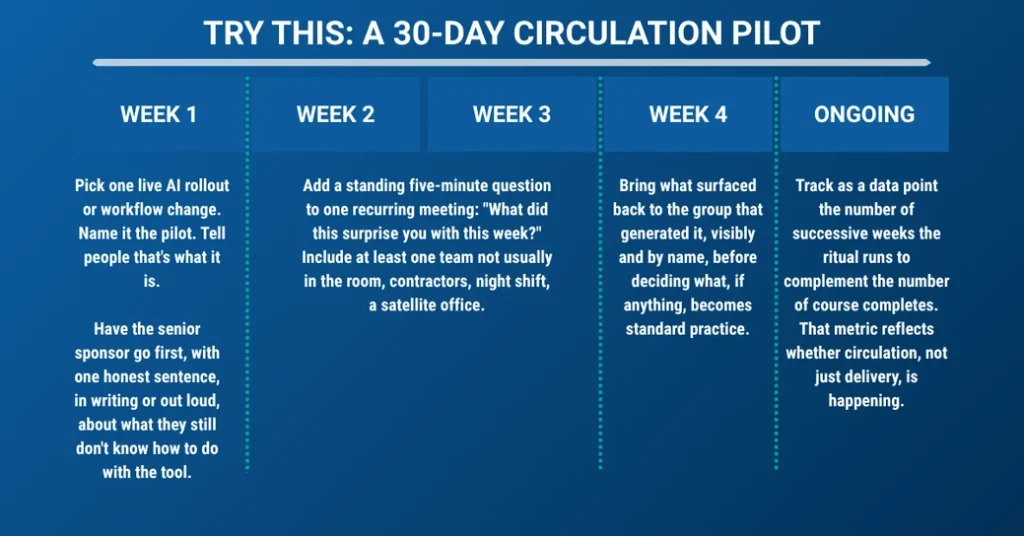
One effective method for building this trust is the implementation of "rapid-cycle inquiry." This involves short, structured bursts of authentic listening, such as flash focus groups or brief workflow walk-throughs, that feed directly into decision-making. For example, some organizations have begun incorporating a single question into every leadership meeting: "What are we assuming about this tool that we haven’t tested?" By having senior leaders answer this question first and model their own uncertainty, they set a norm that allows others to speak freely. This creates "adaptive intelligence"—the collective capacity to sense a signal, question an assumption, and act in the moment rather than waiting for a formal review cycle.
Addressing Equity in Knowledge Circulation
A significant risk in the shift toward circulatory learning models is the potential to reinforce existing power dynamics. Without a focus on equity, those most likely to have their AI experimentation noticed and credited are those already closest to power—those who are visible, credentialed, and fluent in corporate jargon.
Conversely, employees who are further from institutional decision-making—such as contract staff, frontline workers, or those on night shifts—often find their knowledge marginalized. When their insights fail to circulate, the organization loses valuable data. A humanizing mindset requires building learning systems that intentionally bridge these gaps, ensuring that psychological safety extends to all levels of the organization, regardless of identity or rank.
AI as a Listening Partner: The New L&D Infrastructure
Paradoxically, the same technology that is disrupting work can also be used to improve how organizations learn. "Agentic AI"—systems capable of independent action and pattern recognition—can act as a listening partner for L&D teams. These systems can detect when different teams are independently developing unique workarounds or when usage patterns diverge from standard practice.
However, using AI as an early-warning system only works if it is introduced as a high-trust mechanism. It must be named publicly and opted into, rather than used as a form of "bossware" or surveillance. If a sensing tool is perceived as a way to identify who is "behind," the candor required for a circulatory system will vanish. Technology can extend the reach of an inquiry mindset, but it cannot replace the fundamental need for human trust.
Judgment as the New Curriculum
As AI becomes more proficient at teaching the "how" of technical tasks—such as drafting financial models or writing code—the role of L&D shifts. Boston Consulting Group frames this as a "gift" to the field, as it moves training closer to the "moment of need." When a tool can provide procedural instructions on demand, the human curriculum must pivot toward judgment.
The new "power skills" involve knowing when to trust an AI output, how to interrogate it for bias, and how to handle situations where a confident AI answer is factually incorrect. Reflexivity, the capacity to sit with ambiguity, and ethical reasoning are no longer "soft skills" but load-bearing requirements for a modern workforce.
Implications for Team Design and Future Potential
The final stage of this transformation involves redesigning the concept of "potential" around teams rather than individuals. In the past, potential was measured by what an individual could be trained to do. In the AI era, the question is how quickly a team can recombine its human and machine capabilities to meet the demands of a specific project.
This requires "trait-mapping," where strengths such as future-focus, interpersonal sensitivity, and execution are mapped against the work itself rather than a fixed job description. In this systems-based approach, teams become reconfigurable and fluid, assembling around tasks rather than rigid organizational charts. This level of agility is only possible when the culture treats reconfiguration as an opportunity for growth rather than a threat to job security.
Conclusion: The Learning Architect’s Mandate
The transition from a "cascade" model to a "circulatory" model represents a maturation of the corporate learning function. For the CLO, the role is no longer about owning a static curriculum but about acting as a learning architect who designs systems for resilience and connection.
Organizations that successfully build these habits—where senior leaders model vulnerability, where frontline insights are treated as critical data, and where AI is used to enhance human listening—will find themselves with a durable competitive advantage. In a period defined by technological volatility, the ultimate goal is not just to adopt the latest tool, but to build a system where knowledge flows as freely and as fast as the technology itself. AI has opened a portal for organizational transformation, but its success depends entirely on whether people feel safe enough to share what they know and, more importantly, what they do not.






