The global market for professional development, encompassing training, certification, and upskilling, represents a colossal sector exceeding $400 billion annually. A significant portion of this expenditure, nearly one-third, is dedicated to competencies and technologies that extend beyond company-specific applications. For the past three decades, this demand has been predominantly met by a diverse array of training providers, including online course libraries, video repositories, sophisticated simulations, expert assessments, and a multitude of professional certification, testing, and accreditation programs. This market has historically demonstrated remarkable resilience, often described as recession-proof, due to the perpetual need for continuous learning and the organizational imperative to foster career growth and maintain a competitive edge.
However, the landscape of online learning, and by extension, professional development, is undergoing a period of rapid and profound transformation. Prominent players such as Udacity (acquired by Accenture), Coursera, Udemy (recently acquired by Coursera), LinkedIn Learning, SkillSoft, and Pluralsight, along with broader educational and thought leadership platforms like Masterclass, TEDx, and BigThink, are finding their established models challenged. Recent financial indicators, such as the significant drop in stock prices for publicly traded companies in this sector, underscore this disruption. This downturn is not attributed to a lack of managerial acumen but rather to a fundamental evolution in technology and consumer behavior. The traditional approach of simply "selling courses" is rapidly being superseded by a demand for dynamic "delivery of learning and professional growth."
The Evolving Needs of the Modern Professional
The enduring demand for skills development stems from the inherent career aspirations of every working individual, irrespective of their professional domain – be it IT, sales, marketing, finance, support, or HR. This demand can be broadly categorized into five developmental levels, each requiring tailored learning approaches:
Level 1: Foundational Knowledge for Newcomers
At this entry-level, professionals new to a role, profession, or career often seek to acquire foundational knowledge and achieve basic certifications. While organizations like SHRM and HCI offer foundational certifications, their perceived value can fluctuate. The primary need here is to grasp the fundamental concepts, terminology, and an overview of essential tools within a given field.
Level 2: Building Expertise Beyond the Basics
Professionals with two to three years of experience typically possess a grasp of the fundamentals but encounter areas where their understanding is less developed. This stage calls for learning through case studies, advanced use-case scenarios, and exercises designed to broaden their analytical and problem-solving capabilities. For instance, a recruiter aiming for a senior role might need to delve into advanced sourcing strategies, sophisticated skills assessment techniques, candidate marketing, and the application of AI in recruitment.

Level 3: Broadening Specialized Expertise
Individuals at Level 3 have developed deep expertise in a specific niche but lack breadth across related areas. A tech recruiter, for example, might need to expand their skills to executive search or talent acquisition for sales teams. The need here is for exposure to global markets, multi-industry perspectives, or diverse technological applications. Professionals at this juncture often seek new challenges and career advancement, moving from specialized roles to leadership positions that require a broader skill set and developmental training.
Level 4: Elevating World-Class Proficiency
This level encompasses individuals with decades of experience who are driven to remain at the forefront of their fields. They seek to identify emerging technologies, advanced methodologies, and opportunities to globalize or diversify their industry experience. For seasoned HR leaders, for instance, transitioning to a new industry can offer invaluable exposure to novel approaches, enhancing their wisdom, perspective, confidence, and value-creation capabilities. This often involves moving into senior executive roles, transitioning between large corporations and startups, or exploring vast new technological or scientific domains. The drive is often to develop "T-shaped" skills, combining deep domain expertise with knowledge of adjacent fields.
Level 5: Becoming a Knowledge Architect
At the apex, Level 5 comprises a select group of senior, tenured experts – often referred to as 10x engineers or C-suite gurus – who have demonstrated significant impact and seek to contribute through teaching, mentoring, coaching, or writing. Their motivation is not fame but a desire to share knowledge, collaborate with peers, and engage with professional communities, deep research, and global case studies.
The AI Revolutionizing Learning Delivery
The traditional professional development market, often characterized by "packaged solutions," frequently struggles to align off-the-shelf training with the nuanced needs of advancing professionals. This is where Artificial Intelligence (AI) emerges as a transformative force, capable of custom-assembling learning experiences tailored to individual goals.
The rapid adoption of AI tools like ChatGPT, with an estimated 900 million weekly users, highlights a significant shift in information consumption. A substantial portion of these interactions, reportedly 40% or more, involves users seeking to learn, acquire information, develop skills, or solve problems. This indicates that AI has, in a remarkably short period, attracted a learner base potentially exceeding that of traditional Learning Management Systems (LMS) and Learning Experience Platforms (LXP) combined.
This paradigm shift is driven by two primary factors:

- Intuitive Inquiry-Based Learning: AI facilitates a natural, "questioning" approach to learning, mirroring how children acquire knowledge. Users can easily pose questions, explore topics, and satisfy their curiosity through conversational agents.
- Holistic Information Interconnection: AI models, through techniques like embeddings, interconnect information in a systemic and holistic manner. This allows for non-linear learning pathways, enabling users to delve deeper, seek explanations, skip sections, or request more details at any point, significantly enhancing learning speed and quality.
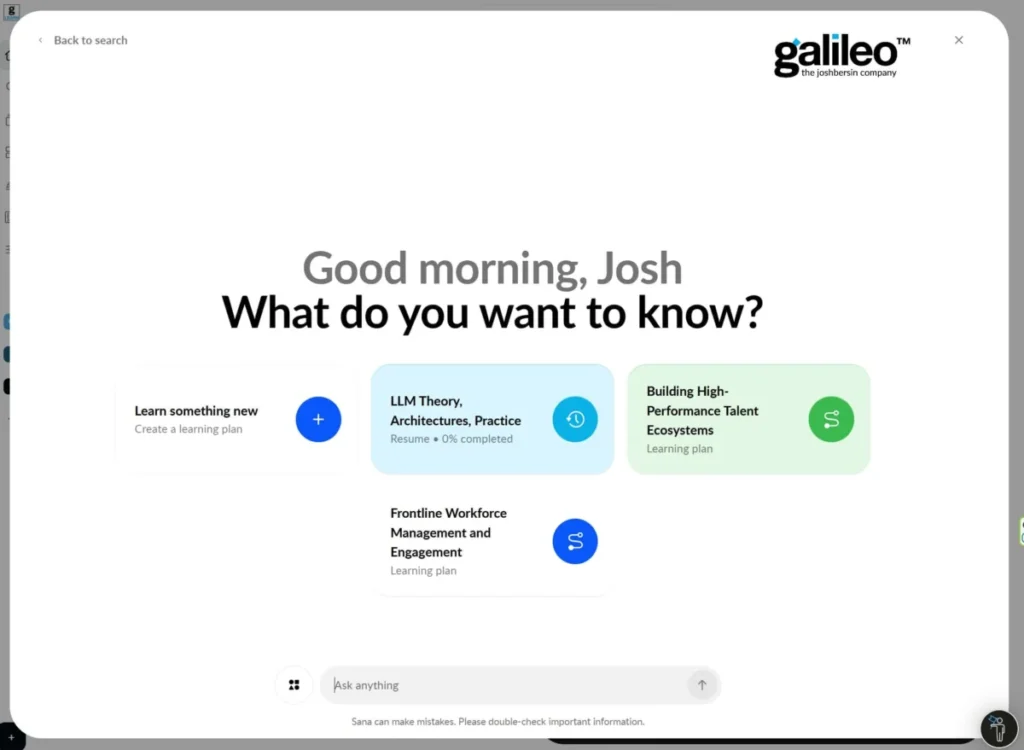
Platforms like Galileo are leveraging this AI-native infrastructure to provide dynamic learning experiences. Instead of solely offering structured courses, they can provide examples, scenarios, challenges, and simulations on demand. A "Supertutor" within such a system can respond to specific questions, drawing upon vast knowledge bases and adapting to the user’s role, interaction history, and other contextual information, offering a truly personalized and engaging learning journey.
Disrupting the Traditional Training and Professional Development Market
This fundamental shift from "publishing courses" to "dynamically delivering content" is reshaping the entire professional development ecosystem, which traditionally comprises learning platforms (LMS, LXP), learning content (course libraries, programs), content development tools, certifications, and learning consultants.
The "old model" of professional development operated on a publishing paradigm. Subject matter experts were engaged to create courses, interactive modules, simulations, and assessments, which were then "published" into an LMS or a proprietary platform and launched to users. This web-based publishing model, pioneered in the late 1990s and early 2000s, disrupted traditional classroom training companies and still underpins many bootcamp and executive education programs. However, for the majority of professional development needs, a new model is emerging.
This "AI-First" or "AI-Native" model utilizes AI for content collection, generation, translation, and delivery. Platforms like Galileo integrate extensive research and case studies with a company’s internal content, allowing users to engage with formal courses, request simulations, participate in role-playing exercises, or simply ask the AI tutor questions. This approach offers a learning experience that is not only more personalized but also significantly automates costly processes such as instructional design, translation, and video generation. The system can generate new learning experiences daily as content is updated and can blend external expert knowledge with an organization’s specific processes, technologies, and cultural practices.
Crucially, features like career pathways, learning paths, skills taxonomies, and even assessments can now be machine-generated. This fundamentally alters the value proposition of professional development vendors, who are now essentially selling "pure content" delivered through an optimized, personalized, and highly accessible user experience. The integration of AI tools like Sora for rapid content creation, or the automatic chaptering of YouTube videos, exemplifies this trend. AI’s ability to analyze reading levels, learning preferences, and technical interests further refines this personalized approach, creating systems that deeply understand the user’s professional context and communication style.
Implications for Professionals, HR, and L&D Buyers
The ongoing transformation necessitates that all training, certification, and professional education providers adapt to this new reality. While existing course libraries and subscriptions may not be replaced overnight, the rise of personalized, AI-centric providers is likely to lead to consolidation and acquisitions within the legacy vendor space.
The widespread deployment of AI agents on personal devices and corporate networks will fundamentally alter how employees access information and support. As employees increasingly turn to internal AI agents for queries ranging from benefits information to career advancement, they will naturally pose questions like, "What is my path to promotion?" This presents a profound opportunity for L&D departments to reimagine their learning deployment strategies. For instance, an hourly worker seeking to earn more could be guided by their AI agent to acquire skills that qualify them for higher-paying roles.
The development of AI-powered leadership coaching agents, AI-driven assessments, and AI-powered content creation tools for videos, audio, tests, and courses is accelerating. Organizations are encouraged to develop a "re-engineered view" of their Learning and Development strategies. Evidence suggests that many traditional L&D functions, including translation services, skills architecture management, LMS publishing, metadata management, and the creation of job aids, are ripe for automation. Companies that have successfully re-engineered their L&D programs have reported significant cost reductions, sometimes as high as 40%, coupled with a demonstrably more personalized employee experience.
For vendors and consultants in the professional development space, the imperative is to embrace this disruptive shift. Boldness in exploring new partnerships, building AI capabilities, or acquiring relevant technologies will be crucial. This period presents an unprecedented opportunity to fundamentally redesign how individuals are developed and supported within organizations, with the demand for effective solutions poised to grow exponentially. As new research and maturity models emerge, the focus will increasingly be on leveraging AI to create agile, personalized, and impactful learning experiences that empower professionals and drive organizational success.