The median compensation package for chief executive officers in the manufacturing sector, while closely mirroring that of CEOs across all private companies, reveals a significant divergence in its composition, particularly between consumer and industrial manufacturing segments. This nuanced landscape, detailed in Chief Executive Group’s annual CEO and Senior Executive Compensation Report, underscores how compensation strategies are tailored to specific industry dynamics, ownership structures, and overarching business philosophies, moving beyond mere dollar figures to reflect deeper organizational values.
Decoding the Manufacturing CEO Paycheck
Chief Executive Group’s latest report, drawing data from a broad spectrum of private companies, places the median total compensation for a consumer manufacturing CEO at $451,705 annually. Industrial manufacturing CEOs, while not far behind, received a median of $428,673. These figures position the manufacturing sector’s median compensation slightly above the overall private company median of $438,203, suggesting a competitive landscape for leadership talent within the industry.
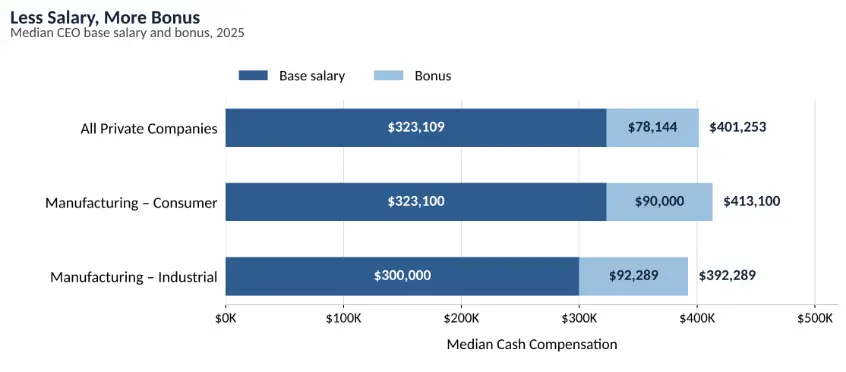
However, a deeper dive into the cash components of these packages—base salary and bonus—unveils more pronounced differences. Consumer manufacturing CEOs saw a median cash compensation of $413,100, compared to $392,289 for their industrial counterparts. This contrasts with the all-company median cash compensation of $401,253, highlighting a greater reliance on variable pay within consumer manufacturing.
The Salary vs. Bonus Divide
The traditional split between base salary and bonus offers a clearer lens into the compensation philosophies at play. For private company CEOs overall, the median base salary stood at $323,109, complemented by a median bonus of $78,144. In consumer manufacturing, the median base salary was remarkably similar at $323,100, yet the bonus component rose to $90,000. Industrial manufacturing, conversely, reported a slightly lower median base salary of $300,000 but offered the most substantial median bonus at $92,289 among the three benchmarks.
This strategic weighting towards bonuses, particularly in industrial manufacturing, is not accidental. Jim Nelson, the CEO of Parr Instruments, a 127-year-old industrial and chemical instruments manufacturer, articulated this approach candidly. "Our base salary is probably not as high as some companies because our [bonus structure] can be pretty lucrative," Nelson stated, emphasizing a deliberate trade-off designed to reward performance.
Parr Instruments employs a dual bonus system. The first is a company-wide bonus distributed to the entire employee base, ensuring even hourly workers receiving overtime are compensated on those additional earnings. The second bonus program is directly tied to profitability. "We take a certain percentage of our operating profit, put it in a bonus pool, and for top executives, it can be more than your salary," Nelson explained. This structure is intentionally designed to align leadership and employee interests with the company’s financial success. "We try to weigh more of our compensation on that bonus structure because we want to be able to pay that in good years, but if it’s a bad year, then everybody, a rising tide floats all boats if we’re doing our job," he added.
This profit-centric incentive model resonates with other industry leaders. Bob Grote, whose family has steered an industrial food processing manufacturing company for 55 years, noted that his workforce is keenly focused on the metrics that drive the bonus pool. "At the end of the day, we pay bonuses based on profit. So that’s what they really care about. When during a town hall meeting, that’s what they’re asking me. It’s like, so how are we on pace? Are we on pace for budget? Are we going to make money?" Grote’s experience illustrates how a transparent bonus structure tied to profitability can foster a shared sense of purpose and accountability throughout the organization.
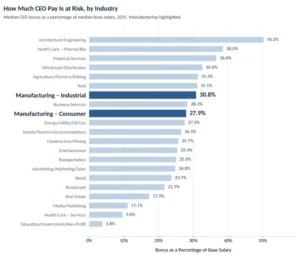
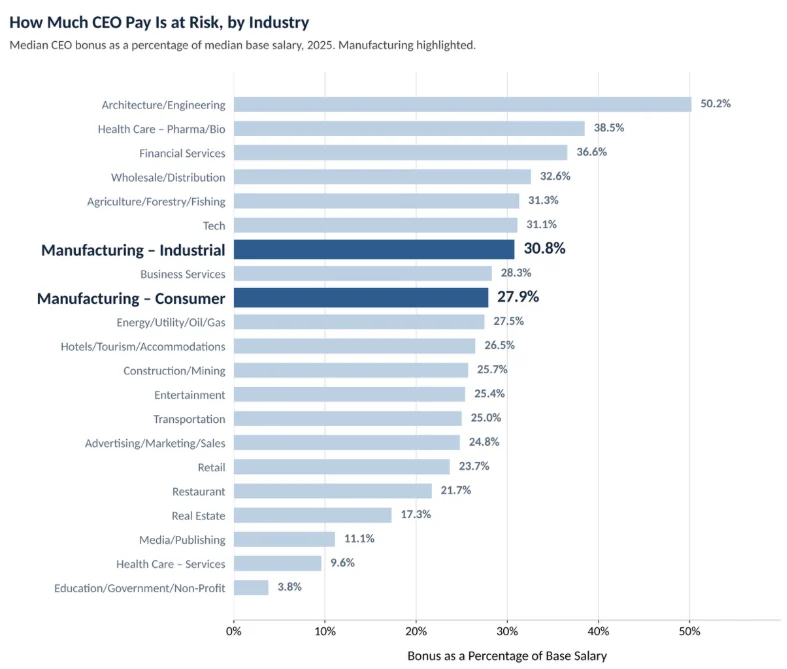
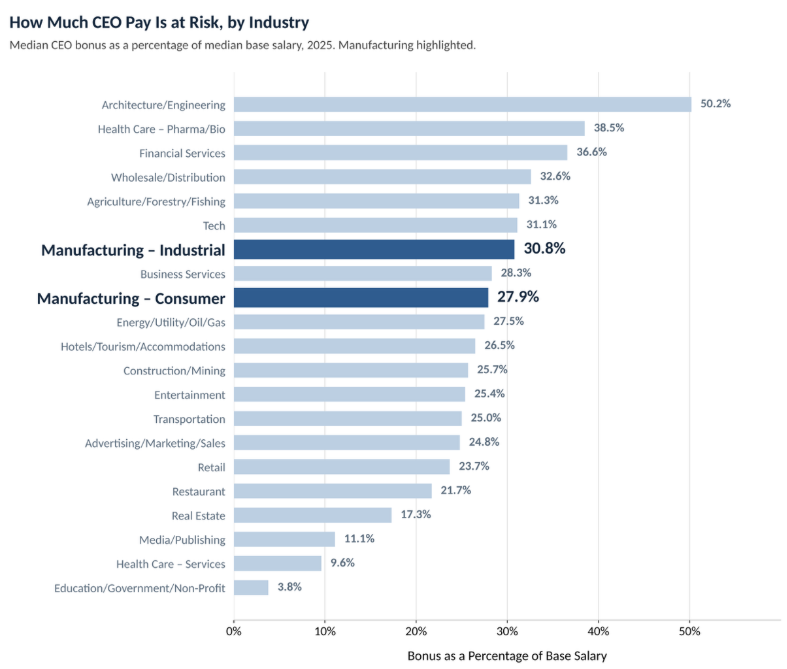
Across the 21 industries surveyed in the Chief Executive Group report, manufacturing bonuses, as a share of base salary, rank notably high. Industrial manufacturing bonuses represent 30.8 percent of base salary, while consumer manufacturing bonuses account for 27.9 percent. Both figures position manufacturing above the midpoint of the surveyed industries, reinforcing the trend of incentivizing performance through variable pay.
Beyond the Cash: Benefits and Perks in Manufacturing
While cash compensation captures a significant portion of executive pay, the landscape of benefits and perks offers another layer of insight into corporate culture and strategy within manufacturing. The prevailing sentiment among many manufacturing CEOs is a "no-frills" approach to perks, often linked to their emphasis on performance-based bonuses.
Jim Nelson of Parr Instruments reiterated this philosophy: "Our philosophy has been pretty no frills. We don’t pay for cell phones, we don’t pay for cars." This stance stems directly from their bonus design. "Because there’s so much incentive wrapped around profitability, the goal is really that operating profit, how high can we get that, because then we’re all rewarded," he explained.
Pete Ensch, leading a private equity-backed manufacturer, Sani-Matic, echoed similar sentiments. "We don’t have a ton of perks." While sales staff might receive car allowances and heavy travelers get some support, the broader executive team experiences minimal non-essential benefits. "Equity-backed companies don’t really have a lot of that. They like to have everything kind of captured in kind of classic buckets," Ensch observed, referring to more structured compensation frameworks common in private equity environments.
Benefits: A Mixed Picture
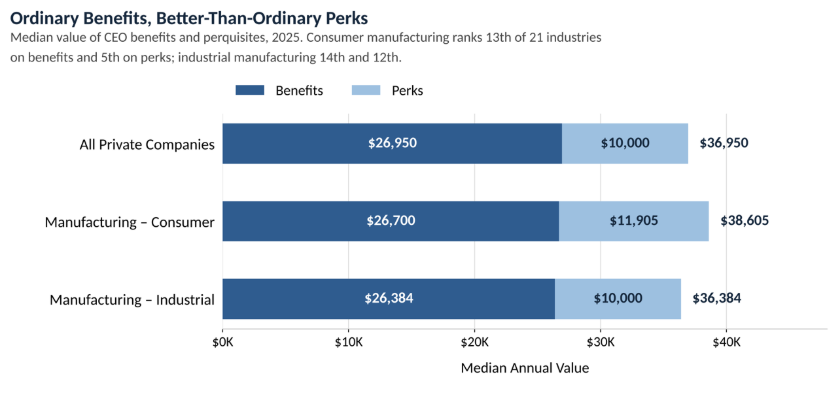
On the broader spectrum of benefits, manufacturing companies generally fall slightly below the median compared to all private companies. The median value of CEO benefits across all private companies was $26,950. Consumer manufacturing CEOs received a median of $26,700, and industrial manufacturing CEOs $26,384, placing them 13th and 14th respectively among the 21 surveyed industries. This positions manufacturing below sectors like financial services, entertainment, and agriculture in terms of median benefit package value, though still above the median for technology companies.
Perks: A More Varied Landscape
The provision of perks, however, presents a more varied picture. Consumer manufacturing companies tend to offer perks that place them near the top of the market, while industrial manufacturing aligns with the overall median. This suggests that while core benefits might be more standardized, the allocation of discretionary perks can differ significantly based on consumer-facing versus industrial-facing business models.
Research indicates that companies approach non-cash compensation components differently, influenced by ownership type and overall compensation philosophy. Al Murphy, CEO of Mother Murphy’s, a prominent flavor manufacturer in the South, exemplifies a more expansive approach to benefits. His company covers 90 percent of employee healthcare, maintains an on-staff nurse, provides access to financial advisors and enrollment counselors, and subsidizes continuing education, including executive physicals at the esteemed Cooper Clinic, a benefit valued at approximately $7,000 per person. Murphy’s philosophy is rooted in the belief that employee well-being is foundational to success: "If you don’t have good health, what are you going to do? You don’t have really anything."
This focus on comprehensive health is a significant differentiator, as only 17.3 percent of private company CEOs nationwide receive an annual physical as a benefit, a perk now standard for Murphy’s executives. To ensure employees understand the full value of their compensation, Murphy’s team issues one-page statements detailing the total compensation package, including benefits and profit sharing, often revealing that an employee’s true remuneration exceeds their base salary by a considerable margin.
The "no-frills" reputation for industrial manufacturing appears to hold true, and perhaps even understates the case in some instances. Conversely, the consumer manufacturing sector shows a greater tendency towards more comprehensive benefit offerings. It is crucial to note what the published numbers typically encompass. Nationally, core benefits like health insurance (95.7% of CEOs), life insurance (85%), and defined contribution plans (82.2%) form the bulk of benefit figures. More discretionary perks, such as company cars or allowances (42%), parking (28.2%), gym memberships (15.8%), and club memberships (12.8%), are rarer. Personal technology, however, is a near-universal perk, with 86.1 percent of CEOs receiving it.
An unusual benefit offered by Nelson’s Parr Instruments, which doesn’t appear in the typical perk columns, is a defined benefit pension plan. This is a rarity in today’s corporate landscape, with only 13.1 percent of private company CEOs having access to such a plan. Furthermore, the company matches 7.75 percent on 401(k) contributions for employees who contribute at least 4 percent, demonstrating a commitment to long-term employee financial security.
The Strategic Role of Equity
Long-term incentive (LTI) plans, particularly those involving equity, play a pivotal role in shaping executive and employee compensation strategies, with their prevalence varying significantly by ownership structure and company size. Private equity-owned companies lead in offering formal LTI plans, with 65.3 percent providing them, compared to 32.7 percent of family businesses. The size of the company also dictates the likelihood of LTI participation, with 77 percent of companies exceeding $1 billion in revenue offering such plans, versus just 27.3 percent of companies under $2 million.
Pete Ensch’s experience at Sani-Matic illustrates the strategic deployment of equity in a private equity-backed environment. The company has intentionally expanded its equity ownership among employees. "When I got here, we had 26 people who had equity in the business… we have 42 people who have equity in the business now," Ensch reported. This expansion is driven by a desire to retain critical engineering talent. "There’s a lot of engineering talent that [we] want to keep," he explained, highlighting how offering stakes in the business cultivates an "owner’s mindset" and alters employee behavior.
Nelson’s Parr Instruments utilizes an employee stock purchase program, funded by discounted share purchases with company financing, serving a similar retention objective. These are described as "golden handcuffs," designed to keep key employees invested in the company’s long-term success.
At Mother Murphy’s, the approach to equity is more tailored, tied to tenure. While fewer than 2 percent of the workforce holds stock, employees become eligible after five years. For those not receiving equity, the focus shifts to a robust benefits and perks program.
Family-owned manufacturers, particularly those without formal LTI plans, face increasing pressure from the hiring market. Bob Grote’s company, for instance, has transitioned from relying solely on stock appreciation rights to offering non-voting shares. "For me to compete for top talent, I have to be able to offer [a long-term equity incentive program] as well," Grote stated. "We hired a CFO, we hired a vice president of sales. To hire at that level, you have to offer [long-term equity incentives] or they’re not even going to talk to you." This indicates a growing necessity for equity-based incentives to attract and retain senior leadership in competitive talent markets.
Concluding Analysis: Philosophy Over Figures
The median compensation figure for a manufacturing CEO provides a foundational understanding of their earnings, but it offers limited insight into the intricate "how." Across the manufacturing sector, the cash component—base salary and bonus—is a standard element of executive remuneration, largely influenced by company revenue. However, the decisions regarding equity, benefits, and perks are more profoundly shaped by a company’s compensation philosophy, ownership structure, and long-term strategic objectives.
The fundamental questions that drive these compensation decisions include: What mechanisms are in place to tie executives to the long-term health of the company? How do executives truly value their benefits and perks? And what is the impact of economic downturns on executive compensation packages? These strategic choices are not solely dictated by the need to compete for talent but are also intrinsically linked to the overarching goals and values that define a manufacturing enterprise. As the industry continues to evolve, the sophisticated interplay between cash, equity, benefits, and perks will remain a critical determinant of leadership attraction, retention, and overall organizational success.
For a more comprehensive understanding of compensation benchmarks across various company sizes, industries, and ownership structures, Chief Executive Group Research’s latest CEO & Senior Executive Compensation Report is available.