
The intricate task of writing, updating, and managing job descriptions has long been a significant hurdle for organizations of all sizes. What once seemed a straightforward administrative duty has evolved into a complex strategic imperative, influencing everything from candidate attraction and diversity pipelines to legal compliance and employer branding. In response to this escalating challenge, an innovative solution has emerged: the automated job description builder, spearheaded by platforms like Ongig’s Text Analyzer.
The Evolving Landscape of Talent Acquisition Challenges
For smaller organizations, managing a limited number of positions might still be a relatively simple endeavor. However, as companies scale, the sheer volume and dynamism of job descriptions become overwhelming. The challenge extends far beyond merely drafting accurate job descriptions; it encompasses the arduous task of managing hundreds, or even thousands, of these documents scattered across shared drives, email inboxes, Applicant Tracking Systems (ATS), and spreadsheets. This fragmentation creates a breeding ground for inconsistency, outdated information, and significant compliance risks. When a single regulatory requirement shifts, manually updating every version across an enterprise becomes an almost impossible feat, leading many talent teams to pivot towards centralized job content management rather than treating each job description as an isolated document.
Effective job descriptions are no longer just wish-list items; they are foundational to any successful hiring strategy. They are critical for cultivating a diverse hiring pipeline and mitigating candidate churn throughout the recruitment process. The modern job description must be detailed, accurate, consistent, and objective. Critically, it must also be gender-neutral, free from opaque industry jargon, and devoid of any potentially offensive language. Beyond merely outlining job duties and applicant qualifications, a compelling job description should articulate the company’s culture and the value proposition for potential candidates.
In smaller companies, HR managers and recruiters may struggle with objectivity and professionalism due to infrequent drafting. Conversely, in larger organizations, the difficulty lies in ensuring uniformity when multiple individuals across various teams contribute, often leading to deviations from company standards in content, format, and language. A telling CareerPlug report highlighted that a staggering 52% of job seekers decline job opportunities due to negative experiences with prospective employers, underscoring the profound impact of poorly constructed job ads. This statistic amplifies the need for an external perspective or a specialized tool to standardize language, formatting, and tone, thereby driving superior candidate engagement and improving conversion rates at scale.
Introducing Automated Solutions: Ongig’s Text Analyzer
Many employers grapple not with crafting a single job description, but with the monumental undertaking of managing 500, 1,000, or even 10,000 of them. Ongig’s Text Analyzer offers a sophisticated, AI-driven solution designed to alleviate these pressures and empower hiring teams to recruit smarter.
At the heart of Ongig’s offering is a centralized Job Library, establishing a single, searchable source of truth for every job description. This eliminates the need for recruiters, HR teams, compensation specialists, and hiring managers to track files across disparate systems. Instead, all stakeholders operate from a unified platform, fostering unprecedented collaboration and consistency. The library boasts robust features such as comprehensive version history, customizable fields, categorized job families, unique requisition IDs, and unlimited job volume, allowing teams to maintain consistency without incurring additional administrative burden.
AI-Powered Creation: Building Job Descriptions from Scratch
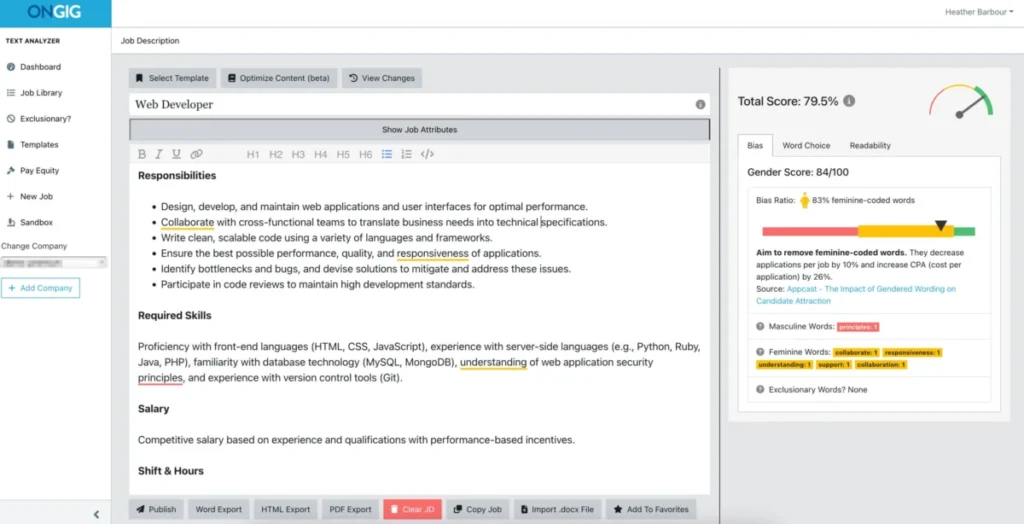
For organizations starting anew or expanding into new roles, Ongig’s automated job description builder provides intuitive guidance. The Text Analyzer empowers users to generate new job postings simply by inputting a job title. For instance, a user can type "Web Developer" into the tool.
The process is streamlined: users select desired sections based on custom templates or Ongig’s research-backed recommendations, then initiate the "Generate Now" function. Leveraging advanced artificial intelligence, Text Analyzer rapidly constructs a comprehensive draft job description for the specified role. This initial draft serves as a solid foundation, which teams can then refine to perfectly align with the specific nuances of the position.
Further optimization is readily available. To mitigate masculine bias and improve conciseness, users can activate the "Optimize Content" and "Rewrite Now" features. The AI intelligently refines the language, enhancing readability and inclusivity.
Enhancing Readability and Inclusivity
Ongig’s Text Analyzer goes beyond mere generation, providing a crucial readability score under its "Section Finder" tab. This feature highlights essential job description sections that resonate with high-quality candidates, such as "Required Skills," "Diversity & Inclusion," and "Mission Statement." The platform contextualizes the importance of each section with current workforce data. For example, it might cite that 32% of working professionals would consider relocating with a pay cut if offered remote work, thereby justifying the inclusion of a "Flexible Location" section where applicable.
Post-AI refinement, users typically observe a significant increase in their job description’s overall score. The platform also identifies potential biases by highlighting specific words. For instance, "support," while seemingly innocuous, can be a feminine-coded term. Text Analyzer automatically suggests neutral alternatives, such as "help," or allows users to remove the term entirely. This meticulous attention to language allows for further optimization, enabling users to replace feminine-coded words to achieve greater gender neutrality and remove any exclusionary language, ultimately broadening the appeal of the job posting. The tool also provides a "View Changes" option for a clear comparison of different versions, ensuring transparency in the editing process.
Once finalized, job postings can be easily exported in various formats (Word, PDF, HTML) or, for premium and professional plans, pushed directly to an ATS via API integration, eliminating manual data entry and ensuring seamless workflow.
Ensuring Compliance in a Dynamic Regulatory Landscape
Compliance is a continuous challenge, particularly in a world of ever-evolving regulations. The real complexity lies not in reviewing a single posting, but in maintaining alignment across an entire suite of job descriptions as rules change. Ongig addresses this by allowing teams to update approved language once and propagate those changes across all relevant job content. Built-in approval workflows, revision tracking, guidance on pay transparency, and audit-ready version history collectively minimize compliance risk while providing HR teams with complete visibility into every update.
The world of hiring and recruitment is in constant flux, necessitating that job descriptions remain current with the latest standards. Ongig’s Text Analyzer proactively ensures compliance with regulations, such as those from the OFCCP (Office of Federal Contract Compliance Programs), by integrating a simple checkbox feature. Activating this feature enables the platform to scan for instances of discrimination, upholding merit-based talent acquisition decisions. This capability streamlines hiring contracts and reinforces a company’s reputation as an Equal Employment Opportunity (EEO) employer.
The benefits extend beyond mere legal adherence; a robust automated job description builder can significantly strengthen a company’s employer brand. By prioritizing employee-first environments where individuals, irrespective of background, have equal opportunities, organizations foster trust among employees, investors, partners, and clients. EEO branding not only enhances employee engagement but also elevates the quality of hires and mitigates workplace dissatisfaction. The adherence to merit-based hiring criteria, especially relevant in light of recent directives such as those from the Trump administration concerning racially discriminatory DEI activities for federal contractors, underscores the critical role of such tools.
Updating and Reformatting Existing Job Descriptions at Scale
Even organizations with extensive existing libraries of job descriptions benefit immensely from an automated builder. Outdated job descriptions are a common pitfall for larger companies, leading to inconsistencies and non-compliance with internal policies or external regulations. Ongig’s Text Analyzer reviews existing job descriptions for quality, consistency, and language, helping customers eliminate biased language and reduce jargon, which demonstrably improves conversion rates among prospective employees.
The automation provided by Text Analyzer significantly reduces the costly human labor typically associated with reviewing and updating vast numbers of job postings. For teams preferring manual updates, the tool still offers invaluable support by scoring job descriptions based on readability and inclusivity, providing actionable suggestions for improvement, and enabling comparative analysis across different roles. The ability to effortlessly replace biased or overly complex language with more inclusive and plain alternatives dramatically improves job postings and enhances the chances of attracting top talent.
Workplace surveys consistently demonstrate that diverse companies outperform their less inclusive competitors, often reporting a 36% increase in profitability. Furthermore, objective, skills-based hiring strategies correlate with a 2.6 times higher likelihood of organizations achieving their hiring targets. Ongig’s Text Analyzer empowers organizations to confidently rewrite existing job descriptions by systematically checking for masculine, feminine, or exclusionary language, offering suggestions for removal or replacement, and automatically applying these changes. This AI-driven process, taking mere minutes, ensures that organizations avoid unintentionally deterring qualified candidates.
Ongig’s exclusionary language detection pinpoints phrases that might create barriers for applicants, providing expert recommendations that make job content more inclusive without compromising the role’s core meaning. The outcome is a broader, more qualified talent pool and an enhanced candidate experience.
For large-scale reformatting and updating, Text Analyzer’s automation capabilities simplify the process. The tool intelligently compares existing job descriptions against preferred templates, making necessary edits to improve readability, clarity, and consistency. It can also automatically populate missing sections, such as salary details, benefits, and information about the hiring process, ensuring adherence to company-wide standards. These customized templates, once configured, can be locked to prevent unauthorized edits, guaranteeing consistency and compliance across the organization.
Bridging the Gap Between Job Descriptions and Job Postings
Ongig’s AI-driven platform offers a seamless transition from internal job descriptions to compelling, candidate-facing job postings with a single click. This shortcut dramatically boosts a talent acquisition team’s efficiency, accelerating the speed-to-job market. The platform also optimizes job postings for SEO, ensuring higher rankings on job boards, increased visibility, and superior candidate conversions.
This reformatting effectively translates the internal language of a job description into the language that resonates most with a target audience, informed by the latest job seeker trends. Ongig’s platform intelligently orders job posting sections to prioritize what candidates seek most, such as "What You’ll Do," "Salary," and "Making an Impact."
The Centralized Job Library: A Unified Source of Truth
Managing countless job descriptions for thousands of roles within an enterprise is a taxing endeavor, and outdated content poses significant legal risks in a continuously evolving compliance landscape. Ongig’s centralized, cloud-based JD library mitigates these challenges by offering a reliable and intuitively designed storage solution. The library provides at-a-glance details including job titles, descriptions, status (active/inactive), department, job family, compensation details, and version history. Users can easily toggle between active and non-active jobs, maintaining a consistent record that keeps hiring teams informed and aligned. This systematic approach simplifies editing, updating, and deleting job descriptions, ensuring hiring strategies remain cohesive.
Beyond Templates: The Power of Job Content Management
While thoughtfully designed job description templates can resolve many common recruiting issues by ensuring consistency and inclusivity, true efficiency and compliance lie in comprehensive job content management. A standardized, inclusive template can significantly improve accuracy and conversion rates. Ongig’s automated builder integrates seamlessly with existing templates or provides recommended ones, allowing for customization of tone and recruiting priorities while locking in standard features to maintain organizational consistency.
Text Analyzer integrates with existing ATS and HRIS systems, supporting both one-way and two-way integrations. This ensures that the ATS, job library, and career site remain synchronized, eliminating the need for manual copy-pasting and preventing version control confusion. When job content changes, all stakeholders work from the same authoritative source. Ongig also offers a flexible, tiered system that scales with an organization’s evolving needs, ensuring that companies only pay for the tools they require, from basic job description analysis to enterprise-level job description library management.
Quantifiable Success: Ongig’s Impact in Action
The efficacy of Ongig’s automated job description builder is underscored by compelling success stories across diverse sectors:
- A Leap in Application Rates: A global employment website, utilizing Text Analyzer for its 60,000 job postings, witnessed a remarkable 133% increase in total application starts and a 21% rise in applications from women, demonstrating the profound impact of refined language on attracting a diverse candidate pool.
- Healthcare Sector Achievements: Ongig supported a healthcare client in revamping over 5,000 job postings, achieving both standardization and pervasive inclusivity. Another healthcare enterprise, managing over 100,000 job postings monthly, attained complete automation, significantly streamlining their recruitment processes.
- Entertainment Industry Transformation: An entertainment sector enterprise focused on enhancing inclusivity and consistency in its job descriptions, resulting in an impressive 100% increase in candidate quality, showcasing how effective job descriptions attract top-tier talent.
- Aerospace and Insurance Sectors’ Strides: An aerospace technology agency successfully addressed gender imbalance in traditionally male-dominated fields like engineering and finance, observing a 22% increase in female applicants with Text Analyzer. Concurrently, a major insurance organization leveraged the tool to target underrepresented groups, achieving a 4X increase in applications from these demographics.
These real-world examples, also highlighted in Ongig’s YouTube video, illustrate the transformative power of nuanced linguistic adjustments and automated management in the recruitment sphere.
The Future of Talent Acquisition
The challenges of writing and updating job descriptions are undeniable. Automated job description builders like Ongig’s Text Analyzer offer a strategic advantage, saving invaluable time for recruitment teams while simultaneously enhancing the quality and impact of job advertisements. With features designed to scale with evolving business priorities, these tools represent a pivotal advancement in talent acquisition. As candidates increasingly seek transparency, inclusivity, and clarity, automated solutions ensure that job descriptions become powerful assets in attracting and securing top talent. Beyond the creation process, Ongig’s Career Site Builder further transforms job descriptions into mobile-friendly, SEO-optimized job pages that remain synchronized with ATS platforms, creating a superior candidate experience without imposing additional manual work on recruiters. The seamless integration of AI-powered job search and department-based navigation exemplifies the comprehensive approach required in today’s competitive talent market.
FAQ: Automated Job Description Builders
Q: Do automated job description builders use AI?
A: Yes, many modern job description builders, including Ongig’s, extensively leverage AI to generate and optimize job content. For instance, Ongig’s Text Analyzer employs AI to suggest edits, rewrite text for enhanced inclusivity and readability, and objectively score job descriptions based on predefined quality metrics. The AI is adept at identifying biased or exclusionary terminology and proposing more inclusive alternatives, thereby aiding organizations in reaching a broader and more diverse talent pool.
Q: How does an automated job description builder help the hiring process?
A: Automated job description builders significantly streamline the hiring process by reducing the time and effort required to write and edit job descriptions. They ensure that job postings are compliant with regulations, engaging to candidates, and consistent across all platforms. This consistency not only improves the candidate experience but also elevates the quality of applicants. Tools like Ongig’s Text Analyzer further assist by flagging outdated language, optimizing formatting, and integrating seamlessly with ATS platforms, allowing HR professionals to allocate less time to administrative tasks and more time to actively engaging with top talent.
Q: What is an automated job description builder?
A: An automated job description builder is a sophisticated digital tool designed to empower HR teams and hiring managers to create, update, and optimize job postings with speed and efficiency. Rather than composing job descriptions manually from scratch or relying on potentially outdated templates, this tool utilizes structured inputs, customizable templates, and frequently AI-powered suggestions to generate clear, accurate, and brand-aligned job advertisements. Comprehensive solutions, such as Ongig’s Text Analyzer, also offer capabilities for managing extensive libraries of job postings and ensuring content consistency across various departments within an organization.






