The global workforce is currently navigating a period of unprecedented transition as generative artificial intelligence moves from a speculative tool to a core component of organizational infrastructure. While much of the public discourse has focused on the potential for job displacement among white-collar workers, a more nuanced transformation is occurring within the middle and senior tiers of corporate leadership. The role of the manager, long defined by task orchestration and administrative oversight, is undergoing a fundamental shift toward a model of human-centric coaching and strategic development. This evolution, driven by the emergence of the "Superworker" and the subsequent necessity of the "Supermanager," represents one of the most significant redesigns of workplace hierarchy since the Industrial Revolution.
The Evolution of the Managerial Mandate
Historically, the path to management has been paved with technical excellence. Employees who excelled at specific tasks—be it software coding, financial analysis, or marketing execution—were traditionally promoted into leadership roles. However, this "player-coach" model has frequently resulted in a systemic disconnect: excelling at the work does not inherently translate to excelling at leading the people who do the work. In the pre-AI era, managers often spent the vast majority of their time on "task orchestration"—tracking deadlines, reviewing outputs, and managing budgets—leaving little room for the "soft" skills of mentorship and emotional intelligence.
As AI begins to augment individual capacity, employees are becoming "Superworkers," capable of managing their own technical workflows and AI agents with minimal oversight. This shift effectively removes the traditional "taskmaster" requirement of the manager. According to recent industry analysis, HR-style responsibilities, such as coaching, development, and skills recognition, currently account for only about 10 percent of a manager’s daily routine. Projections suggest that as AI assumes the burden of administrative and technical oversight, these human-centric responsibilities will expand to encompass 90 percent of the role.
A Chronology of Workplace Transformation
The transition toward AI-integrated management has followed a distinct timeline, accelerating rapidly over the last several years.
In the early 2020s, the focus was primarily on automation of repetitive tasks. During this phase, managers viewed AI as a tool for efficiency, primarily used by individual contributors to speed up data entry or basic content generation. By 2023, the emergence of Large Language Models (LLMs) shifted the focus toward "augmentation," where AI began assisting in complex problem-solving and creative workflows.
In 2024, the concept of the "Superworker" gained traction. Research from organizations like the Josh Bersin Academy highlighted that high-performing employees were using AI to handle 30 to 40 percent of their traditional workloads, allowing them to take on broader responsibilities. This created a vacuum in management; if workers were more autonomous, what was the manager’s purpose?
By 2025, the "Supermanager" paradigm emerged. This current phase is characterized by the integration of AI into Human Capital Management (HCM) systems, where AI acts as a co-pilot for leaders. The focus has moved from "managing work" to "managing people through work," with a heavy emphasis on mental health, career pathing, and skill acquisition.
Statistical Analysis of the AI Impact
Supporting data from the 2025 PwC Global AI Job Barometer and recent Fortune surveys highlight the urgency of this shift. Research indicates that a significant majority of white-collar workers expect AI to fundamentally alter their job descriptions within the next three years. While 47 percent of workers express concern about job elimination, a growing segment—approximately 62 percent—reports that AI has already reduced their daily stress by handling mundane administrative tasks.
However, this productivity gain comes with a psychological cost. Record levels of uncertainty and "transformation fatigue" are being reported across sectors. This is where the new managerial mandate becomes critical. Organizations are finding that the "human touch" is more valuable than ever; employees who feel supported by their managers during technological transitions are 3.5 times more likely to remain engaged and productive.
In technical fields like software engineering, the impact is even more pronounced. Data suggests that up to 50 percent of routine coding tasks could be fully automated by AI in the near future. This forces a radical rethinking of the engineering manager role. Historically, these managers were technical leads; in the future, they will need to be organizational designers who can blend human creativity with machine efficiency.
Redesigning Hierarchies and Technical Domains
The rise of AI-driven work redesign is forcing a "skills audit" of the management class. For decades, organizations tolerated managers with poor people skills because their technical expertise was indispensable. AI is removing that safety net. As technical tasks become commoditized, the "people gap" becomes a liability.
Corporate leaders are now faced with a difficult choice: retrain managers in soft skills or transition them back to individual contributor roles. This organizational redesign is particularly visible in Silicon Valley and global tech hubs, where hierarchies are being flattened. Managers are no longer "gatekeepers" of information; instead, they are "enablers" of talent.
Furthermore, managers are now expected to be the "personalizers" of employee development. With the "L&D AI Revolution," learning and development are no longer centralized in HR departments. Instead, development happens in the "flow of work." AI tools can identify a skill gap in an employee’s output and suggest a specific training module. The manager’s role is to provide the context and encouragement for that learning to take place, bridging the gap between machine-generated data and human career aspirations.
Technological Integration: From Platforms to Workflows
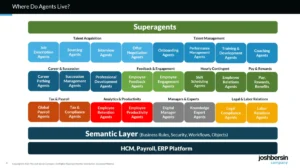
The practical application of AI in management is moving away from standalone platforms like Workday, SAP, or Oracle and into everyday communication tools like Microsoft Teams and Slack. This "AI HR" reality is streamlining the most avoided parts of management.
Traditionally, managers viewed HR tasks—performance reviews, feedback cycles, and compliance reporting—as "extra work" that detracted from their "real work," such as hitting sales targets or launching products. AI is changing this by embedding HR tasks into the natural workflow. For example, rather than a manager having to remember to check a performance dashboard, an AI agent can prompt them within Slack: "Jim has exceeded his targets for three consecutive weeks. Would you like me to draft a recognition note based on his recent contributions to the Alpha Project?"
This level of integration allows for "continuous coaching." Instead of an annual performance review that feels like a post-mortem, managers can provide real-time, data-driven feedback. Interestingly, early adoption data shows that many employees actually prefer receiving constructive, technical feedback from AI agents. It removes the emotional sting and personal bias that can often cloud human-to-human critiques, allowing the manager to step in later as a supportive coach rather than a harsh judge.
Broader Impact and Implications for the Future
The shift toward the "Supermanager" has profound implications for the future of work and the global economy. As managers become more effective at development and engagement, organizational turnover is expected to decrease, and internal mobility is expected to rise.
However, there are risks associated with this transition. There is a danger of "algorithmic bias" if managers rely too heavily on AI insights for performance evaluations. The human element must remain the final arbiter of talent decisions. The most successful organizations will be those that view AI as a "co-pilot" rather than an "auto-pilot" for leadership.
The broader impact also extends to the "managerial pipeline." How do we train the next generation of leaders if the entry-level technical roles they used to fill are being automated? Organizations will need to create new pathways for leadership development that emphasize empathy, strategic thinking, and technological fluency from day one.
In summary, the age of AI does not herald the end of management; it heralds the end of "administration-based" management. The future belongs to the "Supermanager"—a leader who uses technology to handle the complexity of the business so they can focus on the complexity of the human being. By embracing both the human and the technical, leaders can move beyond simple productivity and toward exponential outcomes that benefit both the organization and the individual. The transition may be marked by uncertainty, but the potential for a more humane, productive, and fulfilling workplace has never been higher.