The integration of Artificial Intelligence (AI) into daily operations is fundamentally reshaping management practices, necessitating a new paradigm of leadership to harness its full potential. This evolution is the subject of recent research, notably "The Rise of the Supermanager," which explores the critical role of forward-thinking managers in driving AI-powered innovation from the ground up. As AI tools become more sophisticated and personalized, the traditional manager’s role is expanding to encompass not just oversight and alignment, but also the active enablement and cultivation of AI-driven transformation within their teams.
A Historical Perspective on Management
For decades, management theory, as espoused by thought leaders like Peter Drucker, has largely operated under a clear division: managers lead and workers perform tasks. The core responsibilities of a manager have traditionally included setting strategic direction, ensuring team alignment, establishing priorities, and equipping individuals with the necessary skills and resources for success. This often involves addressing performance gaps through coaching, reassignments, or, in some cases, termination.
The complexities inherent in this role have spurred the development of numerous management philosophies and methodologies. These range from the results-driven "Jack Welch" style, emphasizing accountability and performance metrics, to the "servant leadership" approach popularized by Howard Schultz, which prioritizes employee well-being and development. Jeff Bezos’s "customer-obsessed" approach, often characterized by the "press release" method of defining new products, and Elon Musk’s "first principles" thinking, which encourages fundamental problem-solving, represent other influential models. Despite these varied approaches, the underlying challenge for managers remains consistent: navigating difficult decisions regarding hiring, promotions, and team performance optimization.
The AI Revolution and the Emergence of the Supermanager
The advent of AI introduces a novel dimension to these established management principles. Unlike previous technological advancements that primarily offered efficiency gains, AI is characterized by its capacity for learning, personalization, and the empowerment of individuals and teams with unprecedented analytical capabilities. This transformative power, exemplified by the development of "Digital Twins" and the ability to glean deep insights from enterprise data, shifts the focus from mere implementation to a continuous cycle of enablement, learning, and reinvention. Consequently, the responsibility for leading this AI transformation is increasingly falling upon line managers, who are often the first to identify and leverage emerging AI applications within their specific domains.

The Bottom-Up and Top-Down Dynamics of AI Transformation
The research highlights that significant AI innovations frequently originate from front-line teams who, through experimentation and necessity, develop novel solutions. A notable case involved a distribution center in Japan that independently created a photo-based inventory management application. This custom solution dramatically reduced inventory processing time by 75%, prompting its wider adoption across the company after being shared with corporate leadership.
Similarly, an analyst at the International Air Transport Association (IATA) utilized an AI platform, Galileo, to construct a sophisticated workforce planning model for the airline industry. This self-developed tool significantly streamlined staffing and skills analysis, saving months of traditional effort. The analyst is now disseminating this model to airline executives globally, illustrating the potential for individual initiative to drive industry-wide advancements.
Within the financial sector, an individual investment advisor at a major bank developed a personalized portfolio advisor using the institution’s secure AI agent platform. This creative endeavor was subsequently leveraged by the IT department to build a comprehensive global portfolio management system for high-net-worth clients.
These examples underscore a pervasive trend: AI transformation is a dynamic, multi-directional process. Opportunities for AI application span diverse areas such as marketing content generation, job analysis and recruitment, employee performance data analysis, and the automation of performance appraisal writing. The most impactful innovations often emerge from frontline employees. The "Supermanager" plays a crucial role in fostering an environment where these ideas can be identified, nurtured, and brought to fruition, a process the research terms the "three E’s of AI transformation": Enable, Encourage, and Empower.
The Dual Focus of Supermanagers: Execution and Innovation
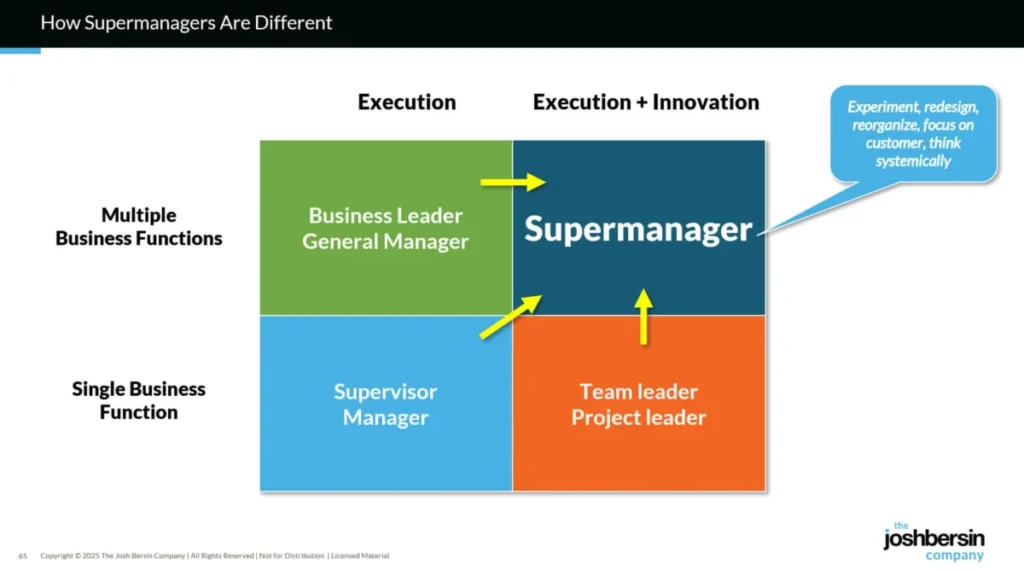
Supermanagers, a category of leaders recognized for their ability to achieve exceptional results, possess a distinct capability: they effectively balance a rigorous focus on execution and tangible outcomes with a proactive drive for innovation and reinvention. This is achieved through a specific set of developed competencies, distinguishing them from mere rebels or disruptors.

While many organizations establish AI steering committees and dedicated technology teams to develop standardized platforms and implement large-scale initiatives, these centralized groups often lack the granular visibility to identify every emergent opportunity. For instance, Standard Chartered is investing in a new global onboarding platform to streamline complex talent integration across over 80 countries, a significant but centralized effort.
In contrast, Supermanagers empower their teams to generate novel ideas, judiciously prioritize initiatives, and champion their innovations. Instead of passively awaiting corporate-driven solutions, they actively support and encourage employees to explore and implement new AI applications. This proactive approach cultivates a culture of continuous improvement and adaptability.
The Critical Role of Supermanagers in Bridging the AI Productivity Gap
A significant challenge in the current AI landscape is the growing disparity between technological advancement and its effective integration into business productivity. As illustrated by research data, while powerful AI tools like Microsoft Copilot are readily available, the time and effort required for individuals and teams to fully leverage them can lead to a lag in productivity gains. This gap is visually represented by a widening divergence between the trajectory of technological capability (often depicted as an upward green arrow) and the realization of business productivity (a slower-moving red arrow).
Traditional managers may adopt a passive stance, either awaiting IT-delivered solutions or issuing general directives for increased productivity without providing concrete support or direction. This approach is insufficient to close the emerging gap.
Supermanagers, conversely, actively engage with AI. They develop a foundational understanding of the technology, encourage experimentation within their teams, collaborate with IT departments for necessary support, and foster an environment that encourages out-of-the-box thinking. These frontline innovations, even if small in scale, generate momentum, build practical experience, and create demand for IT integration. The cumulative effect is a company that fosters numerous innovations, progressively driving the red productivity line closer to the green technological capability line. As new AI features emerge, these Supermanaged teams of "Superworkers" continue to innovate, creating a virtuous cycle of growth and adaptation.

The ease with which modern AI systems can be programmed and customized is a critical enabler of this phenomenon. With platforms like Galileo offering an open system with extensive developer features, creating prompts and managing data within AI agents has become as accessible as using a spreadsheet. This democratization of AI development empowers effective Supermanagers to lead their teams through this transformative period.
Organizational Strategies for Cultivating Supermanagers
Organizations must critically evaluate their existing leadership models to foster the development of Supermanagers. Key considerations include:
Evaluating Leadership Models
- Emphasis on Execution vs. Innovation: Does the current leadership model prioritize tangible results and execution, or does it equally value and reward innovation and creative problem-solving?
- Managerial Autonomy: How much freedom do managers have to reassign roles, redesign jobs, and create new positions within their teams to adapt to evolving technological landscapes?
- Training and Development: Are leaders provided with robust training in job design, organizational change management, and, critically, the practical application and strategic implications of AI?
AI Literacy for Leaders
A fundamental requirement for today’s leaders is a deep and practical understanding of AI. There is no room for complacency; the revolutionary nature of this technology demands that leaders at all levels rapidly acquire new skills. HR leaders, in particular, must set the standard by demonstrating their own commitment to AI literacy and continuous learning.
Revisiting Reward Systems
Organizational reward and recognition systems must be re-aligned to acknowledge and incentivize the behaviors characteristic of Supermanagers. This includes rewarding individuals who champion AI-driven innovation, foster experimentation, and effectively bridge the gap between technological potential and business outcomes.
The research suggests that focusing on cultivating the traits and capabilities of the "Supermanager" may represent one of the most critical and impactful investments an organization can make in its AI transformation strategy. This strategic shift is not merely about adopting new tools, but about fundamentally evolving the leadership approach to unlock the full, transformative power of artificial intelligence.

Further exploration of this topic is available through the research publication "The Rise of the Supermanager" and related resources, including an introductory article on "Galileo for Managers" and a podcast episode dedicated to the subject. These resources provide in-depth insights and practical guidance for organizations navigating the evolving landscape of AI-powered management.