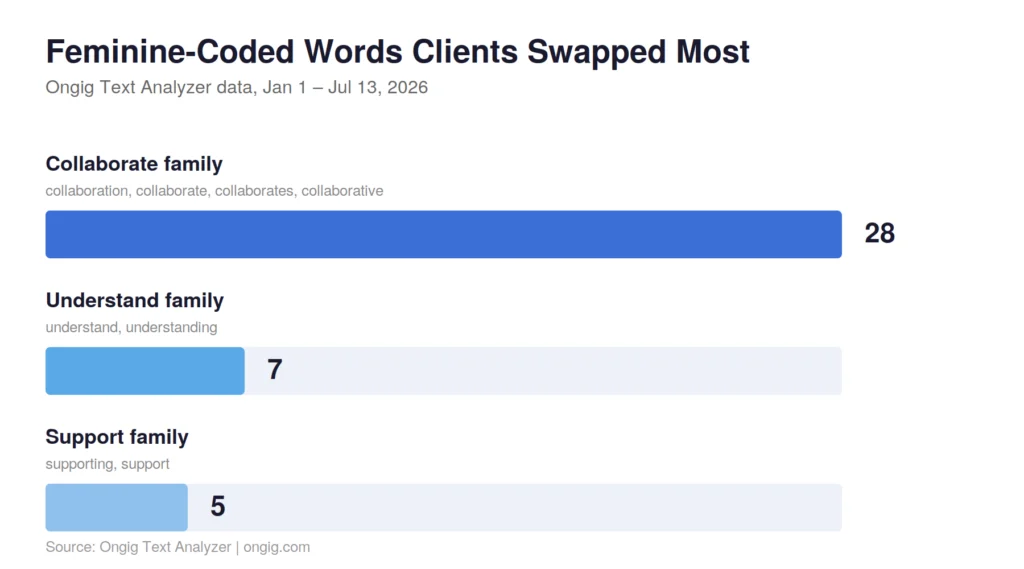
The landscape of inclusive language in recruitment continues its dynamic evolution, with new data from early to mid-2026 revealing that the "collaborate" family of words (including "collaboration," "collaborative," and "collaborates") is the most frequently edited feminine-biased term by recruiters utilizing text analysis tools. This marks a significant shift in how organizations are actively working to de-bias their job postings, moving beyond mere frequency analysis to focus on actionable changes made by hiring professionals. Following "collaborate," the words "understand" and "support" also emerged as prominent feminine-coded terms undergoing active revision. Notably, "committed," a word that has consistently appeared on such lists since 2019, did not make the cut in this year’s analysis, underscoring the fluid nature of language perception and unconscious bias in talent acquisition.
The Evolving imperative of Inclusive Language in Recruitment
In an increasingly competitive global talent market, organizations are under mounting pressure to attract diverse candidates and foster equitable hiring practices. A critical component of this effort involves scrutinizing the language used in job descriptions, which can inadvertently deter or attract specific demographic groups, including by gender. Research consistently shows that certain words carry subtle, unconscious biases, often categorized as "masculine-coded" or "feminine-coded." Masculine-coded terms, such as "aggressive," "dominant," "competitive," and "driven," tend to appeal more to men, while feminine-coded terms like "nurturing," "supportive," "collaborative," and "understanding," are statistically more likely to attract women. The presence of a high concentration of either type can skew applicant pools, limiting diversity and potentially overlooking highly qualified candidates.
The journey to understand and mitigate these biases is not new. For years, organizations and research bodies have sought to identify these linguistic patterns. Previous studies, including those conducted in 2019 and 2024, often relied on scanning vast databases of publicly available job postings to count the frequency of gender-biased words. While valuable, this approach highlighted words that existed in job ads, but not necessarily those that recruiters recognized as problematic and actively sought to change. The 2026 analysis represents a significant methodological advancement, shifting the focus from passive observation to active intervention.
A New Lens: Tracking Action, Not Just Occurrence
For the 2026 update, a distinct and more insightful methodology was employed. Instead of merely tallying the prevalence of feminine-biased words across a random sample of job postings, the analysis focused on the actual editing behavior of clients using specialized text analysis software, specifically Text Analyzer. Data collected from January through mid-July 2026 tracked which words real recruiters, talent acquisition specialists, and HR professionals chose to swap out or remove from their job descriptions.
This methodological pivot offers a more robust understanding of which terms truly "matter" in the context of active bias mitigation. It moves beyond theoretical identification of biased language to practical, real-world application. The words identified in this report are not just common; they are terms that hiring managers are actively flagging and correcting, indicating a growing awareness and commitment to inclusive language. This shift highlights a crucial difference: it’s not just about a word appearing frequently, but about it being perceived as a barrier or a point of bias that needs addressing. While this new tracking mechanism, updated due to internal system changes, provides a different "shape" of data compared to previous years and serves as a mid-year snapshot, its emphasis on active modification provides unprecedented insight into the evolving practices of inclusive recruitment. A fuller year-end report is anticipated to provide a more comprehensive picture.
The 2026 Findings: Decoding the Dominant Feminine-Biased Terms
The analysis of client-initiated swaps revealed a clear hierarchy of feminine-biased terms that recruiters are actively working to neutralize:
-
The "Collaborate" Family (collaborate, collaboration, collaborative, collaborates): This cluster of words emerged as the undisputed leader. Its pervasive presence in job descriptions is understandable; teamwork and cross-functional engagement are foundational to most modern workplaces. However, the overuse or generic application of "collaborative" language can subtly signal an environment that values traditionally feminine traits over others, potentially deterring candidates who perceive it as less action-oriented or individualistic. The subtlety of this bias makes it particularly insidious and easy to overlook, as "collaboration" inherently sounds positive and harmless. Recruiters are now actively identifying instances where this term is either redundant or can be replaced with more precise, outcome-focused language.
-
"Understand" (and understanding): This term ranked second among those most frequently swapped. While "understanding" is a desirable trait, its frequent appearance can make job requirements vague and lean into a feminine-coded emphasis on empathy or comprehension rather than demonstrable skill or direct action. For example, "understanding of SQL" is less impactful and more ambiguously coded than "proficient in writing SQL queries" or "able to troubleshoot SQL databases." The active replacement of "understand" reflects a move towards more concrete, measurable skill descriptions that appeal to a broader range of candidates and clarify expectations.
-
"Support" (and supporting): Coming in third, "support" is another word that often appears innocuous and essential to many roles. However, its overuse, especially in roles that might traditionally be seen as administrative or secondary, can reinforce gender stereotypes. Phrases like "supports the sales team" can be perceived as less dynamic than descriptions that detail specific responsibilities and contributions, such as "manages client onboarding and contract renewals for the sales department." The active swapping of "support" indicates a conscious effort to articulate responsibilities in a way that highlights agency and direct impact, rather than a more passive, assistive role.
The Disappearance of "Committed": A Sign of Evolving Language
One of the most striking observations from the 2026 data is the absence of "committed" from the top swapped feminine-biased words list. This word had been a consistent presence in previous analyses, appearing in both the 2019 and 2024 reports. Its disappearance from the active swap list suggests a few potential interpretations:
- Increased Awareness and Proactive Removal: It’s possible that recruiters and organizations have become more aware of "committed" as a potentially biased term in recent years and have proactively reduced its usage, meaning fewer instances remain for the Text Analyzer to flag.
- Shifting Perceptions: The perception of "committed" itself may have evolved. What was once considered a feminine-coded term might now be seen as more gender-neutral, or simply less problematic in the context of overall job description language.
- Contextual Specificity: Recruiters might be using "committed" more judiciously, reserving it for specific contexts where it conveys a genuine, non-biased meaning, rather than as a generic descriptor.
Regardless of the precise reason, the change underscores the dynamic nature of language and bias. What is considered problematic one year may be less so the next, highlighting the need for continuous monitoring and adaptation in inclusive language strategies.
Global Research: The Persistent Weight of Words
While the 2026 data provides a focused look at active de-biasing efforts, it’s crucial to contextualize these findings within the broader global research on gendered language and labor force participation. A seminal study by Lightcast and UNESCO, analyzing job postings across six English-speaking countries, revealed a stark global reality: women’s labor force participation is 25% lower than men’s worldwide. This research powerfully demonstrated a correlation between male-coded language and industries where this gender gap is most pronounced, such as STEM fields and manufacturing.
Moreover, the Lightcast and UNESCO study extended its analysis beyond initial hiring, finding that manager-level job postings consistently contained noticeably more masculine-coded language than non-managerial roles. This finding directly correlates with the persistent phenomenon of the "glass ceiling," where women encounter systemic barriers to advancement even after entering the workforce. The subtle linguistic cues embedded in job descriptions, therefore, are not merely about initial attraction but play a role in perpetuating gender disparities throughout career trajectories.
The overlap between Ongig’s focused data and the broader global research is compelling. Both "support" and "committed" were identified by Lightcast and UNESCO as top female-coded terms globally. The consistent appearance of these words in earlier Ongig analyses and the current active swapping of "support" reinforces the global relevance of these linguistic biases. The eventual drop of "committed" from Ongig’s active swap list, while significant, does not negate its historical impact or its continued presence as a female-coded term in broader global analyses.
Practical Strategies for Neutralizing Job Posts
Identifying feminine-biased words is only the first step; the true impact comes from effectively transforming job descriptions. The overarching principle for correction is specificity over vagueness. Vague language often serves as a hiding place for unconscious bias, whereas precise, action-oriented descriptions clarify expectations for all candidates, irrespective of gender.
Here’s how to apply this principle to the top identified terms:
-
Addressing the "Collaborate" Family: When job descriptions are saturated with terms like "collaborative environment" or "collaborates cross-functionally" in every bullet point, it dilutes the meaning and risks signaling an overly consensus-driven culture that might not appeal to all candidates.
- Strategy: Rather than eliminating "collaboration" entirely, use it judiciously where it genuinely describes a core aspect of the role or team structure. For other instances, replace it with more active and descriptive verbs.
- Example Swap: Instead of "Collaborates with marketing team on campaign strategy," consider "Partners with the marketing team to develop and execute campaign strategies" or "Works alongside the marketing team to align content and outreach efforts." Other alternatives include "joins forces with," "integrates with," or "coordinates with."
-
Refining "Understand" and "Understanding": This word often leads to ambiguous requirements, leaving candidates to guess the true level of proficiency expected.
- Strategy: Replace "understand" with phrases that describe demonstrable skills or actions. This clarifies the expectation for every applicant.
- Example Swap: Instead of "Understanding of project management methodologies," use "Proficiency in Agile or Scrum methodologies" or "Experience applying Waterfall project management principles." For "understanding of SQL," change to "Comfortable writing complex SQL queries," "Able to analyze data using SQL," or "Experienced in SQL database management."
-
Reimagining "Support" and "Supporting": While "support" can be a legitimate job function, its generic use can make roles sound less impactful or reinforce traditional gender roles.
- Strategy: Detail the specific actions and outcomes associated with the "support" function. Turn passive support into active responsibility.
- Example Swap: Instead of "Supports the executive team," write "Manages executive calendars, coordinates travel, and prepares presentation materials for the executive team." For "supporting client success initiatives," consider "Drives client onboarding, resolves complex inquiries, and contributes to client retention strategies."
The consistent thread across all these recommendations is a commitment to clarity and precision. By focusing on what candidates will do and achieve, rather than relying on abstract or subtly coded adjectives, organizations can create job descriptions that are not only more inclusive but also more informative and appealing to a wider, more diverse talent pool.
The Business Case for Gender-Neutral Language
Beyond ethical considerations and legal compliance, the adoption of gender-neutral language in job descriptions presents a compelling business case. Companies that proactively address linguistic bias stand to gain significantly:
- Expanded Talent Pool: By removing subtle barriers, organizations can attract a broader and more diverse pool of qualified candidates, including those who might have self-selected out due to perceived cultural fit or lack of specific "gendered" traits.
- Enhanced Diversity and Inclusion: A diverse workforce brings a wider range of perspectives, experiences, and problem-solving approaches, leading to greater innovation, better decision-making, and improved financial performance.
- Improved Employer Brand: Companies committed to inclusive hiring practices are viewed more favorably by job seekers, employees, and the public. This strengthens the employer brand, making it easier to attract top talent and retain existing employees.
- Reduced Time-to-Hire and Cost-per-Hire: A larger, more qualified applicant pool can lead to faster recruitment cycles and potentially lower recruitment costs by reducing the need for extensive outreach or repeated postings.
- Legal and Reputational Risk Mitigation: While specific legal interpretations vary by jurisdiction, gender-coded language can, in some contexts, contribute to claims of discrimination. Regardless of direct legal exposure, a public perception of biased hiring practices can severely damage a company’s reputation.
Technological Solutions in the DEI Landscape
The rise of sophisticated AI and natural language processing (NLP) tools, exemplified by platforms like Ongig’s Text Analyzer, has revolutionized the ability of organizations to identify and rectify biases in job descriptions at scale. These technologies can scan text for thousands of potentially biased words and phrases, offering real-time suggestions for more inclusive alternatives. This not only streamlines the de-biasing process but also educates recruiters and hiring managers on best practices, fostering a more mindful approach to language in the long term. Such tools are becoming indispensable for companies committed to embedding diversity, equity, and inclusion into their core talent acquisition strategies.
Conclusion: A Continuous Evolution Towards Equitable Hiring
The 2026 data on feminine-biased words, particularly the prominence of the "collaborate" family and the departure of "committed" from the active swap list, serves as a powerful reminder that inclusive language in recruitment is not a static goal but a continuous process of learning, adaptation, and refinement. As societal norms evolve and our understanding of unconscious bias deepens, so too must our linguistic practices. Organizations that embrace this dynamic approach, leveraging both human insight and advanced technological tools, will be best positioned to attract, engage, and retain the diverse talent essential for future success. The ongoing commitment to meticulously crafting job descriptions that are clear, precise, and free from unintended gender bias is not merely a compliance exercise; it is a strategic imperative for building truly equitable and high-performing teams in the years to come.
July 16, 2026 by Rob Kelly in Writing Job Descriptions