

The landscape of marketing technology has undergone a seismic shift over the past decade, transforming from a peripheral set of digital tools into the central nervous system of modern business operations. For many organizations, particularly within the Business-to-Business (B2B) and Software-as-a-Service (SaaS) sectors, the marketing technology stack—or "MarTech stack"—has evolved into a complex ecosystem that encompasses Customer Relationship Management (CRM) systems, sophisticated automation platforms, deep-dive analytics tools, and burgeoning AI-driven engines. While this technological proliferation offers unprecedented opportunities for precision targeting, it has simultaneously introduced significant operational friction. The core challenge facing contemporary enterprises is not a lack of available technology, but rather the strategic adoption and management of these systems to ensure they act as a growth engine rather than a source of fragmentation.
The Historical Trajectory of MarTech Complexity
The evolution of the MarTech stack can be traced through several distinct eras. In the early 2000s, the stack was largely synonymous with a CRM and perhaps a basic email service provider. By the mid-2010s, the industry witnessed an explosion of "best-of-breed" solutions, leading to what industry analysts famously dubbed the "Martech 5000"—a visualization of the thousands of vendors competing for space in the marketing ecosystem.
As of 2024, the number of available solutions has surpassed 14,000, according to Chiefmartec. This exponential growth has forced a shift from a reactive acquisition model to a more disciplined, architectural approach. Historically, many companies built their stacks reactively: a specific campaign required a new tool, so one was added; a reporting gap appeared, so another platform was introduced. Over time, this "layering" effect created a "Franken-stack"—a disjointed collection of platforms that often fail to communicate, leading to siloed data, redundant costs, and a frustrated workforce.
Redefining the MarTech Stack as a Cohesive System
A common misconception among business leaders is viewing a MarTech stack merely as a software inventory. In a professional journalistic context, it is more accurately defined as a coordinated system of integrated technologies designed to support the entire customer lifecycle. This lifecycle spans from initial brand awareness and demand generation to lead nurturing, conversion, and long-term customer retention.
The true value of a modern stack lies in orchestration. When tools are integrated effectively, data flows seamlessly across departments. Marketing teams gain visibility into how specific campaigns impact the sales pipeline, while sales teams receive rich context regarding a lead’s behavior before the first outreach call. Conversely, a poorly designed stack limits visibility and slows down execution, ultimately resulting in missed revenue opportunities. Industry data suggests that companies with highly integrated MarTech stacks are significantly more likely to meet or exceed their revenue targets compared to those struggling with disconnected systems.

Why MarTech Investments Often Fail to Deliver ROI
Despite billions of dollars in annual investment, many organizations fail to realize the full potential of their technology. Analysis of underperforming stacks reveals several recurring structural issues:
- Tool Overload and Redundancy: Organizations often accumulate platforms with overlapping functionalities. It is not uncommon for a mid-market firm to pay for three different tools that all offer social media scheduling or basic email automation.
- The Integration Gap: When systems do not communicate, data becomes siloed. If a marketing automation platform tracks a prospect’s webinar attendance but that data never reaches the CRM, the sales representative remains uninformed, leading to a disjointed customer experience.
- Absence of Clear Ownership: Without a dedicated Marketing Operations (MarketingOps) function, tools are often misconfigured or underutilized.
- Data Decay: Inconsistent tracking and missing fields lead to flawed insights. Marketing experts note that even the most advanced AI cannot compensate for "dirty" data.
The Five Core Layers of a High-Performing Stack
To move beyond a reactive model, successful organizations structure their technology in functional layers. This architectural approach ensures that each new tool serves a specific purpose within the broader ecosystem.
1. The Data and CRM Layer
This is the foundation of the entire stack. It serves as the "single source of truth" for all customer and prospect information. Every other component depends on the accuracy of the data housed here.
2. The Demand Generation Layer
This layer is responsible for acquisition. It includes tools for search engine optimization (SEO), paid advertising management, and social media engagement. Without this layer, the system lacks the input necessary for growth.
3. The Content and Engagement Layer
Once prospects are in the system, this layer facilitates nurturing. It encompasses email marketing, personalization engines, and content management systems (CMS) that guide the buyer through their journey.
4. The Analytics and Attribution Layer
This layer provides the "eyes" of the operation. It connects marketing activities to specific revenue outcomes, allowing teams to move from guesswork to data-driven optimization.
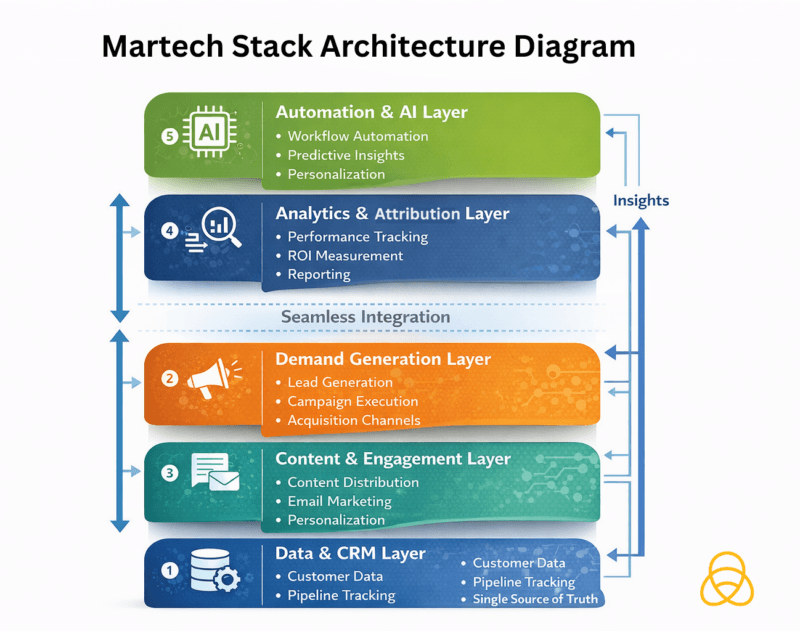
5. The Automation and AI Layer
The uppermost layer enables scalability. By automating repetitive tasks and using machine learning to predict buyer behavior, this layer allows a lean team to manage a massive volume of leads with high precision.
The Integration of Artificial Intelligence
The current market state is defined by the rapid infusion of Artificial Intelligence (AI) across all layers of the MarTech stack. AI is no longer a futuristic add-on; it is becoming the primary driver of operational efficiency. In modern stacks, AI is being deployed for:
- Predictive Analytics: Identifying which leads are most likely to convert based on historical patterns.
- Real-Time Personalization: Adjusting website content or email messaging dynamically based on user behavior.
- Content Generation and Optimization: Using generative AI to scale content production while maintaining brand standards.
- Forecasting: Providing leadership with more accurate revenue projections based on pipeline velocity and historical conversion rates.
Industry analysts suggest that the "AI-first" MarTech stack is the next logical step in the evolution of digital marketing, where systems do not just store data but actively suggest the next best action for the marketer.
Step-by-Step Framework for Building a Strategic Stack
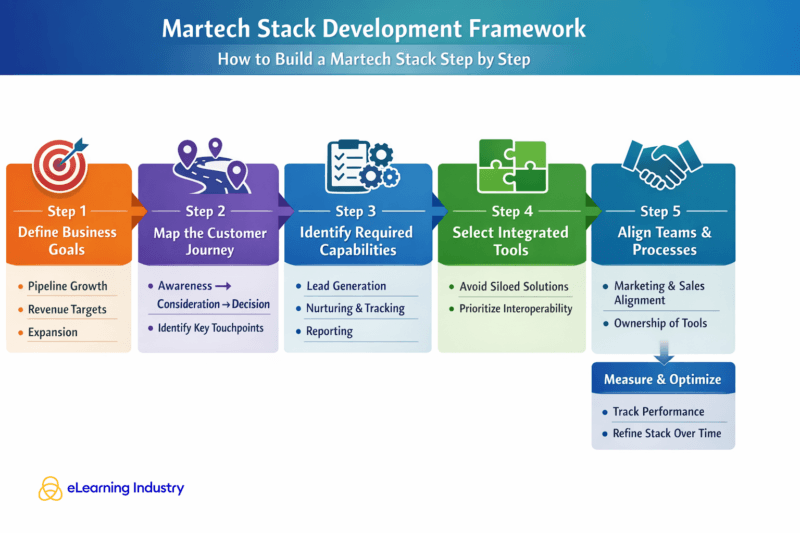
Building a MarTech stack requires a disciplined, strategy-first approach. Experts recommend a six-step progression:
- Define Business Goals: Start with the desired outcome—whether it is reducing Customer Acquisition Cost (CAC), accelerating pipeline growth, or improving customer lifetime value.
- Map the Customer Journey: Identify every touchpoint a prospect has with the brand, from the first ad click to the final contract signature.
- Identify Required Capabilities: Before looking at vendors, list the functions needed to support that journey (e.g., "We need a way to track webinar attendance and automatically trigger a follow-up email").
- Audit Existing Tools: Evaluate current software for redundancy or gaps.
- Select for Interoperability: Prioritize tools that offer robust APIs or native integrations with the existing CRM.
- Continuous Optimization: A stack is never "finished." It requires regular auditing to ensure tools are being used to their full capacity and still align with business goals.
The Role of External Platforms in the Modern Ecosystem
A significant shift in MarTech strategy is the recognition that a stack is not comprised solely of internal tools. External platforms—such as industry-specific ecosystems, lead generation sites, and third-party data providers—are increasingly viewed as extensions of the internal stack.
While internal tools manage the data, external platforms provide the audience. For example, a company in the Learning and Development (L&D) space might integrate their CRM with an external platform like eLearning Industry. This allows them to tap into a pre-existing audience of high-intent buyers, feeding the internal demand generation layer with qualified leads that are already further along in the consideration stage. This "hybrid" approach—combining internal infrastructure with external reach—is often the fastest way to scale visibility and ROI.
Broader Implications and Economic Impact
The move toward more structured MarTech stacks is happening against a backdrop of economic scrutiny. With marketing budgets facing increased pressure, the focus has shifted from "growth at any cost" to "efficient growth." This has led to a period of SaaS consolidation, where companies are cutting underutilized tools in favor of comprehensive platforms that offer multiple functionalities.
Furthermore, the rise of privacy regulations, such as GDPR and CCPA, has made the data management layer of the MarTech stack more critical than ever. Organizations must now ensure that their technology not only drives growth but also maintains rigorous standards for data security and consumer privacy.
In conclusion, the MarTech stack has transitioned from a collection of "nice-to-have" digital tools to a vital strategic asset. The organizations that will thrive in the coming decade are those that view their technology as a unified infrastructure designed for scalability, alignment, and long-term demand generation. By focusing on integration, data quality, and the strategic application of AI, businesses can transform their MarTech investments into a powerful engine for sustainable revenue growth.






