A recent comprehensive study on neurodiversity in leadership reveals a striking paradox: while neurodivergent professionals are present and performing effectively across all levels of organizations, a significant majority remain largely invisible to the very systems designed to support their growth and development. This widespread phenomenon of "identity masking" not only impacts individual well-being and career progression but also represents a substantial untapped resource for organizational innovation and resilience.
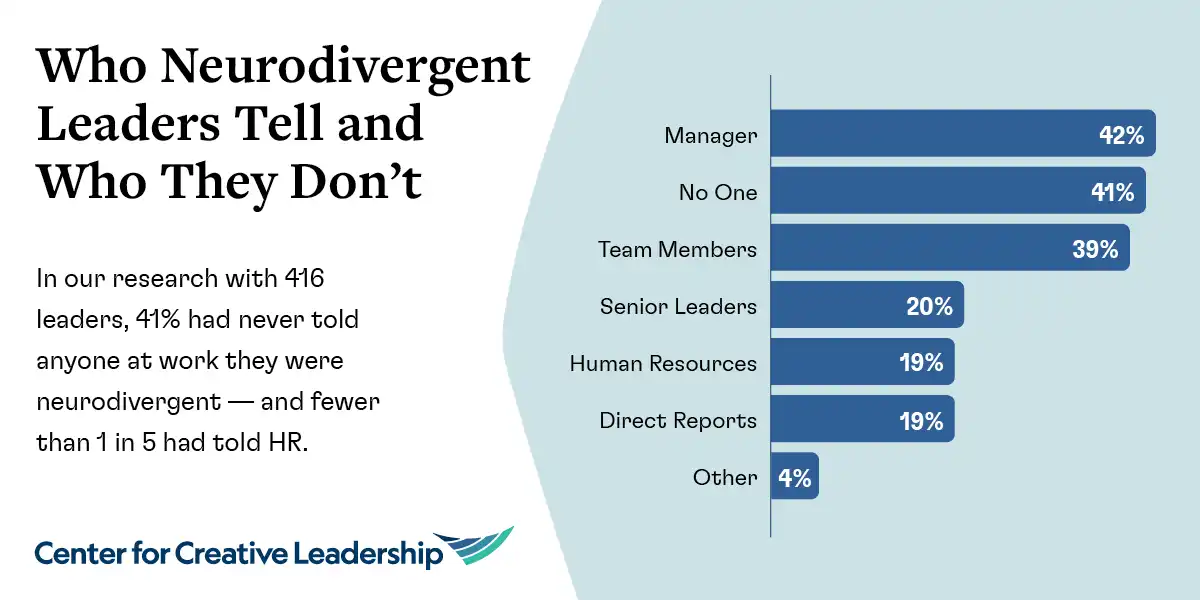
The research, conducted by the Center for Creative Leadership (CCL) and involving 416 neurodivergent professionals in leadership roles across the United States and the United Kingdom, paints a clear picture of an under-recognized segment of the workforce. A staggering 41% of these leaders reported never having disclosed their neurodivergent identity to anyone at work. Further compounding this invisibility, only 42% had confided in their direct manager, and fewer than one in five had approached human resources, the department ostensibly responsible for formal accommodations and support. Disclosure, when it occurred, most frequently happened through informal, trusted relationships, highlighting a significant gap in organizational structures designed for inclusivity.
This pervasive lack of disclosure means that organizations are often unaware of the neurodivergent talent within their ranks. This invisibility can lead to misinterpretations, with leadership teams potentially concluding that neurodivergent individuals are less interested in leadership positions or that such talent is scarce within the organization. However, the data strongly suggests otherwise: neurodivergent leaders are present, performing well, and often exceeding expectations, yet their contributions are not fully acknowledged or supported because their neurodivergent identities are concealed.
The implications of this hidden leadership are far-reaching. Organizations that underestimate the prevalence of neurodivergent leadership often make decisions about leadership development, succession planning, and inclusion initiatives based on incomplete or inaccurate assumptions. Formal processes, such as identifying high-potential employees and designing leadership development programs, tend to be built around conventional notions of leadership, inadvertently excluding or overlooking individuals who may exhibit leadership qualities in different ways. As a result, aspiring neurodivergent leaders lack visible role models, hindering their ability to envision and pursue leadership pathways that feel authentic and attainable. This absence of representation is not merely symbolic; it is a critical developmental resource that can shape career trajectories and foster a sense of belonging and possibility.
Understanding Neurodiversity: A Spectrum of Cognitive Differences
Neurodiversity, in its broadest sense, refers to the natural variation in human cognitive functioning. It acknowledges that individuals think, learn, and experience the world in diverse ways. By this definition, every workplace is inherently neurodiverse. Neurodivergent individuals are those whose cognitive processes differ significantly from what is considered typical or standard. This umbrella term encompasses a wide range of conditions, including Attention-Deficit/Hyperactivity Disorder (ADHD), autism, dyslexia, dyspraxia, dyscalculia, Obsessive-Compulsive Disorder (OCD), and Tourette syndrome, among others. Current estimates suggest that approximately 20% of the global workforce falls under the neurodivergent umbrella, making cognitive difference a fundamental characteristic of modern workforces rather than a peripheral issue.
Despite their prevalence, neurodivergent individuals often face underemployment relative to their qualifications and experience. This pattern is particularly pronounced for autistic individuals, who experience significantly lower employment rates and limited advancement opportunities. While autism garners considerable attention, conditions such as ADHD, dyslexia, and dyspraxia are more common and constitute a substantial portion of neurodivergent employees whose challenges may be less understood or acknowledged. The reasons for this disparity are complex and likely involve a combination of societal perceptions regarding support needs, documented hiring and retention gaps, and persistent stigma.
A critical aspect of understanding neurodiversity in the workplace is recognizing its inherent diversity. Neurodivergence is not a monolithic category. Diagnostic labels describe broad patterns, but the lived experience of neurodivergence is highly individual. No two people with the same diagnosis will experience it identically, and many individuals possess multiple neurodivergent conditions, such as co-occurring ADHD and autism, or dyslexia alongside other processing differences. A formal diagnosis alone rarely captures the full spectrum of an individual’s cognitive style, processing abilities, or workplace presentation.
Furthermore, the timing of diagnosis adds another layer of complexity. Many neurodivergent individuals discover their neurodivergent identities later in life, often well into their careers, while some may never receive a formal diagnosis. In the CCL study, the average age of first diagnosis was 27, with 40% of participants receiving their diagnosis after the age of 30, and many others even later. This means many leaders are navigating their professional roles and leadership expectations while simultaneously making sense of their neurodivergent identities.

Neurodivergence is increasingly understood as a social construct that encompasses formal diagnoses, self-identification, and lived experience. As awareness grows, self-identification has become more prevalent. Regardless of formal documentation, many neurodivergent individuals benefit from accommodations once they understand their needs and can access appropriate support. However, access to such support is often contingent on organizational policies, which may require formal diagnoses as the sole gateway to flexibility. This approach risks overlooking numerous neurodivergent employees and leaders who are already contributing significantly to their organizations. Consequently, a nuanced understanding of neurodivergence in the workplace necessitates acknowledging its scale, its profound diversity, and the persistent disparities in employment outcomes.
The Hidden Costs of Unseen Leadership
The invisibility of neurodivergent leaders carries significant organizational consequences. When the presence and capabilities of neurodivergent leaders are underestimated, decisions regarding leadership development, talent management, and inclusive practices are often misinformed. High-potential identification processes, leadership training programs, and promotion criteria are frequently designed with implicit biases that favor conventional leadership styles, overlooking individuals who may not fit the established mold. This can create a self-perpetuating cycle where neurodivergent talent is less likely to be recognized, developed, or advanced.
Moreover, the lack of visible neurodivergent role models at higher levels of leadership can stifle the aspirations of emerging neurodivergent talent. When individuals do not see people like themselves in leadership positions, it becomes more challenging to envision their own leadership futures. Representation is therefore not just a matter of diversity metrics; it is a crucial developmental resource that can illuminate attainable pathways to success and foster a sense of belonging and authenticity.
Research Insights: The Leadership Experience of Neurodivergent Professionals
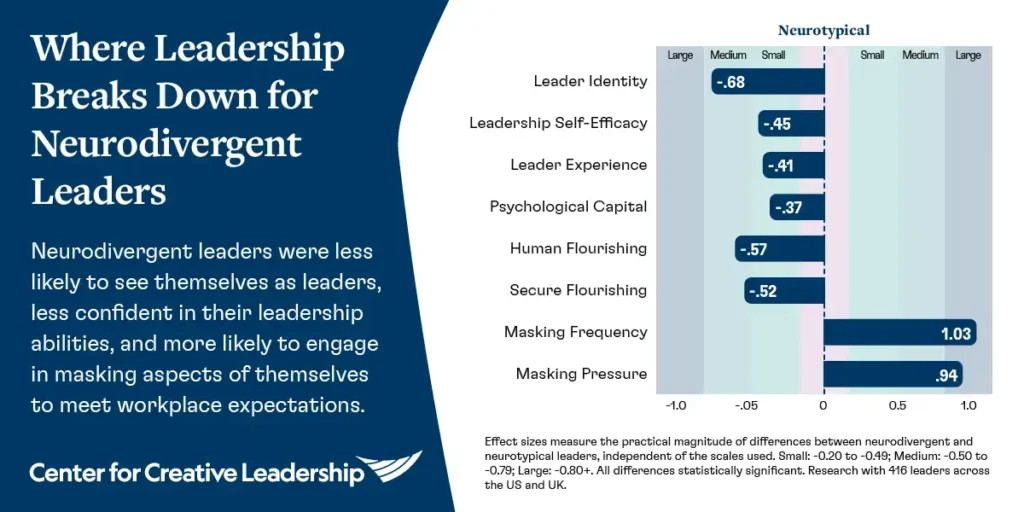
The CCL research delved into several key aspects of the leadership experience for neurodivergent professionals, revealing consistent patterns that highlight the challenges they face. Across measures of leadership self-perception, well-being, and the practice of masking (consciously or unconsciously suppressing aspects of oneself to conform to workplace expectations), neurodivergent leaders consistently reported experiences that made leadership more difficult to internalize and sustain, even when their performance was strong.
A significant finding was that neurodivergent leaders were less likely to view themselves as leaders and expressed lower confidence in their leadership abilities. This phenomenon occurred despite nearly all participants holding leadership positions and often performing at high levels. The disconnect between capability and self-perception appears to stem from environments that do not consistently recognize or validate their leadership contributions.
Many organizations tend to define and recognize leadership through a narrow set of observable behaviors. These often include verbal assertiveness in group settings, comfort with ambiguous social interactions, and proactive self-promotion or networking styles. When these behaviors become the primary indicators of leadership potential, individuals who communicate or engage differently may not receive the same confirming feedback, access to challenging assignments, or sponsorship opportunities, even when their performance is exemplary. Over time, this can lead to a diminished sense of ownership over their leadership roles. When leaders do not see individuals like themselves acknowledged as leaders, or when their unique contributions are not explicitly valued as leadership, their confidence erodes. Leadership then becomes something they perform, rather than something they fully embody and claim.
Masking and Psychological Safety: The Unseen Burden
One of the most pronounced differences observed between neurotypical and neurodivergent leaders was the prevalence of masking. For many neurodivergent individuals, leading effectively involves an ongoing, often invisible, effort to suppress or conceal aspects of their neurodivergent traits to align with perceived workplace norms. Masking was reported as a routine practice for neurodivergent leaders, and it was closely correlated with lower levels of well-being and diminished psychological resources over time.
This phenomenon is fundamentally a matter of psychological safety. When leaders do not feel secure in the expectation that their authentic working styles will be accepted or understood, they resort to compensation mechanisms like masking. While masking may enable them to perform and meet expectations, it comes at a significant cost. It requires constant self-monitoring, limits access to genuine support, and diverts energy that could otherwise be dedicated to learning, growth, and innovation. Individuals do not typically choose to mask; rather, it is an adaptation to environments where they perceive it is unsafe to lead as themselves. High rates of masking strongly suggest that prevailing leadership norms leave little room for cognitive diversity.
Research consistently indicates that a leader’s demeanor and the extent to which their team members feel psychologically safe are more impactful on career outcomes than formal accommodations alone. Creating psychologically safe conditions involves consistent behaviors that clarify expectations, invite diverse forms of contribution, acknowledge mistakes, and ensure that participation is not dictated by who speaks first or loudest.
Well-being and Sustainability: The Quiet Burnout of Capable Leaders
The cumulative burden of masking, coupled with inconsistent reinforcement of their leadership, creates a precarious situation for the sustainability of neurodivergent leaders. Even when their performance remains strong, the continuous effort required to adapt to their environment depletes essential leadership resources, such as relational energy, resilience, and psychological capital. This puts organizations at risk, as leaders who appear to be functioning well may be the most vulnerable to disengagement or departure. They can become worn down by an environment that makes sustained leadership more challenging, despite their commitment and potential.
The structure, support, and reward systems for leadership roles play a far more significant role in these outcomes than an individual’s inherent resilience or self-management skills. To foster sustainability, organizations must examine the systemic factors that contribute to this quiet burnout. This includes designing work environments that inherently accommodate a broad range of cognitive styles, providing clear agendas, structured feedback mechanisms, and flexible participation formats to minimize unnecessary strain and reduce the need for masking.
The Strategic Advantage of Neuroinclusive Leadership
Embracing neuroinclusion is not merely an ethical imperative; it is a strategic talent and performance imperative. Organizations that cultivate neuroinclusive cultures reap benefits that extend far beyond individual employees. Cognitively diverse teams are demonstrably better at approaching problems from multiple angles, leading to more innovative and effective solutions, often generated more rapidly. When individuals can contribute authentically without expending energy managing their presentation, engagement and retention rates improve. Across various functions, organizations build stronger capabilities for complex problem-solving, foster greater innovation, and enhance overall productivity.
The reality is that most leaders, regardless of their neurotype, are already leading neurodiverse teams, often without full awareness. This underscores the importance of neuroinclusive leadership as a core organizational capability, not a niche concern. Equipping leaders with the skills to recognize and effectively collaborate across cognitive differences represents a high-leverage investment. When leaders create clarity, structure, and psychological safety, performance improves, and the toll on leaders who may not fit conventional norms is significantly reduced.
Neurodivergent leaders are already making substantial contributions, delivering results, and frequently exceeding expectations. However, many advance without adequate recognition, plateau in roles that fail to leverage their full potential, or depart organizations where their unique strengths are misunderstood or overlooked. Simultaneously, individuals with the potential to excel in leadership may never pursue it, or are prematurely screened out, because their communication or working styles do not align with traditional leadership expectations.
To address this, leadership systems must be fundamentally redesigned to identify, develop, and sustain talent effectively. By creating more neuroinclusive environments, organizations can broaden the pipeline into leadership roles, increasing the identification of high-potential individuals, expanding access to development opportunities, and encouraging more diverse candidates to step into leadership positions. This not only strengthens the overall leadership pipeline but also enhances organizational agility and adaptability.
In an era defined by uncertainty and rapid change, a broader mix of leaders, equipped with a more expansive range of perspectives, is a critical strategic asset. Such leaders are better prepared to navigate complexity, respond effectively to unexpected challenges, and identify opportunities that others might miss.
Moving Forward: Cultivating Leadership for Cognitive Diversity
Leadership is inherently a social and relational endeavor. It thrives on recognition, trust, and environments where individuals feel safe to lead authentically. Organizations that intentionally design their leadership systems to accommodate a variety of cognitive styles are not only fostering a more inclusive workplace but also expanding their long-term leadership capacity and creating conditions where more individuals can contribute at their highest potential. This proactive approach ensures that leadership development is not about fitting a predefined mold, but about nurturing the diverse talents that drive organizational success.
The ongoing research into neurodiversity in the workplace continues to uncover critical insights. Organizations seeking to stay at the forefront of inclusive leadership practices are encouraged to engage with these findings and implement strategies that support a broader range of cognitive styles, ultimately building a more resilient, innovative, and effective workforce for the future.