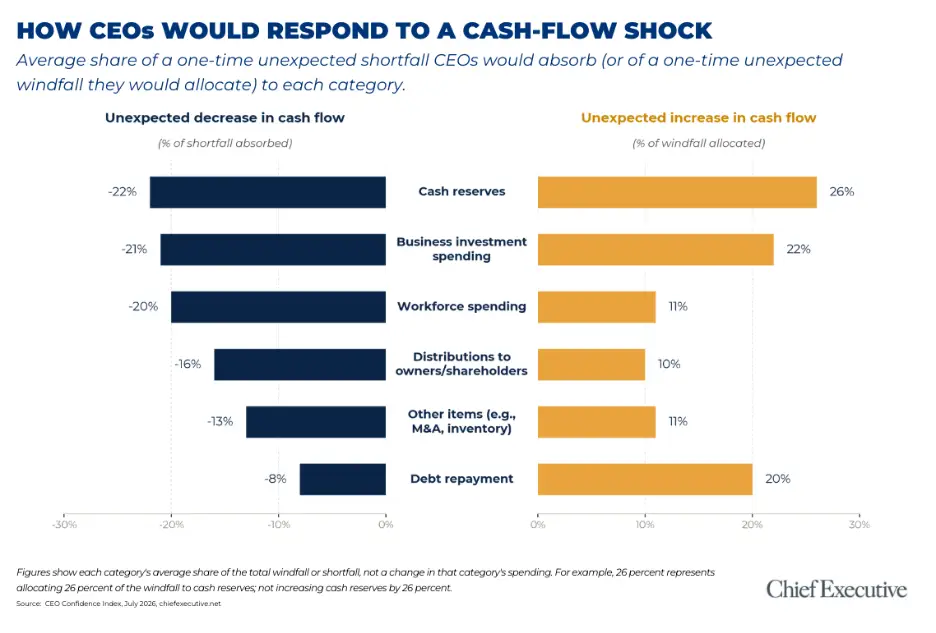
A groundbreaking study by Chief Executive Research has illuminated the often-unseen behavioral reflexes of American business leaders when confronted with sudden shifts in corporate liquidity. The research, which surveyed 321 U.S. CEOs, delves into how these executives would react to unexpected windfalls or shortfalls in cash flow, revealing that their instincts are not always aligned with conventional expectations. The findings carry significant implications for individual business resilience and the broader economic landscape, particularly during periods of heightened financial volatility.
The study, conducted in early July, presented CEOs with hypothetical scenarios involving one-time, unexpected changes in cash flow – either positive or negative – equivalent to 5 percent, 10 percent, or 20 percent of their company’s annual revenue. Crucially, these scenarios were designed to isolate instinctive reactions from performance-driven decisions, serving as a direct test of leadership reflexes in the face of liquidity fluctuations.
"For CEOs, the first response to a cash-flow shock is often straightforward," the study notes. "The harder question is how long the balance sheet can absorb it." This sentiment underscores the critical nature of liquidity management, a topic that, despite its vital importance, remains under-examined in leadership studies. The implications extend beyond individual firms; understanding these collective reactions is paramount when considering the potential for synchronized corporate responses to liquidity crunches, a phenomenon observed during events like the COVID-19 pandemic and the 2008-2009 financial crisis.
Dr. Damjan Pfajfar, who leads the Center for Inflation Research at the Federal Reserve Bank of Cleveland, commented on the study’s significance. "This shortfall scenario helps show which levers companies would pull when cash tightens – whether they draw down reserves, reduce spending, slow debt repayment, or turn to borrowing," he stated in a release provided to Chief Executive Group Research. "This data provides useful information about the margins of adjustments and the role of the financial sector in smoothing short-term shocks." His remarks, made prior to a Federal Reserve blackout period, highlight the potential relevance of these findings for monetary policy and financial stability analysis.
Ownership Structures Drive Divergent Responses
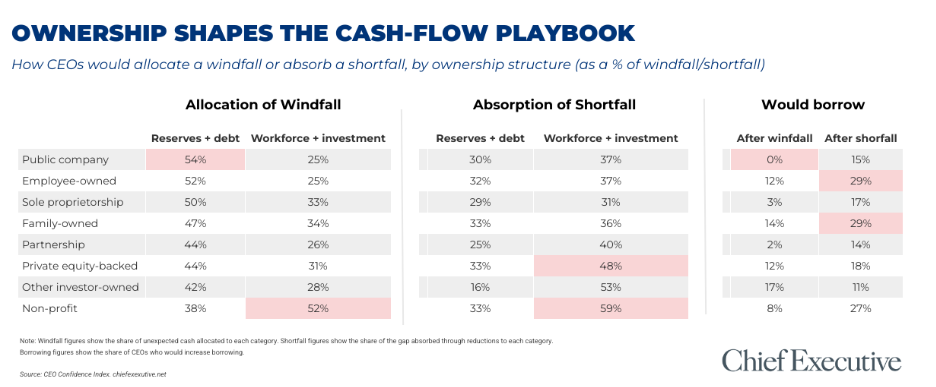
One of the most striking revelations from the Chief Executive Research study is the profound influence of a company’s ownership structure on its CEO’s liquidity management strategy. The research found that the response to both positive and negative cash flow shocks varied significantly based on whether a company was a non-profit, publicly traded, private equity-backed, family-owned, or a partnership/sole proprietorship.
Non-profit organizations emerged as the most growth-oriented entities in the survey. Their CEOs indicated a willingness to allocate 52 percent of any cash windfall towards workforce spending and business investment combined – a higher proportion than any other ownership type. Conversely, when faced with a cash shortfall, these organizations would absorb 59 percent of the impact through reductions in the same two categories. Researchers suggest this might stem from the absence of shareholder distributions, compelling non-profits to manage adjustments primarily through operational changes rather than impacting external stakeholders or debt obligations.
At the opposite end of the spectrum, public companies demonstrated a more conservative approach. Their CEOs reported directing 54 percent of a windfall towards cash reserves and debt repayment, the highest percentage among all ownership types. Notably, none of the public company CEOs surveyed indicated they would increase borrowing following a cash windfall. Furthermore, only 15 percent stated they would borrow to cover a shortfall, a figure below the overall survey average. This suggests a preference for internal liquidity management and deleveraging when additional cash becomes available.
Private equity-backed companies, often perceived as aggressive in their capital deployment, showed a more nuanced response. CEOs of these firms indicated they would allocate 31 percent of a windfall to workforce spending and business investment, a figure comparable to several other ownership types. However, they distinguished themselves in their response to shortfalls. PE-backed companies would reduce distributions to owners by a mere 5 percent of a shortfall, the least of any ownership type. In contrast, family-owned companies, partnerships, and sole proprietorships indicated a significantly higher reduction in distributions, averaging 22 percent across these categories. This suggests that PE-backed firms may prioritize maintaining distributions to investors even during leaner periods, potentially by drawing on other internal resources or delaying other forms of adjustment.
Balancing Immediate Needs with Long-Term Viability
Across all ownership types, the study identified a general tendency towards balanced allocation strategies, particularly when faced with a cash shortfall. When presented with additional cash, CEOs reported plans to direct approximately 46 percent towards cash reserves and debt repayment, with roughly one-third (32 percent) allocated to business investment and workforce spending. This indicates a dual focus on strengthening the company’s financial foundation while also investing in future growth and human capital.
The response to a cash deficit paints an even clearer picture of this balancing act. Rather than sacrificing one area entirely, CEOs indicated they would absorb a shortfall through a more evenly distributed reduction across cash reserves, business investment, and workforce spending. Debt repayment emerged as the least affected lever, with only an 8 percent reduction. This suggests that preserving debt servicing capabilities is a high priority, likely to avoid jeopardizing the company’s creditworthiness and long-term financial stability.
Maurice Ware, president and CEO of Kenneth Young Center, a provider of behavioral health and older adult services who participated in the study, echoed this sentiment. "In either scenario, my approach would be to balance immediate cash discipline with long-term sustainability," Ware stated. "The goal would be to protect the mission, stabilize operations, invest where there is measurable return, and avoid decisions that solve a short-term issue while creating a larger structural problem later." His perspective highlights the strategic thinking involved in liquidity management, emphasizing resilience and future-proofing.
The Critical Role of Liquidity Buffers
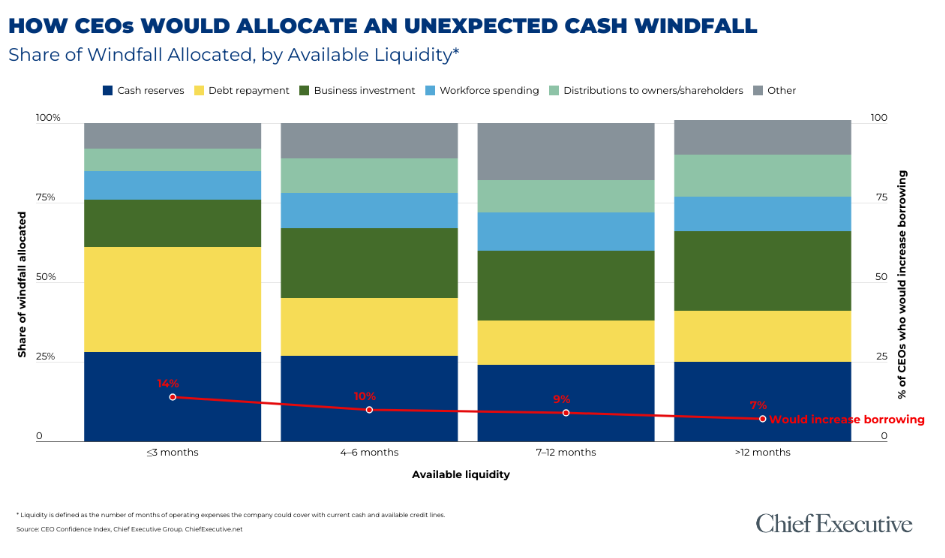
The study also underscored the critical role of a company’s existing liquidity buffer in shaping its response to cash flow shocks. CEOs who anticipated an economic recession or slowdown in the coming months indicated a greater inclination to allocate 52 percent of a windfall to reserves and debt repayment, compared to 44 percent among those expecting economic growth. This defensive posture intensifies when a company’s financial cushion is thin.
Roughly a quarter of the CEOs surveyed reported having three months or less of operating runway, defined by current cash and available credit lines. This liquidity constraint emerged as one of the most significant dividing lines in how CEOs would react to a shortfall.
For CEOs with a limited cash cushion (three months or less), a cash windfall would be predominantly directed towards reserves and debt repayment (61 percent). In stark contrast, companies with more substantial liquidity buffers (four to twelve months or more) would allocate a smaller portion, closer to 38 to 45 percent, to these same uses. Debt reduction accounted for a significant portion of this gap, with thin-cushion CEOs directing 33 percent of a windfall toward repayment, roughly double the share seen among those with seven or more months of liquidity.
When facing a shortfall, the impact on workforce spending was also more pronounced for companies with thinner liquidity. These CEOs would absorb approximately one-quarter of the shortfall through reduced workforce spending, compared to 15 percent among those with more than a year of runway. Furthermore, a substantial 43 percent of thin-cushion CEOs indicated they would borrow to cover a gap, a stark contrast to the mere 8 percent of the most liquid companies who would consider such a measure.
One CEO participating in the study articulated this liquidity discipline as a direct enabler of operational flexibility. "We would use a cash-flow windfall to strengthen growth capacity, but not at the expense of liquidity," the executive stated. "For our business, the biggest constraint is not demand alone; it is the ability to carry the right inventory, protect product quality, support dealers, and manage input-cost volatility without overextending." This perspective emphasizes that adequate liquidity is not just about survival but also about enabling strategic investments and weathering operational challenges.
Borrowing: A Last Resort for Most
The research clearly indicates that borrowing is generally viewed as a last resort, particularly when cash flow is increasing. Only 10 percent of CEOs reported that they would increase borrowing following an unexpected cash increase. For those who would, it is often viewed as a strategic move to support larger investments or capitalize on growth opportunities.
The reluctance to borrow significantly diminishes when faced with a cash shortfall. More than double that share – 22 percent – indicated they would increase borrowing to cover a deficit. This figure also escalates with the magnitude of the shock: 17 percent for a 5 percent shortfall, 22 percent for a 10 percent shortfall, and 28 percent for a 20 percent shortfall.
Despite this increased willingness to borrow during lean times, it remains a minority response. Over 70 percent of CEOs would opt to absorb a cash shortfall through other means rather than adding to their debt burden. This reinforces the prevailing sentiment of prioritizing financial stability and avoiding increased leverage when facing uncertainty.
Company size also plays a role in shaping these responses. Mid-sized companies with revenues between $250 million and $499.9 million were the least likely to borrow to cover a shortfall, at just 5 percent. Paradoxically, these companies also allocated the largest share of a windfall to workforce spending and business investment, at 36 percent. This suggests a potential strategy of investing in growth while maintaining a conservative approach to debt.
Conversely, CEOs at larger corporations (revenues of $1 billion or more) adopted a more defensive posture. They directed 48 percent of a windfall towards reserves and debt repayment and indicated that 11 percent would borrow to cover a shortfall. This highlights a potential strategy of maintaining substantial liquidity reserves as a buffer against economic downturns.
James Loftis, Jr., CEO of Loftis/Robbins, a machining manufacturer in Alabama, expressed a preference for robust financial health. "I prefer my company is asset heavy / cash heavy," Loftis stated. "I only borrow money based on two scenarios: opportunity and debt recovery calculations." His philosophy aligns with the study’s findings, emphasizing strategic borrowing tied to specific, high-return opportunities rather than operational necessity.
The Chief Executive Research study provides a valuable lens through which to understand the complex decision-making processes of American business leaders. The nuanced responses, heavily influenced by ownership structure, existing liquidity, and economic outlook, offer critical insights for policymakers, financial institutions, and business strategists aiming to navigate an increasingly unpredictable economic environment. The consistent emphasis on balance, resilience, and strategic capital allocation, even under duress, underscores the adaptive capabilities of U.S. corporate leadership.