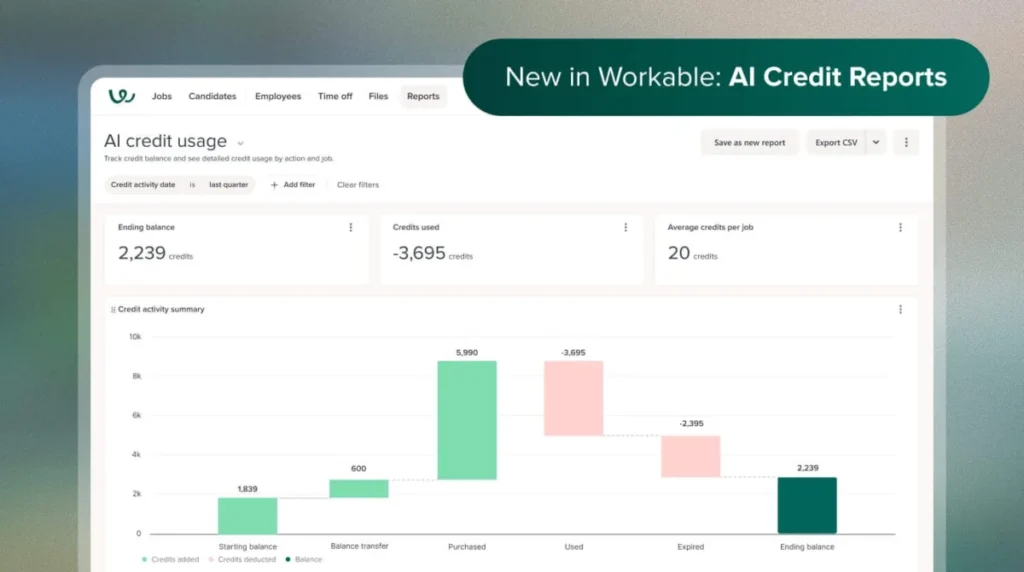
Account administrators leveraging Workable’s robust recruitment platform can now access an unprecedented level of detail regarding their Artificial Intelligence (AI) credit consumption. The company has officially launched a comprehensive AI credits report, designed to provide meticulous insights into the lifecycle of AI credits within an organization’s Workable account. This innovative reporting tool offers a transparent view of purchased credits, actual usage patterns, expired credits, and critically, identifies the specific jobs and activities that are driving AI-related expenditure. Integrated seamlessly into Workable’s existing suite of Recruiting reports, this new functionality is available on every plan without any additional setup, marking a significant step towards empowering organizations with granular control over their AI investments.
The Evolving Landscape of AI in HR and the Imperative for Transparency
The integration of Artificial Intelligence into human resources and recruitment processes has rapidly transitioned from a nascent concept to an indispensable operational reality for countless organizations worldwide. Over the past five years, AI-powered tools have permeated nearly every facet of talent acquisition, from automating initial candidate screening and optimizing job descriptions for wider reach, to streamlining interview scheduling and personalizing candidate communications. This proliferation of AI solutions promises enhanced efficiency, reduced time-to-hire, and improved candidate quality, fundamentally reshaping how companies attract and secure talent in an increasingly competitive global talent market.
However, the rapid adoption of AI has also introduced new complexities, particularly concerning cost management and return on investment (ROI). Many cutting-edge AI services, including those integrated into sophisticated platforms like Workable, operate on a credit-based consumption model. This model typically ties usage to specific computational tasks, API calls, or feature activations, such as generating AI-enhanced job descriptions, performing automated resume analysis, or leveraging predictive analytics for candidate matching. While offering flexibility and scalability, this model can make it challenging for organizations to accurately track and attribute costs without dedicated tools. Prior to this release, account administrators often faced a significant hurdle in understanding the precise flow of these credits – how they were being utilized across different departments, projects, or even individual job requisitions. This lack of granular visibility frequently led to budgeting inaccuracies, unexpected expenses, or, conversely, the underutilization of valuable AI capabilities because their cost-effectiveness could not be clearly demonstrated. Without clear data, justifying further investment or optimizing current spend became a significant challenge for HR and finance departments alike.
Workable, recognized as a leading Applicant Tracking System (ATS) and recruitment software provider, has been at the forefront of integrating intelligent automation to empower its users. Its commitment to enhancing the recruiter experience and optimizing hiring outcomes has naturally led to the incorporation of various AI-driven features. The introduction of this dedicated AI credits report is a direct response to the growing demand from its enterprise and mid-market clients for greater financial transparency and strategic control over these advanced functionalities. It addresses a critical pain point that has emerged as AI tools become more deeply embedded in daily recruitment workflows, underscoring Workable’s dedication to not just providing innovative tools, but also ensuring their effective and accountable management.
Chronology of AI Integration and the Genesis of the Reporting Tool
Workable’s journey into AI integration began several years ago, aligning with broader industry trends towards intelligent automation in HR technology. Initially, AI functionalities were introduced to address specific pain points in the recruitment funnel, such as optimizing job ad reach, suggesting relevant candidates, and automating routine tasks to free up recruiters’ time for higher-value activities. These early iterations, while highly beneficial, operated largely as embedded features without explicit, detailed cost breakdowns at a granular level visible to administrators. The focus was primarily on feature delivery and immediate efficiency gains.
As Workable’s AI capabilities expanded and client adoption grew, particularly over the past two years, the need for enhanced visibility into AI consumption became increasingly apparent. Feedback from account administrators and financial controllers highlighted a critical gap: while the benefits of AI were clear, the ability to budget, track, and justify the expenditure on a per-feature or per-job basis was limited. This became particularly crucial for larger organizations managing numerous recruitment initiatives simultaneously, where understanding the efficiency of AI spend across diverse teams and projects was paramount for strategic resource allocation.
The development of the AI credits report can be traced back to late 2025, following a comprehensive analysis of user feedback, market trends, and internal data on AI feature usage. The goal was to build a reporting mechanism that was not only accurate but also intuitive and actionable, fitting seamlessly into the existing Workable analytics ecosystem. The development team prioritized a solution that could track the full lifecycle of a credit – from its initial purchase, through its allocation and consumption, to its potential expiration – and attribute this usage to specific operational contexts. The new report, officially rolled out recently in September 2026, represents the culmination of these efforts, providing a sophisticated yet user-friendly tool for managing AI investments strategically and transparently.
Detailed Features and Functionality: A Deep Dive into AI Credit Management
The newly launched Workable AI credits report provides account administrators with an unparalleled ability to monitor and manage their AI resources. This dedicated report, now accessible within the Recruiting reports section, offers a comprehensive picture of credit balance and consumption, meticulously broken down by job, action, and time.
Seeing Your Balance Move, Start to Finish:
One of the core functionalities of this report is its ability to track the entire lifecycle of AI credits. Administrators can now observe the ebb and flow of their credit balance, from the initial purchase of credit bundles to their gradual consumption by various AI-driven features. The report clearly delineates how many credits have been acquired, how many have been actively used, and crucially, how many have reached their expiration date without being utilized. This end-to-end transparency is vital for strategic planning, allowing organizations to optimize future credit purchases, prevent waste from expired credits, and ensure that their investment in Workable’s AI capabilities is fully leveraged. This holistic view facilitates better forecasting and budget allocation, transforming AI credit management from a reactive task into a proactive strategic function, integral to financial health.
Knowing What’s Consuming Your Credits:
Beyond just tracking balances, the report offers deep insights into the specific AI actions that are consuming credits. This functionality is pivotal for understanding the actual utility and impact of different AI features within the Workable platform. Whether it’s AI-powered candidate sourcing for specific skill sets, automated email generation for candidate engagement, sophisticated resume parsing for efficient screening, or intelligent job description optimization for broader reach, the report clearly attributes credit usage to these distinct activities. By pinpointing which AI functionalities are being most heavily used, and by extension, generating the most value, administrators can make informed decisions about training, feature adoption, and even internal workflow adjustments. This detailed breakdown allows for a direct correlation between AI investment and operational outcomes, helping to validate the ROI of specific AI-powered recruitment strategies and ensuring resources are directed effectively.
Drilling Down to the Job Level:
A particularly powerful feature for recruitment teams is the ability to drill down into credit consumption at the individual job level. This means that an administrator can see precisely how many AI credits were expended for a specific job requisition, whether it’s for a senior software engineer position requiring extensive AI-driven sourcing or a high-volume customer service representative role benefiting from automated screening. This granular attribution is invaluable for assessing the efficiency and cost-effectiveness of AI tools in relation to particular hiring needs. For instance, if a specific job category consistently consumes a high volume of AI credits but yields suboptimal results, it prompts a re-evaluation of the AI strategies applied to that category. Conversely, if a certain type of job benefits significantly from AI-driven processes, this data can justify increased AI allocation for similar future roles, fostering a truly data-driven approach to talent acquisition.
Filtering Your Way to Insights:
To maximize the utility of the collected data, the AI credits report includes robust filtering options. Administrators can customize their views to analyze credit consumption over specific time periods (e.g., weekly, monthly, quarterly, or custom ranges), by individual job requisition, or by the type of AI action performed. This flexibility allows for dynamic analysis, enabling users to isolate trends, compare performance across different periods or job types, and identify outliers. For a multi-national corporation, filtering by department, team, or region (if Workable’s setup allows for such segmentation) could further refine insights, enabling localized optimization of AI spend and strategy. This level of customization ensures that the report serves as a versatile analytical tool, adaptable to the unique reporting needs of diverse organizations and strategic objectives.
How It Works: Seamless Integration and Immediate Accessibility
Workable has meticulously engineered the AI credits report to ensure it integrates seamlessly into the existing administrative workflow. Unlike external tools or complex setups, this report is built directly into the "Recruiting reports" section, a familiar environment for account administrators. This strategic placement means that users can access AI credit data alongside other critical recruitment metrics, fostering a holistic view of their talent acquisition performance.
The implementation is designed for immediate utility:
- No Extra Setup Required: There are no additional configurations, installations, or complicated onboarding processes. Once released, the report automatically becomes available to all account admins across every Workable plan. This plug-and-play approach ensures that organizations can instantly leverage the new insights without any operational overhead or IT intervention, accelerating time to value.
- Intuitive Interface: The report features an intuitive dashboard design, incorporating clear visualizations such as graphs, charts, and tabular data. This ensures that complex data sets are presented in an easily digestible format, allowing administrators to quickly grasp key trends and details without extensive training, thereby promoting broad adoption and efficient use.
- Consistent Experience: By embedding it within the existing reporting framework, Workable maintains a consistent user experience, reducing the learning curve and encouraging widespread adoption among administrators already accustomed to navigating the platform’s analytics. This familiar environment minimizes disruption and maximizes efficiency.
Why This Matters for Account Admins: Broader Impact and Strategic Advantages
The introduction of the AI credits report transcends mere data presentation; it fundamentally enhances the strategic capabilities of account administrators and, by extension, the entire organization.
- Unprecedented Cost Control and Budgeting Precision: For the first time, administrators have a clear, real-time understanding of their AI spend. This granular visibility allows for more accurate budgeting, preventing unexpected overruns and enabling precise allocation of financial resources. It empowers organizations to forecast future AI credit needs based on historical usage patterns, leading to more efficient financial planning and procurement processes.
- Enhanced ROI Measurement and Justification: The ability to attribute AI credit usage to specific jobs and actions provides a direct link between investment and outcome. Admins can now quantify the value derived from AI tools, demonstrating their ROI to stakeholders. For instance, if AI-powered sourcing consistently fills critical roles faster and with higher quality candidates, the associated credit cost can be easily justified against the time and resource savings, as well as the improved business outcomes. This data-driven justification is crucial for securing continued investment in HR technology.
- Optimized Operational Efficiency and Resource Utilization: By identifying which AI features are most effective and which might be underutilized or inefficient, organizations can optimize their operational strategies. This could involve re-training users on specific AI tools, reallocating AI resources to more impactful areas, or even refining recruitment workflows to maximize the benefits of AI. The report helps ensure that every credit spent contributes meaningfully to recruitment goals, enhancing overall operational efficiency.
- Data-Driven Strategic Decision-Making: The insights gleaned from the AI credits report empower administrators to make informed strategic decisions about their AI adoption journey. Should they invest more in AI for specific candidate types? Are certain AI-driven campaigns yielding better results than others? The report provides the empirical evidence needed to answer these questions, guiding the evolution of an organization’s talent acquisition strategy towards greater effectiveness and alignment with business objectives.
- Transparency and Accountability: This level of detailed reporting fosters greater transparency across the organization regarding AI investments. It allows for clearer accountability among teams and departments utilizing AI, promoting responsible usage and encouraging a more strategic approach to leveraging advanced technologies for talent acquisition.
Supporting Data: The Growing Imperative for AI Cost Management in HR Tech
The demand for such granular reporting tools is not isolated but reflects a broader trend in the HR technology landscape. According to a recent report by Grand View Research, the global HR management software market size was valued at USD 24.06 billion in 2022 and is expected to grow at a compound annual growth rate (CAGR) of 11.2% from 2023 to 2030, with AI and machine learning being significant drivers of this expansion. Within this, AI in recruitment is projected to see even faster growth, driven by its potential to address talent shortages and improve efficiency.
However, a survey by Deloitte indicated that while 70% of organizations are experimenting with or have adopted AI in HR, a significant portion struggles with measuring its effectiveness and managing its costs. Many enterprises report