The strategic alliance between Workday, a leading provider of enterprise cloud applications for finance and human resources, and Achievers, a premier employee recognition and engagement platform, marks a significant evolution in the landscape of human capital management. This partnership, culminating in the integrated offering known as Workday Recognition provided by Achievers, aims to embed appreciation directly into the fabric of daily work, transforming employee recognition from a standalone program into a continuous, data-driven habit.
The Problem: A Crisis of Appreciation in the Modern Workforce
In today’s dynamic work environments, the effectiveness of employee partnerships often hinges on fundamental questions: Will this solution genuinely scale across diverse global teams? Will employees embrace it organically? Can it seamlessly integrate within complex organizational structures? Most critically, will it enhance the employee experience or merely add another layer of complexity? These inquiries frequently lead to a sobering realization: a pervasive lack of genuine appreciation among employees.
According to the Achievers Workforce Institute (AWI) 2026 Engagement and Retention Report, a stark 75% of employees report not feeling genuinely appreciated at work. This sentiment directly correlates with engagement levels, as only 26% of respondents describe themselves as truly engaged. The report further underscores the severity of this issue, revealing that nearly two-thirds of employees would contemplate returning to a former employer if it meant regaining a sense of value and recognition. These figures are not isolated; they echo similar findings from leading research firms like Gallup, which consistently highlight a global engagement crisis, costing the world economy trillions in lost productivity annually. The core challenge, therefore, is not a lack of intent from organizations to recognize their employees, but rather a systemic failure in ensuring that appreciation consistently reaches its intended recipients in a meaningful and impactful way. Traditional recognition programs often falter due to their peripheral nature, failing to integrate into existing workflows and daily routines.
Workday’s Strategic Imperative: Beyond Features, Towards Adoption
Recognizing this critical gap, Workday embarked on a rigorous search for a recognition partner. Their objective extended beyond merely adding another feature to their robust suite of applications. Workday sought a solution that could intrinsically align with existing work processes, support the intricate demands of enterprise-level organizations, and yet retain a deeply human touch. This meticulous evaluation process underscored Workday’s commitment to delivering holistic employee experiences that drive real business outcomes, not just standalone functionalities. The criteria were stringent, focusing on usability, scalability, security, and the potential for deep integration.
The extensive search culminated in the selection of Achievers. This decision was driven by Achievers’ proven expertise in fostering robust recognition cultures and its platform’s design philosophy, which prioritizes seamless adoption and embedded engagement. The resulting collaboration, Workday Recognition provided by Achievers, represents a partnership built on mutual trust, shared design principles, and a collective belief that recognition must transcend fleeting moments to become an integral, ongoing habit.
Introducing Workday Recognition Provided by Achievers: A Deep Integration
The prevalent challenge with employee recognition has long been its "reputation problem." While the importance of recognition is universally acknowledged, and few organizations lack the belief in its value, consistent execution remains a significant hurdle. Many recognition initiatives exist as separate programs, requiring distinct logins, separate tools, and often fading into irrelevance as employees’ daily calendars fill up. Workday understood that adding another such program would be counterproductive.
Instead, Workday sought a recognition solution that employees would intuitively use, without constant prompting, reminders, or nudges. This is where Achievers distinctly stood out. At the core of the Achievers platform is social recognition, serving not as an optional add-on but as the fundamental engine of engagement. This peer-to-peer, frequent, and highly visible recognition mechanism is crucial for transforming appreciation into tangible behaviors, which in turn shape and reinforce positive company culture. When recognition is effortlessly accessible and inherently social, it ceases to feel like an administrative task. It evolves into a natural acknowledgment of contributions, a seamless integration of appreciation into the flow of work itself. This distinction is paramount, as true adoption is not enforced by mandates but cultivated through natural, repeatable moments that genuinely resonate with employees.
Designing for the Modern Enterprise: Complexity, Scalability, and User Experience
Modern organizations are inherently complex, characterized by hybrid teams, globally distributed workforces, and matrixed roles that often span multiple departments and geographies. Employees may be frontline, deskless, or remote, sometimes all within the same company. For recognition to be truly effective, it must operate with the same fluidity and adaptability as the work itself. This understanding is central to the Workday-Achievers partnership, which extends far beyond a superficial integration.
Workday Recognition provided by Achievers is not merely compatible; it is co-developed and certified to reside deeply within the Workday experience. This means recognition does not exist in a separate system, awaiting a moment of recollection. Instead, it appears precisely where employees are already working, during the moments when contributions are being made, and when appreciation holds the greatest relevance and impact. This deep embedding translates not just to convenience, but to critical consistency. Recognition becomes an organic part of everyday workflows, rather than another item vying for limited attention in a crowded digital ecosystem. This approach significantly reduces friction, increases accessibility, and ensures that appreciation becomes a consistent thread woven throughout the employee journey.
Meeting HR and IT Demands: Security, Compliance, and Seamless Operations
For enterprise organizations, the allure of innovative software must be tempered by stringent operational realities. The luxury of experimentation without robust guardrails is simply not an option. Security, scalability, compliance with global regulations, and the integrity of existing IT infrastructure are not mere "nice-to-haves"; they are foundational requirements. A recognition software that impresses in a demo but creates backend headaches is unsustainable for large-scale operations.
Workday’s partner ecosystem is deliberately selective, reflecting a commitment to high standards. Achievers’ role as Workday’s recognition partner is a testament to its successful navigation of a rigorous evaluation process that scrutinized not only product features but also security protocols, scalability architecture, and demonstrable customer impact. This meticulous vetting provides significant advantages for key stakeholders. For HR teams, it translates into fewer unexpected challenges, reduced vendor sprawl, and streamlined management. For IT departments, it guarantees certified integrations that are designed to perform reliably at scale, mitigating risks of system instability or security vulnerabilities. Ultimately, for the entire organization, this means a recognition solution that integrates cleanly into existing systems, avoiding the complexity and administrative burden of managing yet another exception. This adherence to enterprise-grade standards ensures that the recognition program is not just effective, but also operationally sound and secure.
From Feel-Good to Factual: Leveraging Recognition Data for Organizational Intelligence

While recognition is intrinsically powerful as a morale booster, its true potential is unlocked when it integrates seamlessly with the broader HR ecosystem. Within the Workday environment, recognition transcends being merely a "feel-good moment" to become a potent source of organizational intelligence. This integration transforms recognition data into actionable insights, providing a real-time pulse on employee contributions, cross-functional collaboration, and the manifestation of core values.
Imagine the analytical possibilities:
- Identifying high-impact individuals and teams: By tracking who is recognized, by whom, and for what, organizations can pinpoint key contributors and collaborative hubs.
- Understanding skill development: Recognition often highlights informal skills and competencies (e.g., mentorship, problem-solving, innovation) that may not be captured in formal performance reviews or HRIS data.
- Gauging cultural health: Consistent recognition aligned with company values provides tangible evidence of culture in action.
- Predictive analytics for retention: A dip in recognition for an individual or team could serve as an early warning signal for potential disengagement or turnover risk.
- Informing talent mobility and development: Understanding patterns of recognition can help identify employees ready for new challenges or specific training needs.
This robust data integration shifts recognition from a qualitative "culture initiative" to a quantitative engine of organizational intelligence, grounded in actual employee behavior rather than assumptions or anecdotal evidence. Crucially, because this recognition data flows through the same Workday system that leaders already utilize for other HR functions, accessing these insights requires no additional effort. The intelligence is readily available, waiting to be leveraged for more informed decision-making across talent management, workforce planning, and strategic HR initiatives.
Transforming Key HR Moments: Practical Applications of Integrated Recognition
The profound value of deep integration often becomes most apparent in the seemingly small, everyday moments that collectively shape the employee experience. Workday Recognition provided by Achievers fundamentally transforms several critical HR interactions:
-
Performance Conversations That Feel More Human and Evidence-Based: Traditional performance reviews often rely on managers’ fallible memories or a few cherry-picked highlights from the past quarter. With integrated recognition, employees and managers can bring specific, real-time recognition moments directly into feedback and performance discussions. This provides concrete examples of impact, fostering more objective, richer, and ultimately more human conversations, reducing guesswork and increasing fairness. It allows for a continuous feedback loop that aligns with modern performance management philosophies.
-
Skills and Strengths Made Visible Beyond Formal Metrics: Job descriptions and formal skill matrices often fail to capture the full spectrum of an employee’s contributions. Recognition, particularly peer-to-peer, frequently highlights crucial behaviors such as mentoring colleagues, demonstrating exceptional collaboration, proactively solving complex problems, or embodying company values. When these recognition moments are connected to skills data within Workday, leaders gain a far richer, more dynamic picture of how work truly gets done and where latent talents reside within their workforce. This can inform talent development, succession planning, and internal mobility strategies.
-
Global Recognition Without Global Complexity: In multinational enterprises, ensuring equitable and effective recognition across diverse cultures and geographies can be a logistical nightmare, riddled with currency conversions, tax implications, and varied cultural norms for rewards. With Workday Recognition provided by Achievers, global rewards and payroll alignment are handled seamlessly behind the scenes. This robust backend infrastructure frees organizations to focus on the meaning and impact of recognition, rather than getting bogged down in administrative complexities. It ensures that every employee, regardless of location, can experience appreciation in a fair, consistent, and culturally appropriate manner. These seemingly small improvements, taken together, represent a significantly enhanced employee experience and more efficient HR operations.
Industry Resonance: What This Partnership Signifies for the HR Tech Landscape
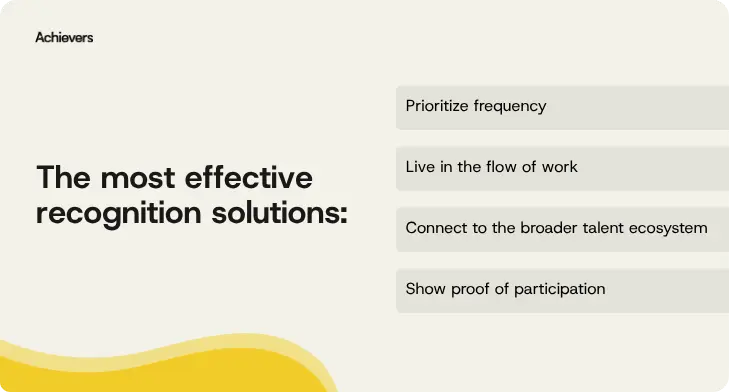
Workday’s deliberate choice of Achievers offers a valuable blueprint for HR and business leaders currently evaluating recognition solutions. It signals a clear shift in market expectations. The most effective recognition solutions in the modern era share several non-negotiable traits:
- Deep Integration: They are not standalone tools but are embedded within core HR platforms, ensuring accessibility and reducing friction.
- Employee-Centric Design: They prioritize ease of use and social interaction, making recognition intuitive and enjoyable.
- Enterprise-Grade Capabilities: They meet rigorous standards for security, scalability, and compliance, essential for large, complex organizations.
- Data-Driven Insights: They transform recognition events into actionable data that informs broader HR and business strategy.
- Global Scalability: They accommodate diverse workforces and regulatory environments without adding administrative burden.
Recognition solutions that embody these criteria do not require constant internal marketing or cajoling. They inherently earn their place by proving their utility and becoming an indispensable part of daily operations. This partnership sets a new benchmark for how HR technology should integrate, moving away from fragmented systems towards a unified, intelligent ecosystem that prioritizes the employee experience and delivers measurable business value. It signals a maturation of the HR tech market, where deep, certified integrations are becoming table stakes for impactful solutions.
A Playbook for Leaders: Cultivating a Culture of Continuous Recognition
While technology provides the platform, a thriving recognition culture is ultimately built through consistent leadership and repeatable behaviors. Leaders play a pivotal role in making recognition stick:
- Lead by Example: Actively and visibly recognize team members, peers, and cross-functional partners. Show, don’t just tell, that recognition is valued.
- Be Specific and Timely: Don’t just say "good job." Detail what was done well, why it mattered, and what impact it had. Deliver recognition as close to the event as possible.
- Encourage Peer-to-Peer Recognition: Foster an environment where employees feel empowered and encouraged to recognize each other, creating a network of appreciation that extends beyond hierarchical lines.
- Connect Recognition to Values and Goals: Link acts of recognition to specific company values or strategic objectives. This reinforces desired behaviors and clarifies their importance.
- Utilize Recognition Data: Regularly review recognition trends within your team or department. Use these insights to identify strengths, address gaps, and inform coaching conversations.
- Make it Public (where appropriate): Public recognition amplifies its impact, reinforces positive behaviors for others, and builds a culture of transparency and shared success.
Recognition cultures are not accidental occurrences; they are meticulously constructed through these small, consistent actions that reinforce a sense of value and belonging.
The Broader Vision: Workday, Achievers, and the Future of Employee Experience
At its core, the Workday–Achievers partnership is founded on a deep respect for people’s time, an acknowledgment of organizational complexity, and an understanding of the realities of modern work. Most leaders are not seeking another system to manage; they are looking for fewer obstacles between their intentions and meaningful action. Recognition thrives when it seamlessly integrates into how work already happens, rather than demanding employees and managers to remember an additional task, log into yet another platform, or follow an entirely new process.
This is why recognition is most effective when it is:
- Embedded: Living directly within existing workflows and platforms like Workday.
- Effortless: Requiring minimal effort to give or receive, making it a natural part of daily interactions.
- Impactful: Delivering meaningful appreciation that resonates with employees and provides actionable insights for the organization.
Workday’s decision to partner with Achievers was not about augmenting its offerings with just another feature. It was a strategic move to support a recognition solution capable of scaling connection, insight, and performance across an enterprise, all while preserving its fundamental humanity. For HR and business leaders, this means a shift in focus: recognition becomes less about the administration of a program and more about proactively shaping the day-to-day experience of work. It evolves into a reliable signal that employees can trust, a natural tool that managers can leverage, and a rich source of learning that organizations can tap into without introducing complexity or administrative burdens. When recognition is deeply woven into the fabric of daily work, culture ceases to be an abstract concept. It becomes a tangible, felt experience that permeates every interaction and reinforces a sense of value and purpose for every employee.