
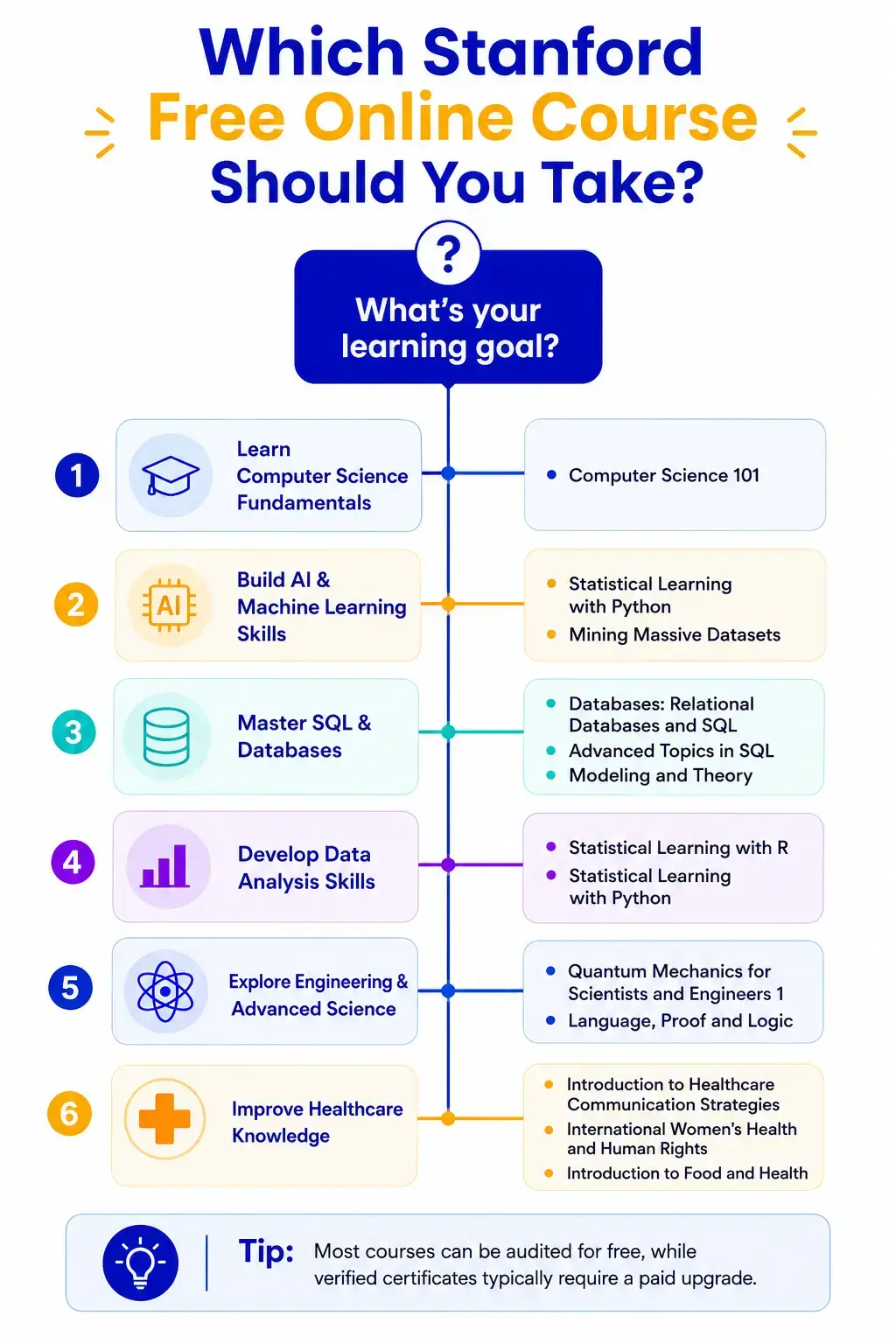
The democratization of higher education has reached a significant milestone as Stanford University continues to expand its digital footprint, offering high-level academic content to a global audience at no cost. As the modern labor market undergoes a rapid transformation driven by generative artificial intelligence and automated systems, the demand for continuous professional development has moved from a luxury to a career necessity. Stanford Online, the university’s central portal for digital learning, now serves as a critical bridge between elite academic theory and practical industrial application, providing a diverse catalog of courses that cater to technical specialists, healthcare workers, and corporate leaders alike.
The Evolution of Digital Pedagogy at Stanford
Stanford University has long been at the vanguard of the "Open Educational Resources" (OER) movement. The current landscape of online learning can be traced back to 2011, often referred to as the "Year of the MOOC" (Massive Open Online Course), when Stanford professors Sebastian Thrun and Peter Norvig offered an "Introduction to Artificial Intelligence" course for free online. The experiment drew over 160,000 students from 190 countries, effectively proving that the appetite for university-level knowledge transcended physical campus boundaries.
Since then, Stanford has refined its delivery model. While the university maintains its prestigious on-campus programs, its digital arm leverages platforms like edX, Coursera, and its proprietary Stanford Online site to disseminate knowledge. This strategic expansion aligns with broader economic shifts; according to the World Economic Forum’s 2023 Future of Jobs Report, six in 10 workers will require training before 2027, yet only half of workers are seen to have access to adequate training opportunities today. Stanford’s free offerings directly address this "reskilling revolution."
Navigating the ‘Freemium’ Model of Online Education
Prospective learners must distinguish between the various tiers of online engagement offered by Stanford. The majority of the courses listed are provided under a "freemium" model. This allows students to "audit" the course—accessing video lectures, reading materials, and discussion forums—entirely for free.
However, there is a clear distinction between learning for personal enrichment and obtaining professional credentials. A "Verified Certificate" or a "Professional Certificate" typically requires a financial investment, ranging from $50 to several hundred dollars. These paid tracks often include graded assignments and exams that are not available to audit-level students. For Human Resources (HR) and Learning and Development (L&D) professionals, understanding this hierarchy is essential when evaluating the resumes of job candidates who list MOOC completions as part of their skill sets.
Technical and Data Science Foundations
The most robust segment of Stanford’s free catalog focuses on computer science and data analytics. As data becomes the primary currency of the digital economy, these courses provide the foundational logic required to navigate complex systems.
1. Computer Science 101
Designed for those with no prior background in the field, this course demystifies the "magic" of computing. It covers the hardware-software interface, how the internet works, and the basics of structured programming. It is an essential primer for non-technical managers who oversee engineering teams.
2. Statistical Learning with Python
3. Statistical Learning with R
These twin offerings focus on the "Statistical Learning" framework—a set of tools for modeling and understanding complex datasets. While Python is the preferred language for general AI development, R remains a staple in academic research and traditional statistics. Both courses teach the mathematical underpinnings of machine learning, such as linear regression and resampling methods.
4. Databases: Relational Databases and SQL
5. Databases: Advanced Topics in SQL
6. Databases: Modeling and Theory
7. Databases: Semistructured Data
Stanford’s multi-part database series is widely considered the gold standard for online SQL education. SQL (Structured Query Language) remains the most in-demand technical skill for data analysts globally. By offering modules ranging from basic queries to semistructured data formats like JSON and XML, Stanford ensures that learners can handle the data architectures of both legacy systems and modern cloud environments.
Advanced Algorithms and Machine Learning
For those already established in technical roles, Stanford provides high-level courses that mirror the rigor of their graduate-level curriculum.
8. Algorithms: Design and Analysis Part 1
9. Algorithms: Design and Analysis Part 2
Taught by Professor Tim Roughgarden, these courses focus on the efficiency of code. In an era where "Big Data" is the norm, understanding how to write algorithms that can process information in linear or logarithmic time is vital for software scalability.
10. Mining Massive Datasets
This course targets the intersection of data science and engineering. It explores how to extract meaningful patterns from datasets so large they cannot fit into a single computer’s memory. Topics include MapReduce, PageRank (the foundation of Google’s search engine), and large-scale stream processing.

11. Language, Proof, and Logic
Logic is the foundation of both philosophy and computer science. This course teaches the formal languages used in mathematical logic, providing a rigorous framework for problem-solving that is highly applicable to cybersecurity and software verification.
Specialized Sciences and Healthcare
Beyond the computer lab, Stanford’s online outreach extends into the realms of physics and public health, areas where the university holds significant research influence.
12. Quantum Mechanics for Scientists and Engineers 1
As quantum computing moves from theoretical physics to experimental reality, this course provides the necessary mathematical background (linear algebra and differential equations) to understand the behavior of particles at the subatomic level.
13. Introduction to Healthcare Communication Strategies
In the healthcare sector, technical errors are often secondary to communication failures. This course is designed for medical professionals to improve patient-provider interactions and internal team coordination, directly impacting patient safety and satisfaction scores.
14. International Women’s Health and Human Rights
This course provides a global perspective on health issues that are often inextricably linked to social and legal status. It is a critical resource for those working in NGOs, public policy, or international development.
15. Introduction to Food and Health
Addressing the global epidemic of obesity and type-2 diabetes, this course focuses on the science of nutrition. It moves away from "dieting" and toward a sustainable understanding of how food processing affects metabolic health.
The Strategic Value for L&D and HR Leaders
For organizational leaders, these courses represent a cost-effective method for workforce "up-skilling." Rather than commissioning expensive, bespoke training programs, L&D departments can curate learning paths using Stanford’s existing modules.
Industry analysts point out that "skills-based hiring" is on the rise. A 2024 LinkedIn report indicated that recruiters are 5x more likely to search for candidates based on skills rather than degrees. By encouraging employees to audit Stanford courses, companies can foster a culture of "lifelong learning" that increases employee retention and prepares the workforce for the eventual integration of AI-driven tools.
Analysis of Implications: The Future of the Degree
The availability of free Stanford-level education raises fundamental questions about the future value of a traditional four-year degree. While the "Stanford experience"—networking, research opportunities, and campus life—cannot be digitized, the "Stanford knowledge" is now accessible to anyone with an internet connection.
This shift has profound implications for social mobility. A learner in a developing nation can now access the same lecture materials as a student in Palo Alto. However, the "credential gap" remains. Without a paid certificate or a formal degree, these learners may still face barriers in the traditional job market. The next phase of digital education will likely focus on how employers and institutions validate these non-traditional learning paths.
Conclusion: A Framework for Lifelong Growth
Stanford’s suite of free online courses serves as a testament to the university’s commitment to global knowledge sharing. For the individual professional, these courses offer a way to stay competitive in a volatile economy. For the organization, they provide a blueprint for a more knowledgeable and agile workforce.
Success in these courses requires more than just an internet connection; it requires a disciplined approach to self-paced learning. As the boundaries between "school" and "work" continue to blur, the ability to navigate these digital platforms will become a core competency for the 21st-century professional. Whether one is looking to master the intricacies of SQL or understand the global dynamics of human rights, Stanford’s digital doors are open, provided the learner has the initiative to step through them.






