
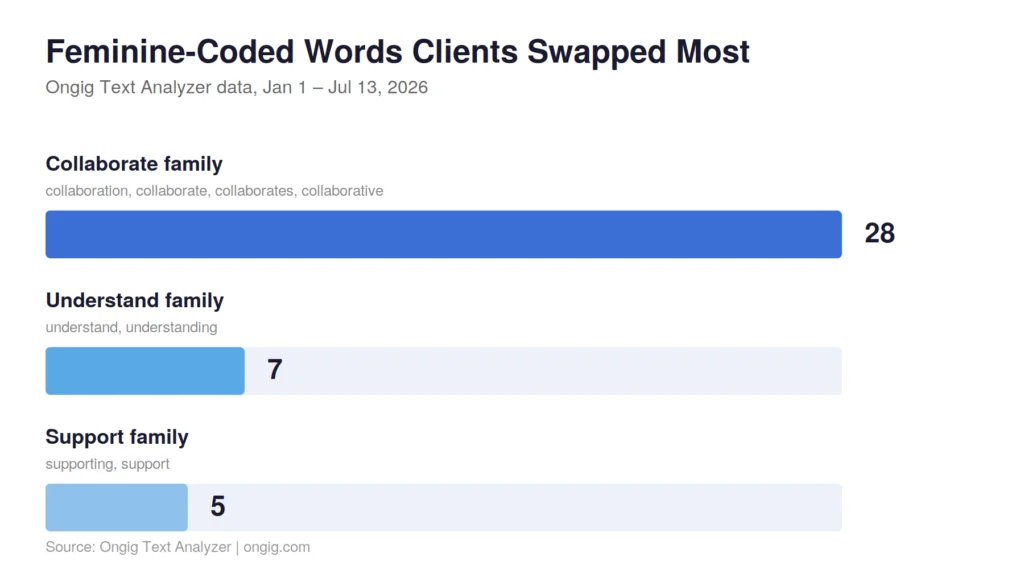
In a significant shift for talent acquisition analytics, new data for 2026 reveals that phrases related to "collaboration" are the most frequently modified feminine-biased words in job descriptions by companies utilizing text analysis tools. This year’s findings from Ongig, a leading platform for transforming job descriptions, mark a departure in methodology and highlight the evolving landscape of inclusive language in hiring. The "collaborate" family of words—including "collaboration," "collaborate," "collaborative," and "collaborates"—emerged as the clear frontrunner, followed by "understand" and "support." Notably, the word "committed," a consistent feature on this list since 2019, did not make the cut in the current analysis.
A New Lens on Language Bias: From Frequency to Action
The evolution of understanding and addressing gender bias in recruitment language has taken a crucial step forward with Ongig’s 2026 report. Previous analyses in 2019 and 2024 relied on scanning vast quantities of random job postings to identify the most prevalent feminine-biased words. This approach, while informative, primarily measured a word’s mere existence and frequency within the broader job market. The 2026 update, however, introduces a more granular and actionable metric: it tracks the words Ongig’s clients actively chose to swap out or remove when processing their job descriptions through the company’s Text Analyzer platform between January and mid-July 2026.
This methodological pivot offers a powerful insight into what truly "matters" to recruiters and HR professionals. It moves beyond theoretical prevalence to practical application, reflecting real-world decisions made by those on the front lines of talent acquisition. As an Ongig spokesperson noted, "It’s the difference between a word existing and a word actually being flagged and changed. This data reflects genuine recruiter intent to mitigate bias." This shift in data collection, facilitated by a Mixpanel update to Ongig’s internal tracking systems, provides a mid-year snapshot, with a more comprehensive year-end review anticipated. While the change in tracking means the 2026 list presents a slightly different "shape" compared to its predecessors, its value lies in its direct correlation to active bias-reduction efforts.
Decoding the 2026 Feminine-Biased Word Data
The prominence of "collaboration" and its variants at the top of the swapped-out list is particularly telling. This linguistic family, often perceived as benign and indicative of teamwork, is increasingly recognized as subtly feminine-coded. Its ubiquitous presence in modern job advertisements often leads to overuse, inadvertently signaling a workplace culture that might disproportionately appeal to or attract certain gender demographics while potentially deterring others. Recruiters, when prompted by analysis tools, are now actively identifying and reducing this redundancy, aiming for more neutral and impactful phrasing.
"Collaboration language, in all its forms, is clearly the dominant feminine-coded pattern our clients are catching right now," the report states. "It’s everywhere in job ads, and it’s an easy one to miss because it sounds so harmless." This highlights a growing sophistication in understanding how seemingly innocuous terms can contribute to unconscious bias.
Following "collaboration," "understand" and "support" also ranked highly among the words actively modified. These terms, while essential in describing certain job functions, often become vague descriptors that can lean towards a feminine archetype when overused or applied imprecisely. The goal of modification is not necessarily to eliminate these words entirely but to refine their usage, ensuring they convey specific responsibilities and expectations rather than broad, potentially gender-coded traits.
Perhaps one of the most intriguing findings is the absence of "committed" from the 2026 list. This word had consistently appeared in Ongig’s top feminine-biased words since 2019. Its disappearance suggests a potential shift in either the prevalence of its use in job descriptions or, more likely, an increased awareness among recruiters, leading them to proactively remove or replace it before analysis tools even flag it. This subtle change underscores the dynamic nature of language and its perception, indicating that efforts to raise awareness about biased language are having a tangible impact on hiring practices over time.
The Global Imperative: The Weight of Words in Workforce Participation
The micro-level insights from Ongig’s client data gain significant context when viewed against broader global research on gender-coded language. A comprehensive study by Lightcast and UNESCO, analyzing job postings across six English-speaking countries, underscored the profound impact of language on labor force participation. Their research revealed a stark reality: global labor force participation for women is 25% lower than for men. Crucially, this disparity is exacerbated in industries where male-coded language is more prevalent, such as STEM fields and manufacturing.
The Lightcast and UNESCO study further highlighted that gender bias in language doesn’t cease once a woman is hired. Manager-level job postings consistently exhibit noticeably more masculine-coded language than non-managerial roles. This linguistic pattern, the research concluded, aligns with and potentially reinforces the persistent "glass ceiling" phenomenon, where women encounter invisible barriers to advancement despite having successfully navigated initial hiring hurdles.
Zooming back into Ongig’s data, the overlap with this global research is compelling. Both the Lightcast/UNESCO study and previous Ongig reports identified words like "support" and "committed" as top female-coded terms globally. While "committed" has now dropped off Ongig’s most-swapped list, its historical presence in both sets of data reinforces the notion that these words carry a measurable, if often subconscious, gender signal. This global perspective elevates the importance of granular analysis, demonstrating that seemingly small linguistic choices can contribute to systemic inequalities in the workforce.
Strategic Rewriting: Practical Steps to Neutralize Job Posts
Understanding which words are problematic is only the first step; the true challenge lies in effective remediation. Ongig’s methodology for fixing feminine-biased words emphasizes specificity and clarity, transforming vague, coded language into precise, inclusive descriptions.
Addressing "Collaborate," "Collaboration," and "Collaborative": The pervasive nature of collaboration-related terms often leads to their overuse, diluting their meaning and inadvertently reinforcing a feminine-coded environment. If every bullet point in a job description mentions a "collaborative environment" or the need to "collaborate cross-functionally," the message loses its impact and can become off-putting to candidates who may not identify with such a heavily emphasized trait.
The solution lies in strategic deployment. Instead of repetitive use, identify one or two critical instances where collaboration is truly a core function—perhaps in relation to a specific project, a cross-departmental initiative, or a unique team structure. In other instances, replace the terms with more neutral and active alternatives. For example, "works with," "partners with," or "joins forces with" convey teamwork without the potential gender coding. This approach ensures that the essence of teamwork is communicated effectively, but without the unintentional bias.
Refining "Understand" and "Understanding": The terms "understand" or "understanding" often appear as vague requirements that can be interpreted differently by various candidates. While an "understanding of SQL" might seem straightforward, it lacks the specificity needed for a candidate to accurately self-assess their fit. This vagueness can be particularly challenging for women, who statistically tend to apply for jobs only when they meet 100% of the qualifications, whereas men might apply with fewer.
The fix involves asking what "understanding" truly entails in a practical, measurable sense. Instead of "understanding of SQL," consider "comfortable writing SQL queries," "ability to debug SQL scripts," or "experience with SQL database management." This not only reduces the feminine coding of the word but also provides clearer, more actionable criteria for all applicants, making the job requirement transparent and objective.
Reimagining "Support" and "Supporting": The word "support" is particularly tricky because it frequently describes legitimate job functions. Phrases like "supports the sales team" are common and accurately reflect many administrative, operational, or auxiliary roles. However, its overuse or unspecific application can contribute to a feminine-coded impression.
The strategy here is not to eliminate "support" but to enrich the sentence in which it appears. Instead of a generic "supports the sales team," expand the description to detail the specific actions and responsibilities involved. For example, "handles onboarding processes and manages contract renewals for the sales team" provides concrete examples of the support provided. This makes the role’s contribution explicit, reduces the abstract "support" terminology, and presents a more robust and attractive picture to potential candidates, regardless of gender.
Across all three categories, the overarching principle is to "get specific." Vague language acts as a hiding place for gender coding. By precisely describing the actual work, responsibilities, and required skills, recruiters minimize the room for any single word to carry unintended signals, thereby creating job descriptions that are clearer, more inclusive, and ultimately more effective in attracting a diverse talent pool.
The Business Case for Gender-Neutral Language
Beyond ethical considerations, the adoption of gender-neutral language in job descriptions presents a compelling business case. In 2026, diversity, equity, and inclusion (DEI) are not merely buzzwords but critical components of corporate strategy. Companies with diverse workforces consistently outperform their less diverse counterparts in areas such as innovation, employee engagement, and financial returns.
Gender-coded language, even when unintentional, narrows the applicant pool by discouraging qualified candidates who do not identify with the implicit gender bias. This directly impacts a company’s ability to attract top talent, particularly women, who represent a significant and often underutilized segment of the professional workforce. By removing these subtle barriers, companies can access a wider array of candidates, leading to better hiring outcomes and stronger organizational performance.
Furthermore, in an increasingly transparent and socially conscious corporate environment, a company’s commitment to inclusive hiring practices is a critical aspect of its employer brand. Organizations perceived as actively working to eliminate bias are more attractive to a new generation of talent that values diversity and equity. Conversely, those that fail to address gender-coded language risk reputational damage and legal challenges, depending on jurisdictional regulations regarding fair hiring practices. While direct legal exposure for gender-coded language can vary, the business grounds alone—from talent acquisition to brand reputation—make its rectification an imperative.
Technological Advancement and the Future of Inclusive Hiring
The findings from Ongig’s 2026 report underscore the growing reliance on advanced text analysis tools in the HR tech landscape. Artificial intelligence and natural language processing are no longer nascent technologies but indispensable allies in the fight against unconscious bias in recruitment. Tools like Ongig’s Text Analyzer empower recruiters to identify and correct biased language in real-time, providing actionable recommendations that go beyond simple spell-checking.
These platforms are continuously evolving, learning from vast datasets of job postings and user interactions to refine their algorithms. The shift in Ongig’s methodology from passive frequency tracking to active user-swap data reflects this evolution, prioritizing practical impact and user-driven insights. As the understanding of linguistic nuances and their societal impact deepens, such tools will become even more sophisticated, offering tailored suggestions that consider industry, role, and organizational context.
The ongoing effort to identify and neutralize gender-biased words is part of a larger movement towards creating truly equitable and inclusive workplaces. It acknowledges that language, often an invisible force, plays a powerful role in shaping perceptions, influencing decisions, and ultimately, determining who gets access to opportunities. As companies continue to invest in DEI initiatives, the meticulous refinement of job descriptions through data-driven insights will remain a cornerstone of attracting a diverse and high-performing workforce.
Ongig remains committed to its mission of transforming job descriptions to eliminate biases and enhance their attractiveness. For organizations hiring at scale, leveraging tools like Text Analyzer offers a strategic advantage in achieving diversity goals and strengthening talent pipelines. The 2026 data serves as a vital compass, guiding recruiters towards more equitable language and, by extension, a more inclusive future for talent acquisition.
July 16, 2026 by Rob Kelly in Writing Job Descriptions






