
In a significant shift for the Southern healthcare landscape, Mississippi has officially become the second state in the United States to implement a direct financial incentive for small businesses to transition from traditional group health insurance to Individual Coverage Health Reimbursement Arrangements (ICHRAs). Governor Tate Reeves signed House Bill 343 into law on April 6, 2026, establishing a targeted state income tax credit designed to alleviate the administrative and financial burdens often associated with providing employee health benefits. The legislation is structured to be retroactive, taking effect from January 1, 2026, allowing businesses to claim credits for the current fiscal year.
The move signals a growing legislative appetite for "defined contribution" healthcare models, which allow employers to provide a set amount of tax-free money for employees to purchase their own health insurance on the individual market. By following the blueprint established by Indiana in 2024, Mississippi is positioning itself as a leader in healthcare benefit innovation, specifically targeting the small business sector that has historically struggled with the rising costs of traditional premiums.
Legislative Framework and the Mechanics of the Tax Credit
House Bill 343 was designed with specific parameters to ensure the benefits reach the state’s smallest employers. The tax credit is exclusively available to organizations with fewer than 50 employees, a demographic that frequently lacks the scale to negotiate favorable rates with major insurance carriers. Under the new law, qualifying employers can claim a state income tax credit of up to $400 per covered employee during the first year the ICHRA is offered. In the second year, the credit remains available at a reduced rate of up to $200 per employee.
To maintain fiscal responsibility, the state has imposed a "first-come, first-served" aggregate cap of $1 million for any given fiscal year. This means that once the Mississippi Department of Revenue has allocated $1 million in total credits to various businesses across the state, no further credits will be issued until the following year. However, the legislation includes a strategic "carry-forward" provision: if an employer’s tax liability is lower than the credit they are eligible for, they can carry the remaining credit forward for up to ten years. This is particularly beneficial for startups and small businesses that may be in a growth phase with minimal current profits but long-term viability.
To ensure compliance and assess the long-term efficacy of the policy, the law mandates that employers report back to the Department of Revenue every three years. This reporting is intended to track whether businesses are maintaining their ICHRA programs or returning to traditional group plans, providing the state with data to measure the policy’s impact on market stability and employee coverage rates.
A Chronology of Policy Evolution: From Indiana to Mississippi
The path to Mississippi’s HB 343 began in the Midwest. In 2023, Indiana legislators passed HB 1004 (Public Law 203), which became the first state-level tax credit of its kind in the nation, effective January 1, 2024. The Indiana model proved that state-level incentives could move the needle on employer behavior, prompting several other states to consider similar measures.
The timeline for Mississippi’s adoption was notably swift, reflecting a high degree of political consensus:

- January 1, 2026: The effective start date for the credit (retroactive).
- Early 2026: HB 343 was introduced in the Mississippi Legislature, drawing on the successes and language of the Indiana statute.
- April 6, 2026: Governor Tate Reeves signed the bill after it cleared both chambers with overwhelming support.
- Post-April 2026: The Mississippi Department of Revenue is expected to issue formal guidance to clarify technical citations within the bill.
While Mississippi’s legislation mirrors Indiana’s in its core intent, there are distinct differences. Indiana’s program offers a $10 million annual aggregate cap—ten times larger than Mississippi’s—reflecting the different sizes of their respective small business economies. Additionally, while both states target the under-50 employee segment, Mississippi’s inclusion of the ten-year carry-forward provides a longer tail for financial planning than some other state-level tax incentives.
Analyzing the Legislative Support and Bipartisan Momentum
Perhaps the most striking aspect of HB 343 is the near-unanimous support it received in a political climate often characterized by polarization. The bill passed the Mississippi House of Representatives with a landslide vote of 118-0 (with only four members voting "no" on subsequent procedural motions) and cleared the Senate with a 45-4 margin.
This level of consensus suggests that the ICHRA model appeals to a broad ideological spectrum. For conservatives, it represents a market-based solution that reduces government entanglement in employer-employee relations and promotes individual choice. For moderates and liberals, it offers a mechanism to ensure more workers in the small business sector have access to portable, high-quality health insurance that isn’t tied to a specific job’s group plan.
This state-level momentum is mirrored at the federal level. In recent years, Congress has seen multiple introductions of the "CHOICE Arrangement" act, which seeks to codify ICHRA rules into federal law, protecting them from future regulatory changes. The bipartisan nature of the Mississippi vote reinforces the idea that "portable" benefits are becoming a preferred policy tool for addressing the healthcare affordability crisis.
Technical Clarifications: The ICHRA vs. QSEHRA Citation
A point of technical interest for tax professionals and benefits administrators lies in the bill’s reference to Internal Revenue Code (IRC) Section 9831(d). While the text of HB 343 repeatedly uses the term "ICHRA," Section 9831(d) is the federal statute that governs the Qualified Small Employer Health Reimbursement Arrangement (QSEHRA).
This same citation discrepancy occurred in Indiana’s initial legislation. Industry experts anticipate that the Mississippi Department of Revenue will follow Indiana’s lead by issuing clarifying guidance that applies the credit to both ICHRAs and QSEHRAs, or specifically confirms its application to ICHRAs as intended by the bill’s primary nomenclature. For small businesses, the distinction is vital: QSEHRAs have annual contribution limits and are only for businesses with fewer than 50 employees, while ICHRAs have no contribution limits and can be used by employers of any size (though the MS tax credit is restricted to those under 50).
The Economic Impact on Small Businesses and Employees
The shift toward ICHRAs facilitated by this tax credit addresses several pain points in the traditional insurance market. For decades, small businesses have been at the mercy of "experience-rated" premiums, where one employee’s catastrophic illness could lead to a 30% or 40% increase in premiums for the entire company the following year.
ICHRAs move employees into the "community-rated" individual market. In this market, premiums are based on broader geographic and age demographics rather than the specific health history of a small group of coworkers. This provides the employer with "defined contribution" logic: they decide exactly how much they can afford to contribute (e.g., $500 per month per employee), and their costs remain fixed regardless of the employees’ medical claims.
For the employee, the benefits include:
- Portability: If they leave the company, they can often keep their individual plan (though they lose the employer’s subsidy).
- Choice: Instead of being forced into the one or two plans the boss chose, employees can select from dozens of plans on the exchange, finding the network and deductible that fits their family’s specific needs.
- No Participation Requirements: Traditional group plans often require 70% or more of staff to enroll for the plan to be valid. ICHRAs have no such requirement, making them ideal for businesses with many part-time workers or employees who have coverage elsewhere.
Industry Perspectives and Future Outlook
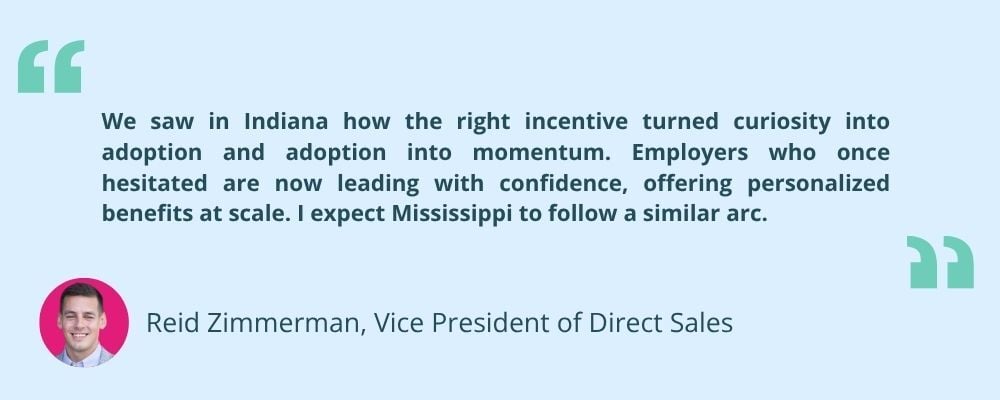
Market analysts and benefits experts view Mississippi’s move as a catalyst for other states. Reid Zimmerman, Vice President of Direct Sales for Remodel Health, noted that the introduction of such incentives often turns "curiosity into adoption." According to Zimmerman, the experience in Indiana showed that when the state provides a financial "cushion," employers who were previously hesitant to abandon the familiar group insurance model are much more likely to make the leap to personalized benefits.
The $1 million cap in Mississippi, while modest, is expected to be reached quickly. Advocates for the bill suggest that if the initial $1 million is exhausted rapidly, it will provide the necessary data for proponents to argue for an expansion of the cap in future legislative sessions.
As of mid-2026, similar legislative efforts are being monitored in Ohio, Texas, Georgia, and Connecticut. While some of these bills have faced delays in committee, the "Mississippi Model" provides a fresh case study in how to successfully navigate a bill through a state legislature with bipartisan support.
Conclusion and Strategic Implications
Mississippi’s HB 343 represents a pivotal moment in the evolution of state-sponsored healthcare policy. By providing a direct financial incentive for small businesses to adopt ICHRAs, the state is not only offering tax relief but is also actively encouraging a more resilient and flexible health insurance market.
For Mississippi small business owners, the message is clear: the window to claim a portion of the $1 million annual credit is open, and the retroactive nature of the law provides an immediate opportunity to recoup costs for the 2026 tax year. As the Mississippi Department of Revenue prepares to administer these credits, the broader insurance industry will be watching closely to see if this "Magnolia State" experiment leads to a wider national trend of state-level ICHRA support. The move underscores a fundamental shift in how the American workforce may soon receive healthcare: less as a one-size-fits-all corporate mandate and more as a personalized, portable, and state-supported individual choice.