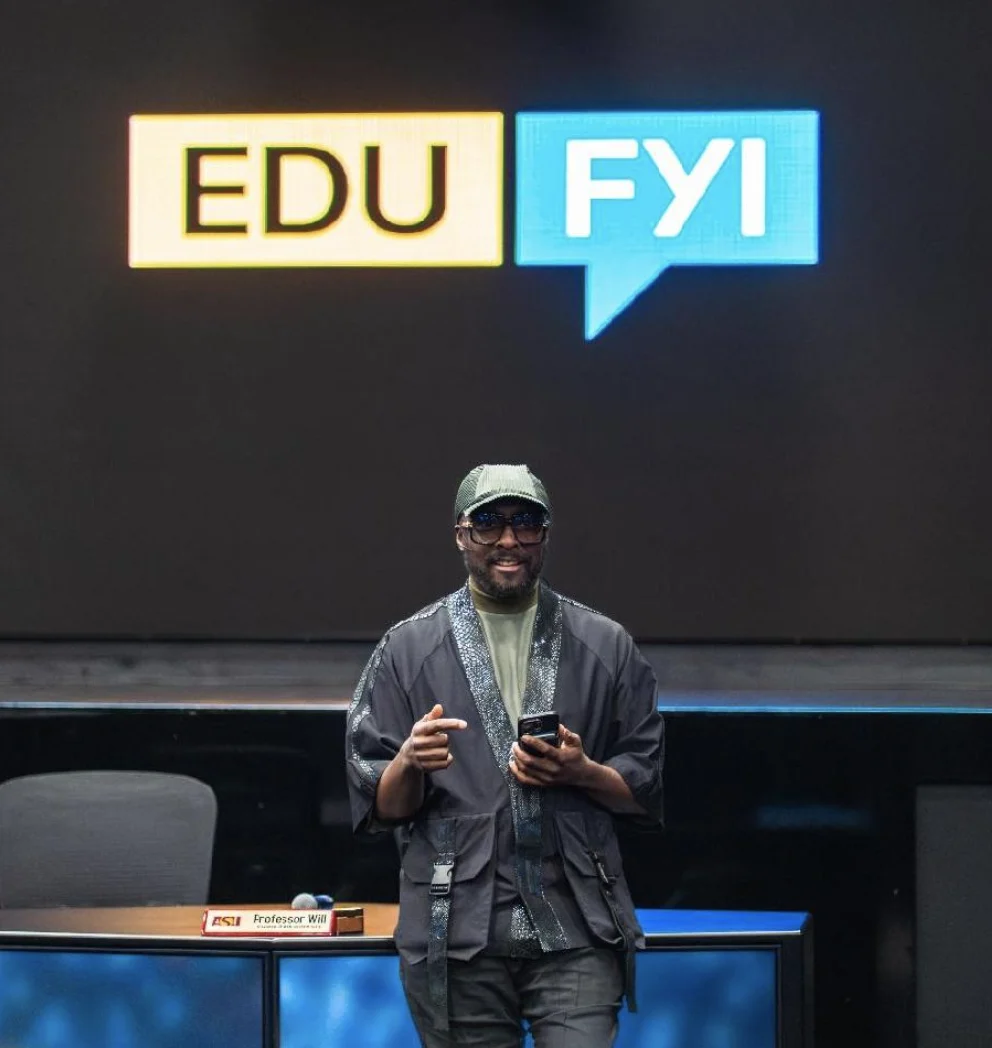
The intersection of celebrity influence, academic rigor, and technological advancement reached a new milestone in 2025 with the launch of The Agentic Self, a pioneering course developed through a partnership between Arizona State University (ASU) and the multi-platinum musician and tech entrepreneur will.i.am. This initiative represents a significant shift in higher education, moving beyond the technical mechanics of artificial intelligence toward a philosophy of personal agency and data ownership. Hosted at the FYI (Focus Your Ideas) campus in Hollywood, the program serves as a laboratory for "Professor Will" and a cohort of innovation professionals to explore how AI can be harnessed to enhance human capability rather than replace it.
The collaboration comes at a time when ASU has solidified its reputation as the most innovative university in the United States, according to U.S. News & World Report. In 2024, ASU became the first higher education institution to partner directly with OpenAI, granting its faculty and students access to ChatGPT Enterprise. The Agentic Self course is the next evolution of this digital strategy, focusing on the creation of personalized AI "personas" that act as extensions of the individual’s values, interests, and professional goals.
The Architecture of Collaborative Learning
The physical environment of the course reflects its pedagogical goals. Transforming a dedicated space at the FYI campus, will.i.am and ASU leadership designed a learning room modeled after the United Nations General Assembly. The U-shaped configuration features individual stations equipped with high-fidelity microphones and ergonomic seating, a design choice intended to facilitate seamless integration between in-person participants and virtual guests.
This "Hollywood-meets-Higher-Ed" atmosphere is more than aesthetic. The FYI campus is described as a creative hub—a digital-era equivalent to a production factory—where music, product design, and AI development converge. By placing students in an environment that prioritizes high-stakes communication and global collaboration, the course forces a re-evaluation of how humans interact with machine intelligence. The core question addressed in this setting is whether organizations can replicate these conditions to foster innovation within their own workforces.
Defining the Agentic Self
Central to the curriculum is the concept of the "Agentic Self." In a public statement shared via NBCLA, will.i.am defined the term as an individual claiming their personal data and putting it to work through an AI agent. This agent is not a generic tool but a reflection of the user’s specific beliefs, passions, and ethical concerns.
This philosophy challenges the current trajectory of many AI deployments, which often prioritize efficiency and automation. Instead, the Agentic Self model advocates for a "human-led" approach where curiosity is treated as a core capability. The curriculum posits that in a rapidly shifting technological landscape, courageous curiosity is the primary mechanism through which individuals maintain their relevance and agency.
A Chronology of Innovation: From Prompt to Enterprise Scale
The evolution of AI-driven learning tools is best illustrated through the journey of a conversational skill builder, a project that transitioned through various platforms over a two-year period. This timeline demonstrates how the same core idea can bloom differently depending on the technical and organizational environment:
- Initial Exploration (2023): The project began with Large Language Models (LLMs) like ChatGPT. At this stage, the goal was to test the viability of using AI for practicing "hard conversations." The platform allowed for rapid prototyping of a tool that could provide immediate, personalized feedback on interpersonal communication.
- Enterprise Integration (2024): The concept was moved into Microsoft Copilot Studio within the context of Providence St. Joseph Health, a large healthcare system. This phase addressed the complexities of organizational governance, security, and strategic alignment. It highlighted the friction inherent in deploying AI at scale within a highly regulated industry.
- Multimodal Development (2025): Working with Acolyte AI, a startup focused on strategic innovation, the project integrated avatars and multimodal experiences. This shift opened up richer learning environments, moving the tool from text-based interaction to a more immersive format.
- The Agentic Transformation (2026): Finally, through the FYI platform and the ASU course, the tool evolved into a model for "AI-guided mastery." This represents a middle ground between the "empty prompt" of standard AI and the "rigid structure" of traditional digital learning.
The Strategic Importance of "Best Fit"
For executive leadership and organizational founders, the primary takeaway from the ASU-will.i.am collaboration is the importance of environmental fit. A strong technological idea can fail if the environment—the platform, the culture, and the people—is not aligned with its goals.

Best fit is a driver of adoption and internal performance. The FYI platform, for instance, is not designed for every user; it is built for a specific community that values a human-first approach to AI and strong ethical guardrails. For leaders, this means that selecting an AI platform is as much a cultural decision as it is a technical one. Competitors are no longer just looking for the best tools; they are looking for the best environments to deploy those tools.
Addressing the Workforce Readiness Gap
While many organizations have successfully licensed AI tools and established governance frameworks, a significant "readiness gap" remains. Recent industry data suggests that while early adopters are moving quickly, a large portion of the global workforce remains hesitant or uncertain about how to integrate AI into their daily roles.
Brad Bigelow, founder of Acolyte AI and a collaborator on the project, notes that the gap is rarely technical. "What I observe most often is organizations that have invested heavily in AI access while underinvesting in the structures that help people use it with confidence and purpose," Bigelow stated. He argues that the distinction between being "equipped" and being "ready" will define which organizations lead in the coming decade.
Readiness, according to the findings from The Agentic Self course, requires psychological safety and a culture that allows for exploration and failure. Organizations must move away from a "compliance-based" training model toward one that develops the agentic self—individuals who are empowered to test ideas and move them across different contexts.
Implications for Healthcare and Beyond
The practical application of these theories is already being seen in the healthcare sector. At Providence St. Joseph Health, a version of the AI-guided learning model has recently cleared the governance process and is being deployed at scale. This implementation serves as a case study for how high-level innovation from courses like ASU’s can be translated into real-world enterprise environments.
The healthcare deployment focuses on using AI to prepare staff for complex interactions, ensuring that the technology supports human empathy rather than replacing it. This aligns with the "moral and ethical compass" that will.i.am has emphasized throughout his tech career, from his early work with Intel to his current focus on data sovereignty.
Future Outlook: Learning as a Driving Capability
The ASU course and the FYI campus experience suggest that the future of work will be defined by the "company you keep" and the "rooms you enter." The collaborative nature of these environments indicates that AI development is moving away from solitary coding and toward community-based innovation.
As the first cohort of The Agentic Self concludes their initial study, the broader impact on the educational landscape is becoming clear. Universities are increasingly expected to provide more than just knowledge; they must provide the "magical" environments where students can manifest music, products, and new versions of themselves.
The willingness to explore is no longer a luxury for the creative elite; it is a necessity for any professional navigating an AI-driven world. By fostering the agentic self, institutions like ASU and entrepreneurs like will.i.am are creating a blueprint for a future where learning is the primary capability that drives every other sector forward. The transition from a "skilled user" to an "agentic individual" represents the next frontier of human-AI synergy, ensuring that as the world moves faster, the human element remains at the helm.