
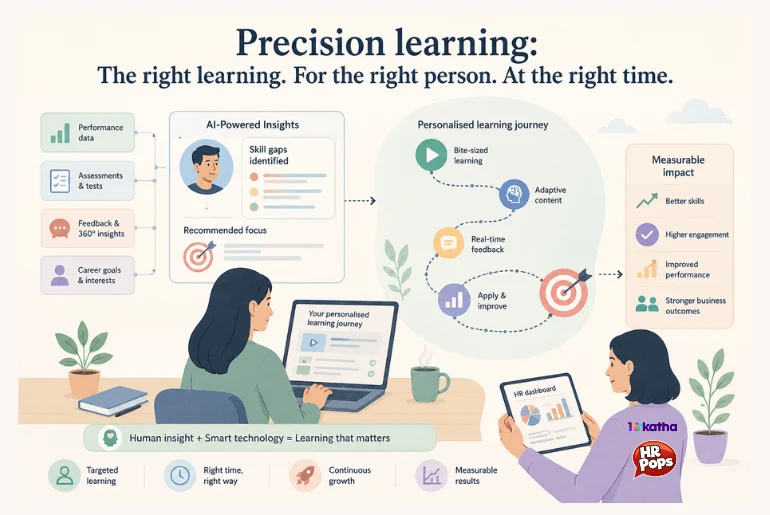
The landscape of corporate learning is undergoing a profound transformation, moving away from a traditional program-centric approach towards a more individualized, data-driven methodology known as precision learning. This paradigm shift, drawing conceptual parallels from precision medicine, prioritates identifying specific individual capability gaps before delivering targeted interventions. Unlike the conventional model where entire workforces are subjected to uniform courses, precision learning aims to provide the right skill, to the right person, at the right time, fundamentally altering how organizations approach talent development and strategic workforce planning.
Defining Precision Learning in the Modern Enterprise
At its core, precision learning represents a significant departure from the "one-size-fits-all" training models that have long dominated corporate learning and development (L&D). Instead of commencing with a pre-designed program, it begins with a meticulous diagnosis of an individual’s specific learning needs or capability gaps. This diagnostic approach is analogous to precision medicine, where treatments are meticulously tailored to a patient’s unique biological and genetic characteristics, rather than applying a standardized regimen to all. In the context of learning, this means leveraging a rich tapestry of data – including assessments, performance reviews, behavioral analytics, and feedback – to pinpoint precisely what an employee needs to learn.
Once these specific gaps are identified, technology plays a pivotal role in adjusting the learning experience. This can involve dynamically modifying content, scaling the difficulty, altering the format (e.g., video, interactive simulation, micro-learning module), or optimizing the timing of delivery to align with an employee’s immediate need or workflow. The underlying principle is deceptively simple: to deliver the most impactful learning experience by ensuring relevance and timeliness. However, the practical execution hinges on accurately defining what "right" truly entails for each unique individual and organizational context.
The Evolution of Learning: From Classroom to Algorithm
The genesis of precision learning can be traced through the gradual evolution of digital learning and the increasing sophistication of educational technologies. For decades, corporate training primarily involved instructor-led classroom sessions or, more recently, digitizing existing classroom content for online consumption. While this offered scalability, it often failed to address the inherent diversity in learners’ prior knowledge, experience, and specific developmental needs.
The concept began to gain significant traction as digital learning platforms matured beyond mere content repositories. Early adaptive learning systems, initially prevalent in academic settings, demonstrated the power of dynamically adjusting questions and content based on a learner’s performance. These systems would, for instance, offer remedial modules if a student struggled with a concept or advance them to more complex material if they demonstrated mastery. As corporate digital platforms began accumulating vast amounts of data on learner behavior, engagement patterns, and performance outcomes, similar adaptive principles started permeating the L&D landscape.
The true acceleration towards precision learning, however, coincided with rapid advancements in data analytics and artificial intelligence (AI). Machine learning algorithms became capable of processing complex datasets, identifying intricate patterns in individual and collective performance, and predicting future skill requirements. This technological leap made increasingly personalized learning pathways not just conceptually appealing but technically feasible. Industry analysts estimate that the global corporate e-learning market, valued at over $250 billion in 2023, is increasingly driven by AI and adaptive technologies, signaling a clear shift in investment priorities.
The appeal for organizations grappling with the inefficiencies of traditional training was undeniable. Corporate L&D had long struggled with a pervasive problem: significant financial investments, often billions globally, were poured into training programs where a substantial portion of employees attended the same courses despite possessing widely varying levels of knowledge and experience. This resulted in considerable resources being expended on teaching some individuals concepts they already understood, while simultaneously failing to address the genuine skill deficits of others. Precision learning emerged as a promising solution, offering to replace the blunt instrument of mass training with a sophisticated, diagnostic approach akin to a medical professional tailoring a treatment plan. The integration of AI has amplified this promise, empowering learning systems to proactively recommend content, dynamically adjust learning trajectories, identify nascent skill gaps, and deliver targeted assistance precisely when and where an employee needs it most within their workflow.
The Strategic Imperative for HR: Navigating Rapid Skill Transformation
The relevance and urgency of precision learning are magnified by the accelerating pace of change in the modern workforce. Historically, organizations could reasonably predict the skill requirements for a given job role over several years, making periodic, pre-scheduled training programs a sensible, albeit imperfect, approach. Today, with job roles being fundamentally reshaped by disruptive forces like generative AI, widespread automation, evolving business models, and geopolitical shifts, the luxury of waiting for the next annual learning calendar is increasingly unsustainable and economically unjustifiable. Research from the World Economic Forum, for example, suggests that over 40% of core skills required for current jobs are expected to change in the next five years, underscoring the critical need for agile and responsive learning strategies.
Precision learning empowers Human Resources (HR) departments to shift their strategic focus dramatically. Instead of merely asking, "What training should we provide?" HR can now pose more incisive questions: "What specific capability is missing, where precisely is it missing within our workforce, and what is the smallest, most impactful intervention that could effectively close that gap?" This reorientation fundamentally alters the function and impact of learning and development. Consider a leadership development program: two managers attending the same program might require entirely different developmental interventions. One might struggle acutely with effective delegation, another with conflict resolution, and a third with developing sound commercial judgment. While enrolling all three in identical modules offers administrative convenience, it represents a profoundly imprecise and potentially ineffective use of resources. Precision learning, conversely, would diagnose these distinct needs and provide tailored modules or experiences for each.
Moreover, this approach significantly enhances the utility of learning for strategic workforce planning. By cultivating a credible, data-driven picture of existing capabilities across teams and departments, organizations can proactively identify emerging skill gaps before they escalate into critical shortages. This foresight enables HR to make informed decisions about whether to "build" (develop existing talent), "buy" (recruit externally), or "redeploy" (reassign internal talent) in advance of urgent business needs. The implications for talent retention are also significant, as employees are more likely to stay with organizations that invest in their relevant, personalized growth.
Perhaps most critically, precision learning recalibrates how HR measures the efficacy of learning initiatives. Traditional metrics like training hours completed or course completion rates merely indicate consumption; they offer little insight into actual skill acquisition or behavioral change. Precision learning, by contrast, shifts the focus to outcomes, aiming to demonstrate not just what employees consumed, but what capabilities they genuinely improved, how their performance was enhanced, and ultimately, how their growth contributed to organizational objectives. This move towards demonstrable impact strengthens the business case for L&D and positions it as a strategic driver of organizational success.
The Mechanics of Precision: Data, Technology, and Human Insight
The operationalization of precision learning relies on a sophisticated interplay of data, advanced technology, and human judgment. The data foundation is multifaceted, drawing from various sources across the employee lifecycle. This includes formal assessments (pre-assessments, post-assessments, certifications), performance management data (KPIs, goal attainment, 360-degree feedback), behavioral analytics (how employees interact with learning content, time spent, completion rates, application in real-world scenarios), and qualitative feedback from managers and peers. The aggregation and analysis of this diverse data provide a holistic view of an individual’s current capabilities and potential areas for growth.
The technology stack underpinning precision learning typically involves AI and machine learning algorithms, integrated within adaptive learning platforms or modern Learning Experience Platforms (LXPs). These systems are designed to ingest and process vast quantities of data, identify patterns indicative of skill gaps, and then dynamically curate and deliver personalized learning interventions. For instance, an AI might detect, through performance data and self-assessments, that a sales manager consistently struggles with closing complex deals. The system could then recommend a series of micro-learning modules on advanced negotiation techniques, provide access to relevant case studies, or even connect them with an internal mentor who excels in that area. The system can also adjust content difficulty based on real-time learner interaction, provide instant feedback, and suggest alternative learning paths if a particular approach proves ineffective for an individual.
However, the "right" challenge remains. While technology can process data and make recommendations, the quality of the diagnosis is paramount. If the underlying data is flawed or the algorithms are not accurately trained to interpret capability gaps, even the most sophisticated platform will merely personalize content distribution rather than deliver true precision learning. This highlights the ongoing need for human insight in defining desired outcomes, validating algorithmic recommendations, and understanding nuances that data alone cannot always capture.
The Uncomfortable Realities and Ethical Considerations
While the promise of precision learning is compelling, its implementation is fraught with uncomfortable realities and significant ethical considerations that HR and L&D leaders must address.
Firstly, the efficacy of precision learning is directly tied to the precision of an organization’s understanding of skills. Many enterprises, despite aspirations for data-driven L&D, lack this foundational clarity. Job descriptions are often outdated, competency frameworks are broad and generic, performance data can be inconsistent or subjective, and managers frequently hold differing views on what constitutes "good performance" for a given role. Feeding such imperfect or ambiguous data into a sophisticated AI platform does not magically yield an accurate diagnosis; it merely produces personalized recommendations based on potentially flawed assumptions. The crucial distinction here is that personalized learning, while appearing sophisticated by recommending different courses to different employees, is not synonymous with precision learning if it fails to accurately identify and address the actual capability gap.
Secondly, the extensive data required for precision learning raises profound questions about employee privacy, data security, and algorithmic fairness. How much information about an employee’s performance, behavior, learning habits, and perceived weaknesses should a system collect? Who has access to this highly sensitive data? Could a learning recommendation, or the lack thereof, later influence critical decisions regarding promotions, performance reviews, or even job security? For instance, if an algorithm repeatedly flags particular demographic groups for "remedial development," it could perpetuate biases and create an inequitable learning environment. These are not arguments against precision learning itself, but rather critical reminders that greater data-driven precision necessitates a commensurate increase in responsibility, transparency, and ethical governance from HR. Organizations must establish clear data policies, ensure secure data handling, and implement mechanisms for algorithmic accountability and human oversight.
Furthermore, there are aspects of human development that technology, however advanced, cannot neatly diagnose or address through prescriptive learning modules. Development is not always about closing a measurable skill gap defined by an algorithm. A manager struggling with team morale might primarily need a boost in confidence, not another course on management theory. A promising employee might benefit more from exposure to senior leadership or a challenging stretch assignment than from additional formal training. Sometimes, an employee’s performance struggles might stem from external factors, such as a poor managerial relationship or an unsupportive team environment, rather than a deficiency in their individual capabilities. In such cases, an algorithm can recommend learning interventions, but human judgment, empathy, and holistic understanding are still indispensable to determine whether learning is truly the most appropriate answer, or if other interventions—coaching, mentoring, organizational changes—are required.
Broader Implications and the Future Landscape of Learning
Despite these challenges, the broader implications of precision learning for organizational effectiveness and employee experience are significant. For employees, it promises a more relevant, engaging, and ultimately more impactful learning journey, fostering a sense of empowerment and ownership over their professional growth. For organizations, it contributes to greater agility, enabling faster adaptation to market shifts and technological disruptions by ensuring the workforce possesses the necessary skills.
The investment landscape reflects this shift, with venture capital and corporate spending increasingly directed towards AI-powered L&D solutions. The global market for AI in education and corporate training is projected to grow significantly, reaching tens of billions of dollars in the coming years, indicating a strong belief in its transformative potential.
The role of L&D professionals is also evolving. They are transitioning from being primarily content curators or program managers to becoming strategic capability architects, data interpreters, and facilitators of bespoke learning experiences. Their expertise in instructional design, combined with a deep understanding of organizational strategy and human psychology, becomes crucial in guiding the implementation of precision learning systems and ensuring they serve genuine human and business needs. The long-term vision is a dynamic learning ecosystem deeply integrated with business strategy, continuously sensing skill needs, delivering targeted development, and validating impact on performance.
Conclusion: A Call for Strategic Implementation
Precision learning represents a vital and necessary correction to decades of often inefficient, one-size-fits-all corporate training methodologies. Its true promise lies not merely in the ability to deliver a different course to every employee, but in empowering organizations to gain a far deeper and more accurate understanding of what individuals genuinely need to become more capable, effective, and resilient in a rapidly changing world.
For HR and L&D leaders, this necessitates a critical perspective: resisting the temptation to conflate sophisticated algorithmic recommendations with genuinely sophisticated learning. While technology can personalize content distribution endlessly, true precision depends fundamentally on the quality and accuracy of the diagnosis underpinning it. The biggest problem with generic training was never simply that everyone received the same content; it was, more profoundly, that organizations often lacked the precise insight into what each person genuinely needed in the first place. Precision learning, when implemented thoughtfully and ethically, offers the tools to finally bridge that critical knowledge gap, fostering a culture of continuous, highly relevant, and impactful development.








