The conventional wisdom in talent acquisition dictates that the journey from posting a job opening to extending a signed offer is a marathon, typically spanning 36 to 44 days. This timeframe, already a significant commitment, often stretches considerably for technical, specialized, or high-volume hourly roles, where every vacant shift represents a tangible operational cost. However, a paradigm shift is underway, driven by technological advancements that promise to cut these timelines in half, not by compromising candidate quality or skipping crucial evaluation steps, but by systematically eliminating the inefficiencies that have become deeply embedded in traditional hiring processes. The key lies in removing the "waiting" and "coordinating" elements that consume disproportionate amounts of time without directly assessing candidate suitability.
The pervasive drag on hiring efficiency stems not from the interviews themselves, which are often perceived as the primary bottleneck, but from the extensive administrative and logistical overhead surrounding them. A detailed examination of a typical 30-to-40-day hiring cycle reveals that while interviews occupy a central position, the most significant time drains occur before candidates enter the interview room and after they have completed their evaluations. These interstitial periods, characterized by the arduous task of scheduling and the subsequent delays in feedback dissemination, routinely outweigh the actual time spent by candidates and interviewers in direct conversation.
The Elusive "Scheduling Tax": A Hidden Cost in Talent Acquisition
One of the most significant, yet often overlooked, contributors to extended hiring timelines is the sheer complexity of scheduling. Coordinating interview loops, especially for roles requiring multiple evaluators, becomes a logistical labyrinth. This process involves reconciling the availability of candidates, who may be employed elsewhere and have limited windows for communication, with the calendars of two, three, or even five interviewers, often across different time zones and competing professional priorities. The reliance on manual coordination, through email chains and Slack threads, is fraught with potential delays. Interviewers may reschedule due to urgent operational demands, while candidates might disengage if the process feels protracted and unresponsive.
Research into remote hiring practices has highlighted the stark difference in efficiency between automated scheduling systems and manual coordination. The transition from a candidate expressing interest to completing an interview can take days when reliant on human scheduling, whereas an automated system can facilitate this step in a matter of hours. This delay is not merely an inconvenience; it represents a critical window of opportunity. During these protracted scheduling periods, strong candidates remain on the market, potentially engaging with other organizations and receiving faster offers, thereby diminishing the likelihood of securing top talent. When this scheduling gap is multiplied across each stage of an interview process, it’s not uncommon for weeks to elapse before any substantive hiring decision can even be considered. This "scheduling tax" is a widely recognized pain point for hiring managers, as it directly impacts their ability to build and maintain a robust team.
Compressing the Interview Stage Through AI-Assisted Evaluation
The most profound opportunities for timeline compression lie within the interview stage itself, particularly through the strategic implementation of AI-assisted interviewing. This technology fundamentally alters the dependency on shared calendars. Instead of waiting for a mutually agreeable time slot between a candidate and a live interviewer, candidates can complete structured, role-relevant interviews on their own schedules. This flexibility accommodates evenings, weekends, and even short breaks between other professional commitments, effectively removing the need for back-and-forth rescheduling and mitigating candidate drop-off due to scheduling conflicts.

For interviewers, the AI-driven approach transforms their time investment. Rather than dedicating significant hours to conducting numerous similar first-round interviews, recruiters and hiring managers receive structured summaries and scored evaluations shortly after each AI interview is completed. These evaluations are typically available within hours, not days. A key advantage of AI interviewing is its inherent consistency. Questions are standardized across all candidates, ensuring that each applicant is evaluated against the same objective criteria and to the same depth, irrespective of their position in the hiring queue. This not only streamlines the evaluation process but also enhances fairness and reduces potential bias.
The impact on time savings is dramatic. Organizations that have adopted AI-assisted interviewing for early and mid-stage evaluations have reported a significant reduction in their overall time-to-hire, compressing it from an average of six weeks to approximately one week. Specifically, the time-to-interview has been observed to drop by as much as 99%. This drastic reduction is primarily attributable to the elimination of calendar-based dependencies, making the interview process fluid and immediate. This singular change is a critical enabler for achieving compressed hiring timelines, moving them from aspirational goals to tangible realities.
A Realistic View: Requisition to Offer in Days, Not Weeks
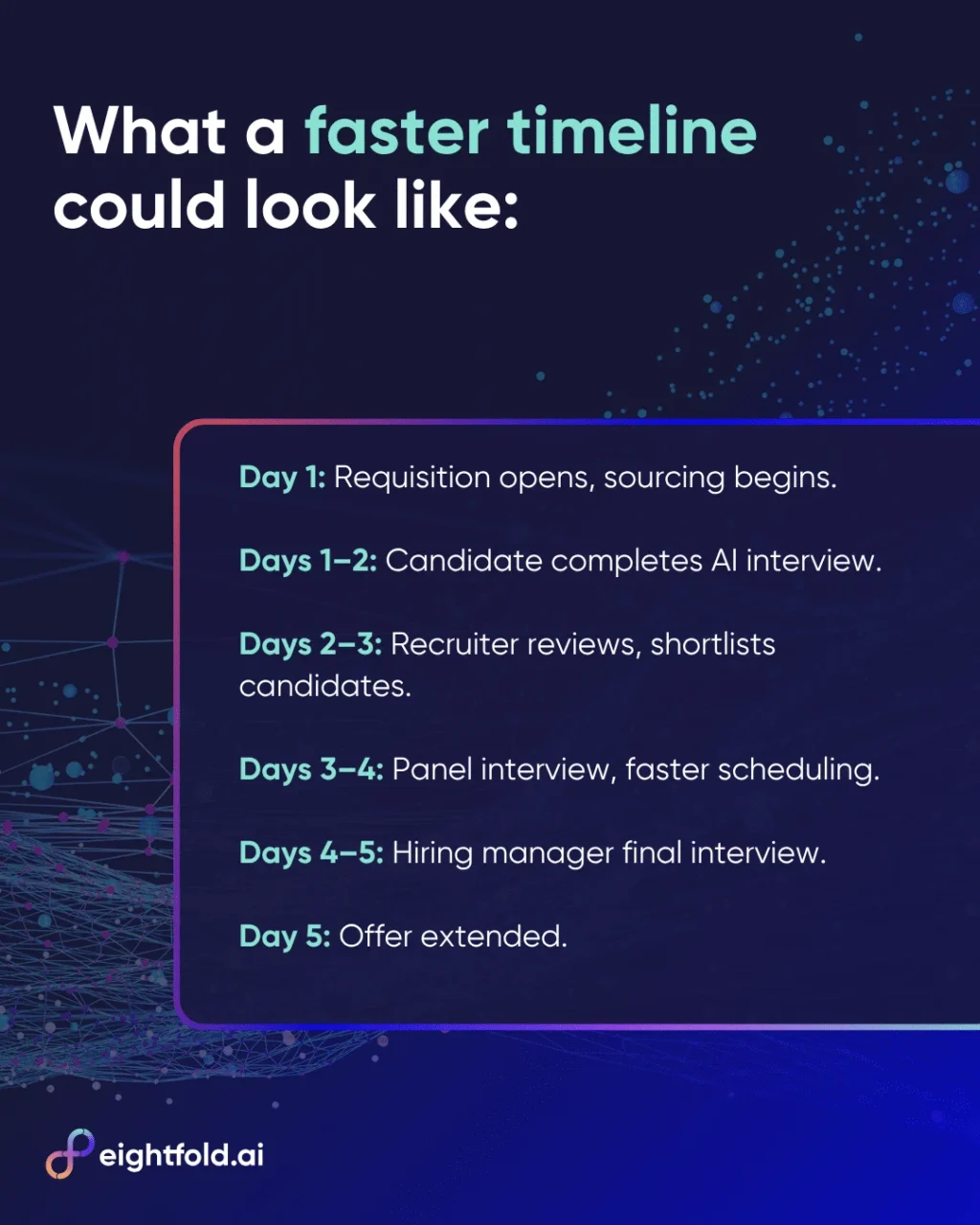
When the identified friction points are systematically addressed, a significantly accelerated requisition-to-offer timeline becomes achievable. A realistic scenario, leveraging AI-assisted interviewing and streamlined coordination, could look as follows:
- Day 1: Job requisition is opened. AI-powered screening and initial assessments are initiated.
- Day 1-2: Candidates complete AI-driven interviews and receive immediate scoring and feedback summaries.
- Day 2-3: Hiring managers review AI-generated candidate evaluations and select a shortlist for final interviews.
- Day 3-4: Final interviews are conducted by human interviewers, focusing on deeper behavioral and situational assessments.
- Day 4-5: Offer is extended and accepted.
This condensed timeline represents five days of a process where no stage is idle. Crucially, the human touchpoints that hold the most significant value – such as the final interview, the offer negotiation, and the moments requiring nuanced judgment and relationship building – remain firmly in human hands. What is eliminated is the unproductive "dead time" that historically characterized the hiring process.
The Ripple Effects: Beyond a Dashboard Metric
The benefits of a compressed hiring timeline extend far beyond a mere improvement in recruiting metrics. This acceleration yields tangible positive outcomes across the entire organization.
For hiring managers, the ability to fill open positions rapidly means that critical workloads are not disproportionately shifted onto existing team members, preventing burnout and maintaining operational efficiency. Projects that were previously on hold due to staffing shortages can commence, driving forward strategic initiatives.

Candidates, too, experience a more positive and respectful hiring journey. A swift and transparent process avoids the disengagement that arises from extended silences or uncertainty about their application status. Candidate experience surveys consistently indicate that fast, consistent, and transparent hiring processes are highly valued, regardless of the technology employed.
Furthermore, in today’s competitive talent market, speed is a crucial differentiator. Highly sought-after professionals rarely remain available for long. If a competitor can reach and extend an offer to a top candidate within five days, while another organization’s process takes three weeks to reach a decision, the outcome is often predetermined. Compressing the hiring timeline is therefore not just an internal efficiency gain; it is a proactive strategy to mitigate the risk of losing top talent to more agile competitors.
The Takeaway: Less Waiting, More Hiring
The hiring timeline that has become the industry standard is not an immutable law of nature. It is, instead, the cumulative effect of numerous small, yet addressable, delays. The most significant opportunities for improvement do not arise from compromising the rigor of candidate evaluation but from systematically removing the administrative and logistical burdens that surround the process. The "scheduling tax" and "coordination drag" are the primary culprits responsible for inflating hiring durations.
Ultimately, achieving a halving of the time-to-hire is not about working faster or pushing candidates through a process more aggressively. It is fundamentally about waiting less. By leveraging technology to streamline administrative tasks and optimize scheduling, organizations can reclaim valuable time, enhance candidate experience, and gain a significant competitive advantage in the war for talent. The future of efficient hiring lies in intelligent automation that frees up human resources for the high-value interactions that truly define the recruitment process.
For organizations seeking to understand how these efficiencies can be realized within their specific operational context, exploring tailored solutions is the next logical step. Demonstrations of AI-powered hiring tools can provide concrete insights into how to transform protracted recruitment cycles into swift, effective talent acquisition strategies.