The critical sectors of military, defense, and public safety are grappling with a persistent challenge: the arduous and time-consuming nature of their hiring processes. Historically, the imperative for thorough vetting and security clearances in these fields has necessitated a deliberate pace, often leading to significant delays in filling essential roles. This inherent tension between the need for speed and the demand for absolute rigor has long been perceived as an unavoidable trade-off. However, the emergence of Artificial Intelligence (AI) in the recruitment landscape, specifically through AI interviewing platforms, is beginning to dismantle this long-standing paradigm, offering a powerful solution that promises to accelerate candidate progression without compromising the stringent standards these sectors demand.
For organizations operating within defense and public safety, the consequences of slow hiring extend far beyond mere administrative inconvenience. A defense contractor facing a deficit of security-cleared analysts, a fire department operating below mandated staffing levels, or a police department struggling to cover patrol shifts due to prolonged academy training cycles are not abstract scenarios; they represent tangible risks to national security, community well-being, and the operational capacity of essential services. Each unfilled position places an undue burden on existing personnel, potentially leading to burnout and diminished effectiveness, and in the most severe cases, can directly impact public safety and emergency response capabilities.
The traditional approach in these sectors has been to prioritize meticulousness over velocity. The cost associated with a poorly chosen candidate in a role involving national security or public trust is often deemed far greater than the inconvenience of extended recruitment timelines. This risk-averse posture has, for decades, guided hiring strategies, emphasizing exhaustive background checks, multiple interview rounds, and extensive credential verification. However, this reliance on manual, often protracted, processes is increasingly being viewed not as an immutable law of nature, but as a limitation imposed by outdated tools and methodologies.
The advent of AI interviewing is fundamentally reshaping this equation. These sophisticated platforms are empowering defense-adjacent employers and public safety agencies to significantly expedite the initial stages of the hiring funnel. Crucially, this acceleration does not come at the expense of the structured, consistent, and thoroughly documented evaluation processes that these roles have always required. Instead, AI interviewing offers a technological solution that enables both speed and adherence to exacting standards, demonstrating that these two critical elements are not mutually exclusive but rather synergistic when supported by the right tools.
The Shared Battleground: Challenges in Defense and Public Safety Recruitment
While military and defense civilian roles may differ in their day-to-day functions from those in public safety, both domains confront a remarkably similar set of hiring challenges. The underlying struggle is to attract, vet, and onboard highly qualified individuals in a timely and defensible manner.

One of the most significant shared demands is the exceptionally high bar for candidate quality. A civilian analyst supporting a sensitive defense program or a paramedic responding to a critical medical emergency are roles where there is virtually no room for on-the-job learning. The necessary skills, judgment, and composure must be inherent from the outset. Mistakes in these positions can have immediate and severe repercussions, underscoring the critical need for candidates who are not only competent but also possess the specific aptitudes and temperament required.
Furthermore, both defense and public safety sectors are experiencing significant shortages in qualified candidates. Defense and security employers find themselves in direct competition with the private sector, which often offers more attractive compensation and benefits, for individuals possessing specialized skills and the necessary security clearances. Simultaneously, public safety agencies are openly acknowledging a pervasive recruiting crisis. Applicant pools are shrinking, and competition for the individuals who do apply is intensifying. This competitive landscape means that every day a position remains unfilled is a day a strong candidate might accept an offer from a faster-moving employer. Data from the Bureau of Labor Statistics indicates a growing gap in critical skill areas relevant to both sectors, exacerbating the recruitment challenges. For instance, the demand for cybersecurity professionals, essential in defense, far outstrips the supply, while the National Institute of Justice has highlighted the escalating difficulties in recruiting and retaining law enforcement officers nationwide.
A third critical commonality is the absolute requirement for a hiring process that can withstand rigorous scrutiny. In these environments, inconsistent interview practices, undocumented decision-making, and variations in how evaluators assess candidates are not merely poor HR practices; they represent significant liabilities. Whether facing an internal audit, a union grievance, or a public records request, the hiring process must be demonstrably fair, consistent, and well-documented. The ability to defend hiring decisions retrospectively is as crucial as the speed with which candidates are processed. This need for a defensible and transparent process is precisely where AI interviewing platforms demonstrate their unique value, by offering a mechanism to compress time without sacrificing the integrity and rigor demanded by these sensitive roles.
Military and Defense: Navigating Security and Efficiency
Defense-adjacent civilian positions – including analysts, program support staff, logistics personnel, and roles requiring security clearances – exist at a critical nexus of national security and operational efficiency. These positions must be filled with urgency to maintain the momentum of vital programs and ensure the seamless execution of missions. However, the hiring process must also be robust enough to satisfy stringent compliance requirements and withstand exhaustive audits.
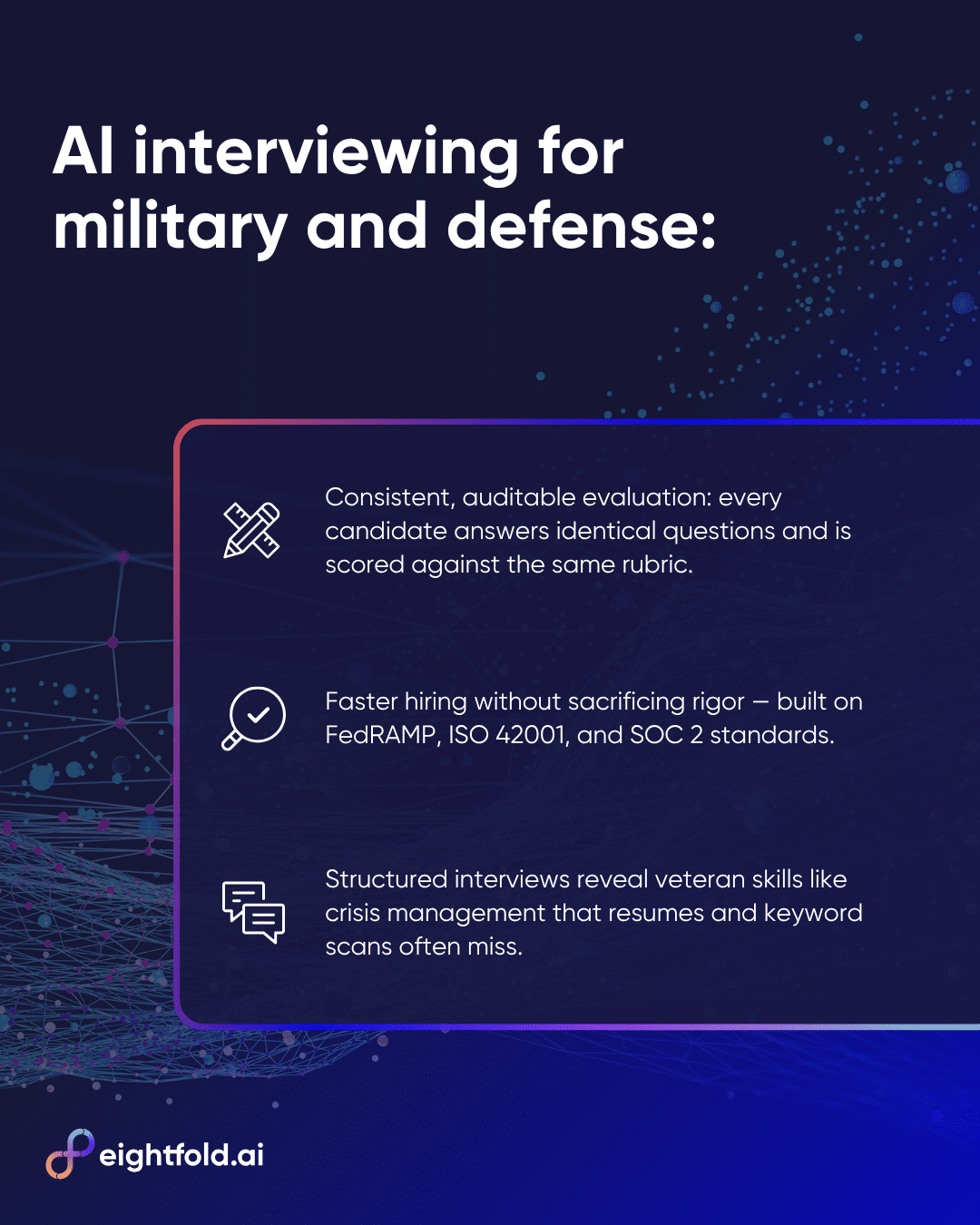
The potential for inconsistency in candidate evaluation within traditional manual processes can easily become a significant finding during an audit. This is precisely where AI interviewing offers a transformative solution. By standardizing the interview experience, AI platforms ensure that every candidate is presented with the same set of structured, role-relevant questions. Crucially, each candidate is then scored against a uniform rubric, eliminating the subjective variations that can arise from different interviewers or differing personal biases. This structured approach eliminates discrepancies based on which recruiter conducted the interview and removes any ambiguity regarding the rationale behind a candidate’s advancement or rejection, thereby creating a clear and auditable trail.
Furthermore, AI interviewing liberates the recruitment process from the constraints of human scheduling. Interviews can be initiated as soon as a candidate applies, rather than being subject to the availability of an interviewer’s calendar. Recruiters then receive structured summaries and objective scores within hours, a dramatic improvement over the weeks that can be consumed by completing a full traditional interview loop. This speed is vital in retaining top talent who are often fielding multiple offers.

Leading organizations are already experiencing the benefits of this approach. Constellis, a prominent global defense and security services provider, faced the challenge of rapidly filling a high volume of security roles while adhering to the stringent compliance and audit trail requirements of its industry. By leveraging Eightfold AI’s AI Interviewer, Constellis successfully navigated this complex demand, demonstrating the platform’s capability to deliver both volume and integrity.
The underlying infrastructure of these AI platforms is also a critical consideration for defense-related organizations. Platforms built on robust security protocols, such as those meeting FedRAMP Moderate and ISO 42001 standards, in addition to SOC 2 certification, are essential. This level of security assurance is paramount for organizations that must account for the handling of sensitive candidate data and the integrity of their hiring decisions. The U.S. Department of Defense, for example, is among the organizations that trust Eightfold’s Talent Intelligence Platform, highlighting its suitability for the most demanding environments. This signifies that these are not generalized tools being retrofitted for specialized use but platforms engineered with the rigorous requirements of national security organizations in mind from their inception.
An often-overlooked advantage of AI interviewing in the defense sector is its capacity to effectively translate military experience into civilian roles. Skills such as crisis management, decisive decision-making under pressure, and effective team leadership, which are honed through military service, can often be obscured or undervalued on resumes formatted for civilian job titles. A structured AI interview, designed to elicit these specific competencies rather than relying on keyword matching, can transform transitioning service members and veterans into visible, competitive candidates, preventing their valuable experience from being overlooked.
Public Safety: Addressing the Recruitment Crisis with Speed and Consistency
Public safety agencies, encompassing police departments, fire services, and emergency medical services (EMS), are confronting a hiring crisis that has been escalating for years. Many departments are critically understaffed, struggling to meet the demands of their communities. The inherent nature of the work – physically demanding, emotionally taxing, and often dangerous – inherently limits the pool of individuals willing and able to undertake such roles. Consequently, every week a position remains unfilled exacerbates the strain on existing personnel, pushing them to their limits.
In this high-pressure environment, speed in the recruitment process is not merely a desirable attribute; it is an absolute competitive necessity. Public safety agencies are increasingly finding themselves vying for talent in the same labor markets as private sector employers. A candidate who is forced to wait weeks for a preliminary interview is a candidate highly likely to accept an offer from another organization that can move more swiftly.
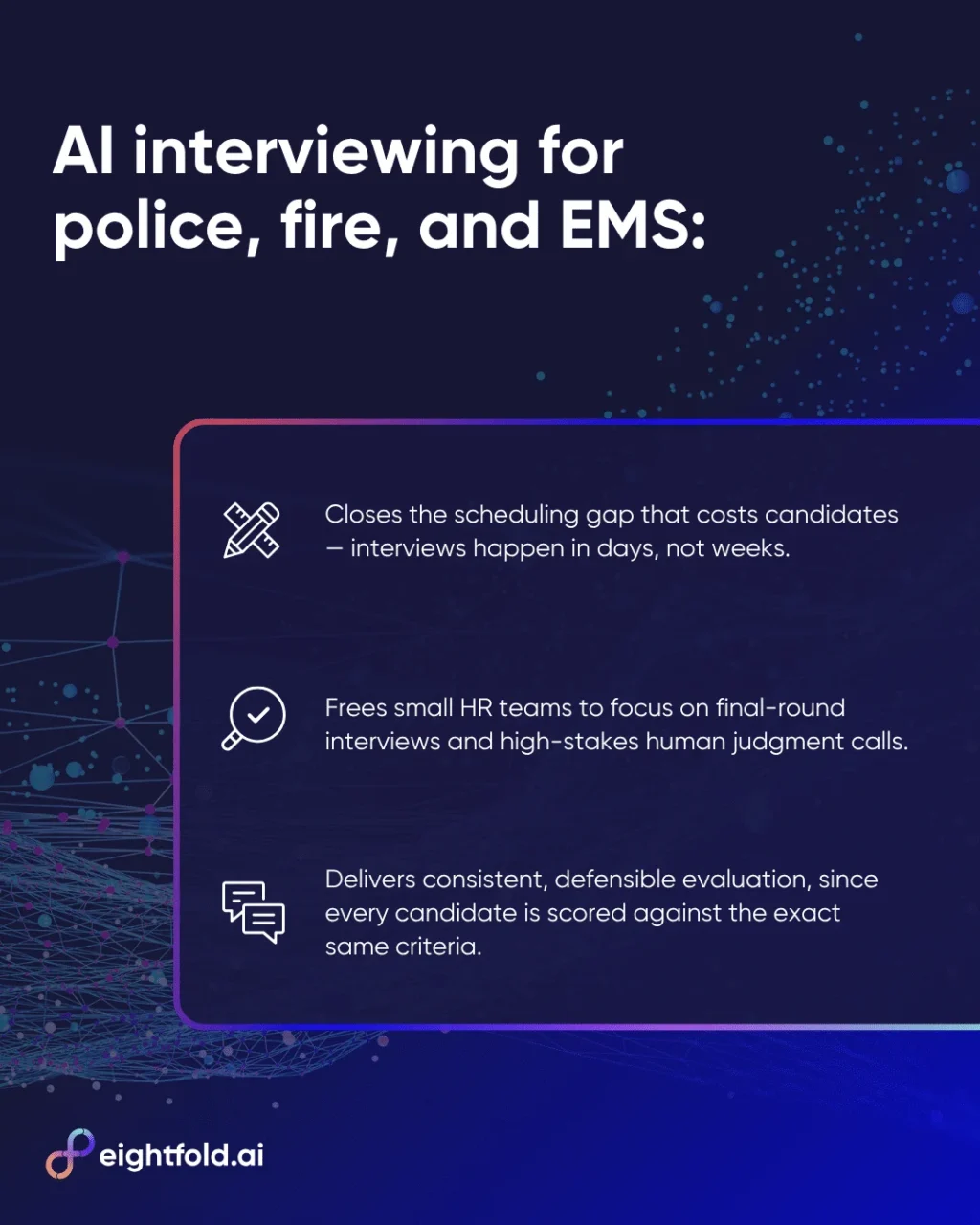
AI interviewing directly addresses this bottleneck by eliminating the scheduling constraints that plague early-stage candidate screening. Instead of waiting for a recruiter’s availability, candidates can complete a structured AI-powered interview within days of applying. This allows hiring teams to quickly identify and advance qualified candidates, significantly shortening the time-to-hire metric. According to industry reports, average time-to-hire in public safety can extend beyond 45 days, a period during which promising candidates can easily be lost. AI can reduce this initial screening phase by as much as 70%.
The importance of consistency in evaluation is as paramount in public safety as it is in defense. In roles where the consequences of a poor hiring decision can manifest in diminished public trust or compromised physical safety, every candidate must be assessed against the same objective criteria. This ensures fairness and mitigates the risk of subjective bias influencing decisions. Structured, standardized screening provides public safety agencies with a defensible foundation for their hiring outcomes. It also liberates often-limited HR and recruiting teams, allowing them to dedicate their valuable time and resources to the critical final-round interviews and the human judgment calls that remain irreplaceable, rather than being consumed by initial screening tasks.
The Unavoidable Conclusion: Speed and Standards No Longer at Odds
For organizations operating within the military, defense, and public safety sectors, the hiring process has historically been governed by a fundamental constraint: the inability to compromise between speed and accuracy. For many years, this reality necessitated the acceptance of slow, manual, and often inefficient processes as the unavoidable price of ensuring rigor and compliance.
However, this perceived trade-off is rapidly becoming obsolete. AI interviewing technology provides these critical sectors with an unprecedented capability to screen candidates more rapidly, with greater consistency, and with enhanced transparency than traditional manual methods could ever achieve. The choice between moving quickly and adhering to stringent standards is no longer a binary decision.
The organizations that first embrace and effectively integrate AI interviewing into their recruitment strategies will gain a significant advantage. They will be the ones best positioned to fill their critical roles swiftly and efficiently, while their more hesitant counterparts continue to grapple with the delays inherent in scheduling and conducting manual first-round interviews. This strategic adoption of AI is not merely an operational upgrade; it is a crucial step towards strengthening national security, ensuring public safety, and maintaining the operational readiness of vital services in an increasingly competitive landscape.
For agencies and organizations evaluating the potential integration of AI interviewing into their hiring frameworks, exploring the capabilities of platforms like Eightfold AI’s AI Interviewer is a prudent next step. Scheduling a demonstration can provide a clear understanding of how these advanced solutions can be tailored to meet the specific demands of mission-critical, high-compliance hiring environments.