
For nearly three decades, the landscape of organizations, work, and human resources has been a dynamic terrain, shaped by successive waves of transformative themes. From the initial surge of digital transformation and the growing emphasis on employee well-being to the complexities of hybrid work models, the imperative of diversity and inclusion, and the ongoing advocacy for women’s rights, a constant evolution has been evident. Now, Artificial Intelligence (AI) has emerged as the latest dominant force, prompting a critical examination of the underlying trajectory of employment and the fundamental relationship between workers and their employers. While some narratives suggest a move towards a "more human" workplace, a deeper analysis of current trends and historical data reveals a more complex and arguably disquieting reality: the "Great Decoupling" of workers from their employers.
The Erosion of Trust and the Rise of Insecurity
The contemporary workplace is characterized by a palpable sense of unease, a sentiment amplified by the persistent specter of layoffs. Companies today frequently resort to perfunctory email notifications, often with minimal notice, to sever employment ties. This abruptness starkly contrasts with previous eras where such decisions were typically handled with greater deliberation and a degree of human interaction. Furthermore, the once-prominent discourse around Diversity, Equity, and Inclusion (DEI) and issues like pay equity, which aimed to foster fairness and reduce disparities, appear to have receded in significance. This is particularly evident in high-demand fields like AI engineering, where starting salaries can exceed half a million dollars, creating a stark dichotomy with the financial realities faced by many other professionals.
The pervasive anxiety among employees is intrinsically linked to a prolonged and concerning decline in trust. Decades of research, including prominent studies by Pew and Edelman, consistently point to a widening chasm between workers and their leadership. A 2024 PwC report underscored this trend, revealing that only 67% of employees express overall trust in their employers. This figure plummets for frontline workers, who constitute a significant majority of the workforce, with less than half indicating trust.
The erosion of faith in leadership is even more pronounced. In 2019, approximately 25% of workers reported trusting their company’s leaders; this figure has now dwindled to around 19% and continues its downward trajectory. While employee trust saw a temporary surge during the initial phase of the COVID-19 pandemic, as organizations rallied to support their workforces, the recent discourse surrounding AI-driven layoffs has triggered a precipitous decline. This sentiment is further exacerbated by the perception that AI is being positioned as a tool for cost reduction rather than as a collaborative partner for human augmentation.
The "Great Decoupling": A Deepening Trend
Beyond the immediate concerns about trust and job security, the most significant and enduring trend in the modern employment landscape is the "decoupling" of workers from their employers. This phenomenon is evidenced by a dramatic increase in supplementary income-generating activities, often referred to as "side hustles." Currently, over 65% of workers engage in such endeavors, reflecting a proactive effort to diversify income streams and reduce reliance on a single employer. Concurrently, the rate of layoffs and voluntary job transitions has surged.
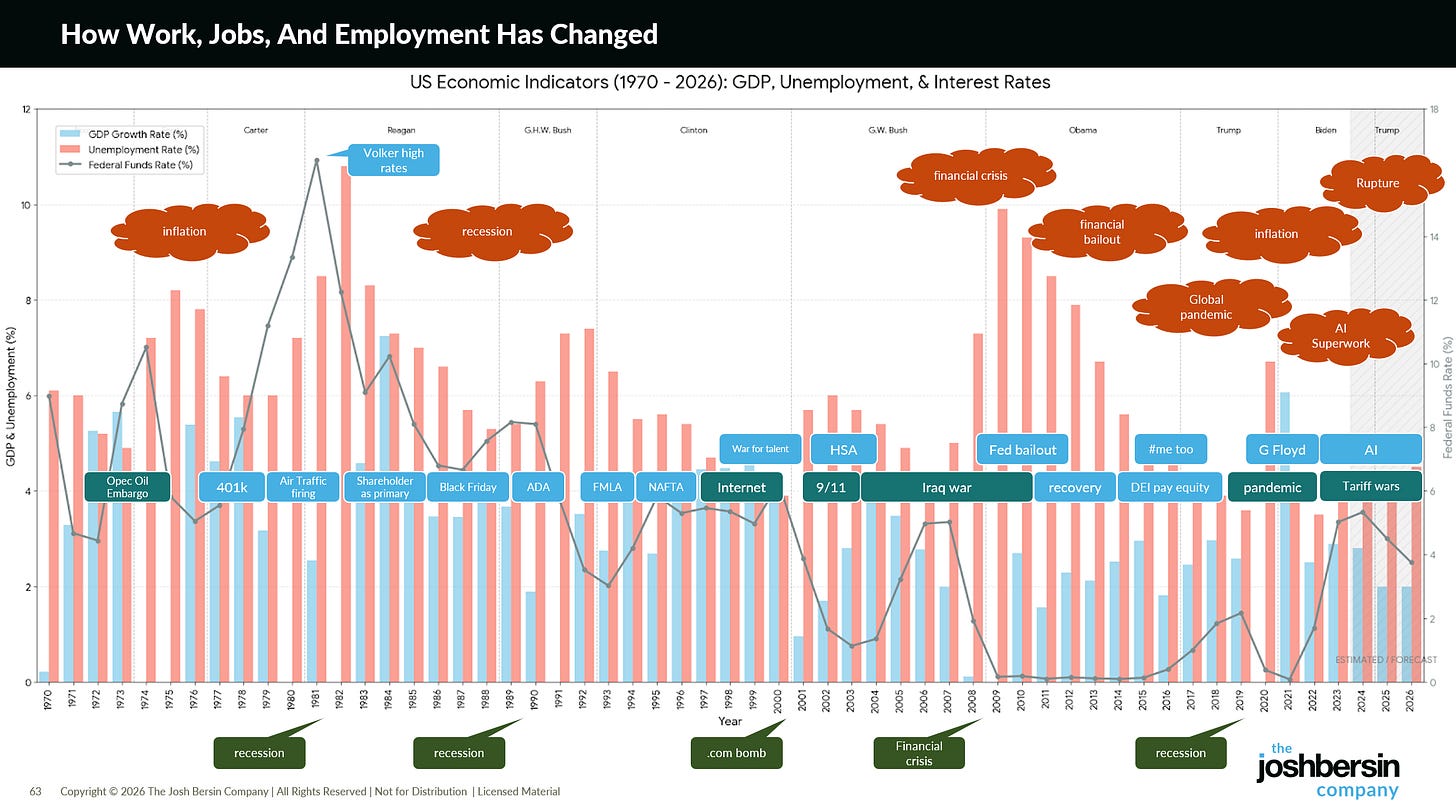
Research indicates a stark increase in career mobility and job changes. While three decades ago, the average US worker might have experienced one or two layoffs throughout their career, current data suggests this number has more than doubled. Projections indicate that the average US worker could face 2.5 layoffs during their professional journey. This trend is not merely anecdotal; it is corroborated by extensive data visualizations that track economic indicators, regulatory shifts, and presidential administrations over extended periods.

Historical Context: From the "Ownership Economy" to Global Competition
A comprehensive review of historical economic data, often presented through charts and graphs, reveals a consistent, multi-decade trend away from traditional labor protections and towards what former President George W. Bush termed an "ownership economy." This shift began to accelerate in the latter half of the 20th century, marked by a decline in the influence of labor unions, a weakening of collective bargaining power, and a corresponding reduction in legislative support for workers’ rights.
Instead, the emphasis has increasingly been placed on individual responsibility and self-reliance. Retirement plans have largely transitioned to defined contribution models like the 401(k), placing the onus of long-term financial security on the individual. Similarly, benefits such as family leave and health savings accounts have shifted a greater portion of the financial burden onto employees. Globalization, exemplified by agreements like NAFTA, further contributed to the outsourcing of stable, traditionally secure jobs, accelerating the move towards a more fluid and less predictable labor market.
The stability of corporations themselves has also diminished. In the 1970s and 1980s, companies typically remained on the S&P 500 for an average of 12-13 years. Today, this average has contracted to approximately 4-5 years, a consequence of rapid technological advancements and intense global competition that constantly threaten established business models. While this dynamism can foster innovation, it fundamentally alters the nature of work and career progression, demanding greater adaptability from individuals.
The AI Revolution and the Pressure for Self-Reliance
The current anxieties surrounding AI are understandable, yet some analysts, like the author of the original piece, view AI as a potential net positive for workers, arguing that it can unlock new avenues for innovation and productivity. This perspective suggests that the accelerating trend towards "self-career management" is reaching a zenith. The encouragement is to proactively engage with emerging technologies, such as advanced AI models, to build personal brands, launch entrepreneurial ventures, or acquire specialized skills in fields like software development.
However, this optimistic outlook overlooks a critical economic reality: a significant portion of the workforce lacks the financial cushion to pursue such entrepreneurial paths. In the United States, over half of the working population has less than three weeks of savings. This precarious financial situation forces many workers into a relentless cycle, constantly striving to maintain their current standard of living. The Michigan US Economic Sentiment Index, a key indicator of consumer confidence, has recently fallen to a 60-year low, a trend exacerbated by rising energy prices and persistent inflation.
The shift in the gig economy further illustrates this dynamic. Once viewed as a liberating alternative to traditional employment, driving for services like Uber or DoorDash has increasingly become a survival tactic for many. As these platforms mature and consolidate market power, they exert downward pressure on labor costs, diminishing the autonomy and earning potential of their workers. This sentiment is echoed across various sectors, with many individuals, including HR professionals, expressing a fear of being automated out of their roles, even if this perception is not entirely grounded in immediate reality.
The Inevitable March of the "Ownership Economy"
The "decoupling" of workers from employers is not a sudden development but rather an ongoing, almost inevitable process that gained momentum under the Reagan administration and has been significantly amplified by the internet and the rise of AI. The ease with which companies can now source talent globally, coupled with sophisticated performance-tracking technologies, facilitates a more transactional approach to labor.
While highly skilled tradespeople, such as nurses, machinists, plumbers, and electricians, may currently enjoy robust demand and stable employment, professionals in fields like accounting and administration may face increased anxiety. The narrative, albeit delivered with a touch of irony, suggests that individuals in these roles might consider leveraging AI tools to establish their own independent practices or ventures.
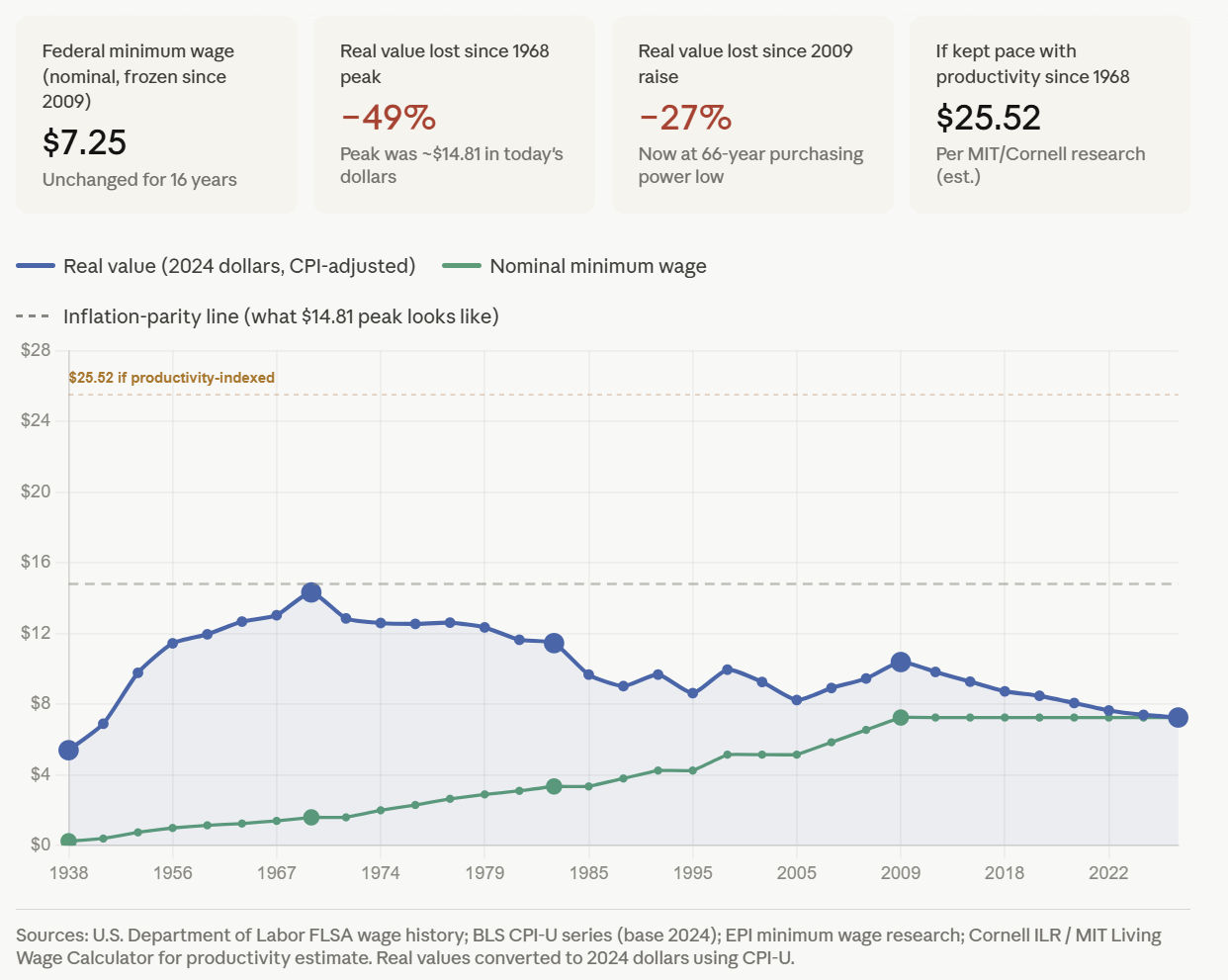
However, the economic realities for many are starkly different. The federal minimum wage in the US has remained stagnant at $7.25 per hour since July 2009, marking the longest period without an increase in history. This stagnation has resulted in a significant loss of purchasing power, with the real value of the minimum wage declining by 49%. While most workers do not earn the minimum wage, this policy inaction reflects a broader governmental stance that places the onus of economic security primarily on individuals rather than systemic support.
The Impact on Worker Earnings and Adaptation Strategies
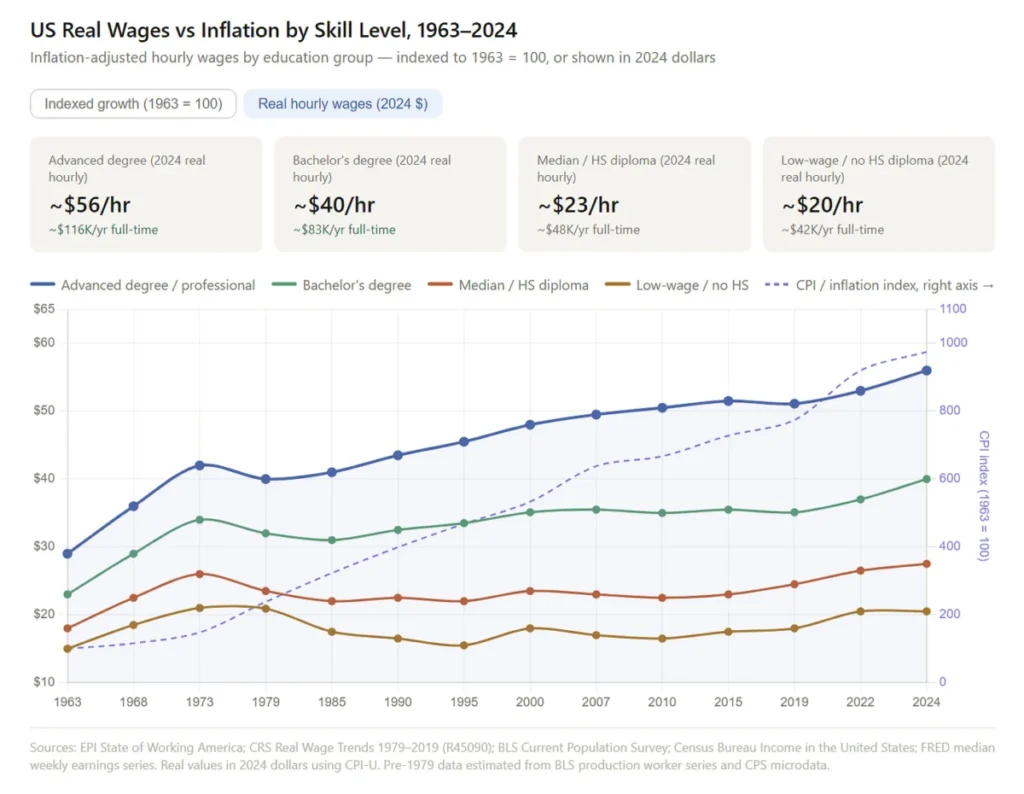
The long-term consequences of this decoupling are starkly illustrated by the stagnant real wages for various segments of the American workforce. Data reveals that since the 1960s and 1970s, before the significant onset of decoupling, wages generally outpaced inflation. However, following the inflationary shock of the 1970s, wages began to lag behind the rising cost of living.
This trend has disproportionately affected different demographic groups. Low-wage workers and high school graduates saw their standards of living decline most sharply in the early 1980s. College graduates began to experience wage stagnation in the late 1990s, and those with advanced degrees, who had previously seen consistent growth, have also begun to see their earnings plateau, even slipping in the wake of the pandemic. This suggests that the traditional pathways to economic advancement, particularly the reliance on higher education as a guarantee of sustained wage growth, have become less reliable.
Reimagining the Employer-Employee Relationship
The fundamental issue underpinning "The Great Decoupling" is not solely about wages versus inflation, but rather about the evolving perception of employers’ responsibilities towards their workforce. A growing number of companies exhibit a diminished sense of obligation or interest in the long-term financial well-being of their employees. This, in turn, has fostered a reciprocal detachment, with employees exhibiting a significantly higher propensity to switch jobs compared to previous decades.
This mutual disengagement is tacitly supported by market dynamics and governmental policies. The stock market often reacts positively to layoff announcements, as financial analysts increasingly view labor as a "cost" to be minimized rather than an "investment" to be nurtured. The accounting principle of treating labor as an expense, rooted in agrarian economic models, perpetuates this perspective, making it resistant to change despite its detrimental impact on workforce stability and morale.
Addressing the Challenges: A Path Forward
While the trend of decoupling may seem inevitable, the approach to addressing its consequences can be varied. The author advocates against massive income redistribution schemes, citing historical failures and the potential for social and political friction. Instead, the focus is placed on empowering individuals through reskilling, upskilling, and continuous education.
The US education system faces significant challenges, with a concerning percentage of adults lacking proficiency in reading comprehension at a 12th-grade level. This deficiency becomes particularly acute with the advent of AI, which requires individuals to process complex information, understand nuanced policy language, and follow multi-step instructions. The argument is made that foundational education in literacy, critical thinking, history, and the humanities is paramount, fostering the "power skills" that enable individuals to adapt and thrive in an evolving technological landscape. Companies are encouraged to invest in broad educational initiatives, such as those offered by organizations like Guild, and to champion the development of these essential cognitive abilities.
Furthermore, the author critiques current corporate practices in workforce and talent management. The prevailing approach, characterized by frequent layoffs, team shrinking, and simultaneous aggressive hiring, is deemed inefficient and detrimental to organizational health. This short-sighted strategy, driven by a perception of readily available talent, erodes company culture, leads to the loss of critical skills and institutional knowledge, and cultivates long-term distrust among employees. A more sustainable approach, the argument goes, involves slowing down hiring processes, being more selective in recruitment, and designing businesses for scalable growth rather than simply managing headcount fluctuations.
The Long-Term Vision: Investing in Human Capital
The "Great Decoupling" has been a gradual process, spanning nearly six decades. While it may appear to be a natural societal evolution, particularly from the perspective of investors and many corporate leaders, it is not an immutable destiny. Companies possess the agency to choose their path. Those that emulate high-growth, venture-backed startups, driven by rapid scaling and immediate market gains, are more likely to perpetuate this trend. In such environments, employee retention may be secondary to rapid expansion and the potential for lucrative exits, with AI further accelerating the potential for automation and detachment.
Conversely, enduring organizations, such as Nvidia, Microsoft, Apple, Seagate, Wynn, Marriott, L’Oréal, Chevron, and Exxon, demonstrate a long-term perspective. While acknowledging the pressures of growth and adaptation, these companies prioritize their human capital. They strive to minimize layoffs, avoid overhiring, and cultivate a stable, skilled workforce.
As AI ushers in an era of unprecedented reinvention, there is a compelling case to be made for leaning into existing talent. Empowering current employees to lead innovation and transformation represents a genuine leadership challenge and a more sustainable strategy for long-term success. The author concludes that people are the only truly appreciating asset in a business, and investment in their long-term development, retention, and growth yields significant returns. In an environment characterized by rapid decisions and reactive market responses, leaders are urged to prioritize the well-being of their people, recognizing them as the ultimate drivers of growth, value, and innovation.







