
The global business landscape is in a state of rapid transformation, driven by the imperative to reskill, upskill, and accelerate the adoption of Artificial Intelligence (AI). This urgency was palpable during recent engagements with over 200 Chief Human Resource Officers (CHROs) in India and Singapore, where the paramount concern was "AI readiness" – specifically, how to rapidly enhance AI fluency and capabilities across their organizations. The overwhelming consensus points to a critical juncture: the established methodologies, technological infrastructures, and operational models for corporate learning are no longer sufficient to meet the demands of this evolving era.
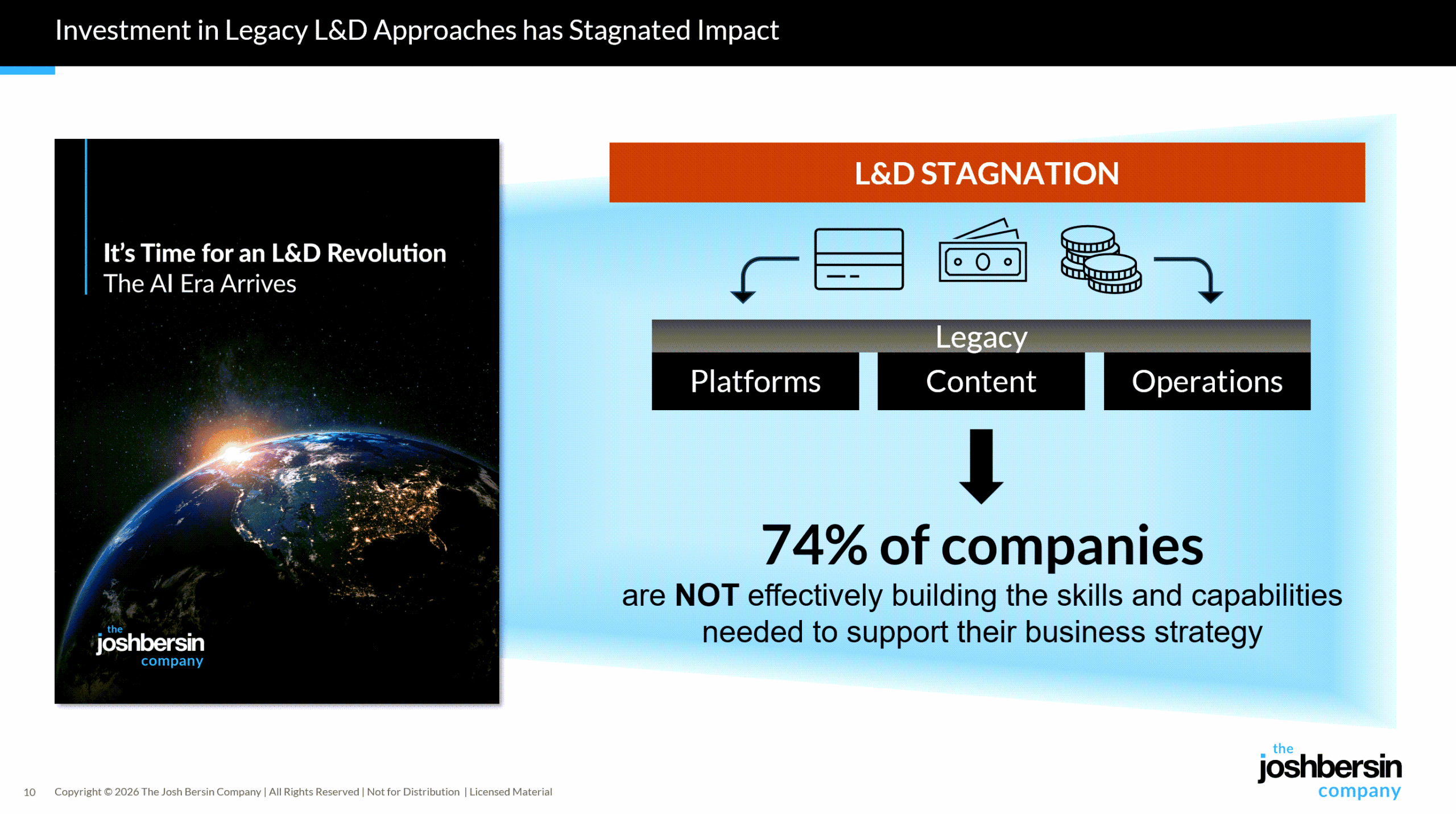
A comprehensive, multi-year study of corporate learning and development (L&D) has yielded startling findings. Released this week, the fifth major study on the subject reveals that a staggering 74% of companies report being unable to keep pace with their organization’s evolving skill requirements. This statistic, emerging from a sector that expends an estimated $400 billion annually on training programs, content libraries, L&D technology, and consulting services, suggests a colossal inefficiency, with billions of dollars potentially representing wasted effort.
The core of the problem, as identified by the research, lies in a fundamental misunderstanding of the challenge itself. The current crisis is not merely about "learning" or "training" in the traditional sense. Instead, it is a complex issue of dynamically sharing information, empowering individuals to explore, question, and apply new ideas effectively. The traditional pedagogical paradigm, deeply entrenched in the concept of "training," is proving to be a significant impediment to progress.

The Paradigm Shift: From Training to Dynamic Enablement
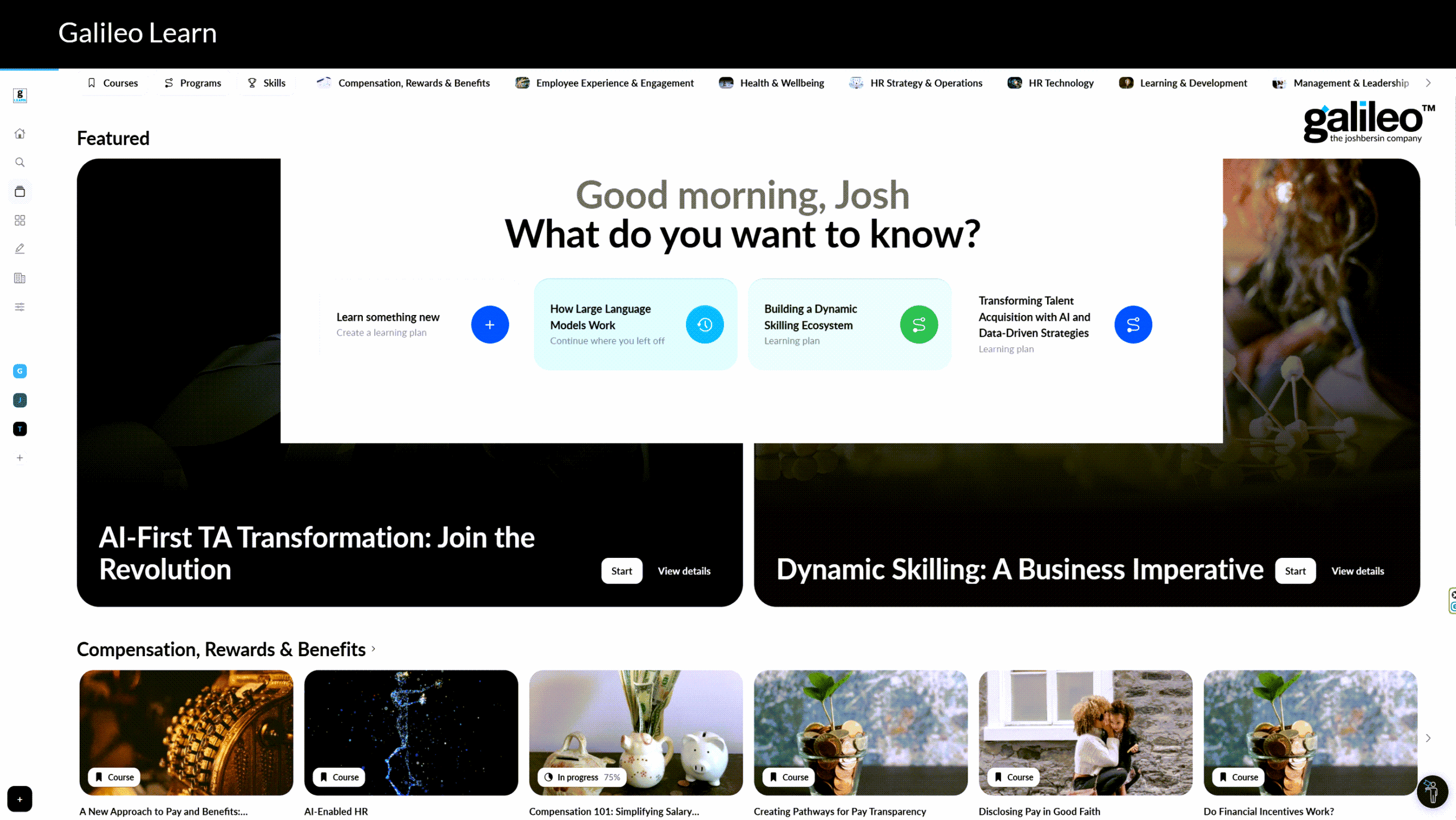
The research underscores a profound shift in how organizations must approach skill development. The advent of AI, particularly generative AI, is poised to fundamentally reinvent the learning experience within enterprises. AI-native systems, capable of dynamically generating and sharing content, offer a revolutionary approach to training, upskilling, supporting, and ultimately, "enabling" employees. This new paradigm, exemplified by platforms like Galileo, promises to redefine L&D, HR, and indeed, all facets of organizational change.
What Constitutes AI-Native Learning?
AI-native learning leverages the inherent capabilities of generative AI to create content on demand. Unlike traditional methods that involve manual design, development, and publication of static courseware, which requires constant updates and revisions, AI platforms can construct content dynamically and present it in any desired format.
Platforms built on this principle allow for the rapid creation of new courses, often in days rather than months. Furthermore, as new information or topics emerge, the entire system can be updated seamlessly. This ensures that employees have immediate access to the most current and relevant knowledge. The benefits for employees are manifold:

- On-Demand Skill Acquisition: Employees can acquire new skills precisely when and where they need them, without the constraints of scheduled courses or lengthy development cycles.
- Personalized Learning Paths: AI can infer an individual’s skill level based on their interactions with the system, automatically categorizing content into relevant skill taxonomies and suggesting tailored learning pathways.
- Contextualized Knowledge Access: Every piece of information within the system is interconnected. This means employees can find answers to questions or access relevant knowledge without needing to navigate through extensive course catalogs. The system functions as a unified "intelligence system" for the organization.
The success of platforms like ChatGPT, with a significant portion of its vast user base engaging in learning activities, highlights the efficacy of this interactive, on-demand approach. This level of engagement and successful knowledge acquisition far surpasses that achieved by traditional course catalogs.
Moreover, these AI-native systems can ingest and process a wide range of content, including recordings of expert interviews. This continuous influx of new information keeps the system current and provides employees with practical insights, tips, and findings directly from subject matter experts. This application of AI is not merely an incremental improvement; it represents a potentially transformative force, capable of driving trillions of dollars in business improvement.
The Learning Maturity Model: Charting the Path to AI-Native Excellence
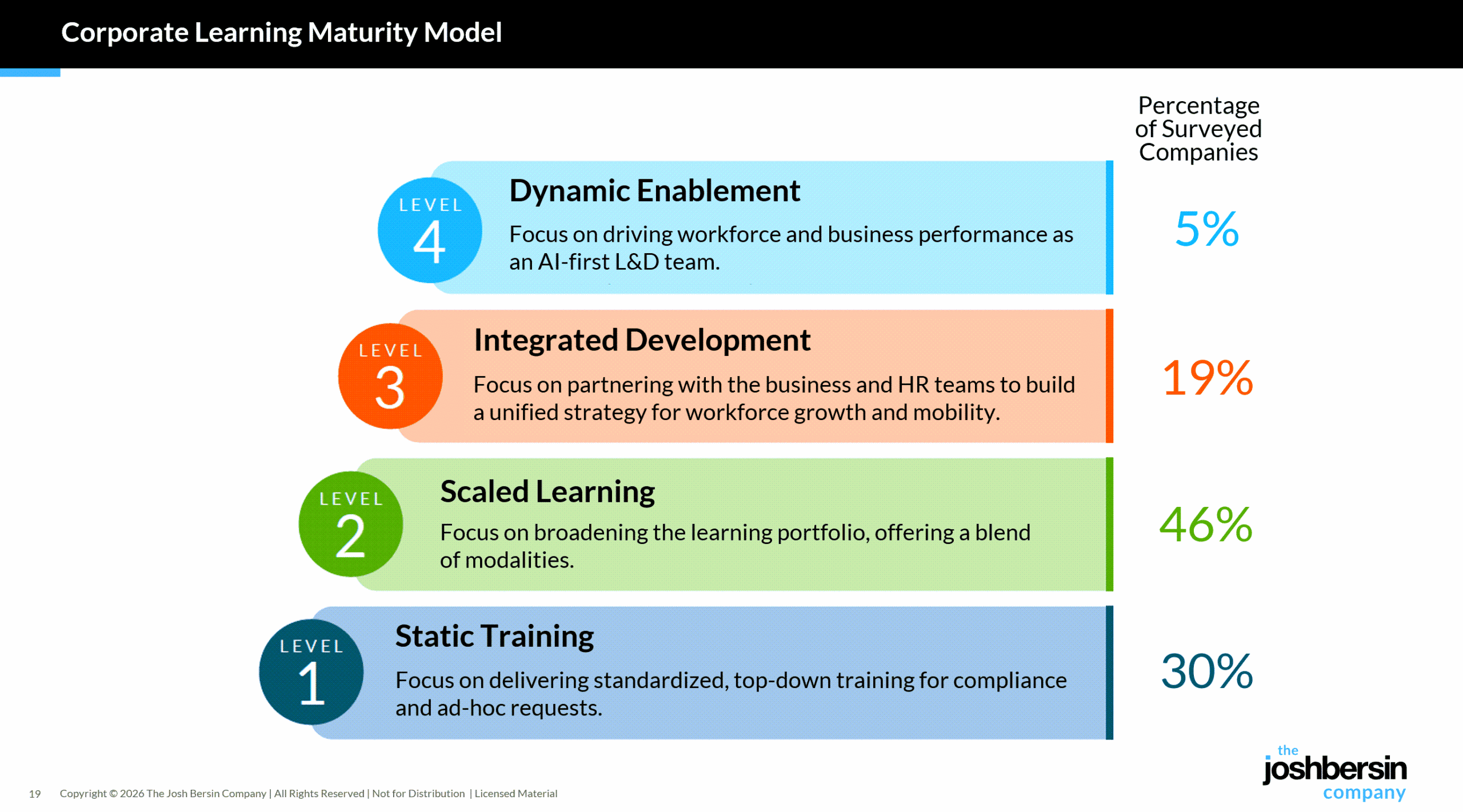
To guide organizations in this transformative journey, a new Learning Maturity Model has been developed, outlining four distinct levels of L&D sophistication.
Level 1: Static Training Programs
The foundational level, characterized by static training programs, focuses on compliance-based or top-down mandatory completion. Companies at this stage typically build or acquire courses to address specific needs like compliance mandates, new product launches, or other episodic requirements. While these programs may be cost-effective and help employees stay current with immediate changes, they offer minimal scope for skills-based learning. This segment represents approximately one-third of the market.
Level 2: Scaled Learning
As organizations mature, they move to Level 2, Scaled Learning, incorporating a broader array of learning formats beyond traditional courses. This includes videos, audio content, job aids, and other "learning tools." The aim is to diversify the learning portfolio and provide employees with more options, often relying on content from external vendors. Major platforms like LinkedIn Learning, Coursera, Skillsoft, and Pluralsight primarily operate within this category. While this expands learning opportunities, it places the onus on the individual learner to discern what, when, and how to consume the available resources.
Level 3: Integrated Development
Level 3, Integrated Development, involves tailoring learning programs around specific job roles, skills, and career paths. Organizations at this stage develop comprehensive "development programs" rather than just isolated training modules. This introduces significant complexity, requiring the management of technical and professional skills, job roles, and career levels.
The challenge at Level 3 is the dynamic nature of the modern workforce. With a substantial percentage of job-related skills becoming obsolete annually, maintaining these intricate, multi-dimensional programs becomes a Herculean task. While effective for channel training, technical education, and onboarding new employees, the maintenance and refreshing of curricula, skills models, and content objects can lead to escalating L&D costs and operational overhead. Companies like Cisco and Ericsson, having invested heavily in this model, often grapple with a vast and sometimes unwieldy array of activities.
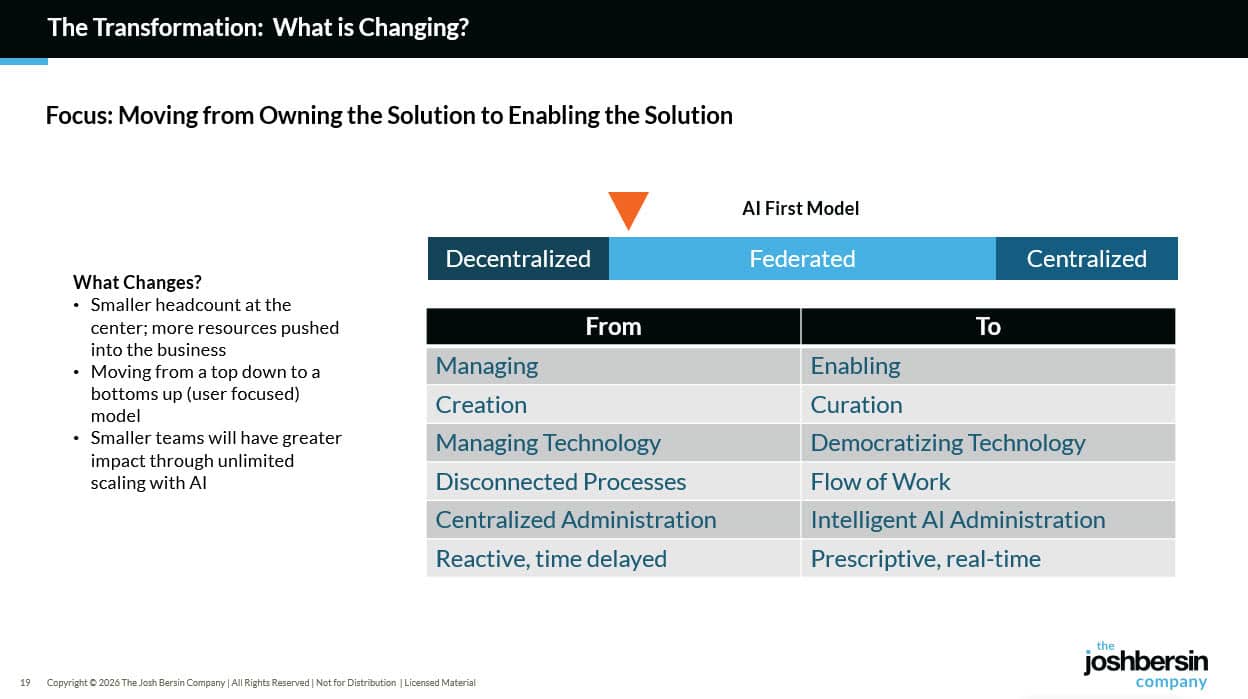
A critical factor at this level is the decentralized nature of corporate learning. While central L&D teams manage strategic programs, an estimated 70% of training occurs within specialized domains such as sales, manufacturing, and customer service. This necessitates localized content development and infrastructure, diverting resources from frontline training needs. Consequently, many Level 3 organizations adopt a "federated" model, delegating business-unit-specific training to local teams, leading to a more complex yet potentially more scalable approach.
Level 4: AI Transforms Everything – Dynamic Enablement
The apex of this maturity model is Level 4, where AI fundamentally transforms the learning landscape, ushering in an era of "Dynamic Enablement." This level envisions a platform that consolidates all organizational knowledge – encompassing courses, documents, policies, and expert interviews. This is far more than a traditional "learning platform"; it represents a holistic knowledge ecosystem.
AI-native learning, as described, enables organizations to publish information rapidly, often in days rather than months. Employees, in turn, can access this knowledge in ways that best suit their individual learning styles and immediate needs. While many organizations retain their legacy Learning Management Systems (LMS) for compliance, new AI-driven platforms are emerging to replace Learning Experience Platforms (LXPs), learning portals, and most content development tools. Early adopters of these AI-native solutions are already reporting significant reductions in internal L&D spend, with some experiencing savings of 40-50%.
The Tangible Impact: Savings, Innovation, and Business Alignment
The transition to Level 4, Dynamic Enablement, offers profound benefits. Organizations can achieve substantial savings in both time and financial resources while delivering an enhanced employee experience. Furthermore, this approach aligns learning directly with business objectives. As outlined in the Systemic HR AI Blueprint, learning can be seamlessly integrated into existing corporate workflows and chatbots.
Consider the practical applications:
- Benefits Assistance: Employees can inquire about benefit options directly within HR systems, receiving immediate, contextually relevant information.
- Sales Enablement: When entering a new opportunity in CRM systems like Salesforce, sales teams can prompt for coaching on strategies specific to that industry.
- Operational Readiness: Upon logging into workstations, frontline workers in manufacturing or healthcare can ask chatbots about recent process changes or departmental updates.
One client, a large travel reservations company, effectively utilizes call recordings from its top customer service agents within the AI learning system. This allows other agents to learn best practices and navigate difficult customer interactions by studying real-world scenarios. Similar opportunities exist across customer service, engineering, sales, and all support functions.
Even within organizations developing these AI platforms, new materials, including client interviews that clients agree to share, are published directly into the system. This empowers any employee to gain insights into specific clients, understand industry nuances, and better comprehend new client needs.
This new domain, termed "Dynamic Enablement," signifies a crucial shift from mere "learning" to actively "enabling" employees. The fundamental premise is that individuals learn at work not for the sake of learning itself, but to enhance their capabilities, perform at a higher level, and drive organizational growth.
Proven Returns: The Financial and Strategic Advantages of AI-Native Learning
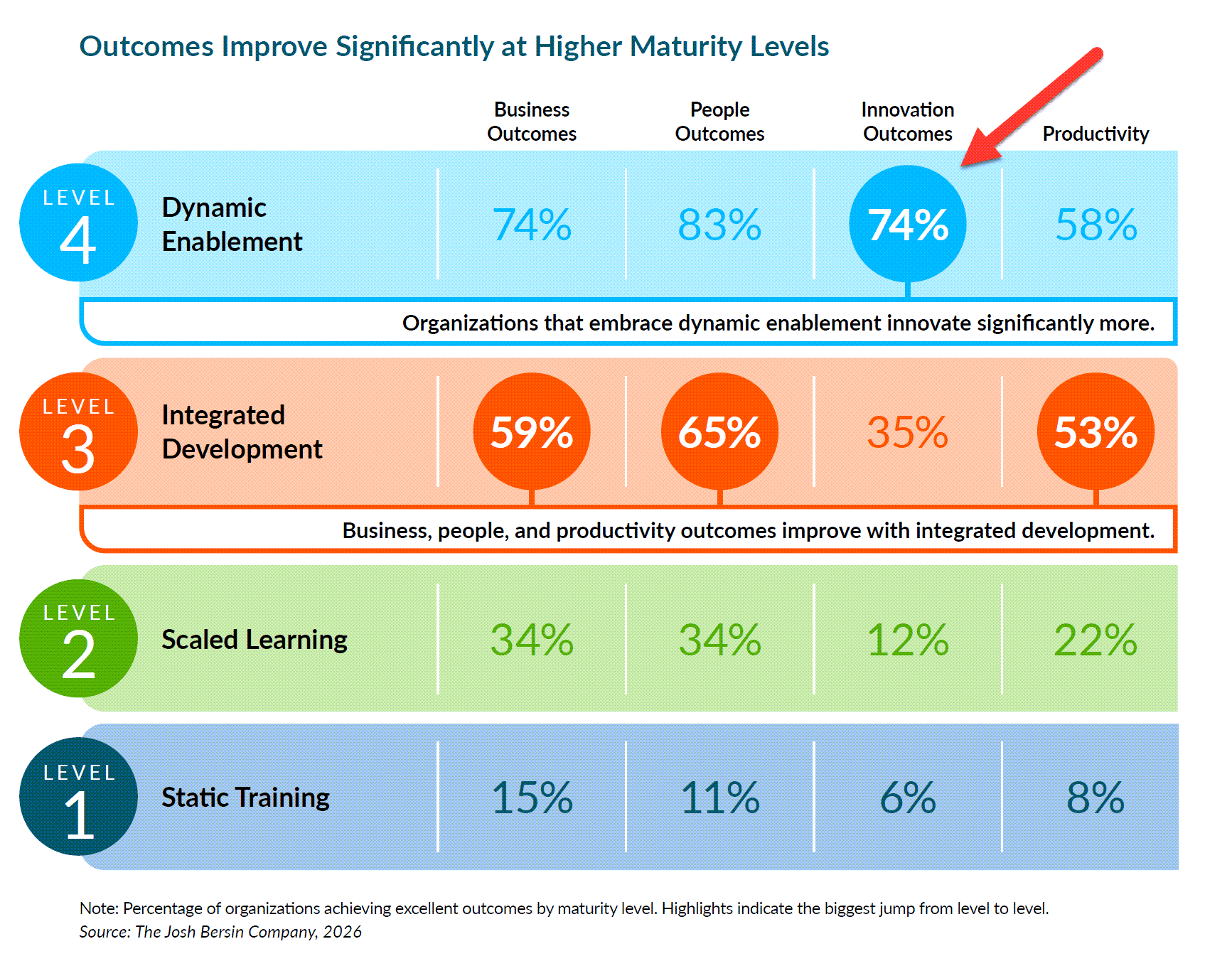
The research consistently demonstrates a strong correlation between advanced learning maturity and positive business outcomes. Companies operating at Level 4 are significantly more likely to be innovation leaders (10 times more likely), exceed financial targets (6 times more likely), and adapt effectively to change (16 times more likely). As these AI-driven learning platforms mature, the magnitude of these benefits is expected to grow even larger.
Charting the Course: Strategic Recommendations for Companies
Achieving AI-Native Learning, or "Dynamic Enablement," is not simply about using AI to expedite course creation. It necessitates a fundamental re-evaluation of existing L&D infrastructures, including a potential transition from traditional SCORM-based LMS to dynamic content systems. Several vendors are emerging in this space, including Sana, Arist, Disperz, Uplimit, and Colossyan, with more expected to follow.
The roadmap to Dynamic Enablement involves several key steps:
- Content Rationalization: Organizations must assess their existing content libraries, identifying which materials are essential and which can be retired or transformed. SCORM courses, for instance, can often be converted into an AI-native format using platforms like Galileo.
- New Governance Models: Establishing new governance structures for L&D is crucial. Early adopters in industries like insurance, healthcare, pharma, and airlines have found that once the AI-native system is operational, line-of-business training can be effectively delegated to local staff.
- Hybrid/Distributed Operating Models: This agile, distributed operating model allows central HR to focus on global strategic priorities such as leadership development, compliance, culture, and overarching business strategy. Simultaneously, individual business units can establish their own "Enablement Academies" for specialized functions like sales or manufacturing.
The Bottom Line: AI-Native Learning as a Catalyst for Business Transformation
The evidence is compelling: companies embracing Level 4, AI-Native Learning, are demonstrably more innovative, financially successful, and adaptable. Dynamic Enablement is emerging as the critical driver for learning, change management, and strategy execution in an era where continuous adaptation is paramount.
To facilitate this transition, comprehensive research, case studies, benchmark data, and maturity model diagnostics are available through platforms like Galileo. These resources, coupled with agentic workflows, enable organizations to assess their current maturity level, explore relevant case studies, and evaluate potential vendors.
A dedicated "Galileo Learning" program, "The Journey to Dynamic Enablement," has also been launched, providing users with a hands-on experience of authoring courses and interacting with AI-Native learning firsthand. The invitation is extended to all organizations to embark on this transformative journey, embracing the future of corporate learning and unlocking unprecedented levels of business performance and employee empowerment. The era of dynamic enablement is not a distant possibility; it is the present imperative for sustained success.