
The contemporary business arena is defined by an intricate web of complexity, constant flux, and an unfortunate propensity for crises. These pervasive conditions have amplified an already challenging operational environment, underscoring the critical imperative for organizations and their leaders to respond with remarkable agility. While the capacity to react swiftly can undoubtedly help businesses weather immediate storms, it is demonstrably insufficient for achieving sustained growth and competitive preeminence. Merely keeping pace in today’s dynamic marketplace will not guarantee enduring success; rather, it necessitates a proactive focus on what truly differentiates an organization and, by extension, the specific leadership behaviors and mindsets that are essential for cultivating that distinction.
This pursuit is fraught with difficulty. The present and future are often obscured by ambiguity, making it challenging to delineate a clear connection between the day-to-day decisions and actions of leaders and the overarching strategic objectives of the organization. However, a robust framework exists that can bridge this gap, illuminating a clear pathway from leadership practices to long-term, sustainable organizational prosperity. This framework, conceptualized through extensive research and practical experience, centers on the integral role of organizational capabilities as the linchpin connecting strategic vision to actionable leadership behaviors.
The Leadership Strategy Model: A Framework for Sustainable Success
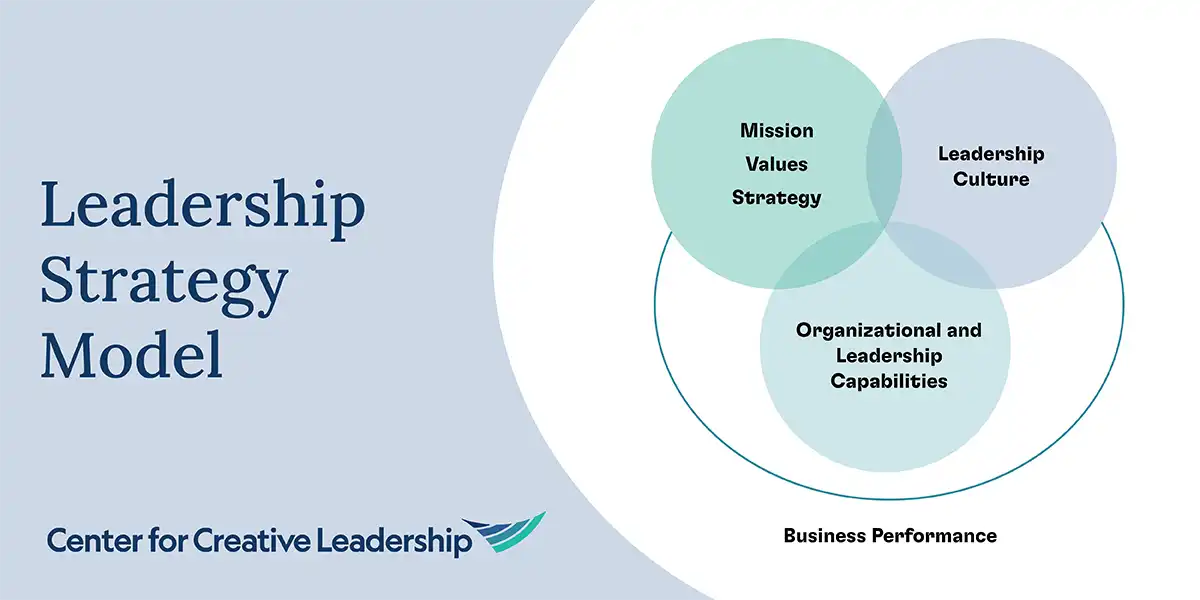
Decades of research and engagement with global organizations have culminated in the development of a comprehensive Leadership Strategy Model, designed to elucidate the intricate relationship between an organization’s strategic aims and the leadership behaviors required to achieve them. At its core, this model comprises five interconnected elements, with organizational capabilities serving as the vital conduit that translates strategy into the development of crucial leadership competencies.
The foundational elements of this model are mission, values, and strategy, which collectively form the organization’s strategic backbone. Equally pivotal is the leadership culture, encompassing the shared beliefs, norms, and expectations that dictate how leadership is enacted and recognized on a daily basis. From this bedrock, organizational capabilities emerge as the distinct attributes that define a business’s competitive identity. Complementing these are leadership capabilities, which empower leaders to cultivate and sustain these organizational strengths. In concert, these components transform abstract strategy into tangible, impactful action.
A common pitfall observed in many organizations is the tendency to leap directly from high-level business strategy to individual leader behaviors, bypassing the crucial step of defining what the organization needs to be collectively proficient at. Organizational capabilities act as the indispensable bridge in this process. Clarifying these capabilities first imbues subsequent efforts, including the prioritization of specific leadership behaviors, with greater purpose and precision.
Defining Organizational Capabilities: The Engine of Competitive Identity
Organizational capabilities represent the collective knowledge, skills, and processes that an organization possesses – encompassing both its inherent strengths and areas requiring development. They serve as a powerful indicator of the customer segments a business is best equipped to serve and the strategies it is most likely to execute successfully. These capabilities are not abstract concepts; they manifest in observable leadership behaviors that can be tracked and measured. Ultimately, organizational capabilities exist only when individuals bring the right combination of skills, knowledge, and attributes to their work, making it impossible to decouple collective organizational strengths from the actions of individual leaders.
The expectation that strategic objectives can be realized solely through individual leader behaviors, without first identifying the necessary collective capabilities, creates a significant disconnect. This oversight leaves leaders without the essential context to prioritize the most impactful behaviors, and it leaves the organization lacking the coherence required for effective execution. When organizational capabilities are clearly defined, they harmonize the business and human systems, enabling the enterprise to create value in ways that competitors find exceedingly difficult to replicate.

The concept of organizational capabilities is not a recent development. Business theorists in the 1990s began shifting the focus from an external market orientation to an in-depth examination of internal organizational strengths. This introspection compelled leaders to make deliberate choices regarding strategic investments. This thinking has since evolved significantly, particularly to address the imperative for organizations to adapt their capabilities in the face of perpetual disruption.
For decades, the Organizational Leadership practice has leveraged a research-based suite of organizational capabilities to guide clients through large-scale change and transformation initiatives. This work has been informed by a deep understanding of leadership as a social process and the profound influence of leadership culture in demonstrating and reinforcing these capabilities. Extensive studies, spanning over 20 years and involving numerous executive teams, have identified a core set of capabilities that consistently play a role in successful organizational transformations.
More recently, this research has been revisited to incorporate the impact of technological advancements, globalization, and other influential factors on organizational capabilities. Detailed behavioral components have been added to enhance understanding and facilitate a more precise connection to leadership capabilities.
A Research-Based Framework: 11 Pillars of Organizational Strength
Through rigorous research and extensive practical application, a framework encompassing 11 distinct organizational capabilities has been established. Each capability is intrinsically linked to an organization’s strategic and cultural identity and is defined by its observable manifestations in action.
- Leading Transformation: The ability to guide the organization through significant change, fostering adaptability and resilience.
- Driving Productivity: Optimizing processes, resource allocation, and operational efficiency to maximize output.
- Fostering Innovation: Cultivating an environment where new ideas are generated, explored, and brought to market.
- Determining Performance: Establishing clear metrics, feedback mechanisms, and accountability structures to drive results.
- Building Talent: Attracting, developing, and retaining individuals with the skills and potential to contribute to organizational success.
- Engaging Stakeholders: Building and maintaining strong relationships with all parties who have an interest in the organization’s success.
- Managing Information: Effectively collecting, analyzing, and disseminating data to inform decision-making.
- Leveraging Technology: Strategically integrating and utilizing technological solutions to enhance operations and competitive advantage.
- Operating Globally: Navigating diverse cultural, economic, and regulatory landscapes in international markets.
- Ensuring Sustainability: Integrating environmental, social, and governance principles into business strategy and operations.
- Managing Risk: Identifying, assessing, and mitigating potential threats to the organization.
While all these capabilities contribute to a high-performing organization, the strategic imperative lies in identifying a focused subset, typically three to four, that will become the primary areas of excellence for a given organization. These chosen capabilities, when viewed collectively, articulate a clear narrative of how the organization positions itself to address strategic challenges and the unique approaches it employs to achieve success.
Consider, for instance, a services company committed to becoming an AI-driven organization, integrating AI into its core processes and client offerings. If the company already possesses strengths in "Fostering Innovation" and "Driving Productivity," its executive team might decide to further develop these capabilities by emphasizing behaviors such as rapidly creating and launching new products and services, and continuously refining the organization’s structure and workflows. Simultaneously, given the magnitude of the required operational overhaul, the team might conclude that building a "Leading Transformation" capability is essential, while potentially reframing their focus on "Determining Performance" to align with the new AI-centric operational model.
The process of narrowing down to the most critical three to four organizational capabilities is not a mere exercise in consensus-building. It demands a thorough evaluation of numerous factors, including where to strategically invest resources and what constitutes acceptable performance levels for the remaining capabilities.
A well-aligned executive team and a broad base of stakeholders who share a common understanding of the essential capabilities pave the way for a clearer and more seamless path to establishing and sustaining them. For decades, executive teams have been guided through this process using a well-established approach that fosters direction, alignment, and commitment – thereby creating the conditions necessary to translate organizational capabilities into both the individual and collective leadership behaviors that bring them to life.
A Three-Phase Approach for Executive Teams
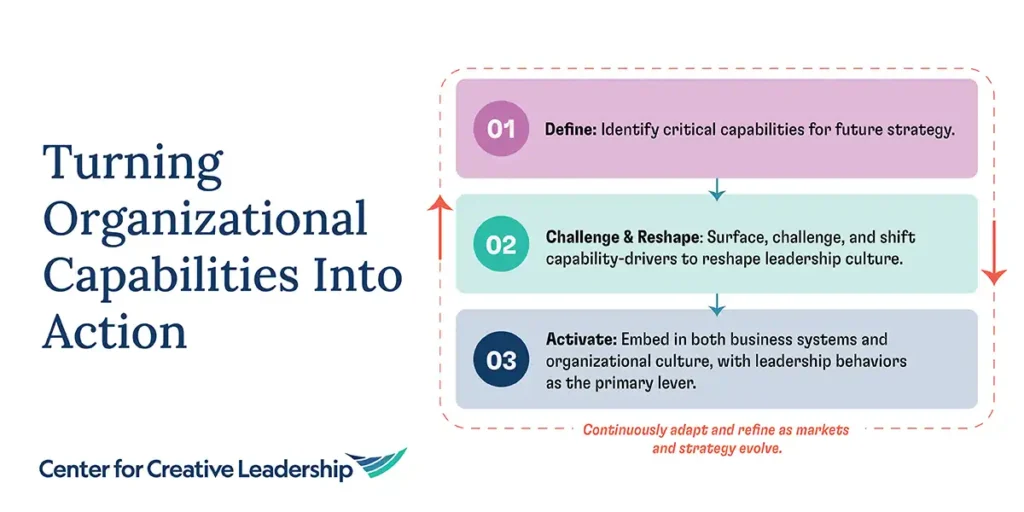
Translating organizational capabilities into actionable strategies requires a dual focus: looking both outward to the future and inward to the organization’s existing strengths and structures. This dual perspective forms the bedrock of a structured, three-phase approach designed for executive teams.
The first phase, Discovery and Diagnosis, involves a comprehensive assessment of the organization’s current state. This includes an in-depth analysis of the external environment, competitive landscape, and emerging trends, alongside an honest evaluation of existing organizational capabilities, leadership culture, and talent pool. The objective is to identify the critical capabilities needed to achieve future strategic goals and to pinpoint current gaps and areas for development.
The second phase, Design and Alignment, centers on defining the target organizational capabilities and aligning them with the overall business strategy. This phase involves making deliberate choices about which capabilities to prioritize, defining the specific behaviors and actions associated with each, and establishing clear metrics for success. Crucially, this phase also focuses on shaping the leadership culture to support and reinforce these chosen capabilities, ensuring that organizational values and mission are inextricably linked to the desired strengths.
The third phase, Development and Integration, focuses on embedding the identified capabilities into the organization’s operational fabric. This involves implementing targeted leadership development programs, revising organizational structures and processes, and fostering a pervasive culture of continuous learning and improvement. The goal is to ensure that these capabilities are not merely theoretical constructs but are actively practiced and sustained by leaders at all levels, driving tangible business outcomes and creating a distinct competitive advantage.
Translating Strategy into Leadership Practice: The Path Forward
As organizations contemplate their future trajectory and the evolving demands on their leadership, organizational capabilities emerge as a pivotal bridging mechanism. By channeling energy into defining and cultivating the organization’s differentiating strengths, organizational capabilities strategically position the enterprise for success and provide invaluable clarity regarding the specific leadership behaviors required for excellence.
The future is inherently dynamic, and with it will come shifts in strategy and evolving expectations for leadership execution. However, when an organization harmonizes its mission, values, strategy, and leadership culture around a clearly defined set of capabilities, it fortifies both its present execution and its capacity for future adaptation. This integrated approach ensures that every component of the Leadership Strategy Model, and indeed everyone within the organization, remains aligned and on the correct path toward sustainable achievement.
Ready to Take the Next Step?
Identifying the organizational capabilities that transform your strategy into a distinct competitive identity—and cultivating the leadership culture necessary to sustain them—is a consequential undertaking for any executive team. Organizations that successfully navigate this process benefit from enhanced strategic clarity, more effective leadership, and a resilient capacity for adaptation. Engaging with expert guidance can illuminate the path forward, helping executive teams define, align, and activate the most critical capabilities for sustained business performance. Partnering with organizations that specialize in this transformative work can unlock a deeper understanding of how to translate complex strategic visions into tangible organizational strengths and enduring leadership excellence.








