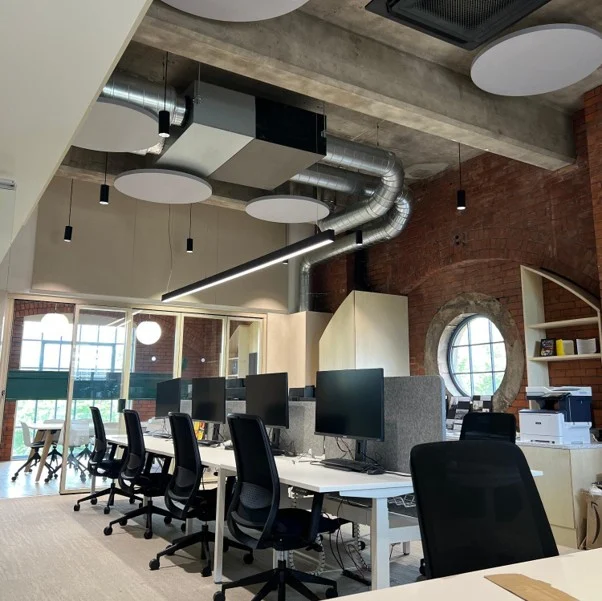
Research consistently shows that excessive noise is the number one cause of distraction in the modern workplace. Hybrid working has changed how open-plan offices are used, but acoustic design has not always kept pace. Hybrid workplaces now ask more activities to coexist within the same space. Video calls, informal meetings, collaborative work, and focused individual tasks may all happen alongside one another, while occupancy can change dramatically throughout the week.
A workplace that once supported mainly desk-based concentration can behave very differently when several people are now taking online calls from the same open-plan area. The physical space may not have changed, but the way it is being used has. The result is not simply more noise. It is a wider range of activities competing within the same acoustic environment, often with very different requirements. This shift, accelerated by the widespread adoption of hybrid working models, has inadvertently amplified pre-existing acoustic challenges and introduced new ones, impacting employee productivity, well-being, and even the very concept of workplace privacy.
The Evolving Landscape of the Open-Plan Office
For decades, the open-plan office has been a dominant design trend, lauded for its perceived benefits in fostering collaboration and communication. However, this architectural choice has long been a double-edged sword. While it can encourage spontaneous interactions, it has also been a persistent source of distraction. Studies, such as those from the Chartered Institute of Personnel and Development (CIPD), have repeatedly identified noise as a primary detriment to concentration and job satisfaction in open-plan environments.
The advent of hybrid working has significantly altered the dynamics within these spaces. Before, the predictable flow of a largely in-office workforce meant that acoustic issues, while present, were often manageable. There was a general hum of activity that could help mask individual conversations. However, with hybrid models, offices are now dynamic ecosystems. Occupancy levels fluctuate daily, and the types of activities occurring simultaneously within the same physical footprint have become far more diverse. A single open-plan area might now host a boisterous team huddle, a hushed one-on-one discussion, multiple individuals engaged in video conferences with varying audio levels, and those desperately trying to focus on complex tasks. This convergence of disparate acoustic needs within a single, undifferentiated space creates a cacophony that undermines the intended purpose of the office.
The Illusion of Zoning: When Aesthetics Trump Acoustics
Modern office design often incorporates the concept of "workplace zoning." This approach utilizes varied furniture, distinct finishes, and strategic layouts to demarcate areas for specific functions – collaboration zones, focus pods, informal breakout spaces. Visually, these zones can appear well-defined. A cluster of comfortable sofas might signal a relaxation area, while a row of ergonomic chairs at shared desks clearly indicates a workspace. However, the effectiveness of these zones is often superficial when acoustic considerations are not deeply integrated.
Acoustic consultants like George Cook, Director at Koru Acoustics, highlight this disconnect. "A workplace can look well zoned on a plan while remaining acoustically connected," he explains. "Furniture, colour, and flooring may define different areas visually, but they do little on their own to stop a conversation in one zone dominating another." The visual cues of zoning are insufficient to mitigate the pervasive nature of sound. Sound waves do not respect aesthetic boundaries. A loud conversation in a designated "collaboration zone" can easily spill over and disrupt individuals attempting to concentrate in an adjacent "quiet zone," rendering the zoning ineffective from an auditory perspective. The aim, therefore, should not be to achieve uniform quietness across the entire office, but rather to strategically manage sound so that different activities can coexist harmoniously. This requires a nuanced understanding of how sound travels and how to control it, rather than relying solely on visual cues.

Decoding the Symphony of Office Sound: Beyond "Noise"
The term "noise" is often used as a catch-all for any undesirable sound, but in an acoustic context, it encompasses a spectrum of distinct problems. Understanding the precise nature of the acoustic challenge is paramount to implementing effective solutions. As George Cook points out, "The word ‘noise’ is often used to describe very different acoustic problems. A reverberant office, where sound reflects from hard surfaces, is different from a quiet office where direct speech travels clearly between desks. Poor sound insulation between rooms, mechanical noise, and badly positioned activities create different problems again."
- Reverberation: This occurs when sound waves bounce off hard, flat surfaces like glass, concrete, or unadorned walls, creating a sense of echo and making speech difficult to understand. It can make an otherwise quiet space feel overwhelmingly loud.
- Direct Speech Transmission: This is the clear, unimpeded travel of sound, particularly human speech, from one person to another. In open-plan offices, this can lead to conversations being overheard, impacting privacy and concentration.
- Sound Leakage: This refers to sound traveling through poorly insulated partitions, doors, or ceilings, allowing conversations or other sounds from one room or area to be heard in another.
- Mechanical Noise: This includes sounds generated by building systems such as HVAC (heating, ventilation, and air conditioning), plumbing, or IT equipment.
These distinct issues demand tailored solutions. Acoustic absorption, for example, is effective at reducing reverberation by converting sound energy into heat. Materials like acoustic ceiling tiles, wall panels, or soft furnishings can significantly dampen reflected sound. However, absorption alone cannot eliminate the direct sound of someone speaking nearby. Conversely, rearranging the office layout might help to physically separate sound sources, but it will do little to address issues of excessive reverberation. A comprehensive acoustic assessment is therefore crucial, beginning with the fundamental question: "What are people hearing that they should not be hearing?" This diagnostic approach ensures that interventions are targeted and effective, rather than being generic or misapplied.
The Counterintuitive Truth: Why Absolute Quiet Isn’t Always Ideal
One of the most surprising observations in workplace acoustics is that some of the most significant complaints about distraction emanate from offices that are, by all accounts, very quiet. This phenomenon is particularly prevalent in environments where deep concentration is a daily requirement, such as legal firms, engineering consultancies, or accounting practices. In these settings, the absence of a consistent background sound level means that any single, intelligible sound can become disproportionately prominent.
"This is especially noticeable in offices occupied by lawyers, engineers, accountants, and other teams whose work involves long periods of concentration," notes Cook. "These spaces often have very little background sound, which means a single conversation can become unusually prominent." A phone call from several desks away, or a hushed discussion in a nearby zone, can easily become intelligible and distracting to those trying to focus. This not only disrupts concentration but can also raise concerns about privacy for the individuals engaged in the conversation.
In contrast, busier, more dynamic office environments often possess a natural ambient sound level. The constant hum of activity – people moving, interacting, and talking at a moderate volume – creates a soundscape where individual voices tend to blend in rather than stand out. This doesn’t advocate for a noisier workplace, but rather illustrates that acoustic quality is a complex interplay of factors. Speech intelligibility, the degree to which speech is understandable, is a critical element. Excessive intelligibility of unwanted speech is a primary source of distraction. Similarly, the relationship between different activities and the need for privacy are crucial. A well-designed acoustic environment manages these elements to support diverse work needs.
The Acoustic Blueprint for the Hybrid Workplace
Hybrid working has undeniably exposed and exacerbated pre-existing acoustic deficiencies in many open-plan offices. Spaces designed for a more predictable, in-office workforce now struggle to accommodate the fluid and multifaceted nature of hybrid operations. The open-plan office has always been a social hub, and hybrid working has further amplified the importance of in-office days for collaboration and team cohesion. The core challenge lies in fostering this essential interaction without compromising the ability of employees to concentrate or maintain necessary privacy.
Achieving this balance necessitates an integrated approach to workplace design. Acoustics must be considered concurrently with layout, furniture selection, technological integration, and even the cultivation of appropriate workplace behaviours. The goal is not to create sterile, silent environments, but rather functional spaces where a variety of activities can occur productively and comfortably. This means enabling people to converse without inadvertently disrupting their colleagues, allowing for focused work without the constant reliance on noise-canceling headphones, and ensuring that private conversations remain just that – private.

Data-Driven Insights into Workplace Acoustics
The impact of poor acoustics on productivity and well-being is increasingly being quantified. Studies have linked noise distraction to significant reductions in cognitive performance. For instance, research published in the Journal of Applied Psychology has indicated that elevated noise levels in offices can lead to increased stress, higher error rates, and decreased employee satisfaction. A 2021 report by the UK’s Health and Safety Executive (HSE) highlighted that work-related stress, depression, or anxiety accounted for 51% of all work-related ill health cases in 2020/21, with noise pollution and poor working environments often contributing factors.
Furthermore, the economic implications are substantial. Companies are investing heavily in creating attractive office spaces to draw employees back into the physical workplace. If these spaces fail to address fundamental issues like acoustics, the return on investment can be diminished. A survey by Steelcase in 2022 revealed that while employees value the social aspects of the office, they also report significant challenges with distractions, with noise being a top complaint. This disconnect between the intended purpose of the office and the lived experience of its occupants underscores the urgency of prioritizing acoustic design.
Future-Proofing the Acoustic Environment
As organizations continue to refine their hybrid working strategies, a proactive and informed approach to acoustic design will be crucial. This involves:
- Comprehensive Acoustic Audits: Engaging acoustic consultants to conduct thorough assessments of existing spaces, identifying specific problem areas and their root causes. This moves beyond subjective complaints to objective measurement of sound levels, reverberation times, and speech intelligibility.
- Strategic Zoning with Acoustic Intent: Implementing zoning that is acoustically informed, not just visually appealing. This might involve creating dedicated quiet zones with enhanced soundproofing, establishing clearly defined areas for video conferencing equipped with acoustic treatments, and designing collaborative spaces that manage sound spill.
- Material Innovation and Application: Utilizing a range of acoustic materials and treatments, from ceiling baffles and wall panels to floor coverings and furniture upholstery, tailored to the specific acoustic challenges of different zones.
- Technology Integration: Exploring sound masking systems that introduce a low level of ambient background sound to help mask distracting conversations, thereby improving speech privacy and focus.
- Behavioral Guidelines: Encouraging and reinforcing workplace etiquette that respects the acoustic needs of colleagues, such as guidelines for taking phone calls or managing the volume of conversations.
The evolution of the workplace is ongoing, and the acoustic environment must evolve with it. The hybrid model, while presenting challenges, also offers an opportunity to reimagine office spaces as truly conducive to a range of work styles and needs. By understanding the science of sound and applying it thoughtfully, organizations can transform their offices from sources of distraction into environments that foster productivity, well-being, and a positive employee experience. The future of effective workplace design lies not in simply filling space, but in orchestrating sound.
About the Expert:
George Cook is a Director at Koru Acoustics, a firm specializing in improving workplace sound environments through bespoke acoustic assessment, design, supply, and installation. With over a decade of experience in building acoustics, Cook has been instrumental in helping organizations across the UK address noise-related challenges to enhance employee productivity and well-being. Koru Acoustics offers complimentary onsite workplace acoustic assessments for businesses seeking to optimize their sonic environment.