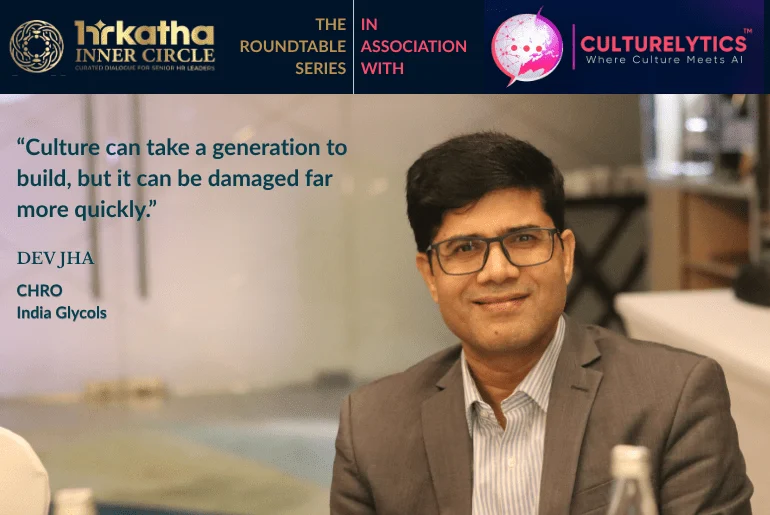
Trust takes time to build, yet it can disappear remarkably quickly, a truism that resonates with increasing urgency in the contemporary workplace. For Dev Jha, CHRO of India Glycols, this fundamental principle positions trust as one of the most critical dimensions of organizational culture, especially as the pervasive influence of artificial intelligence (AI) fundamentally reshapes the intricate relationship between people, managers, and the very nature of work itself. Speaking at the HRKatha Inner Circle, an exclusive forum held in partnership with Culturelytics, Jha articulated a profound and "worrying shift" he perceives within organizations: a perceptible decline in trust between employees and their immediate managers, and indeed, between the workforce and senior management. This erosion, he posited, is further complicated and accelerated by the rapid integration of AI technologies, introducing unprecedented layers of complexity to an already delicate social contract.
The Precarious State of Workplace Trust
Jha’s observation at the HRKatha Inner Circle on the Culture–Performance Equation is not an isolated one but rather reflects a broader trend recognized by numerous industry analysts and evidenced in various global surveys. The modern workplace has been subjected to a confluence of stressors over the past decade, ranging from rapid technological advancements and economic volatility to the seismic shift towards remote and hybrid work models. These factors have collectively strained traditional hierarchical structures and communication channels, often leading to a perceived lack of transparency, inconsistent leadership, and a sense of detachment among employees.
Recent studies, for instance, frequently indicate that a significant percentage of employees—sometimes as high as 40-50% in certain regions—express a degree of skepticism regarding their leadership’s commitment to their well-being or the fairness of organizational decisions. This erosion of trust manifests in various detrimental ways: decreased employee engagement, higher rates of absenteeism, increased voluntary turnover, and a measurable dip in productivity. When employees do not trust their managers, communication breaks down, collaboration suffers, and innovation stagnates. They become less willing to take risks, share feedback, or invest their discretionary effort, all of which are vital ingredients for a thriving, high-performing culture. This foundational fragility makes organizations particularly vulnerable to new disruptions, such as the widespread deployment of AI.
Organizational Culture: A Generation to Build, an Hour to Damage
Dev Jha succinctly captured the delicate nature of organizational culture by stating, "All of us agreed that it takes a generation to build the culture." Yet, the very fabric painstakingly woven over years through shared values, repeated experiences, consistent leadership, and strong interpersonal relationships can be damaged "in a day or an hour." This asymmetry underscores the profound importance of proactive cultural stewardship. Organizational culture is not merely a set of stated values on a wall; it is the collective personality of an organization, dictating how things are done, how people interact, and how decisions are made. It influences every aspect of an employee’s experience, from onboarding to daily tasks, and ultimately determines an organization’s resilience and adaptability.
A robust, positive culture, deeply rooted in trust, fosters psychological safety, encouraging employees to voice concerns, experiment with new ideas, and contribute fully without fear of reprisal. Conversely, a culture characterized by low trust breeds cynicism, micromanagement, and a blame-oriented environment, creating a vicious cycle of disengagement and underperformance. In such a fragile state, the introduction of a transformative technology like AI, without careful cultural consideration, poses an existential threat to organizational cohesion.
The AI Imperative: A New Trust Frontier
The arrival of AI is not merely an incremental technological upgrade; it represents a paradigm shift in how work is conceived, executed, and managed. AI systems are increasingly integrated into every facet of business operations, from automating routine tasks and processing vast datasets to informing complex strategic decisions and managing human capital. In human resources specifically, AI is being deployed in recruitment (applicant tracking, resume screening, predictive analytics), performance management (feedback analysis, sentiment tracking), learning and development (personalized training paths), and even employee well-being (proactive support based on behavioral patterns).
As humans and AI increasingly work alongside one another, organizations are compelled to confront a new, multifaceted set of questions around trust. Jha articulated these critical queries: How comfortable will employees be relying on AI for guidance, decision support, or even direct task execution? How will managers navigate the complex terrain of decision-making when human judgment must intersect with machine-generated insights, especially when those insights might lack transparent reasoning? And what happens to existing interpersonal relationships within organizations—the very bedrock of collaboration and informal knowledge sharing—as more work is shared, delegated to, or mediated by technology?
The integration of AI introduces several new dimensions of trust:
- Trust in the Technology Itself: Do employees believe the AI is fair, unbiased, accurate, and reliable? Are they confident in its capabilities, or do they harbor suspicions about its algorithmic processes, data privacy implications, or potential for surveillance? Concerns about algorithmic bias, data security, and the "black box" nature of some AI systems are prevalent among the workforce.
- Trust in Leadership’s Use of AI: Do employees trust that management is deploying AI ethically, transparently, and with their best interests at heart? Or do they perceive AI as a tool for control, surveillance, or job displacement? The intent behind AI deployment significantly influences employee acceptance.
- Trust in Managers’ Integration of AI: How will managers balance AI-driven metrics with human empathy and contextual understanding? Can managers effectively lead teams that include AI co-workers, ensuring equitable workload distribution and fair performance evaluations, even when some tasks are AI-assisted or fully automated?
The HRKatha Inner Circle: A Nexus for Critical Dialogue
The HRKatha Inner Circle, an esteemed platform for senior HR leaders, serves as a vital forum for discussing and dissecting the most pressing challenges and transformative trends shaping the human resources landscape. Held in partnership with Culturelytics, an organization focused on leveraging data and analytics to understand and enhance organizational culture, the specific session "on the Culture–Performance Equation" provided a particularly pertinent backdrop for Dev Jha’s insights. These Inner Circle events are typically characterized by an intimate, Chatham House Rule environment, fostering candid and deep-dive discussions among CHROs, HR VPs, and other key decision-makers. The objective is to move beyond superficial trends, to critically examine the strategic implications of evolving workplace dynamics, and to collectively explore actionable solutions.
Jha’s observation about the accelerating decline of trust, amplified by AI, resonated deeply within this context. It underscored the fact that while technology offers unparalleled efficiencies and capabilities, its successful integration hinges not just on technical prowess but, more critically, on human factors—culture, ethics, and, pre-eminently, trust. The discussions likely extended to how HR leaders can act as custodians of culture, championing ethical AI adoption and ensuring that human values remain central amidst technological advancements. The question Jha posed—if trust is fundamental to culture but can deteriorate so quickly, can organizations identify the warning signs before the damage becomes visible?—became a central theme, prompting an exploration into proactive metrics and cultural diagnostics.
Navigating the Trust-AI Nexus: Strategies for Proactive Stewardship
To mitigate the risks of trust erosion in the AI era and harness the full potential of these transformative technologies, organizations must adopt a proactive, human-centric approach. This requires a multi-pronged strategy encompassing leadership commitment, ethical frameworks, transparent communication, and continuous learning.
- Cultivating Transparent and Ethical AI Principles: Organizations must establish clear, well-communicated ethical guidelines for AI development and deployment. This includes principles around fairness, accountability, transparency (explaining how AI makes decisions), data privacy, and human oversight. Employees need to understand what data AI uses, how it processes information, and how its outputs are integrated into decision-making. Regular audits of AI systems for bias and unintended consequences are essential.
- Championing Human-Centric AI Design: AI should be designed to augment human capabilities, not merely replace them. This means focusing on AI tools that enhance creativity, problem-solving, and employee well-being. Employee involvement in the design and implementation phases of AI can foster a sense of ownership and reduce resistance. When AI is perceived as a collaborative partner rather than a competitive threat or a surveillance tool, trust naturally increases.
- Leadership as Trust Architects: Senior leaders play an indispensable role in building and maintaining trust. They must visibly champion ethical AI, communicate transparently about its benefits and limitations, and demonstrate a commitment to employee development and job security amidst automation. Leaders who model vulnerability, admit mistakes, and actively listen to employee concerns can rebuild trust even in challenging times. Their consistent behavior and decisions are powerful cultural signals.
- Redefining Managerial Roles and Skills: Managers are at the forefront of AI integration. Their role must evolve from command-and-control to coaching, facilitating human-AI collaboration, and interpreting complex data. Training programs must equip managers with the skills to understand AI outputs, critically evaluate machine insights, and blend them with human empathy and situational awareness. They need to become adept at leading hybrid teams of humans and intelligent machines, fostering psychological safety for both.
- Investing in Upskilling and Reskilling: Addressing fears of job displacement is critical. Organizations must invest heavily in upskilling and reskilling programs that prepare employees for new roles that emerge from AI integration. This commitment demonstrates that the organization values its human capital and is investing in their future, thereby strengthening trust.
- Establishing Feedback Mechanisms and Cultural Diagnostics: To identify warning signs of trust erosion, organizations must implement robust feedback mechanisms. This includes regular pulse surveys, anonymous feedback channels, focus groups, and cultural audits. Leveraging cultural analytics tools, like those offered by Culturelytics, can provide data-driven insights into the health of organizational trust and culture, allowing leaders to intervene proactively before damage becomes irreversible.
Broader Implications and The Future of Work
The imperative to address trust in the age of AI extends beyond immediate operational efficiency; it has profound implications for an organization’s long-term sustainability, talent attraction, and societal impact. Companies that successfully navigate this trust-AI nexus will gain a significant competitive advantage, attracting top talent who seek psychologically safe and ethically responsible workplaces. They will foster innovation, build resilient cultures, and maintain a strong employer brand.
Conversely, organizations that fail to prioritize trust risk widespread employee alienation, a talent drain, ethical breaches, and reputational damage. The future of work, as envisioned by Dev Jha and other thought leaders, is not merely about technology adoption; it is about the judicious and humane integration of technology within a strong, trust-based organizational culture. AI offers an unparalleled opportunity to enhance human potential and organizational performance, but only if it is built on a foundation of unwavering trust, nurtured by transparent leadership and ethical stewardship. The challenge is immense, but the opportunity for those who get it right is transformative. The journey to build and maintain trust in this new era will undoubtedly be a generational effort, yet the cost of neglect could be catastrophic, capable of eroding years of cultural investment in a mere moment.