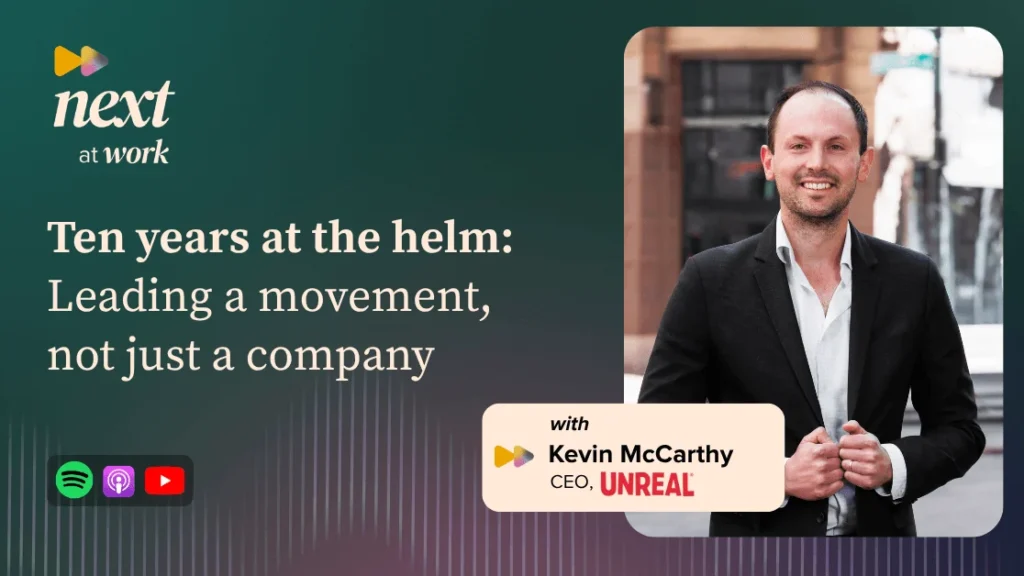
At the remarkably young age of 24, Kevin McCarthy stepped into the demanding role of CEO at UNREAL, a burgeoning chocolate company with an ambitious mission: to fundamentally reshape how American consumers perceive and indulge in candy. A decade later, his tenure at the helm has seen UNREAL transform from an innovative passion project into the preeminent better-for-you chocolate brand in the United States, commanding a significant presence across more than 35,000 retail locations, including major chains like Target, Costco, and Whole Foods. McCarthy’s journey, detailed in a recent episode of the "Next at Work" podcast hosted by Brendan Jeannetti, offers profound insights into entrepreneurial leadership, the critical importance of a mission-driven culture, and the practicalities of fostering a sustainable business in an increasingly fast-paced and competitive market, particularly with a fully remote team dispersed nationwide.
The Genesis of UNREAL: A Sweet Revolution Begins
To fully appreciate UNREAL’s trajectory under McCarthy, it’s essential to understand its origins within a confectionery landscape long dominated by traditional giants. The company was founded in 2012 by father-and-son duo Michael and Adam Green. Adam, then a young boy, developed a keen interest in understanding why his favorite candies contained so many artificial ingredients, high sugar content, and often unpronounceable chemicals. This innocent curiosity sparked a parental quest for healthier alternatives, leading to the realization that a significant gap existed in the market for indulgent treats made with simpler, higher-quality, and more natural ingredients. The Green family’s "passion project" aimed to "unjunk" classic candies, offering beloved flavors without the guilt or artificial additives.
This emergent "better-for-you" segment was still nascent when UNREAL launched. Consumers were beginning to express concerns about processed foods, sugar intake, and artificial colors, but mainstream options were scarce. UNREAL positioned itself at the forefront of this shift, committing to using less sugar, no artificial colors or flavors, and responsibly sourced ingredients. Kevin McCarthy joined the company as an employee approximately 12 years ago, immersing himself in its operations, supply chain, and multifaceted roles, gaining invaluable hands-on experience before ascending to the top leadership position. His early involvement provided a deep, intrinsic understanding of the brand’s core values and operational intricacies, laying a robust foundation for his future leadership.
McCarthy’s Ascent and the Evolution of a Brand
McCarthy’s promotion to CEO at 24 was unconventional, challenging the traditional corporate ladder often associated with such a senior role. His appointment underscored a belief in his operational acumen and, crucially, his unwavering commitment to UNREAL’s founding mission. This period marked a critical inflection point for the company, as it transitioned from an ambitious startup to a scaling enterprise. The initial years under his leadership were characterized by navigating the complexities of scaling production, expanding distribution channels, and fiercely competing within one of the most saturated consumer goods categories. The chocolate industry alone is a multi-billion dollar market, with entrenched players holding significant brand loyalty and shelf space. UNREAL’s success in carving out its niche against such formidable competition speaks volumes about its product quality and strategic leadership.
Under McCarthy, UNREAL has not only secured placement in over 35,000 retail outlets but has also achieved consistent growth, reporting a commendable 15% year-over-year increase in mainstream retailers. This expansion reflects a broader consumer trend towards healthier eating and a willingness to pay a premium for products aligning with these values. The "better-for-you" snack market, valued at over $27 billion globally in 2023, is projected to grow at a compound annual growth rate (CAGR) of over 6% in the coming years, driven by increasing health consciousness and demand for clean label products. UNREAL’s strategic focus on less sugar, non-GMO, gluten-free, and fair-trade ingredients directly taps into these powerful market forces, solidifying its position as a market leader in its category.
Leadership Lessons from a Young CEO: Beyond the Conventional Playbook
McCarthy’s decade at UNREAL has not merely been about scaling a business; it has been a profound lesson in adaptive leadership, particularly in an era marked by rapid technological change and evolving workplace dynamics. His insights, shared on the "Next at Work" podcast, offer a refreshing counter-narrative to many prevailing business philosophies.
Readiness is a Trap: Embracing the Learning Curve
One of McCarthy’s most candid reflections addresses the myth of feeling "ready" for significant leadership roles. When questioned about his preparedness at 24, he unequivocally stated, "I don’t think you’re ever, like, ready ready." This sentiment challenges the conventional wisdom that advocates for checking every box and accumulating extensive experience before pursuing high-level positions. McCarthy, despite having two years of hands-on experience across various operational facets of UNREAL, understood that true readiness often emerges through action and a genuine belief in the mission.
His advice resonates with a growing number of young entrepreneurs and aspiring leaders: rather than passively waiting for the "perfect" moment or the ideal resume, individuals should prioritize finding a problem they genuinely care about solving. McCarthy emphasizes that a deep commitment to a mission and the drive to deliver on its promise are far more potent than a lengthy list of credentials. He sought these same qualities when hiring UNREAL’s first ten employees—individuals he describes as "entrepreneurs with hunger," willing to prioritize the mission over personal ego or immediate stability. The enduring tenure of these early team members, many still with the company eight years later, underscores the power of aligning personal drive with organizational purpose. This perspective suggests that leadership is less about inherent qualification and more about an active, iterative process of learning, adapting, and proving oneself through dedication.
Burnout as a Leadership Problem: Prioritizing Sustainable Performance
McCarthy is a staunch critic of "hustle culture," a prevalent ethos that often glorifies relentless work hours and constant grind. He has witnessed its detrimental effects on individuals and organizations alike, stating, "That’s not sustainable. That can be a sprint, but everything is a marathon in life." This insight is particularly salient in a global workforce increasingly grappling with burnout, a phenomenon recognized by the World Health Organization as an occupational syndrome resulting from chronic workplace stress. Studies indicate that a significant percentage of employees experience burnout, leading to decreased productivity, increased turnover, and adverse health outcomes.
McCarthy posits that burnout is not merely an individual failing but fundamentally a leadership problem. Leaders who model unsustainable work habits, consciously or unconsciously, create an environment where their teams feel compelled to do the same. His approach advocates for "situational awareness," where protecting personal and team boundaries becomes a strategic imperative for the company’s long-term health and mission fulfillment. Healthy employees are productive employees.
Practically, McCarthy advises leaders to strategically build capacity by hiring individuals who excel in areas where the leader might be weaker, fostering mentorship networks, and continuously assessing whether work remains challenging and enjoyable. This proactive approach to talent management and well-being stands in stark contrast to reactive measures often taken only after burnout has taken hold. By planning for future organizational needs and actively preventing overload, leaders can cultivate a resilient and high-performing workforce, ensuring the company’s ability to endure the "marathon" of business growth.
Culture Follows Mission: The UNREAL Ethos
For McCarthy, company culture is not an abstract concept or a set of superficial perks; it is a direct embodiment of the organization’s core mission. UNREAL’s unwavering commitment to "create a world where all food is 100% real" serves as the bedrock for its internal culture. McCarthy openly acknowledges that when he first joined, the office environment lacked energy, failing to reflect the vibrant, wholesome promise of the brand. Over the past decade, he has meticulously rebuilt the culture to align with UNREAL’s brand identity: fun, transparent, and profoundly mission-driven.
A vivid illustration of this mission-driven culture is UNREAL’s now-famous "Chocolate Expensing" policy. Instituted in 2025, this policy allows employees to purchase and expense chocolate from any brand. Within just seven months of its rollout, UNREAL employees had expensed over 3,900 pounds of chocolate. While seemingly a generous perk, the policy serves a much deeper strategic purpose. It encourages employees to actively engage with the category, taste competitor products, understand market trends, and, crucially, stay intimately connected to the customer experience and the fundamental "why" behind UNREAL’s work. This policy transforms a simple benefit into a powerful tool for market research, product development inspiration, and cultural reinforcement, ensuring the team remains deeply aligned with the company’s objective of offering superior chocolate alternatives.
Navigating the Remote Work Landscape with Intentionality
UNREAL’s decision to transition to a fully remote model, with approximately 100 employees spread across the United States, presented a unique set of cultural challenges. McCarthy readily admits the inherent difficulties: the absence of spontaneous in-person interactions, the inability to "read the room" effectively on virtual calls, and the increased potential for communication distortions.
His solution is rooted in continuous, deliberate effort. Remote culture, McCarthy argues, is never a "solved" problem; it requires ongoing intentionality, adaptation, and leadership modeling. In a remote environment, leaders’ actions become even more scrutinized. When McCarthy consciously protects his own boundaries and models healthy work habits, he implicitly grants his team permission to do the same. This approach to remote culture emphasizes clear communication protocols, investment in effective virtual collaboration tools, regular check-ins, and intentional virtual team-building activities, all designed to foster trust and connection despite geographical distances. The success of a remote model, therefore, hinges not just on technology, but on a sustained commitment from leadership to cultivate a connected, supportive environment.
Focusing on What Truly Matters: Product and Purpose Over Personal Brand
Throughout his tenure, Kevin McCarthy has consistently steered UNREAL with an unwavering focus on the product itself. In an era where personal branding and leader visibility often eclipse organizational achievements, McCarthy offers a refreshing counterpoint. He has spent less time cultivating his personal image as a "young CEO" and more time asking the fundamental questions that drive business success: "Do people buy the product again? Do they recommend it to others? What’s the repeat purchase rate?" These metrics, rather than social media engagement or industry accolades, are the true indicators of a healthy, sustainable business.
This product-centric approach, combined with his leadership philosophy, has been instrumental in UNREAL’s growth to become the largest better-for-you chocolate brand in America. His journey exemplifies a career approached as a marathon, not a sprint, characterized by surrounding himself with individuals who genuinely believe in the company’s mission and cultivating a culture that authentically reflects the brand’s values.
As consumer preferences continue to evolve towards healthier, more transparent, and ethically sourced products, UNREAL is exceptionally well-positioned to capitalize on these shifts. McCarthy’s perspective on leadership and business building serves as a powerful reminder that while compelling individual stories exist, the ultimate measure of success lies in "how you build something serving consumers." For business leaders navigating a landscape increasingly obsessed with personal visibility, McCarthy provides a compelling argument for redirecting attention to the core mission, the product, and the sustainable health of the organization itself. His story, while compelling, is ultimately a testament to the power of a clear purpose, a dedicated team, and a relentless focus on delivering real value to consumers.
The insights from Kevin McCarthy’s leadership journey are disseminated through the "Next at Work" podcast, produced by Workable, an all-in-one talent platform. Workable provides comprehensive solutions for hiring and managing teams, integrating recruiting, employee management, time-off tracking, and payroll, all enhanced by AI capabilities. Serving over 30,000 companies across 100 countries, Workable plays a crucial role in empowering organizations to build and sustain effective workforces, aligning perfectly with the themes of effective leadership and team management explored by McCarthy.