The contemporary talent landscape is characterized by fierce competition and unprecedented fluidity, presenting organizations with a critical challenge: the pervasive issue of candidate reneges. Historically, many recruitment programs have operated without a defined process for identifying and addressing the early warning signs of a potential renege, leading to reactive scrambling and significant operational disruptions. Teams often discover a candidate’s decision to withdraw only after the fact, when silence or unresponsiveness indicates a choice already made. This reactive posture not only incurs substantial financial costs but also undermines operational efficiency and employer brand integrity. The emerging solution, championed by forward-thinking talent acquisition strategists, lies in a paradigm shift: treating engagement signals not as post-mortem diagnostics, but as crucial leading indicators for candidate retention.
The Escalating Challenge of Candidate Renege in a Dynamic Market
The phenomenon of candidate reneging—where an individual accepts a job offer but subsequently withdraws before their start date—has become an increasingly pressing concern for organizations globally. A 2023 report by the National Association of Colleges and Employers (NACE) indicated that an average of 10-15% of accepted offers for entry-level positions are ultimately reneged upon, with figures potentially higher in specialized or highly competitive sectors like technology and healthcare. This figure, while an average, masks significant fluctuations and can escalate dramatically during periods of high economic activity or intense talent wars.
The reasons behind a candidate’s decision to renege are multifaceted. They often include receiving a more attractive competing offer, personal circumstances changing unexpectedly, a loss of enthusiasm due to poor communication post-offer, or simply lingering uncertainties about the role or company culture that were not adequately addressed. The cost of a renege extends far beyond the immediate disruption. Estimates from industry analysts, such as those published by the Society for Human Resource Management (SHRM), suggest that the average cost to replace an employee can range from 50% to 200% of their annual salary, factoring in recruitment fees, lost productivity during the vacancy, onboarding expenses, and the administrative burden of restarting the hiring process. For high-volume or critical roles, these costs can quickly spiral into hundreds of thousands of dollars for a single position.
Traditionally, recruitment processes have been heavily front-loaded, focusing intensely on sourcing, screening, interviewing, and offer extension. Once an offer is accepted, the engagement often wanes, with communication becoming sporadic until the designated start date. This "black box" period—the time between offer acceptance and onboarding—is precisely where the risk of renege escalates exponentially. Without a structured approach to maintain engagement and monitor candidate sentiment, organizations remain vulnerable to unexpected withdrawals, forcing them back to square one in an already arduous talent acquisition journey.
The Paradigm Shift: Engagement Signals as Leading Indicators
Recognizing this critical vulnerability, innovative talent acquisition leaders are advocating for a proactive, data-driven methodology. The core principle is simple yet transformative: rather than waiting for a candidate to go quiet or explicitly renege, organizations must actively monitor engagement signals as leading indicators of their commitment and enthusiasm. This approach transforms the pre-start period from a passive waiting game into an active engagement phase, allowing for timely interventions.
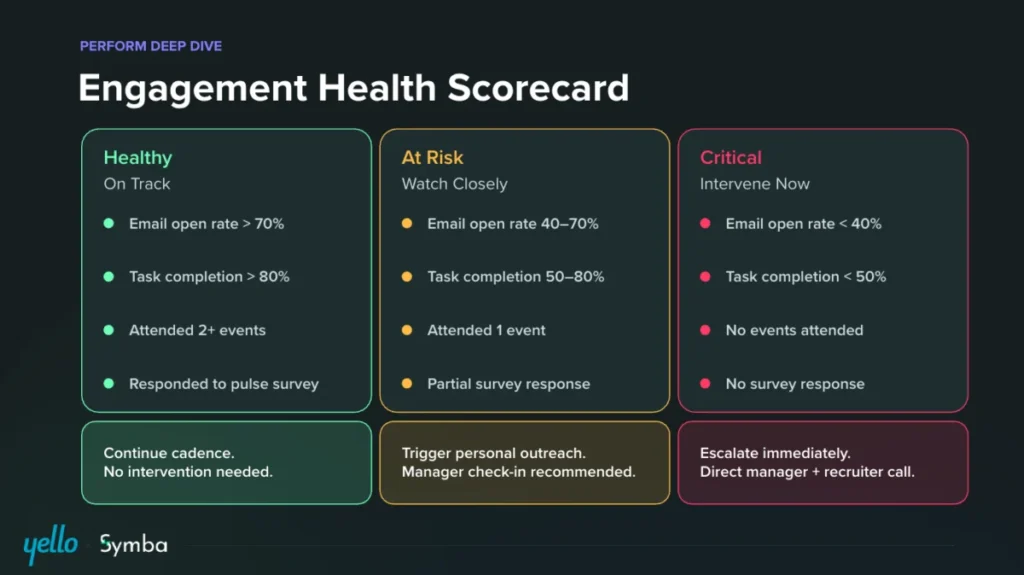
At the heart of this strategy is the Engagement Health Scorecard, a structured framework designed to categorize candidates into distinct risk groups based on their behavior during the crucial pre-start phase. This scorecard provides a clear, actionable roadmap for talent teams, enabling them to tailor their engagement efforts and intervene strategically.
Deconstructing the Engagement Health Scorecard: Tiers and Interventions
The Engagement Health Scorecard typically classifies candidates into three primary groups: Healthy, At-Risk, and Critical, each defined by specific engagement metrics and requiring targeted responses.
1. Healthy Candidates: Sustaining Momentum (Engagement above 70%)
- Behavioral Indicators: Candidates in this category demonstrate consistent and robust engagement. They exhibit high email open rates (typically above 70%), diligently complete pre-onboarding tasks, actively participate in company-sponsored events (e.g., virtual meet-and-greets, webinars, informational sessions), and promptly respond to surveys. Their activity logs show regular interaction with provided resources and communication channels.
- Strategic Action: For healthy candidates, the objective is to maintain positive momentum and reinforce their decision. The recommended action is to continue the established communication cadence, providing relevant updates, further insights into the company culture, and opportunities for informal connection. This could include personalized messages from future team members, sharing relevant company news, or providing access to internal resources that build excitement and a sense of belonging. The key is consistent, positive reinforcement without overwhelming the candidate.
2. At-Risk Candidates: Prompt Intervention (Engagement between 40-70%)
- Behavioral Indicators: This group displays a noticeable decline in engagement. Their email open rates fall into the 40-70% range, attendance at optional events becomes sporadic or limited, and survey responses might be incomplete or delayed. They may also show reduced interaction with pre-onboarding platforms or communication channels. These signals, while not definitive of a renege, serve as crucial early warnings that a candidate’s enthusiasm may be waning or that external factors are influencing their decision.
- Strategic Action: At-risk candidates necessitate immediate and personalized outreach, ideally within 48 hours of detecting declining engagement. A generic, mass-distributed email is insufficient; instead, a direct message from the program manager or a key stakeholder (e.g., the hiring manager or a senior team member) can be highly effective. This outreach should be personalized, acknowledging their specific situation (e.g., "noticed you missed our last virtual coffee chat, hope everything is okay") and offering support or clarification. An individualized invitation to an upcoming event, highlighting specific benefits relevant to them, can also re-engage. A brief, informal check-in call from the hiring manager can often turn the tide quickly by demonstrating genuine care and commitment from the organization. The goal is to open a dialogue and proactively address any emerging concerns.
3. Critical Candidates: Immediate Escalation and Root Cause Analysis (Engagement below 40%)
- Behavioral Indicators: Candidates classified as critical show almost no engagement. Their email open rates are consistently below 40%, they have attended no pre-start events, have not responded to surveys, and exhibit no activity across communication platforms for three or more consecutive weeks. This level of disengagement strongly suggests a significant issue or a decision already made, making immediate and high-level intervention imperative.
- Strategic Action: This tier requires urgent escalation and direct, personal communication. The first step should be a direct call from the hiring manager, bypassing email, to initiate a real, empathetic conversation about what might be happening. This should be followed by a personal touchpoint from the recruiter, offering support and attempting to uncover the root cause. Often, the reasons for critical disengagement are a competing offer, unforeseen personal circumstances, or profound uncertainty about the role or company. Catching these issues in time, through direct and honest dialogue, can sometimes allow the organization to address the candidate’s concerns, whether by providing additional information, clarifying aspects of the role, or even, in some cases, adjusting offer terms (where appropriate and feasible). The objective is to understand, empathize, and, if possible, salvage the relationship before it’s too late. Even if a renege is inevitable, a respectful and understanding approach leaves a positive impression, preserving the employer brand.
Data-Driven Decisions: The Cornerstone of Retention and Efficiency
The fundamental difference between organizations that successfully retain candidates and those that consistently scramble to backfill positions lies in their approach to data. The former continuously monitors engagement data, leveraging it to make informed, proactive decisions. The latter typically reacts only when a formal renege email is received, by which point intervention is largely futile. This continuous data analysis is not merely about tracking metrics; it’s about building a predictive model for candidate success and retention.
Industry analysts from leading HR technology firms like Gartner predict that by 2025, over 60% of Fortune 500 companies will leverage predictive analytics in their talent acquisition processes to mitigate risks like candidate reneges and early attrition. This trend underscores the strategic importance of systems like the Engagement Health Scorecard. By integrating data from various touchpoints—email analytics, task completion rates, event attendance, survey responses, and communication platform activity—organizations gain a holistic view of each candidate’s journey. This allows talent teams to move beyond gut feelings and anecdotal evidence, grounding their strategies in verifiable data.
Inferred Industry Perspectives and Expert Commentary
"The cost of a renege isn’t just financial; it’s also a significant blow to team morale and operational momentum," states Dr. Evelyn Reed, a leading consultant in talent strategy. "Implementing an Engagement Health Scorecard transforms a reactive weakness into a proactive strength. It’s about demonstrating to candidates that they are valued from the moment they accept the offer, not just on their first day."
Sarah Chen, VP of Talent Acquisition at a major tech firm, echoes this sentiment: "For years, we operated under the assumption that once an offer was accepted, the hard work was done. We were wrong. The pre-start phase is perhaps the most critical for retention. Our adoption of a scorecard system has drastically reduced our renege rates by enabling our recruiters and hiring managers to engage meaningfully when it matters most. It’s a competitive differentiator in today’s market."
These insights highlight a growing consensus within the HR community: passive post-offer management is no longer sustainable. Proactive engagement, underpinned by data, is becoming a non-negotiable component of a robust talent acquisition strategy.
Broader Implications and Strategic Advantages
The widespread adoption of proactive engagement strategies, epitomized by the Engagement Health Scorecard, carries significant implications across several dimensions for organizations:
- Financial Impact: By reducing renege rates, companies save substantial amounts on recruitment fees, advertising costs, and the internal labor hours spent on restarting hiring processes. This directly translates into a healthier ROI for talent acquisition efforts.
- Operational Efficiency: A more stable and predictable talent pipeline reduces operational disruptions caused by unexpected vacancies. Teams can plan more effectively, allocate resources efficiently, and maintain project timelines without the constant pressure of backfilling critical roles.
- Enhanced Employer Brand: A systematic, caring, and proactive engagement process creates a superior candidate experience. Even if a candidate ultimately decides to withdraw, the positive impression left by a supportive and communicative organization can lead to positive word-of-mouth, enhancing the company’s reputation as an employer of choice. Conversely, a poor pre-onboarding experience can damage brand reputation.
- Competitive Edge: Organizations that effectively leverage predictive engagement analytics gain a significant advantage in securing top talent. In a market where talent is scarce, the ability to retain accepted candidates can be the difference between achieving strategic objectives and falling behind competitors.
- Future of Talent Acquisition: This approach marks a fundamental evolution in talent acquisition, shifting it from a transactional process to a continuous relationship management function. It positions HR as a strategic business partner, capable of mitigating risks and driving organizational success through data-driven talent insights.
The KEEP Playbook: A Comprehensive Framework for Continuous Improvement
To facilitate the implementation and refinement of this proactive strategy, comprehensive resources like "The KEEP Playbook" have emerged. Such playbooks typically include the full engagement health scorecard with detailed thresholds and recommended actions for each tier. Beyond just identification and intervention, they often incorporate a step-by-step intervention playbook, providing scripts and guidelines for recruiters and hiring managers to navigate delicate conversations effectively. Crucially, these resources also offer a post-cycle review template, enabling organizations to analyze their performance, learn from each program, and continuously refine their engagement strategies. This iterative process of data collection, intervention, and review ensures that talent acquisition functions become increasingly adept at not just attracting, but also retaining, the best talent.
In conclusion, the era of passively hoping candidates will show up is over. The modern talent acquisition landscape demands a proactive, data-driven approach to candidate engagement. By leveraging tools like the Engagement Health Scorecard, organizations can transform a significant risk into a strategic advantage, ensuring a robust talent pipeline, optimizing operational efficiency, and solidifying their reputation as employers who truly value their future employees from the moment the offer is accepted. This is not merely a recruitment tactic; it is a fundamental shift in how organizations build and sustain their most critical asset: their people.