
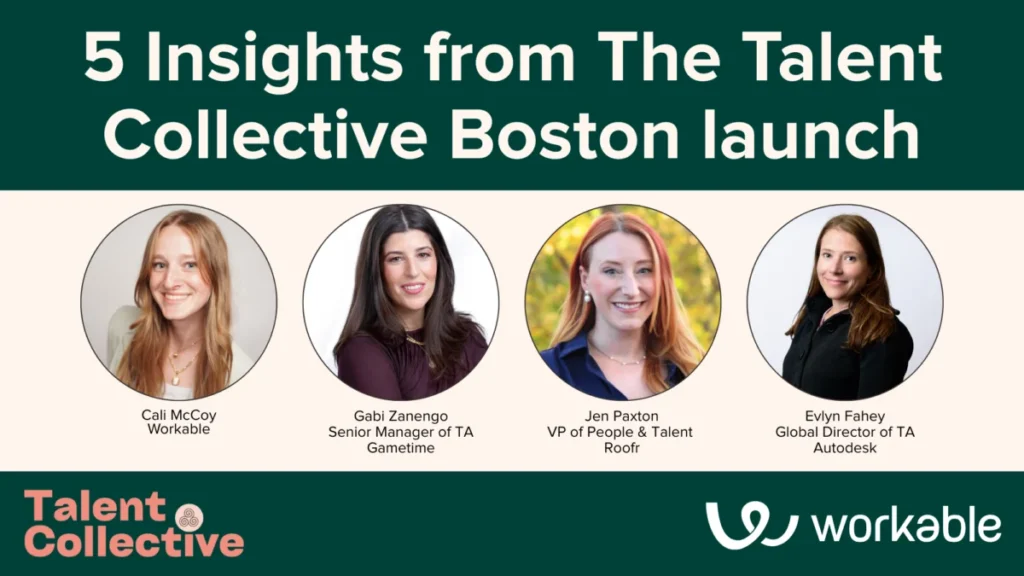
Boston recently hosted a pivotal gathering for human resources and talent acquisition (TA) leaders, marking the official launch of The Talent Collective’s Boston chapter. The event, held in a packed room, focused on a question that resonates deeply across the modern corporate landscape: "How can TA teams innovate quickly without losing what makes hiring fundamentally human?" This discussion, moderated by Workable’s Cali McCoy, brought together a panel of industry powerhouses to dissect the intricate challenges and emerging solutions defining the recruitment sector today and for the foreseeable future.
The Talent Collective, an organization dedicated to fostering community and knowledge sharing among talent leaders, chose Boston as its latest hub, recognizing the city’s vibrant tech ecosystem and diverse professional landscape. The launch underscored a growing need for collaborative platforms where experts can openly discuss the paradigm shifts occurring in talent acquisition. As companies globally grapple with unprecedented changes driven by technology, economic volatility, and evolving workforce expectations, the role of TA has never been more critical or complex. The event served as a timely forum for these leaders to converge, share insights, and collectively chart a course through the turbulent waters of contemporary hiring.
The candid and dynamic conversation among the panelists, representing various industries and organizational scales, revealed a striking consistency in the challenges faced by TA teams. Despite differing contexts, the core issues – from the nature of desired skills to the sheer volume of applications and the ethical integration of AI – mirrored each other, painting a clear, albeit challenging, picture of what hiring will entail by 2026 and beyond. This convergence of experience highlighted universal truths in a rapidly fragmenting talent market, emphasizing the shared journey of adapting to a new era of recruitment.
The Era of Hyper-Specialized Roles: A Recalibration for Talent Acquisition
One of the most significant shifts identified by the panel was the move away from high-volume, generalized hiring towards a demand for deeply niche and often hybrid-skilled roles. The market is no longer merely seeking "more of the same"; instead, the hunt is on for unique combinations of expertise. Examples cited included candidates possessing both technical prowess and creative flair, or individuals who are not only AI-literate but also possess strong strategic acumen. This trend is a direct consequence of digital transformation, the acceleration of technological advancements, and the increasing complexity of business problems that require multifaceted skill sets to solve.
Industry data corroborates this observation. According to a 2023 report by LinkedIn, the demand for "fusion skills"—combinations of technical and soft skills—has surged by over 20% in the last two years, particularly in fields like data science, cybersecurity, and product management. This shift has profound implications for TA teams, demanding a recalibration of their recruitment strategies. Traditional keyword-based searches and broad job descriptions are proving ineffective. Recruiters must now possess a deeper understanding of specific departmental needs, the nuances of emerging technologies, and the intricate interplay of different skill sets. This necessitates a closer partnership with hiring managers, grounding expectations in the reality of the current talent pool. The consensus among the leaders was clear: while excellence remains paramount, the pursuit of a "unicorn" candidate – someone who perfectly embodies every desirable trait – is often an exercise in futility. Instead, the focus must shift to identifying candidates with core competencies and high adaptability, recognizing that continuous learning and development will fill skill gaps post-hire. This approach also implies a stronger emphasis on internal mobility and upskilling existing employees to meet evolving demands, thereby nurturing talent from within rather than solely relying on external acquisition.
Exploding Candidate Volumes: Overwhelming Systems and Sparking Innovation
Paradoxically, even as roles become narrower and more specialized, the volume of applications per requisition has exploded, with some roles attracting over 1,000 applicants. This phenomenon creates a perfect storm for TA teams, leading to several critical issues. Firstly, it results in an overwhelming administrative burden, with recruiters spending an inordinate amount of time sifting through resumes, many of which are unqualified or irrelevant. This significantly detracts from their capacity to engage meaningfully with promising candidates or focus on strategic sourcing.
Secondly, the sheer volume exacerbates the risk of overlooking truly qualified candidates amidst the deluge. Valuable applications can get lost in the shuffle, leading to missed opportunities for the organization. Thirdly, it inevitably degrades the candidate experience. With thousands of applicants vying for a single role, personalized communication becomes nearly impossible, leading to slow response times, generic rejections, and a general feeling of being a number in a vast pool. This negative experience can tarnish employer brand and deter future applications from top talent.
The surge in application volume is fueled by several factors, including the widespread adoption of remote work, which removes geographical barriers for applicants; economic uncertainties that lead more people to actively seek new opportunities; and the ease of applying through various online platforms with minimal effort. This scenario has accelerated the urgent need for AI support in screening processes. However, the panel strongly emphasized that this AI integration must be transparent, ethical, and designed to augment human decision-making, not replace it. AI’s role, in this context, is to intelligently filter, categorize, and prioritize applications based on predefined criteria, thereby freeing up recruiters to focus on qualitative assessments, interviews, and relationship building. This strategic deployment of AI aims to restore a human-centric approach to candidate engagement by streamlining the initial, often monotonous, stages of the hiring funnel.
The Mounting Threat of Candidate Fraud: Safeguarding Integrity in Hiring
Perhaps no topic elicited more widespread agreement and concern than the escalating threat of candidate fraud. The room was filled with nods as panelists detailed the increasingly sophisticated tactics employed by fraudsters. This ranges from outright identity impersonation, where individuals pretend to be someone else during interviews or throughout the hiring process, to the submission of AI-generated resumes and cover letters that convincingly mimic human writing but often contain fabricated experience or skills. Another prevalent issue is the submission of fake credentials, including diplomas, certifications, and employment verification documents. Furthermore, the rise of "ghosting" and "deepfake" interviews, where fraudsters use advanced technology to mimic a legitimate candidate’s appearance and voice, poses a new and alarming challenge.
The implications of candidate fraud are severe. For organizations, it can lead to significant financial losses through mis-hires, onboarding costs for unqualified individuals, and potential damage to reputation. It also undermines team morale and productivity if fraudulent hires are made. For legitimate candidates, it creates an unfair and distrustful environment, potentially prolonging their job search and eroding faith in the hiring process.
In response to this growing threat, TA leaders are adopting a multi-pronged approach involving creative tactics and advanced technological solutions. These include implementing robust IP checks and location validation to verify the geographical authenticity of applicants, deploying advanced identity verification software that uses biometric data or multi-factor authentication, and enhancing background check processes to scrutinize credentials and employment history more rigorously. The discussion highlighted the importance of integrating these security measures without creating an overly cumbersome or alienating experience for genuine candidates. Balancing security with a positive candidate journey is a delicate act, but one deemed essential to protect both organizational integrity and the overall trust in the hiring ecosystem.
AI Adoption in TA: A Spectrum of Maturity and Strategic Imperatives
The conversation around AI adoption revealed a landscape of varied maturity levels across companies. As one panelist aptly put it, every organization is "somewhere different on the map." Some companies are aggressively experimenting with AI, leveraging tools for automated resume screening, sophisticated candidate matching, predictive analytics for talent forecasting, and even AI-powered chatbots for initial candidate interactions and FAQ support. These early adopters are keen to harness AI’s potential to enhance efficiency, reduce bias, and improve the quality of hires.
However, many other organizations are encountering significant legal and compliance friction. Concerns about data privacy (e.g., GDPR, CCPA), algorithmic bias, and potential discrimination risks are legitimate hurdles that slow down widespread AI integration. The panel offered a standout insight for navigating these challenges: instead of asking legal departments, "Can we do this?" a more productive approach is to inquire, "Under what conditions would this not be allowed?" This subtle but powerful reframing shifts the conversation from outright prohibition to a strategic exploration of controlled experimentation within defined boundaries. It encourages a proactive dialogue between TA and legal teams, enabling the development of ethical guidelines and compliance frameworks that facilitate responsible AI adoption.
Across the board, a unifying principle emerged regarding AI’s role in TA: AI should eliminate administrative burdens, not become the ultimate decision-maker. This philosophy underscores the belief that while AI can streamline processes, analyze vast datasets, and offer insights, the final hiring decisions—which involve nuanced judgment, cultural fit, and human intuition—must remain firmly in human hands. This ensures that AI acts as a powerful assistant, freeing up recruiters to focus on the human elements of connection, empathy, and strategic talent development, thereby enhancing rather than diminishing the human touch in hiring.
Evolving Candidate Experience: The Shift to Continuous Feedback
The final key takeaway from the Boston launch focused on a significant evolution in candidate experience strategies: a move from singular, post-process surveys to continuous, stage-by-stage check-ins. Traditionally, feedback was solicited only after a candidate was either hired or rejected, at which point emotions could be at their peak, potentially skewing responses and making it difficult to pinpoint specific process breakdowns.
The new paradigm advocates for quick, unobtrusive feedback requests at various stages of the hiring journey. This could involve brief pulse surveys after an initial application, a screening call, or an interview round. The primary objective is to surface friction points earlier in the process. By gathering real-time feedback, TA teams can identify issues such as unclear communication from recruiters, inconsistencies in interview questions or evaluations, or unexplained process delays while candidates are still actively engaged. This proactive approach allows teams to make immediate adjustments, troubleshoot problems, and refine the candidate journey in real time.
While not every candidate will respond to every check-in, the goal is not necessarily high volume of feedback but rather the early detection of signals. Even a small sample of timely feedback can provide invaluable insights into systemic issues, enabling TA teams to course-correct before problems escalate or lead to significant candidate drop-off. This continuous feedback loop transforms candidate experience from a reactive, post-mortem analysis into a dynamic, adaptive process that prioritizes transparency, responsiveness, and empathy. Ultimately, this fosters a more positive and respectful experience for all applicants, strengthening the employer brand and enhancing the likelihood of securing top talent.
The Bottom Line: Balancing Innovation with Humanity
The Talent Collective Boston launch made one overarching truth abundantly clear: the field of hiring is undergoing its most dramatic transformation in a decade. The advent of sophisticated AI, the evolving nature of skill demands, and the sheer scale of candidate interactions are reshaping every facet of talent acquisition. Yet, amidst this rapid technological advancement, the core message resonated: AI will undoubtedly transform the process, but people will continue to define the experience.
As the complexity of talent acquisition continues to grow, the competitive advantage will increasingly belong to those teams that can master a delicate and intricate balance. This balance is characterized by a blend of innovation and integrity, where new technologies are embraced responsibly and ethically. It demands a synergy of automation and empathy, leveraging tools to streamline tasks while preserving and enhancing genuine human connection. Finally, it requires a combination of speed and substance, ensuring that efficiency does not come at the expense of thoroughness or quality. These six qualities – innovation + integrity + automation + empathy + speed + substance – represent the bedrock upon which the future of successful talent acquisition will be built. The lively and insightful discussions in Boston demonstrated that leaders are actively cultivating these very qualities, poised to navigate the complex landscape of talent acquisition with foresight and a human-centered approach.






