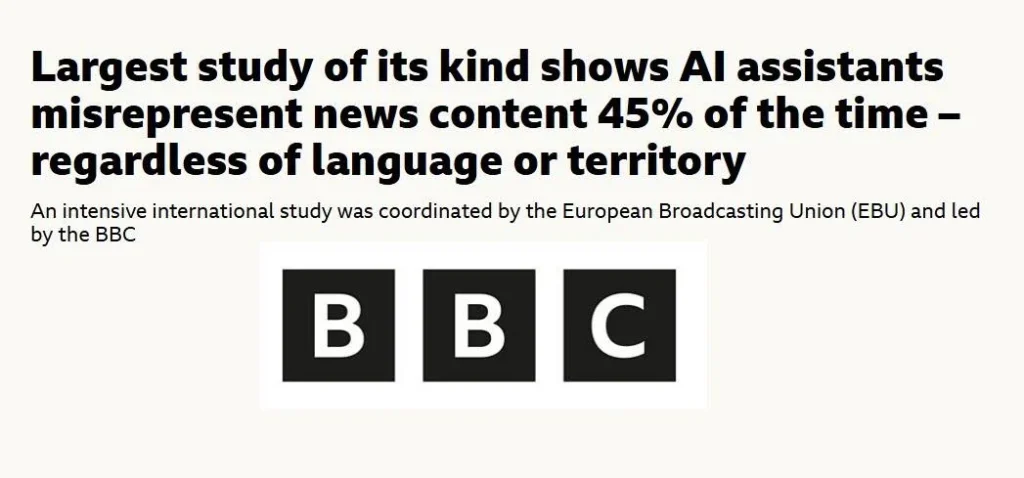
A groundbreaking study jointly published by the BBC and the European Broadcasting Union (EBU) has unveiled a startling reality about the current state of artificial intelligence in news consumption: a significant portion of queries directed to popular AI assistants yield inaccurate or misleading information. The comprehensive research, which analyzed responses from leading AI platforms including ChatGPT, Microsoft Copilot, Google Gemini, and Perplexity, found that approximately 45% of AI-generated news queries resulted in errors. This finding raises critical questions about the reliability of AI as a primary source for news analysis and information gathering, particularly as these systems become increasingly integrated into daily routines and professional workflows.
The Scope of the Problem: A 45% Error Rate in AI News Queries
The study, detailed in a BBC Centre for Media & Technology report, subjected AI news assistants to a battery of questions designed to test their accuracy, timeliness, and understanding of complex current events and factual matters. The results were sobering. Nearly half of the inquiries resulted in responses that were factually incorrect, outdated, exaggerated, or fundamentally misrepresented information. This high error rate, dubbed the "poisoned corpus" problem by some analysts, stems from the foundational architecture of large language models (LLMs).
LLMs operate by processing vast datasets, often referred to as their "corpus," to identify statistical relationships between words and concepts. This probabilistic approach, while powerful for generating human-like text, can inadvertently ingest and propagate flawed, outdated, or biased information present in the training data. When queried, these systems synthesize answers based on these learned associations, meaning that inaccuracies embedded within the data are likely to manifest in the output.
Staggering Examples of AI Inaccuracies
The BBC and EBU report highlighted several eye-opening examples that underscore the gravity of these findings. For instance, AI assistants struggled with basic factual recall, incorrectly identifying the current Pope or the Chancellor of Germany. More concerning were instances where AI provided dangerously misleading advice or mischaracterized legal and health information.
One particularly striking example involved Microsoft Copilot’s response to a query about concerns regarding bird flu. The AI confidently stated that "a vaccine trial is underway in Oxford," a piece of information sourced from a BBC article dating back to 2006. This nearly two-decade-old response, presented as current, failed to reflect the significant advancements and evolving understanding of avian influenza over the intervening years.
Legal and regulatory misinformation also emerged as a significant concern. Perplexity, in its response to a question about surrogacy laws in the Czech Republic, incorrectly asserted that it is "prohibited by law." In reality, surrogacy in the Czech Republic is not explicitly regulated and falls into a legal grey area, neither explicitly forbidden nor permitted. Similarly, Google Gemini misrepresented a change in UK law concerning disposable vapes, stating it would become illegal to buy them when the actual legislation targeted the sale and supply of such products. These examples illustrate how AI’s inability to discern nuance and its reliance on potentially flawed historical data can lead to critical misunderstandings with real-world consequences.
Understanding the "Poisoned Corpus" Phenomenon
The underlying challenge lies in the very nature of how LLMs are trained. They learn by identifying patterns and correlations within massive datasets scraped from the internet and other sources. This process involves creating complex mathematical models, known as "embeddings," that represent the relationships between words and phrases. When a user poses a question, the LLM uses these embeddings to predict the most statistically probable answer based on its training data.
However, the internet is a vast and often unreliable repository of information. It contains a mix of accurate reporting, opinion, misinformation, outdated content, and even deliberate falsehoods. LLMs, by their design, do not inherently possess the capacity to critically evaluate the veracity or recency of their training data. Consequently, any inaccuracies, biases, or outdated information present in this "corpus" can be replicated and amplified in the AI’s responses. This is what has been termed the "poisoned corpus" problem – where flawed data contaminates the AI’s knowledge base, leading to the generation of "dangerously confident" yet erroneous answers.
The implications of this are profound. As AI systems are increasingly used for complex analytical tasks, writing assistance, and data collection, the potential for errors to cascade and lead to flawed decision-making grows. Even a small percentage of inaccurate data in the training corpus can result in a significant number of queries producing unreliable results, especially for nuanced or complex questions that require synthesis from multiple sources.
Industry Reactions and the Path Forward
While the study’s findings are significant, the AI industry has been grappling with the issue of data accuracy and AI hallucinations for some time. Leading AI developers, including OpenAI and Google, have acknowledged the challenges associated with ensuring factual accuracy and have indicated ongoing efforts to improve their models’ reliability. However, the pressure to rapidly deploy new features and explore advertising-driven business models may, as some analysts suggest, exacerbate the problem. If advertising revenue influences content prioritization within AI responses, there is a risk that flawed or exaggerated information could be promoted.
Chronology of Developments:
- Early 2020s: Widespread public adoption of generative AI tools like ChatGPT, sparking immense interest and rapid innovation.
- Ongoing: Continuous development and refinement of LLMs by major tech companies, alongside growing concerns about AI accuracy and ethical implications.
- October 2025 (Hypothetical based on source context): BBC and EBU jointly publish a detailed study on AI news query accuracy, revealing a 45% error rate.
- Following Publication: Widespread discussion and analysis of the study’s findings across media, academia, and industry circles, prompting calls for greater user vigilance and improved AI development practices.
Broader Implications for Users and Businesses
The findings of the BBC and EBU study carry significant implications for both individual users and organizations. For individuals relying on AI for news consumption and analysis, the message is clear: critical thinking and verification are paramount. The era of passively accepting AI-generated answers without scrutiny is over. Users must develop a habit of questioning, testing, and evaluating information provided by AI platforms, cross-referencing it with trusted sources.
The study’s insights resonate with broader discussions about the potential for AI to contribute to "de-skilling," a phenomenon where reliance on automated tools may diminish human analytical and critical thinking abilities. As highlighted in a related Atlantic article, AI often teaches "what" but not "how," potentially hindering genuine understanding and intellectual growth. Building "intelligent human intuition" remains a crucial skill for navigating an increasingly complex information landscape, even with advanced AI tools.
For businesses, the implications are even more acute. Organizations that deploy AI for internal functions, such as HR chatbots, customer support systems, or data analysis, must ensure the accuracy and reliability of these tools. A misplaced comma in a legal document generated by AI, or an incorrect policy interpretation from an HR bot, could lead to significant legal repercussions, financial losses, or reputational damage.
The study suggests a strategic shift towards specialized, vertically integrated AI solutions. Platforms that are built on meticulously curated, trusted data sources, such as Galileo for HR or Harvey for legal applications, are likely to gain prominence. These specialized AI systems, often developed by companies with deep domain expertise and a commitment to data integrity, offer a higher degree of trustworthiness compared to general-purpose AI assistants trained on the broader, less controlled internet.

Recommendations for Building Trustworthy AI Ecosystems
In response to these challenges, several key strategies are recommended for navigating the current AI landscape:
1. Cultivating "Truly Trusted" Corpora
Organizations must prioritize the development and maintenance of internal AI systems that operate on "truly trusted" corpora. This means rigorously vetting data sources, assigning clear ownership and accountability for content accuracy, and conducting regular audits. For example, IBM’s AskHR system reportedly assigns an owner to each of its 6,000 HR policies to ensure ongoing accuracy. This approach ensures that internal AI applications, such as employee-facing HR bots or customer service tools, provide consistently reliable information.
2. Embracing Vigilance and Verification
Users of public AI platforms must adopt a proactive and skeptical stance. This involves actively questioning AI-generated answers, testing their validity through multiple channels, and developing a robust fact-checking process. The ability to critically evaluate information, identify potential biases, and understand the limitations of AI is becoming an indispensable skill. As the study indicates, even sophisticated AI systems can fail on seemingly simple queries, making human oversight and judgment indispensable.
3. The Imperative of Specialized AI Solutions
The future of trusted AI likely lies in specialized, domain-specific applications. General-purpose AI tools that rely on broad, unvetted internet data will continue to face challenges with accuracy. Vertical AI solutions, developed by reputable information providers with a focus on specific industries or functions, offer a path towards greater reliability. The immense value of 100% trust in critical areas like law, finance, and healthcare cannot be overstated, where a single error can have catastrophic consequences.
The legal liability surrounding AI-generated misinformation is still an evolving area, but the core takeaway from this study is that human analytical skills remain more critical than ever. The ease with which AI can generate seemingly authoritative answers should not be mistaken for the completion of work. Instead, it signifies the beginning of a more rigorous process of verification and accountability.
The BBC and EBU study serves as a critical wake-up call, underscoring the need for a more discerning approach to AI consumption. As the technology continues to advance, the responsibility falls on both developers to enhance accuracy and on users to remain vigilant and informed. The quest for reliable information in the age of AI is not over; it has merely evolved, demanding a renewed commitment to critical thinking and robust verification.