Success at work rarely announces itself with a fanfare of fireworks; more often, it manifests in the quiet triumph of a project finally crossing the finish line, the delicate navigation of a tough conversation, or simply the unwavering dedication of a team showing up, day after day, to get the job done. Yet, in the relentless pace of contemporary business, these crucial moments, especially the small, consistent victories, are too frequently overlooked or rushed past, diminishing their potential to fuel a vibrant, resilient, and high-performing workforce. The strategic imperative for organizations today is to consciously and consistently cultivate a culture where success, in all its forms, is not just acknowledged but genuinely celebrated.
This strategic oversight carries significant implications for employee engagement, performance, and ultimately, retention. Data from the Achievers Workforce Institute’s (AWI) 2026 Engagement and Retention Report paints a stark picture: only 26% of employees globally report feeling engaged, and a mere 25% feel genuinely appreciated at work. This profound chasm between employee effort and organizational appreciation is precisely where motivation begins to erode, leading to disengagement, reduced productivity, and increased turnover risk. Learning to celebrate success—consistently and meaningfully—is one of the most potent, yet often underutilized, tools available to bridge this divide and foster a workplace where individuals not only thrive but actively choose to remain.
The Foundational Importance of Workplace Celebration
At its core, celebration in the workplace is an act of recognition. It is the deliberate acknowledgment of effort, progress, and contribution, extending beyond mere final results. When individuals perceive that their work is seen, heard, and valued, they are intrinsically more likely to stay engaged, replicate positive behaviors, and feel a profound connection to their organization’s mission and objectives. This psychological anchoring is critical in an era characterized by dynamic work environments and a competitive talent landscape.
Research consistently underscores the tangible benefits of a celebratory culture. A study cited by Forbes reveals that a staggering 69% of employees would be motivated to work harder if they felt their efforts were better appreciated. This impact is not limited to monumental achievements; showing appreciation for minor victories and acknowledging those who contributed to them strengthens team bonds and creates a powerful, self-perpetuating cycle of positive motivation. The AWI data further corroborates this, indicating that employees who feel appreciated are significantly more likely to exhibit higher levels of engagement, a stronger sense of belonging, and a reduced intent to seek employment elsewhere. Beyond mere morale boosting, celebrating work reinforces individual purpose, fosters collective connection, and acts as a robust retention mechanism.
Evolution of Workplace Recognition: A Brief Chronology
Historically, workplace recognition often revolved around annual awards ceremonies or occasional, formal acknowledgments. While these grand gestures certainly have their place, the modern understanding of effective recognition has evolved significantly, particularly in response to shifts in work culture and employee expectations.
- Early 20th Century: Recognition was largely tied to seniority or significant career milestones, often in the form of long-service awards or retirement gifts.
- Mid-20th Century: The rise of human resources departments introduced more structured performance reviews and annual bonuses, though recognition remained largely top-down and outcome-focused.
- Late 20th Century: Concepts like "Employee of the Month" gained popularity, attempting to introduce more frequent, albeit still somewhat formal, recognition.
- Early 21st Century (Pre-2010s): The internet began to enable more widespread internal communications, but systematic, real-time recognition was still nascent.
- 2010s onwards: With the advent of social media, digital platforms, and a growing understanding of organizational psychology, the emphasis shifted dramatically towards continuous, real-time, peer-to-peer recognition. The understanding that frequent, informal acknowledgments could have a profound impact on daily motivation and belonging began to take hold, laying the groundwork for integrated recognition platforms.
This evolution highlights a move from sporadic, formal gestures to embedded, continuous practices, acknowledging the diverse and ongoing contributions of every employee.
Deconstructing "Celebration of Success"
To genuinely celebrate success at work does not imply a constant stream of lavish parties or expensive gifts. Instead, it involves a conscious and continuous effort to acknowledge the myriad contributions that constitute daily work life. The most impactful celebrations are frequently the smallest, most personal, and most frequent ones.
This looks like:
- A manager sending a quick email acknowledging a team member’s initiative on a challenging task.
- A colleague publicly praising another’s support on a shared project in a team meeting.
- A department head taking a moment to highlight a minor process improvement that saved time or resources.
- A peer-to-peer recognition message celebrating someone’s consistent positive attitude or willingness to help.
- A small, spontaneous team gathering to mark the successful completion of a tricky phase of a long-term project.
The critical factor here is recognition frequency. Global reports consistently demonstrate that weekly or monthly recognition is strongly correlated with higher engagement levels, a more robust sense of belonging, and a significantly lower intent to leave the organization. Conversely, employees who rarely or never receive recognition face a dramatically elevated turnover risk. This underscores a crucial insight: regular, authentic acknowledgment far outweighs the impact of infrequent, grand gestures. Celebrating success regularly transforms it from a special event into an integral part of the organizational culture.
The Micro-Moments: Why Small Wins Matter Most
While major milestones naturally command attention, the consistent acknowledgment of small wins often serves as the bedrock of sustained progress and team morale. These smaller achievements are the building blocks that culminate in larger successes, and celebrating them along the way offers several profound benefits:
- Sustained Momentum: Acknowledging incremental progress keeps teams motivated during long, complex projects, preventing burnout and maintaining enthusiasm.
- Reinforcement of Desired Behaviors: By recognizing small, positive actions, organizations can effectively reinforce the behaviors and values they wish to cultivate.
- Increased Psychological Safety: When minor efforts are celebrated, employees feel more secure in taking risks, experimenting, and contributing ideas without fear of failure. This fosters an environment conducive to innovation.
- Enhanced Sense of Purpose: Regularly seeing their efforts acknowledged, no matter how small, helps employees understand their contribution to the bigger picture, preventing the feeling of merely "checking boxes."
- Improved Connection and Belonging: In an era where only about one in five employees globally report a strong sense of connection or belonging at work (Achievers Workforce Institute), frequent, small celebrations can significantly bridge this gap. They serve as regular reminders that individuals are valued members of a collective, not just cogs in a machine.
Actionable Strategies: How to Celebrate Success Authentically

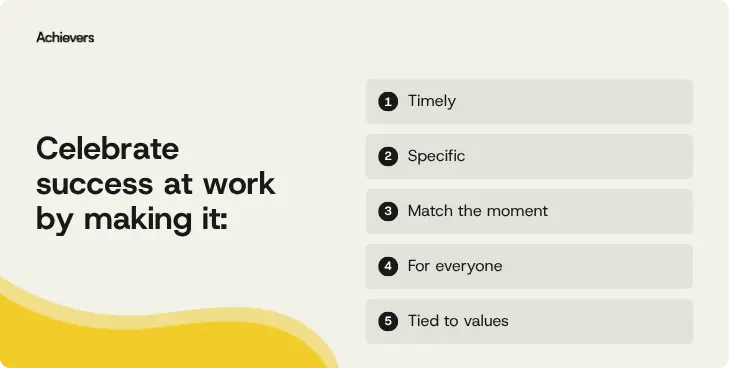
Effective workplace celebration does not require extravagant budgets or elaborate events. What it fundamentally demands is intention, consistency, and authenticity. When recognition is thoughtful and integrated into daily operations, it powerfully reinforces desired behaviors without feeling forced or performative. Here’s what truly works:
-
Make it Timely: The impact of recognition diminishes significantly with delay. Appreciating an action shortly after it occurs maximizes its effect, creating a direct link between effort and acknowledgment. Timely recognition helps employees understand that their actions mattered in real-time, solidifying the positive behavior. Dr. Elena Rodriguez, an organizational psychology expert, emphasizes, "The brain forms stronger associative links when feedback is immediate. Delayed praise loses much of its potency, becoming a historical footnote rather than a behavioral prompt."
-
Be Specific: Generic praise like "Great job" lacks impact. Specific recognition, which details what someone did and why it mattered, provides clear guidance on desirable behaviors. For instance, instead of "Good presentation," try "Your clear articulation of the market research data in today’s presentation was instrumental in helping us refine our strategy." This specificity removes ambiguity, builds confidence, and transforms recognition into a powerful learning tool.
-
Match the Moment: Not every achievement warrants a public spectacle. Some wins are best celebrated with a team-wide announcement, others with a quiet, personal thank-you, and some with a formal award. The key is to align the celebration method with the achievement’s scale and the individual’s preference. When the celebration method fits the context, it feels genuine and deeply meaningful, rather than an obligatory performance. Sarah Chen, an HR Director at a leading tech firm, notes, "Understanding your team members’ preferences for recognition is crucial. Some thrive on public praise, while others prefer a quiet word of thanks or a personalized note."
-
Involve Everyone (Peer Recognition): Celebration should not be solely a managerial responsibility. Peer recognition is a vital component, particularly in distributed, hybrid, or frontline environments where managers may not witness every contribution. Empowering employees to acknowledge the successes they observe daily makes recognition more frequent, inclusive, and deeply embedded in the organizational fabric. This fosters a sense of collective responsibility for cultural well-being.
-
Tie Celebration to Values: When recognition highlights actions that embody the organization’s core values, those values transition from abstract concepts into living examples. Celebrating "collaborative problem-solving" or "customer-centric innovation" not only praises the individual but also visibly reinforces the cultural tenets that define success within the organization. Over time, this practice powerfully shapes culture by demonstrating how success is achieved, not merely what is delivered.
The Obstacles: What Deters Consistent Celebration?
Most organizations do not neglect celebration out of indifference but rather due to systemic challenges. The primary culprit is often the sheer pace of business. Deadlines accumulate, priorities shift, and recognition, perceived as a "soft" activity, gets postponed indefinitely.
This habitual postponement carries significant risks. When appreciation diminishes, so too does the sense of belonging. The 2026 Engagement and Retention Report highlights a critical correlation: employees who feel appreciated are 54 times more likely to report a strong sense of belonging, and belonging is consistently identified as one of the strongest predictors of employee retention. Therefore, when celebration falters, it’s not just a missed "nice moment"; it’s a missed opportunity to leverage a powerful retention strategy. Other common barriers include:
- Lack of dedicated tools: Manual, ad-hoc recognition methods are often cumbersome and inconsistent.
- Managerial skill gaps: Not all managers are equipped with the skills or confidence to deliver effective, timely, and specific recognition.
- Perceived cost: Some organizations mistakenly view recognition as an expense rather than a strategic investment with a measurable return.
- Cultural inertia: In workplaces where recognition has historically been absent or sporadic, establishing a new norm can be challenging.
From Occasional Applause to an Enduring Habit
The ultimate goal is to transcend sporadic acts of appreciation and embed celebration as a fundamental habit within the organizational culture. When celebration becomes a deeply ingrained practice:
- Employee morale and motivation naturally rise.
- Teams become more cohesive and resilient.
- Innovation is fostered as individuals feel more secure in contributing.
- Retention rates improve, reducing costly turnover.
- Organizational values are consistently reinforced through lived examples.
This transformation is particularly vital given that only 18% of employees globally feel genuinely supported by their managers in ways that enable their best work. Regular, visible recognition is one of the most direct and effective ways to profoundly alter this experience, shifting the perception of management from task-masters to enablers of success.
Leveraging Technology: How Achievers Empowers Daily Celebration
Platforms like Achievers are designed to facilitate and embed this culture of continuous recognition. Achievers believes that recognition is not merely about fostering good feelings—though that is a beneficial byproduct—but about strategically shaping behavior, fortifying organizational culture, and driving measurable business results.
The Achievers platform empowers organizations by:
- Simplifying Recognition: Providing intuitive tools for managers and peers to send timely, specific, and values-aligned recognition from anywhere, at any time.
- Integrating with Core Values: Allowing organizations to customize recognition programs that directly link acknowledgments to specific company values, making them tangible and actionable.
- Enabling Peer-to-Peer Appreciation: Facilitating a bottom-up flow of recognition that builds stronger team bonds and ensures contributions are seen across all levels.
- Offering Diverse Reward Options: Providing a flexible system for monetary and non-monetary rewards that can be tailored to individual preferences and company policies.
- Providing Data-Driven Insights: Offering analytics on recognition trends, identifying top contributors, and highlighting areas where more appreciation might be needed, allowing for continuous program optimization.
- Fostering Global Consistency: Ensuring that recognition programs can be deployed consistently across diverse geographical locations and cultural contexts.
In an increasingly competitive and dynamic global economy, organizations cannot afford to overlook the strategic power of celebrating success. When individuals feel seen, heard, and genuinely appreciated, they don’t merely work harder; they work smarter, commit longer, and bring a deeper sense of purpose to their roles. Moving beyond occasional applause to build a culture where celebration is a daily expectation is not just a human resources initiative; it is a fundamental business imperative. By recognizing, rewarding, and nurturing their human capital, organizations can truly shape their workforce and achieve enduring results.