
The contemporary talent acquisition landscape is marked by intense competition and a concerning trend: the rising prevalence of candidate reneges. Far too often, organizations find themselves scrambling to backfill positions after a candidate withdraws their acceptance, a discovery typically made only after the individual has already disengaged. This reactive posture, where teams learn of a renege after the decision has solidified, underscores a fundamental flaw in many recruitment processes. By the time a candidate falls silent, their decision is frequently already made, leaving companies with limited recourse. The imperative, therefore, shifts from belated damage control to proactive, data-driven engagement, with the "Engagement Health Scorecard" emerging as a critical tool for identifying and mitigating risk during the crucial pre-start period.
The Rising Challenge of Candidate Reneges in a Competitive Market
The phenomenon of candidate reneges is not merely an inconvenience; it represents a significant operational and financial burden for businesses across industries. In today’s candidate-driven market, where skilled professionals often receive multiple offers, the period between offer acceptance and the first day of employment has become increasingly volatile. Industry reports suggest that renege rates can range from 10% to 20% across various sectors, escalating in highly competitive fields like technology and healthcare. This volatility is exacerbated by factors such as the rise of remote work, which broadens candidates’ options, and the speed at which competing offers can materialize.
The financial implications of a renege are substantial. Beyond the immediate costs associated with re-opening a search—including advertising, recruiter time, and interview expenses—there are indirect costs that often go unquantified. These include lost productivity due to a vacant role, delayed project timelines, increased workload for existing team members, and potential impacts on team morale. Estimates frequently place the cost of a single renege in the thousands, if not tens of thousands, of dollars, factoring in the full lifecycle of recruitment, onboarding, and the opportunity cost of an unfilled position. Furthermore, a high renege rate can subtly erode an employer’s brand reputation, signaling a potentially flawed or disengaging pre-boarding process to future candidates.
Understanding the Pre-Start Engagement Gap: A Critical Timeline
The candidate journey, post-offer acceptance, typically involves a period of anticipation and administrative tasks before the official start date. This phase, often spanning several weeks or even months, is where the "engagement gap" can widen. Traditional recruitment processes frequently conclude their intensive engagement efforts once an offer is accepted, shifting focus to administrative onboarding. However, this oversight creates a vacuum where candidates can experience second thoughts, receive more attractive competing offers, encounter personal circumstances that alter their plans, or simply feel a lack of continued connection to their future employer.
Without a structured approach, organizations lack visibility into a candidate’s evolving sentiment during this critical window. The absence of a defined process means that warning signs—subtle shifts in communication, delayed responses, or a lack of participation—go unnoticed until it’s too late. This reactive posture is akin to an airline only checking its engines after a failure has occurred, rather than continuously monitoring their health. The key to mitigating reneges lies in transforming this period of uncertainty into one of sustained, measurable engagement.
The Engagement Health Scorecard: A Framework for Proactive Intervention
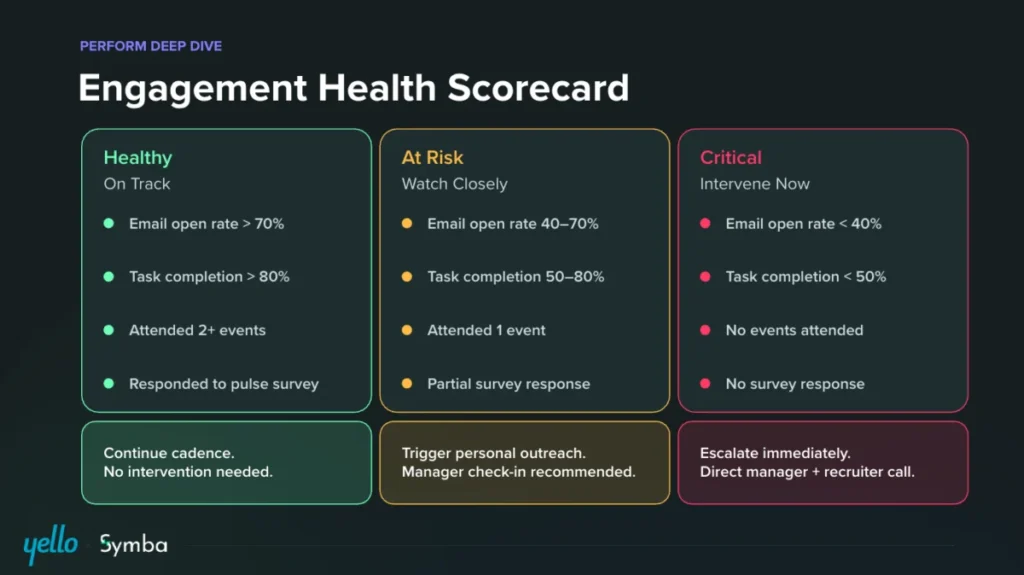
The solution lies in treating engagement signals as leading indicators of a candidate’s commitment. The Engagement Health Scorecard provides a robust, data-driven framework for systematically monitoring candidate behavior during the pre-start period, categorizing individuals into three distinct groups based on their level of interaction and enthusiasm. This proactive system enables timely, targeted interventions, preventing disengagement from escalating into a full-blown renege.
1. Healthy Candidates: Sustained Engagement and Reinforcement
Healthy candidates exhibit strong and consistent engagement, indicating a high level of commitment and enthusiasm for their upcoming role. Their behaviors typically include:
- Email Open Rates: Consistently above 70%, signaling attentiveness to official communications and updates.
- Task Completion: Promptly completing any pre-onboarding tasks, such as background checks, paperwork, or preliminary training modules.
- Event Attendance: Actively participating in optional pre-start events, virtual meet-and-greets, or introductory webinars.
- Survey Responses: Providing timely and complete feedback on engagement surveys.
- Responsiveness: Quick and positive replies to outreach from the hiring team or HR.
For candidates in this category, the recommended action is to "continue the cadence and stay the course." This involves maintaining the established communication schedule, providing relevant updates, and reinforcing their decision to join the company. The goal is to nurture their positive sentiment, ensure they feel valued, and solidify their psychological commitment without overwhelming them. This continuous, positive reinforcement helps to ward off any potential second thoughts or the allure of competing offers by consistently demonstrating the value and excitement of their chosen path.
2. At-Risk Candidates: Personalized Outreach for Re-Engagement
At-risk candidates display declining engagement signals, suggesting a potential shift in their commitment or an emerging issue that requires attention. These indicators include:
- Email Open Rates: Falling into the 40% to 70% range, indicating less consistent attention to communications.
- Limited Event Attendance: Sporadic or no attendance at optional pre-start events.
- Incomplete Survey Responses: Partial or delayed submission of feedback, or a lack of detail in their responses.
- Reduced Responsiveness: Slower replies or less enthusiastic communication.
Candidates categorized as "At-Risk" require immediate, personalized outreach within 48 hours of these declining signals being identified. A generic, mass-distributed message is unlikely to be effective. Instead, interventions should be tailored and personal:
- Direct Message from Program Manager: A personalized message from the program manager or a direct team leader, expressing enthusiasm for their start and checking in, can make a significant difference. This human touch reaffirms their importance to the team.
- Individualized Event Invitation: Rather than a mass email, a direct, personal invitation to an upcoming event, highlighting how it specifically benefits them or aligns with their interests, can increase participation.
- Hiring Manager Check-in: A brief, informal call or message from the hiring manager to simply say hello, ask if they have any questions, and reiterate excitement for their arrival, can often turn things around quickly. This demonstrates that their future leader is invested in them.
The objective here is to re-establish a personal connection, identify any nascent concerns, and provide reassurance, thereby preventing further disengagement and re-igniting their initial enthusiasm.
3. Critical Candidates: Immediate Escalation and Direct Communication
Critical candidates exhibit almost no engagement, signaling a high probability of a renege unless immediate and significant intervention occurs. Their behaviors are characterized by:
- Email Open Rates: Consistently below 40%, or no opens at all, indicating a complete disconnect from communications.
- No Event Attendance: A complete absence from any pre-start events.
- No Survey Responses: A failure to respond to any feedback requests.
- Extended Inactivity: No communication or activity for three or more weeks, which is a strong red flag.
For candidates in the "Critical" category, immediate escalation is paramount. This situation demands direct, high-level engagement to uncover the root cause and attempt to salvage the hire:
- Direct Call from the Hiring Manager: A personal, direct phone call from the hiring manager is crucial. This is not a casual check-in but a genuine conversation to understand "what’s going on." It conveys the seriousness of the situation and the company’s commitment.
- Personal Touchpoint from the Recruiter: The recruiter, having built the initial relationship, should follow up with a personal call, offering support and attempting to understand any concerns.
- Real Conversation: The aim of these interactions is to have an open and honest dialogue. Often, the root cause is a competing offer, a personal circumstance (e.g., family relocation, health issue), or simple uncertainty about the role or company culture. If caught in time, many of these issues can be addressed through further clarification, negotiation, or providing resources. The goal is to provide a safe space for the candidate to voice concerns without fear of judgment.
This level of intervention underscores the organization’s investment in the candidate and its willingness to address their specific needs, potentially preventing a costly and disruptive renege.
The Strategic Imperative: Data-Driven Talent Retention
The fundamental difference between teams that successfully retain candidates and those that are perpetually scrambling to backfill positions lies in their approach to data. The first group continuously monitors engagement data, not just waiting for a renege email to arrive. This proactive, data-centric strategy offers numerous strategic advantages beyond merely reducing renege rates.
Implementing an Engagement Health Scorecard aligns with broader trends in people analytics and predictive HR. By leveraging technology to track interactions across various touchpoints—email, event registrations, survey completions, and platform activity—organizations gain unprecedented insight into candidate sentiment. This data allows for:
- Reduced Backfill Costs: By preventing reneges, companies avoid the significant financial outlay and time investment associated with restarting recruitment processes.
- Improved Time-to-Hire: Fewer reneges mean fewer delays in filling critical roles, leading to faster project initiation and sustained productivity.
- Enhanced Candidate Experience: A system that actively monitors and responds to candidate engagement ensures a more personalized and supportive pre-boarding journey. This positive experience enhances the employer brand, making the company more attractive to future talent, even if a candidate ultimately chooses another path.
- Better Project Planning and Team Stability: Predictable hiring outcomes allow for more accurate workforce planning, ensuring teams are adequately staffed and projects remain on schedule.
- Stronger Onboarding: Candidates who feel consistently engaged and supported during the pre-start phase are likely to arrive on their first day feeling more committed, informed, and ready to contribute, leading to more successful long-term retention.
Resources like "The KEEP Playbook," for instance, offer comprehensive guides for implementing such a system, providing detailed engagement health scorecards with specific thresholds, step-by-step intervention playbooks, and post-cycle review templates. These tools empower organizations to continuously refine their pre-boarding strategies, learning and improving with every recruitment cycle.
Expert Perspectives on Proactive Engagement
HR leaders and talent acquisition specialists are increasingly recognizing the strategic importance of proactive candidate engagement. According to Dr. Evelyn Reed, a prominent HR analytics consultant, "The modern talent landscape demands a paradigm shift from reactive firefighting to proactive engagement. Companies that invest in robust pre-boarding strategies, like the Engagement Health Scorecard, are not just reducing reneges; they are building stronger, more committed workforces from day one. It’s a fundamental shift from viewing an offer acceptance as the finish line to understanding it as the start of a critical engagement period."
A spokesperson for a leading global talent acquisition firm, who requested anonymity to speak candidly, noted, "The cost of a lost candidate extends far beyond recruitment fees. It impacts team morale, project timelines, and can even damage a company’s reputation as an employer of choice. Systems that provide early warning signals are no longer a luxury; they are a necessity for any organization serious about talent retention and employer branding. The human touch combined with data-driven insights is the winning formula." This sentiment underscores a growing consensus within the industry that investing in sophisticated pre-boarding engagement is an investment in the long-term health and stability of the workforce.
Broader Implications and Future Outlook
The adoption of Engagement Health Scorecards represents a significant step towards a more human-centered and data-driven approach to talent management. This methodology aligns seamlessly with broader HR trends, including the increasing focus on personalized employee experiences, the strategic application of people analytics, and the development of predictive HR capabilities. As technology continues to evolve, we can anticipate these scorecards becoming even more sophisticated, potentially incorporating artificial intelligence and machine learning algorithms to analyze vast datasets of candidate interactions, identify nuanced patterns, and offer even more precise, automated intervention recommendations.
Furthermore, this proactive approach has positive implications for diversity, equity, and inclusion initiatives. By ensuring consistent, measured engagement with all candidates post-offer, organizations can create a more equitable pre-boarding experience, reducing the likelihood that candidates from underrepresented groups might feel overlooked or less connected, which can sometimes contribute to reneges.
In conclusion, the era of passively awaiting a candidate’s start date is rapidly becoming obsolete. In a fiercely competitive talent market, organizations that thrive are those that embrace continuous data monitoring and proactive engagement. The Engagement Health Scorecard provides a powerful, actionable framework for achieving this, transforming the pre-start period from a silent risk zone into an opportunity for sustained connection, commitment, and ultimately, superior talent retention. By understanding, categorizing, and responding to candidate engagement signals, companies can significantly reduce renege rates, optimize their talent acquisition investments, and build a more stable and engaged workforce.






