Improving the speed of your job description (JD) process extends far beyond merely drafting documents faster. In today’s dynamic and competitive talent landscape, a swift and efficient job description management journey is paramount for attracting top talent, reducing time-to-hire, and maintaining a competitive edge. This necessitates a holistic approach, optimizing every stage from initial concept to final publication, including approval workflows, collaborative frameworks, robust version control, and streamlined storage solutions. This comprehensive guide delves into strategic tips and technological advancements designed to revolutionize your JD process.
The Evolving Landscape of Talent Acquisition: Why JD Speed Matters
In an era where talent is a company’s most valuable asset, the speed and quality of job descriptions directly impact an organization’s ability to secure skilled professionals. Delays in posting accurate and engaging JDs can lead to prolonged vacancies, increasing operational costs, hindering project timelines, and potentially impacting team morale. Studies indicate that the average time-to-hire can range from 30 to 45 days, with a significant portion of this attributed to inefficiencies in the initial stages of defining and articulating job roles. Each day a position remains unfilled can cost a company thousands in lost productivity and potential revenue.
Moreover, the modern job seeker has evolving expectations. They seek clarity, transparency, and an efficient application process. A poorly structured or slow-to-publish job description not only deters qualified candidates but can also negatively impact the employer brand. Therefore, optimizing the JD process is not just an administrative task; it’s a strategic imperative for talent acquisition and overall business success.
Beyond Drafting: A Holistic Approach to JD Management
The journey to an optimized JD process begins long before the first word is written. It demands a systematic evaluation of current practices and the implementation of proactive strategies to ensure efficiency and accuracy. Before commencing the drafting of any job description, organizations should prioritize three foundational steps:
- Define the Role’s Purpose and Impact: Clearly articulate why the role exists, its strategic contribution to the organization, and its anticipated impact on business objectives. This moves beyond a mere list of tasks to define the value proposition of the position.
- Identify Key Performance Indicators (KPIs) and Success Metrics: Establish measurable outcomes and performance expectations for the role. This ensures the JD focuses on results, providing both the hiring team and potential candidates with a clear understanding of what success looks like.
- Understand the Target Candidate Profile: Develop a comprehensive persona of the ideal candidate, including essential skills, desired experience, cultural fit, and potential career aspirations. This informs the language, tone, and specific requirements of the JD, making it more appealing to the right talent.
With these foundational insights firmly established, the process of building the first JD draft becomes significantly more streamlined and purposeful.
Key Strategies for Accelerating Your Job Description Workflow
The following strategies offer actionable insights for boosting JD speed and effectiveness across the entire management journey:
1. Structure Your Job Descriptions for Skimmability and Impact
A well-organized job description is crucial for both internal efficiency and candidate engagement. Disorganized JDs lead to confusion, slow down internal reviews, and deter potential applicants who often scan documents for key information. Without clear headings and a logical flow, team members waste time trying to decipher content, rather than focusing on their specific tasks. Candidates, in turn, are likely to abandon complex or difficult-to-read JDs, contributing to higher drop-off rates.
To enhance structure and ensure skimmability, consider the following elements:
- Compelling Job Accurate, clear, and searchable.
- Concise Summary/Introduction: A hook that explains the role’s purpose and value.
- Key Responsibilities and Duties: Bulleted lists of core functions, using action verbs.
- Required Skills and Qualifications: Differentiating between "must-haves" and "nice-to-haves."
- Preferred Qualifications (Optional): Additional skills or experiences that add value.
- About the Company/Team: Engaging description of culture, mission, and values (employer branding).
- Benefits and Perks: Clearly outlining compensation, health, growth opportunities.
- Equal Employment Opportunity (EEO) Statement: Ensuring compliance and inclusivity.
- Application Instructions: Clear guidance on how to apply.
This structured approach not only accelerates internal creation and review but also empowers candidates to quickly identify relevant sections, improving their overall experience and increasing application rates.
2. Leverage Standardized Templates for Consistency and Speed
Templates are indispensable tools for efficiency, eliminating the need to start from scratch with each new role. They provide a pre-structured framework that ensures consistency, reduces errors, and minimizes ambiguity. An effective JD template should include essential components that reflect organizational standards and legal compliance:
- Standardized Headers and Footers: Company branding, legal disclaimers.
- Pre-defined Sections: As outlined in the skimmability section (Job Title, Summary, Responsibilities, etc.).
- Boilerplate Language: Standardized sections like "About Us," EEO statements, benefits overview, and application instructions.
- Placeholders for Customization: Clearly marked areas for role-specific details.
- Inclusion of Keywords: Prompts for relevant keywords to enhance searchability.
- Guidelines for Inclusive Language: Reminders for bias-free writing.
- Review and Approval Fields: For tracking workflow.
Utilizing a robust template can cut initial drafting time by as much as 70%, leaving the remaining 30% for tailoring specific role requirements. This approach ensures brand consistency, legal compliance, and a professional presentation across all job postings.
3. Data-Driven JD Creation: Learning from Past Performance
Eliminating guesswork from the hiring journey is achievable through the systematic analysis of past candidate data, whether from an Applicant Tracking System (ATS) or other hiring intelligence platforms. Data-backed JD creation provides invaluable insights, allowing organizations to understand:
- Successful Candidate Profiles: What characteristics did your top hires possess?
- Effective Keywords and Phrases: Which terms attracted the most qualified applicants?
- Optimal Job Board Performance: Where did your best candidates come from?
- Candidate Drop-off Points: At which stage did candidates disengage, and why?
- Time-to-Fill for Similar Roles: Benchmarking and identifying bottlenecks.
As Milos Eric, General Manager at OysterLink, noted, "We found that starting to write JDs with actual candidate behavior in mind saved us time. So we decided to observe which listings our top candidates clicked on, what prompts them to apply, and what causes them to drop off. Using this information, we reverse-engineer our JDs to make them more effective at converting top candidates to apply to our openings. This eliminates most of the time we’d waste creating JDs by second-guessing." This approach shifts JD creation from a subjective exercise to a strategic, analytical process, leading to more effective and efficient talent acquisition.
4. Establish a Centralized Job Description Library
A centralized cloud-based library for all job descriptions is a critical time-saving asset. This repository eliminates the need to start JDs from scratch or waste time sifting through fragmented documents across various platforms (Word, Shared Drives, Google Docs).
A well-managed JD library allows teams to:
- Quickly Locate Existing JDs: Using advanced search and filtering capabilities by department, title, skill, or keywords.
- Leverage Approved Content: Use existing, approved JDs as inspiration or templates for new roles.
- Ensure Consistency: Maintain a single source of truth for all job descriptions.
- Track Historical Data: Analyze past versions and their performance.
This central hub transforms JD creation into an adaptive process, significantly reducing duplication of effort and ensuring that the most current and compliant versions are always accessible.
5. Foster a Collaborative Job Description Creation Team
Poor collaboration is a major impediment to JD creation speed. Questions like "Who is working on this section?" or "Why hasn’t this document moved to the next stage?" are red flags indicating a disorganized process. Disorganized collaboration leads to:
- Duplicated Efforts: Multiple individuals working on the same section.
- Conflicting Edits: Overlapping changes that require reconciliation.
- Communication Gaps: Delays due to unclear assignments or missed feedback.
- Lack of Accountability: Unclear ownership leading to stalled progress.
- Increased Revision Cycles: More iterations needed to achieve consensus.
Implementing collaborative tools and clearly defining roles and responsibilities within the JD creation team can dramatically improve efficiency. This includes designating owners for specific sections, establishing clear communication channels, and using platforms that allow real-time co-editing and commenting.
6. Implement Effective Version Control
The absence of robust version control is a significant drain on time and resources. It forces teams to redo work, reconcile conflicting edits, and painstakingly search for the correct version of a JD. This chaos also obscures individual contributions and progress, making it impossible to estimate publication timelines accurately.
Investing in JD software with integrated version control features can mitigate these issues by providing:
- Detailed Revision History: A clear audit trail of all changes.
- User Attribution: Identifying who made which changes and when.
- Rollback Capabilities: The ability to revert to previous versions if needed.
- Comment and Feedback Threads: Centralized communication within the document.
Effective version control ensures that teams are always working on the most current and accurate document, eliminating confusion and speeding up the finalization process.
7. Collect Key Information from Important Stakeholders Upfront
Often, the individual responsible for drafting the JD does not possess all the necessary critical information. To avoid constant back-and-forth communication and revisions, it is essential to proactively engage key stakeholders before drafting begins.
Identify individuals who hold crucial details, such as hiring managers, team leads, and even current employees in similar roles. This upfront engagement ensures clarity on:
- Accurate Job Titles: Reflecting internal structure and external market standards.
- Core Responsibilities: A precise list of daily tasks and long-term projects.
- Essential Experience and Skills: Differentiating between mandatory and desirable attributes.
- Team Dynamics and Culture: Information that helps attract the right fit.
Lucas Botzen, CEO of Rivermate, highlighted this approach: "We rely heavily on collaboration upfront to avoid many revisions later. Before we even start drafting, we spend a focused amount of time with hiring managers to clarify expectations, success metrics, and must-have versus nice-to-have skills. This helps us avoid vague or overly broad descriptions that would otherwise need multiple revisions. In my experience, a 15-minute alignment conversation can save hours of rewriting." This strategic front-loading of information significantly reduces subsequent revision cycles.
8. Cultivate Clarity and Consistency in JD Guidelines
Clarity is the bedrock of an efficient job description process. Without clear guidelines on what type of JD to create, what language to use, and what expectations exist, teams will struggle with conflicting information, leading to reconciliation efforts that consume up to 70% of their time. For instance, without a set standard for language, individuals may use varied terminology, requiring extensive editing to achieve a consistent, candidate-friendly tone.
To prevent such confusion, hold initial meetings to:
- Define the Role’s Core Objectives: Ensure everyone understands the purpose.
- Assign Clear Tasks and Ownership: Outline each team member’s responsibilities.
- Establish Language and Tone Guidelines: Promote consistency in brand voice and clarity.
- Document All Agreed-Upon Information: Create a central reference point.
This upfront investment in clarity streamlines the entire creation process, ensuring alignment and reducing ambiguities.
9. Create an Organized Approval Workflow Process
A disorganized JD approval workflow is a significant bottleneck. Waiting for multiple stakeholders to provide feedback and sign-off can stretch a process from days into weeks. Common indicators of a slow approval process include:
- Lost Documents: JDs getting stuck in someone’s inbox.
- Undefined Approval Stages: No clear sequence of who approves what.
- Lack of Accountability: Unclear ownership for moving the JD forward.
- Manual Reminders: Requiring constant follow-ups to prompt approvals.
Implementing an automated approval workflow is crucial. This system ensures that:
- Notifications are Sent Automatically: Stakeholders receive alerts when it’s their turn to review.
- Deadlines are Tracked: Promoting timely feedback and approvals.
- Progress is Visible: Teams can identify where JDs are in the workflow and pinpoint bottlenecks.
- Audit Trails are Maintained: Documenting each approval step for compliance.
Automated workflows can drastically reduce approval times, often from weeks to a single day, by providing transparency and accountability.
10. Leverage Dedicated Job Description Software
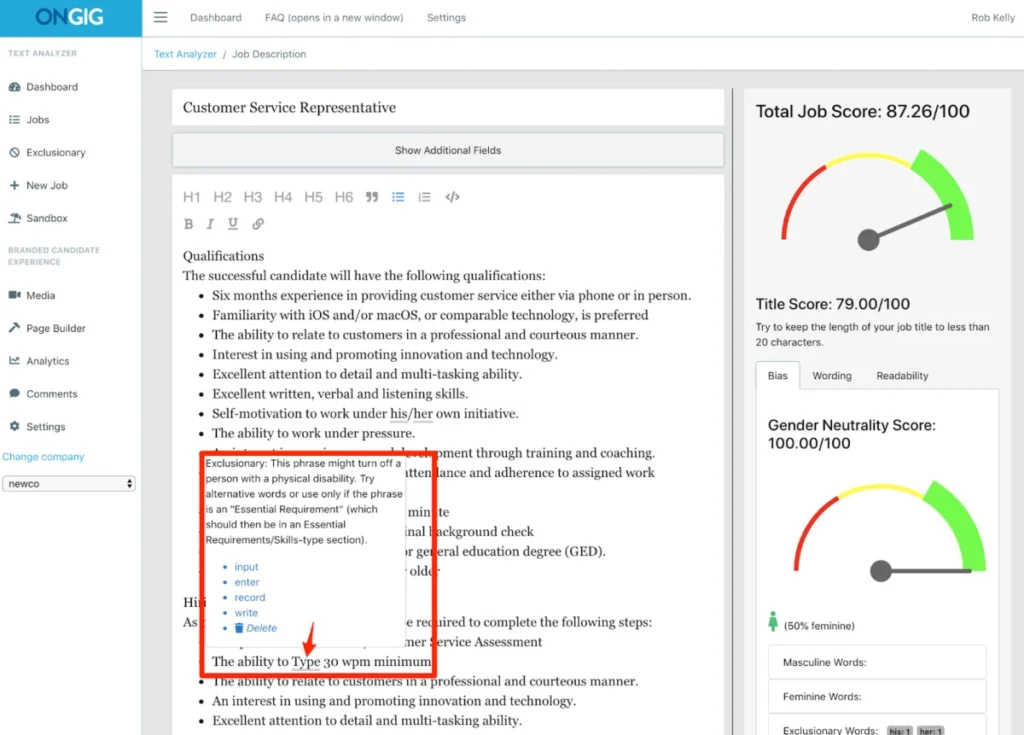
Job description software is an overarching solution that automates and optimizes the entire JD management lifecycle, moving beyond mere writing assistance. Tools like Ongig Text Analyzer exemplify how specialized software simplifies the JD process by:
- Centralized JD Library: Storing and managing all JDs in one accessible location.
- AI-Powered Writing Assistance: Generating initial drafts or suggesting improvements based on best practices and data.
- Bias Detection and Inclusivity Analysis: Identifying and suggesting alternatives for biased language to attract diverse talent.
- Real-time Collaboration Features: Enabling multiple users to work on JDs simultaneously with version control.
- Automated Approval Workflows: Streamlining the review and sign-off process.
- Compliance Checks: Ensuring adherence to EEO, ADA, and other legal requirements.
- ATS Integration: Seamlessly publishing JDs to your Applicant Tracking System.
- Performance Analytics: Tracking JD effectiveness and candidate engagement.
- Customizable Templates: Providing pre-built structures that can be tailored.
This comprehensive approach transforms JD management from a series of manual, disjointed tasks into a cohesive, efficient, and data-driven operation.
11. Adopt Adaptive Reuse: Copy and Modify Existing Job Descriptions
A key benefit of a well-maintained job description library is the ability to leverage existing, approved JDs rather than starting from scratch. When hiring for similar roles, the most efficient approach is to copy and modify a proven JD.
The strategy involves:
- Locating the Most Relevant JD: Using the centralized library’s search and filter functions.
- Retaining Common Elements: Utilizing approximately 70% of the existing content, such as company overview, benefits, and general qualifications.
- Customizing Unique Components: Dedicating the remaining 30% to update specific duties, responsibilities, and unique skill requirements for the new role.
This method drastically reduces drafting time while ensuring consistency and adherence to established standards, particularly useful for high-volume recruitment or recurring roles.
12. Implement a Comprehensive Job Description Checklist
Even with robust workflows, minor details can be overlooked. A comprehensive checklist serves as a final quality assurance step, confirming the accuracy and completeness of your JD before publication. This prevents last-minute corrections and avoids time wastage due to missing information.
A sample checklist could include:
- Clarity and Conciseness: Is the language easy to understand?
- Accuracy: Do job title, responsibilities, and requirements accurately reflect the role?
- Completeness: Are all essential sections included (summary, responsibilities, qualifications, company info, benefits)?
- Inclusivity and Bias-Free Language: Has the JD been checked for gendered, ageist, or exclusionary terms?
- Keyword Optimization: Are relevant keywords included for search engine visibility?
- Employer Branding: Does the "About Us" section effectively convey company culture and values?
- Compliance: Does it adhere to EEO, ADA, and other relevant legal standards?
- Grammar and Spelling: Is the document free of errors?
- Call to Action: Are application instructions clear and easy to follow?
- Formatting: Is the document structured for skimmability (headings, bullet points)?
- Stakeholder Approval: Has final approval been secured from all necessary parties?
This checklist should be customized to align with your organization’s specific requirements and compliance mandates, serving as a critical safeguard against errors and ensuring a professional, effective job posting.
The Broader Impact: Benefits Beyond Speed
Optimizing the job description process yields benefits far beyond just faster turnaround times. These strategies collectively contribute to:
- Improved Candidate Quality: Clearer, more targeted JDs attract candidates who are a better fit for the role and culture.
- Enhanced Candidate Experience: A streamlined process reflects positively on the employer brand, making candidates more likely to engage.
- Reduced Time-to-Hire: Faster creation and approval cycles mean vacancies are filled more quickly, minimizing business disruption.
- Cost Savings: Less time spent on administrative tasks, fewer rounds of revisions, and reduced vacancy costs contribute to significant financial efficiencies.
- Greater Compliance and Reduced Risk: Standardized templates and bias detection tools help ensure legal adherence and promote fair hiring practices.
- Better Hiring Manager Satisfaction: An efficient process reduces frustration and allows hiring managers to focus on interviewing rather than drafting.
In conclusion, the pursuit of top talent demands an agile and intelligent approach to job description management. Relying on manual processes and non-specialized tools in today’s fast-paced environment is no longer sustainable. Organizations that embrace a holistic strategy, incorporating structured content, data analytics, collaborative platforms, and dedicated software, will not only accelerate their JD process but also elevate their entire talent acquisition strategy, securing the best candidates and driving long-term success.
April 9, 2026 by Harrison Mbuvi in Job Descriptions