
The adoption of artificial intelligence (AI) among U.S. businesses has seen a steady increase, climbing from 17.7% in January to 21.7% by July 2026. However, recent data underscores a significant disparity in this technological integration, with larger corporations and industries heavily reliant on office environments adopting AI at a substantially faster pace than their smaller counterparts. Intriguingly, some major metropolitan areas have even witnessed a decline in AI usage, suggesting a complex and uneven rollout across the American business landscape. This widening gap in AI integration is also reflected in businesses’ diminishing confidence regarding the pace of future adoption. In January, companies anticipated a 4.7 percentage point increase in AI usage over the subsequent six months. By July, this projection had been revised downward to a more cautious 2.8 percentage points, signaling a potential recalibration of expectations amid the realities of implementation and perceived value.
The Growing Chasm: Company Size and Industry Sector
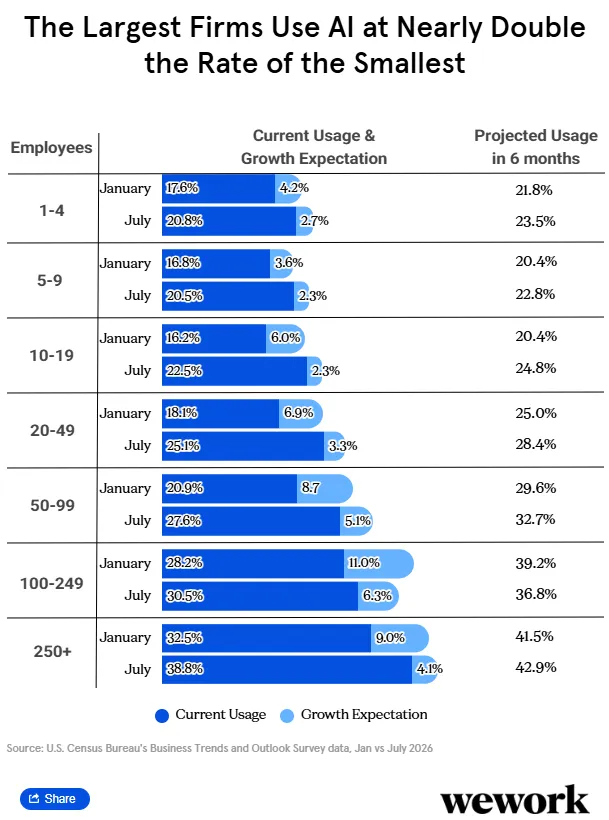
A primary determinant of AI adoption rates is unequivocally company size. A comprehensive report from WeWork reveals a stark contrast: in July 2026, only 20.8% of businesses employing one to four individuals reported utilizing AI. This figure sharply contrasts with the 38.8% of companies with 250 or more employees that have integrated AI into their operations. This disparity suggests that smaller businesses, often operating with tighter budgets and fewer dedicated IT resources, face greater hurdles in exploring and implementing advanced AI technologies.
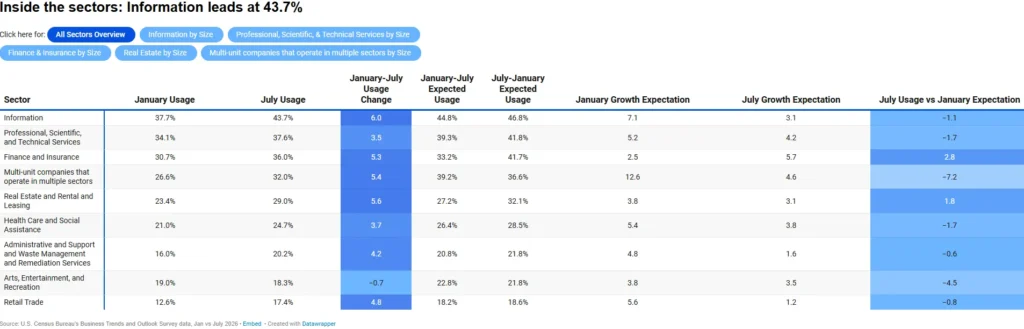
The divergence becomes even more pronounced when examining specific industry sectors, particularly those characterized by their office-centric nature. The Information sector, which encompasses technology, media, and data services, exhibits the highest AI adoption rate. Among large companies within this sector (250+ employees), a remarkable 77% reported using AI, indicating a deep integration of these technologies into core business functions. This leadership position for the Information sector is consistent across all company sizes, with the industry as a whole reporting an average AI usage of 43.7%.

Following closely behind are Professional, Scientific, and Technical Services, with 37.6% of businesses employing AI. The Finance and Insurance sector also demonstrates a strong propensity for AI adoption, standing at 36%. Other office-based industries show varying degrees of engagement: Real Estate at 29%, and Healthcare at 24.7%. These figures suggest that industries that rely heavily on data analysis, complex problem-solving, and digital workflows are more readily embracing AI solutions to enhance efficiency, gain competitive advantages, and improve service delivery. Conversely, industries with more tangible, on-site operations or a less digitally-intensive business model may find the immediate applicability and return on investment for AI less clear, contributing to lower adoption rates.
The trend of larger companies leading AI adoption can be attributed to several factors. These organizations typically possess greater financial resources to invest in AI infrastructure, talent acquisition, and training. They also often have dedicated research and development departments tasked with exploring emerging technologies. Furthermore, the potential return on investment for AI in terms of operational efficiency, cost reduction, and enhanced customer experience is often more significant and measurable for larger enterprises with complex workflows. The presence of in-house IT expertise also facilitates the integration and management of AI solutions, mitigating some of the technical challenges that smaller businesses might encounter.
Geographic Variations: Hotspots and Cooling Markets
The unevenness of AI adoption extends beyond organizational structures and industry classifications to geographic locations. Analysis of the 25 largest U.S. metropolitan areas reveals that 15 of them reported AI usage rates exceeding the national average of 21.7% in July 2026. This indicates that certain urban centers are becoming hubs for AI integration, likely driven by a confluence of factors including a strong presence of tech industries, a skilled workforce, and supportive local business ecosystems.
Tampa, Florida, emerged as a standout performer, experiencing the most significant surge in AI adoption. Its usage rate climbed by an impressive 14.9 percentage points, reaching 32%. Detroit, Michigan, also showed robust growth, with AI usage rising by 11.4 percentage points to 24.5%. These gains suggest proactive efforts within these cities to foster technological innovation and attract AI-savvy businesses.

However, the narrative of consistent growth is not universal. Phoenix, Arizona, provides a counterexample. After boasting the highest AI adoption rate among major metropolitan areas in January 2026 at 30.1%, its usage rate subsequently declined by 8.6 percentage points to 21.5% by July. This downturn is a significant indicator that AI integration is not a one-way street and can be influenced by market dynamics, economic shifts, or a reassessment of AI’s practical benefits. Similarly, Baltimore, Houston, Portland, and San Diego also recorded decreases in AI usage, pointing to localized challenges or a broader re-evaluation of AI investment priorities in these areas.
Major economic centers like New York and Los Angeles, while significant hubs for business and innovation, are currently trailing behind the national average in AI adoption. New York reported a usage rate of 17.9%, while Los Angeles stood at 19.7%. This could indicate that while these cities are home to many large corporations, the sheer diversity of their economies and the presence of numerous smaller businesses may be diluting the overall AI adoption percentage. It could also suggest that the integration of AI within these sprawling urban economies is more complex and slower to manifest uniformly across all sectors.
The localized fluctuations in AI adoption highlight the dynamic nature of technological integration. Factors such as local economic conditions, the presence of venture capital funding for tech startups, the availability of specialized AI talent, and even local government initiatives aimed at promoting technological advancement likely play a crucial role in shaping these trends. The cooling of AI adoption in certain cities could signal a period of consolidation, a reassessment of AI strategies, or perhaps a more nuanced understanding of the technology’s practical applications and limitations within their specific business contexts.
AI’s Primary Role: Augmenting Human Capabilities
For businesses that have embraced AI, its most prevalent application revolves around enhancing employee productivity, particularly in tasks related to communication and information processing. A substantial 85.4% of companies using AI reported that their employees leverage the technology for writing and editing documents, emails, and other forms of communication. This indicates that generative AI tools are largely being deployed as sophisticated assistants, streamlining routine tasks and freeing up employees to focus on more complex and strategic work.
Information retrieval and synthesis are also key areas where AI is proving invaluable. Information searches are conducted using AI by 49.9% of adopting businesses, while 44.6% utilize AI to summarize or analyze documents. This points to a growing reliance on AI for efficiently sifting through vast amounts of data, extracting key insights, and condensing information, thereby improving decision-making processes and accelerating research efforts.
In terms of business functions, Sales and Marketing currently exhibit the highest rate of AI utilization, with 14.3% of businesses reporting its use. This is followed by Strategy and Business Development at 12.4%, and Research and Development (R&D) at 11.2%. The strong presence of AI in these areas suggests that businesses are recognizing its potential to drive revenue growth, inform strategic planning, and accelerate innovation cycles.
Crucially, the employment data emerging from AI-using businesses paints a picture of augmentation rather than outright replacement. A striking 95.7% of these companies reported no change in their total employment numbers following AI integration. Only a marginal 2% indicated a decrease in employment, while a slightly larger 2.3% reported an increase. This suggests that AI is primarily being implemented to supplement or enhance existing job roles, rather than to displace human workers. At 43.7% of firms, AI is reported to supplement or enhance an employee’s task, while in 10.1% of cases, it performs a task previously undertaken by a human worker. This nuanced approach to AI deployment underscores a strategic focus on leveraging the technology to boost efficiency and output without significantly impacting workforce size, potentially leading to a more skilled and productive workforce.
The Inertia of Non-Adoption: Perceived Applicability and Understanding Gaps
Despite the growing adoption rates and the evident benefits in certain sectors, a significant portion of U.S. businesses remain hesitant to integrate AI. The primary obstacle, as revealed by the data, is a straightforward belief that AI is not applicable to their specific business operations. A substantial 61.6% of businesses that do not plan to adopt AI within the next six months cited this lack of applicability as their main reason.

This sentiment is particularly pronounced among smaller businesses. A concerning 63.3% of companies with one to four employees expressed that AI was not relevant to their operations. This indicates a significant disconnect between the capabilities of AI and the perceived needs of small enterprises, potentially stemming from a lack of awareness or a failure to translate AI’s potential benefits into practical use cases for these smaller entities.
Beyond perceived applicability, other significant barriers include a limited understanding of AI’s capabilities, cited by 22% of non-adopting businesses, and concerns about privacy and security, mentioned by 20.7%. These figures highlight the ongoing need for education and clear communication about AI’s functionalities, benefits, and the robust security measures that can be implemented. Addressing these knowledge gaps and assuaging privacy concerns could be critical in unlocking AI adoption for a broader spectrum of businesses.
The persistent belief that AI is not applicable to their business suggests a need for more targeted outreach and demonstration of AI’s value proposition across diverse industries and company sizes. As AI technology continues to evolve and become more accessible, it is imperative for solution providers and industry advocates to clearly articulate how these tools can address specific challenges and create tangible value, even for businesses that may not operate in highly technical or data-intensive fields.
Implications and Future Outlook
The current landscape of AI adoption in the U.S. presents a dual narrative of rapid advancement and persistent inequality. While AI is undeniably transforming business operations for a growing segment of the economy, its benefits are not being distributed uniformly. The widening divide between large and small businesses, and between technologically advanced sectors and others, poses a significant challenge to overall economic competitiveness and equitable growth.
The declining confidence in the pace of future adoption, coupled with the primary barrier of perceived non-applicability, suggests that the next phase of AI integration will require a more strategic and inclusive approach. Businesses that successfully navigate this evolving technological terrain will likely be those that can clearly identify specific use cases, invest in workforce training, and foster a culture of continuous learning and adaptation.
The trend of AI augmenting rather than replacing human workers is a positive development, potentially leading to more fulfilling and productive work environments. However, it also underscores the importance of reskilling and upskilling initiatives to ensure that the workforce is equipped to collaborate effectively with AI tools. As AI becomes more sophisticated and integrated into the fabric of business, its impact will continue to be a subject of keen observation, shaping the future of work and economic prosperity in the United States. The coming years will likely see continued efforts to bridge the AI adoption gap, driven by the need for enhanced productivity, innovation, and a more democratized technological landscape.