The conversation around artificial intelligence (AI) in hiring is often characterized by bold claims that outpace empirical support. While the potential for bias in hiring is a well-documented and persistent challenge, many vendors have historically relied on unsubstantiated assurances rather than concrete proof. This article delves into the complexities of AI-powered recruitment, addressing common misconceptions with verifiable data and highlighting the critical importance of transparent, independent audits. It is not an argument that concerns about AI bias are misplaced, but rather an examination of how these concerns are being actively addressed through rigorous testing and public disclosure.
A crucial point to establish upfront is that passing a bias audit does not signify a permanent, unassailable freedom from bias. Instead, it indicates that, under a specific, defined methodology, a system met predetermined fairness thresholds at the time of testing. This verifiable evidence serves as a foundational input for due diligence, not a replacement for it. Organizations must understand that these audits are snapshots in time, requiring ongoing vigilance and re-evaluation.
Misconception 1: "AI Hiring Is A Black Box. No One Can Check Its Work."
This assertion fundamentally misunderstands the nature of transparent AI systems. A truly "black box" system, by definition, would not offer insight into its operational logic or its testing procedures. However, advanced AI hiring tools are increasingly designed with explainability and auditability in mind.
The Reality: Verifiable Audit Trails and Transparent Methodologies
A robust AI hiring system, such as Eightfold’s matching model, does not operate in opacity. Its fairness testing results are not confined to internal reports but are published, often bearing the signature of an independent auditor. This provides a critical layer of external validation.
Consider a fundamental test for fairness: taking a candidate’s resume and duplicating it, with the sole alteration being a signal indicative of gender. A system engineered for equitable hiring should not be able to reliably distinguish between these two identical profiles based on this single, protected attribute. Eightfold’s matching model undergoes this type of testing at scale, with the resulting bias audit reports publicly accessible. These reports detail the methodology and findings, offering a level of transparency that directly challenges the "black box" narrative.
The most recent comprehensive audit, for instance, analyzed data spanning from January 2024 to December 2025. This extensive dataset encompassed over 29 million candidate assessments where demographic information was self-declared. The analysis was meticulously broken down by gender, seven distinct race and ethnicity groups, and all intersections of these categories. This granular approach is vital, as bias can manifest subtly within combined demographic groups even when individual categories appear balanced.
It is important to distinguish between a simple demonstration and a rigorous audit. While a single instance of a swapped resume might show minor score fluctuations – a natural occurrence akin to random coin flips – a true audit examines the average difference across thousands of paired resumes. It measures whether any observed gap exceeds expected statistical variation. This focus on distribution, rather than isolated examples, is what elevates a test from a demo to a credible audit.
Misconception 2: "Bias Testing Is Just The Vendor Grading Its Own Homework."
This is a valid concern, particularly given the historical lack of accountability in some technology sectors. However, the increasing regulatory landscape and the emergence of specialized auditing firms are shifting this paradigm.
The Reality: Independent Auditors and Unbiased Methodologies
The integrity of a bias audit hinges on the independence of the auditor and the impartiality of the methodology. In the case of Eightfold, the fairness reports are generated by BABL AI, an independent auditing firm. Crucially, BABL AI’s lead auditors possess ForHumanity Certified Auditor status under the NYC AEDT bias-audit standard. Their engagement terms are structured to ensure impartiality, with fixed fees that are explicitly disconnected from the audit’s outcome. This financial independence is a cornerstone of credible auditing.
This rigorous process is applied to multiple facets of the AI hiring ecosystem. Eightfold’s systems undergo separate audits for its candidate-to-job matching model and its AI Interviewer product, recognizing that each component carries its own potential bias risks. This dual-auditing approach provides a more comprehensive view of the technology’s fairness.

Furthermore, the methodologies employed are designed to handle data limitations with caution. For instance, when dealing with sparse demographic data in the matching model’s audit, records lacking disclosure are excluded rather than subject to estimation. The AI Interviewer’s audit, being more recent, employs synthetic personas, clearly labeled as such, to fill gaps in thin data slices (e.g., specific intersectional demographic groups) where real data is insufficient for reliable analysis. Both audits have consistently passed across key metrics, including disparate impact, governance, and risk assessment.
The framework itself is not proprietary but draws inspiration from established financial auditing principles, emphasizing independence, fixed fees, and a published methodology. This structure aligns with standards found in peer-reviewed academic proceedings, such as the 2024 ACM Conference on Fairness, Accountability, and Transparency. This approach provides a robust blueprint for any vendor seeking to demonstrate genuine commitment to bias mitigation.
Misconception 3: "The Algorithm Just Repeats Whatever Bias Was Already In The Data."
This is a plausible hypothesis, as AI models are trained on historical data, which can indeed contain societal biases. The critical question, however, is not whether bias exists in the data, but whether it demonstrably influences the outcomes of the hiring process.
The Reality: Outcome Testing and Rigorous Thresholds
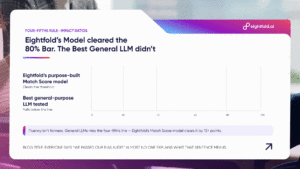
Auditors typically employ established legal benchmarks to assess real-world outcomes. The "four-fifths rule," derived from the U.S. federal government’s Uniform Guidelines on Employee Selection Procedures, is a common standard. It stipulates that no protected group should advance at a rate less than 80% of the rate of the group with the highest selection rate. A flag under this rule is an indicator for further investigation, not an immediate declaration of guilt, and is most meaningful when sample sizes are large enough to prevent single outcomes from skewing the overall rate.
Eightfold’s most recent matching model audit demonstrates adherence to these principles. Every tested group surpassed the four-fifths threshold. For instance, male candidates exhibited an impact ratio of 96.2% relative to the female reference group. The widest race/ethnicity disparity, for the Asian candidate group, stood at 93.8%. Even the most narrowly defined intersectional pairings, such as Asian females and non-Hispanic white males, achieved an 88.0% impact ratio. When demographic data is not disclosed by a candidate, the audit methodology excludes these records from relevant analyses rather than making potentially unreliable estimations.
Academic research consistently underscores the need for outcome testing. Studies have shown that occupation-prediction models can inadvertently learn gender stereotypes from text, even when explicit gender markers are removed. Similarly, research has indicated that identical resumes with names perceived as belonging to certain racial groups receive more callbacks than those with names associated with other groups. This highlights why a hiring model requires its own outcome-based testing, rather than simply relying on the assertion that the underlying data was "clean."
Misconception 4: "One Clean Audit Means The Bias Problem Is Solved."
The dynamic nature of hiring processes and evolving applicant pools means that fairness is not a static achievement but an ongoing commitment.
The Reality: Continuous Auditing as a Necessity
Legislation like New York City’s Local Law 144 mandates annual bias audits for AI hiring tools, recognizing that models trained on past data need regular recalibration against current realities. This annual cadence ensures that tools remain compliant and equitable as hiring patterns shift with the labor market. Eightfold’s matching model, for example, has undergone these required annual re-audits since the law’s enforcement. The AI Interviewer operates on its own distinct audit schedule, as a separate product cannot inherit the compliance documentation of another.
The rationale for this regular re-testing is rooted in practicalities. Hiring dynamics are influenced by external factors such as economic conditions, industry trends, and shifts in applicant demographics. A model that performed equitably in one period may exhibit different behaviors when applied to a significantly altered applicant pool. Continuous re-testing provides the necessary feedback loop to identify and address any emergent biases.
What Actually Makes A Bias Audit Credible
For organizations evaluating AI hiring vendors, a credible bias audit should possess several key characteristics. Published documentation is paramount, offering tangible evidence that can be scrutinized.
- Published Audit Reports: The full report from an independent auditor, detailing methodology and findings.
- Independent Auditor Identity: Clear identification of the auditing firm and its credentials.
- Published Methodology: A transparent description of how the audit was conducted.
- Regular Cadence: Evidence of ongoing, periodic re-auditing.
- Fixed Fees and Auditor Independence: Confirmation that the auditor’s compensation is not tied to the audit’s outcome.
The absence of these elements should raise significant red flags. A blanket claim of "our AI is unbiased" is insufficient. Bias can infiltrate various stages of the recruitment funnel, not solely within a single AI model.

Understanding Bias Risks Across the Hiring Funnel
| Hiring Stage | Common Bias Risk | How It’s Typically Mitigated |
|---|---|---|
| Sourcing | Targeting based on past applicant patterns can narrow diversity of outreach. | Review audience criteria, test reach across diverse groups, document signals driving recommendations. |
| Resume Review | Keyword-heavy parsing can favor familiar titles, schools, or uninterrupted employment. | Mask personal identifiers, assess relevant skills, conduct separate audits of the matching model. |
| Interview | Inconsistent questions or scoring can introduce unequal treatment. | Use standardized prompts and transcript-based scoring criteria, with an audit specific to the interview product. |
| Final Decision | Subjective interpretation of tool outputs can reintroduce preference or automation bias. | Require human judgment at key decision points, monitor outcomes over time, and ensure clear documentation of rationale. |
Misconception 5: "AI Is About To Make Recruiters Obsolete."
While AI is undeniably transforming the recruitment landscape, its role is more accurately described as augmentation rather than outright replacement.
The Reality: The Evolving Role of the Recruiter
The urgency behind the fear of obsolescence is palpable. Statistics reveal a significant surge in AI adoption within HR functions, with organizations increasingly integrating AI tools into their talent acquisition strategies. AI agents, in particular, are projected to be adopted or piloted by nearly all recruiting teams. This rapid adoption underscores the pressure on talent acquisition professionals to adapt.
AI interviewers excel at handling repetitive, high-volume tasks: gathering structured responses, applying consistent criteria, and generating rapid insights. This dramatically enhances capacity. However, AI cannot replicate the nuanced judgment and contextual understanding that human recruiters bring. Recruiters are essential for interpreting team dynamics, understanding individual candidate narratives, addressing accommodation needs, and synthesizing competing evidence. The shift is from administrative triage to higher-value work: cultivating candidate relationships, advising hiring managers, and ensuring that automated insights are applied judiciously and ethically.
Misconception 6: "AI Hiring Tools Are Less Effective Than Human Judgment."
Effectiveness, when measured by quantifiable outcomes, often tells a different story.
The Reality: Measurable Improvements in Efficiency and Outcomes
Specific customer data illustrates the tangible benefits of AI-powered hiring tools. For example, Vodafone reported a 50% reduction in both cost-per-hire and time-to-hire, alongside a significant increase in candidate Net Promoter Score (NPS). Morgan Stanley saw its time-to-hire decrease from an average of 79 days to 45 days, a 57% improvement.
Beyond efficiency, skills-based matching, a core capability of advanced AI platforms, has demonstrated a correlation with improved downstream talent outcomes. Eightfold’s Match Score, for instance, has been linked to an 11.9% increase in promotability and a 26% reduction in attrition. These metrics highlight a demonstrable connection between AI-driven matching and key talent metrics, moving beyond mere hiring predictions to long-term employee success.
It is imperative to note that these effectiveness metrics do not negate the necessity of bias audits. A fast or well-received tool must still meet the same rigorous fairness standards as any other AI hiring solution.
AI Bias vs. Human Recruiter Bias: A Comparative Analysis
The comparison between AI bias and human bias is not about which is inherently "greater" or "smaller," but rather about the measurability and accountability of each process.
| Decision-Maker Type | Documented Pattern | Measurement Basis |
|---|---|---|
| Human Recruiter Judgment | Men tend to rate their performance higher than equally performing women; women often delay application until meeting all criteria. | Published research on gender differences in self-assessment and application behavior. |
| Audited, Purpose-Built AI | All tested groups cleared the four-fifths threshold; tightest intersectional pairing at 0.880 impact ratio. | Independent third-party audit, publicly published. |
| Unaudited AI (Any Vendor) | Impact on different groups remains unknown without representative data, outcome testing, and independent review. | No published evidence to support fairness claims. |
The fundamental choice is between audited AI, unaudited human judgment, or unaudited AI. The pursuit of a perfectly bias-free process is an aspiration, but in practice, the options involve varying degrees of transparency and accountability. Continuous review of audit results is essential, as applicant pools are not static.
This discussion has focused on the critical aspects of bias audits within the context of AI hiring and the broader regulatory landscape, particularly in regions like New York. The next steps involve exploring how these principles apply globally and what questions to pose to vendors who may be reluctant to provide transparent audit data. The assertion "we tested for bias" demands substantiation beyond a brief statement.
For organizations evaluating AI hiring vendors, including Eightfold, the standard is clear: request the audit report, the auditor’s name, and the audit cadence. A vendor that readily provides all three is offering a verifiable pathway to understanding their commitment to fairness – a standard that every organization should demand.