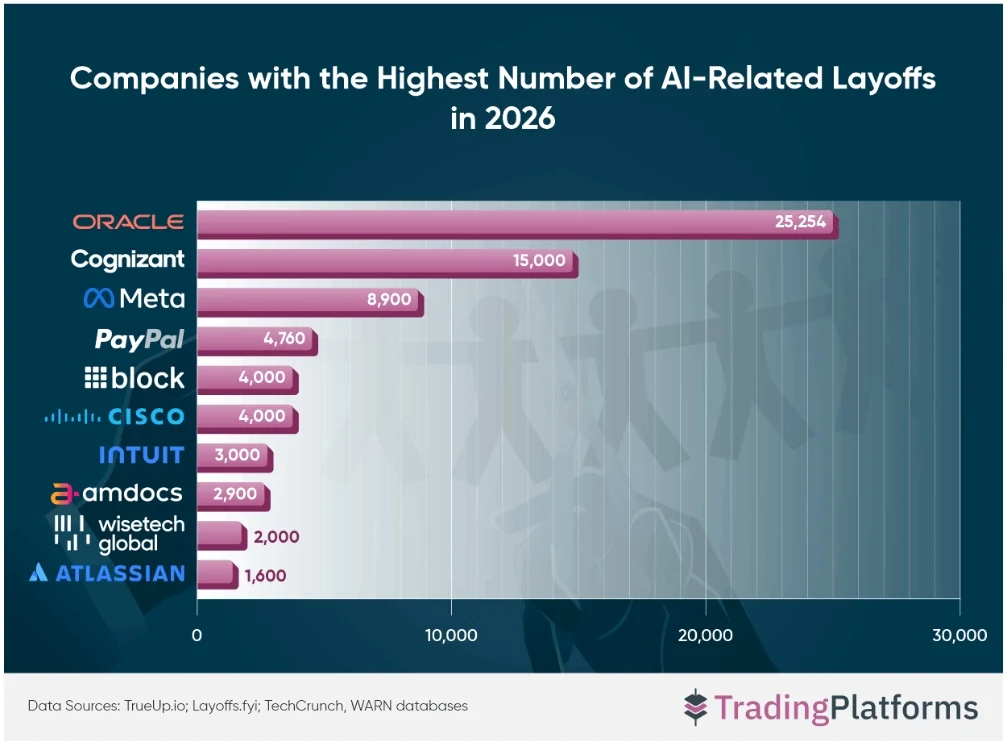
The year 2026 has witnessed a stark reality unfold in the technology sector, with major players like Oracle, Amazon, Cloudflare, and Block announcing significant workforce reductions, frequently citing Artificial Intelligence (AI) as a driving factor. However, a granular analysis of these developments reveals a complex and often divergent application of the AI narrative by these tech behemoths. A comprehensive report from TradingPlatforms, scrutinizing over 156,975 tech job cuts globally through mid-July 2026, indicates that the term "AI-driven restructuring" is being employed to encapsulate a spectrum of strategic decisions. These range from substantial cost reallocations towards AI infrastructure and data center expansion, to organizational streamlining, and in some instances, direct AI-enabled role consolidation.
The crux of the matter lies in understanding whether AI is genuinely automating existing roles or if its invocation serves as a justification for strategic investments in future technologies, often at the expense of current personnel. The TradingPlatforms research highlights that while nearly 60% of the tracked tech job cuts are broadly linked to AI-driven restructuring, the underlying motivations and implications vary considerably.
Divergent Paths: Infrastructure Investment vs. Direct Automation
Oracle’s Strategic Pivot: In a move that underscored the company’s robust financial performance, Oracle announced layoffs impacting approximately 25,254 roles in 2026. This decision coincided with a remarkable 95% surge in its net income, reaching an impressive $6.13 billion. The company’s stated strategy involves redirecting these substantial savings towards bolstering its AI infrastructure and expanding its data center capabilities. This approach suggests that Oracle is leveraging workforce adjustments to free up capital and resources for its ambitious AI buildout, a strategy aimed at future-proofing its operations and capitalizing on the burgeoning AI market. Crucially, Oracle has not publicly asserted that AI systems are directly replacing the functions previously performed by the laid-off employees. Instead, the narrative points towards these cuts enabling the significant scaling of AI initiatives, which are still in their developmental and deployment phases.
Amazon’s Organizational Realignment: Similarly, Amazon, a titan of e-commerce and cloud computing, initiated layoffs affecting over 17,000 employees. The stated rationale for these cuts was the simplification of its organizational structure. This occurred even as Amazon reported staggering 2025 revenues of $716.9 billion. Looking ahead, the company has earmarked an ambitious capital expenditure of up to $200 billion for AI-related projects in 2026. Much like Oracle, Amazon’s layoff announcements are framed within the context of supporting its expansive AI ambitions. The company’s focus appears to be on creating leaner, more agile operational frameworks to facilitate its significant investments in AI technologies. The direct replacement of human roles by AI has not been explicitly cited as the primary driver for these reductions.
Cloudflare’s Agentic AI Model: A different trajectory is observed with Cloudflare, a company at the forefront of web infrastructure and security. Cloudflare implemented layoffs impacting over 1,100 employees, a move that represented approximately 20% of its global workforce. The company explicitly linked these cuts to the adoption of what it terms an "agentic AI-first operating model." This implies a fundamental shift in how the company intends to operate, with AI agents playing a more integral role in its workflows. Cloudflare reported a dramatic increase in internal AI tool usage, surging by over 600% within a three-month period. The company anticipates that this restructuring will incur costs of up to $150 million, primarily for severance packages. This scenario suggests a more direct, albeit still evolving, integration of AI into operational functions, potentially leading to the consolidation or reassignment of certain tasks.
Block’s AI-Powered Efficiency: Block, formerly Square, also embarked on a significant workforce reduction, cutting around 4,000 roles. Block’s leadership has been more explicit in acknowledging the direct impact of AI on its workforce. They have indicated that AI is now capable of handling a "meaningful share" of the work previously performed by these employees. This statement points towards a more direct substitution of human labor by AI capabilities, driven by the pursuit of enhanced efficiency and cost optimization.
The Nuance of Layoff Communication: Implications for HR and Stakeholders
The TradingPlatforms analysis underscores a critical distinction: the current capabilities of AI systems to assume significant workloads at scale are still limited. This suggests that a substantial portion of the "AI-driven" layoffs in 2026 are not a direct consequence of AI fully automating jobs, but rather pre-emptive cost-cutting measures designed to finance the substantial investments required for AI infrastructure development.
This dichotomy carries significant implications for Human Resources (HR) departments and the broader communication strategy surrounding layoffs. Employees, employee representative bodies (such as works councils), and regulatory bodies in various jurisdictions will expect distinct disclosures based on the stated rationale for workforce reductions. Misrepresenting the underlying reasons for layoffs can lead to a disconnect between employee expectations and the actual operational realities of the business.
For instance, if a company claims layoffs are due to AI automation, employees might anticipate a future where their roles are directly superseded by technology. However, if the layoffs are primarily to fund AI infrastructure, the immediate impact on job functions might be less pronounced, with the focus being on future technological enablement. Mixing these explanations can foster confusion and erode trust.
Cloudflare’s Reputational Tightrope
Cloudflare’s situation presents a particularly interesting case study in the evolving narrative surrounding AI and its workforce. The company had previously been a vocal proponent of AI’s potential to augment human capabilities rather than replace them. It actively promoted expanded internship hiring and publicly argued for a collaborative AI-human work environment. Months later, the announcement of over 1,100 layoffs, directly linked to an "agentic AI-first operating model," raises questions about the swiftness with which stated AI-and-talent philosophies can be re-evaluated and potentially superseded by new strategic imperatives.
This raises a crucial question for Chief Human Resource Officers (CHROs) and senior leadership: how should public commitments regarding AI’s role in the workforce be formulated, and what level of flexibility should be built in to accommodate future strategic shifts? The timing of Cloudflare’s announcements, following its earlier pronouncements, highlights the challenge of balancing forward-looking technological adoption with consistent and transparent employee relations.
Data Underpinning the Analysis
The TradingPlatforms analysis is built upon a robust dataset, meticulously compiled from various reputable sources. This includes data from TrueUp, TechCrunch, Layoffs.fyi, and multiple U.S. WARN (Worker Adjustment and Retraining Notification) databases. The compilation of country and sector totals through mid-July 2026 provides a comprehensive snapshot of the global tech layoff landscape.
Key Data Points from the Analysis:
- Total Tech Job Cuts Tracked: 156,975 (through mid-July 2026).
- Percentage Linked to AI-Driven Restructuring: Nearly 60%.
- Oracle Layoffs: 25,254 roles.
- Oracle Net Income Surge: 95% to $6.13 billion.
- Amazon Layoffs: Over 17,000 roles.
- Amazon 2025 Revenue: $716.9 billion.
- Amazon AI Capital Expenditure: Up to $200 billion planned for 2026.
- Cloudflare Layoffs: Over 1,100 roles (approximately 20% of global workforce).
- Cloudflare Internal AI Tool Usage Increase: Over 600% in three months.
- Cloudflare Restructuring Cost Estimate: Up to $150 million.
- Block Layoffs: 4,000 roles.
Broader Implications for the Tech Industry
The divergence in how leading tech companies are framing their AI-related workforce adjustments has far-reaching implications:
- Investor Relations: The narrative surrounding AI can significantly influence investor perception. Companies that frame layoffs as strategic investments in future growth through AI infrastructure may be viewed more favorably than those perceived as simply cutting costs through automation.
- Talent Acquisition and Retention: The public discourse on AI’s impact on jobs can create anxiety among existing employees and prospective hires. Companies need to articulate a clear vision for how AI will be integrated into their operations, emphasizing upskilling and reskilling opportunities where applicable.
- Regulatory Scrutiny: As AI’s role in the workforce becomes more pronounced, regulatory bodies are likely to increase their scrutiny of AI-driven decisions, particularly concerning job displacement and ethical considerations. Companies need to ensure their justifications for layoffs are transparent and legally sound.
- Competitive Landscape: The race to develop and deploy advanced AI capabilities is intensifying. Companies that successfully navigate the complexities of AI integration, while managing their workforce effectively, will likely gain a competitive edge. The current trend suggests a strategic bifurcation: some companies are using AI as a catalyst for massive infrastructure investment, while others are more directly integrating AI to automate tasks and streamline operations.
The year 2026 stands as a pivotal moment in understanding the true impact of AI on the global workforce. The nuanced application of the AI narrative by tech giants like Oracle, Amazon, Cloudflare, and Block highlights the ongoing evolution of business strategy in the face of transformative technology. As AI continues its rapid advancement, the way companies communicate their strategic decisions and manage their human capital will be increasingly critical in shaping both internal culture and external perception. The distinction between investing in AI infrastructure and AI directly replacing jobs is a crucial one, demanding clarity and transparency from corporate leadership to navigate the complexities of this new technological era.