
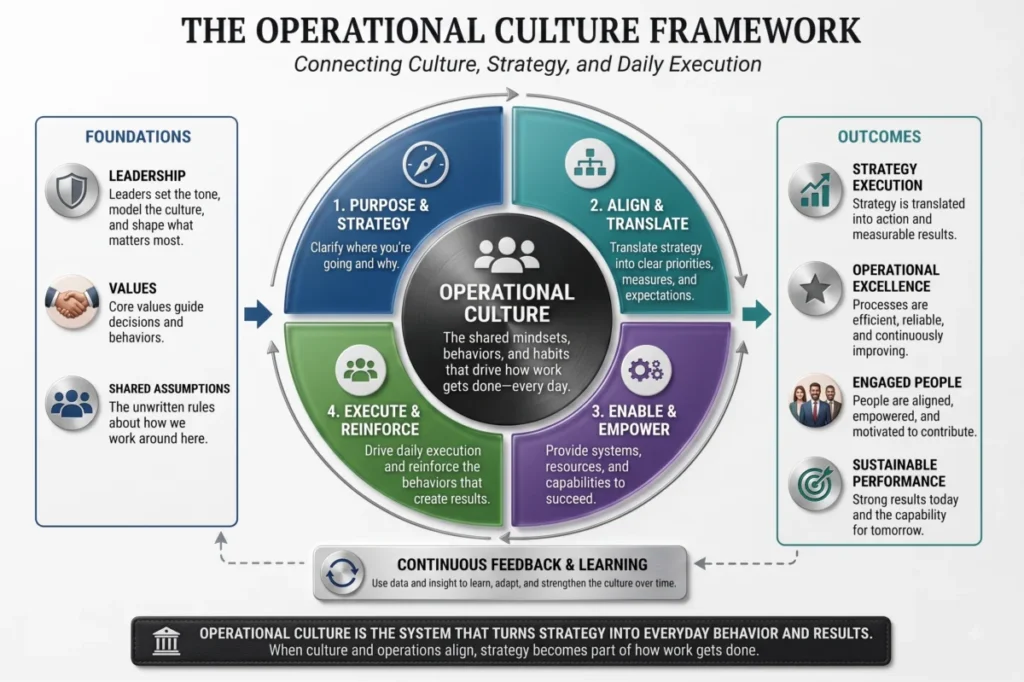
The persistent gap between strategic intent and organizational reality has become a defining challenge for modern leadership, with research indicating that a vast majority of corporate strategies fail not due to poor design, but due to flawed execution. While executives frequently attribute these failures to "culture problems," emerging organizational theories suggest that the diagnosis is often incomplete. Strategy does not stall because of a lack of commitment or shared values; it stalls because organizations fail to build the operational conditions necessary for people to make decisions that align with the mission on a daily basis.
In the current economic climate, characterized by rapid technological disruption and the integration of artificial intelligence, the ability to translate high-level goals into consistent action has become a critical competitive advantage. Leaders are increasingly moving away from viewing culture as an abstract set of values and are instead treating it as an operational capability—a framework of clarity, accountability, collective intelligence, and adaptability that functions as the infrastructure for execution.
The Execution Crisis: Analyzing the Strategy-to-Performance Gap
The struggle to execute strategy is well-documented across industries. According to seminal research by Robert Kaplan and David Norton, creators of the Balanced Scorecard, approximately 90 percent of organizations fail to execute their strategies successfully. This failure rate highlights a systemic inability to translate strategic objectives into coordinated, day-to-day action.
The "six-month stall" is a common phenomenon in executive suites. After months of developing strategic plans, communicating priorities, and aligning resources, momentum often dissipates. Departments begin moving in divergent directions, meetings prioritize updates over decisive action, and new initiatives fail to deliver measurable results. When this occurs, the default explanation is often a "culture problem." However, experts argue that culture is not an independent entity that executes strategy; rather, people execute strategy through hundreds of small, ordinary decisions made every day.
These decisions—how to prioritize demands, when to collaborate, whether to raise concerns, and how to respond to change—collectively determine whether an organization moves toward its goals or drifts away from them. The challenge for leadership, therefore, is not merely to foster a "strong culture," but to design the organizational conditions that enable people to consistently make decisions that advance the mission.
The Evolution of Organizational Culture Theory
To understand the shift toward "operational culture," it is necessary to examine the evolution of how organizational behavior is defined. For decades, culture was discussed as a set of shared values, beliefs, and norms. This led to a corporate era defined by the crafting of mission statements, core value lists, and posters in conference rooms.
Edgar Schein and Peter Schein, leading voices in organizational psychology, describe culture as the shared assumptions that develop as organizations solve problems together over time. These assumptions are not accidental; they are shaped by leadership decisions and reinforced through organizational systems. Employees experience culture less through what an organization says and more through what it consistently does.
Culture reveals itself in the mechanics of the workplace:
- How priorities are established and communicated.
- Which behaviors are recognized and rewarded.
- The systems used to evaluate performance.
- The transparency of decision-making processes.
When exceptionally talented people struggle to execute, it is rarely a lack of skill. Instead, they are often operating within environments that constrain effective decision-making. If ownership is inconsistent or expertise remains isolated in functional silos, even the most sophisticated strategies lose momentum.
The Operational Culture Framework: Four Essential Capabilities
To bridge the execution gap, leaders are increasingly adopting an operational culture framework. This approach views culture as a tangible capability that can be intentionally designed and refined. The framework is built around four core pillars: clarity, accountability, collective intelligence, and adaptability.
1. Clarity as a Catalyst for Direction
Clarity is the foundational requirement for execution. People perform at their highest potential when they understand what success looks like and how their specific work contributes to the broader mission. Clarity reduces the "noise" of uncertainty, allowing employees to make faster, more accurate decisions without constant upward referral.
In many organizations, clarity is sacrificed for complexity. When priorities are not ranked, everything becomes a priority, leading to burnout and fragmented efforts. Operational clarity requires leaders to align resources strictly with articulated goals and to ensure that every level of the organization understands the "why" behind the "what."
2. Accountability and the Shift to Ownership
Accountability is often misunderstood as a mechanism for punishment or compliance. In an operational culture, accountability is the process of transforming expectations into ownership. This requires leaders to not only establish clear responsibilities but also to provide the authority and resources needed for individuals to act.
When accountability is integrated into the organization’s daily rhythm rather than being relegated to an annual performance review, it creates a sense of shared ownership. This shift ensures that outcomes are tracked in real-time, allowing for course corrections before a strategic initiative fails entirely.

3. Collective Intelligence and Psychological Safety
The most effective organizations recognize that the best decisions rarely emerge from a single leader in a vacuum. Collective intelligence involves intentionally leveraging expertise across various functions. However, this capability cannot function without psychological safety—the shared belief that it is safe to speak up, dissent, or admit mistakes.
Structures must be in place to surface expertise and dissent. An "open-door policy" is often insufficient; true collective intelligence requires formal mechanisms where cross-functional teams can collaborate and challenge existing assumptions without fear of professional reprisal.
4. Adaptability: Learning Faster than the Market
Adaptability is the ability of an organization to learn and pivot as conditions evolve. As noted by leadership expert John Kotter, there is a significant distinction between managing change as a one-time event and building an organization structured for continuous change.
Adaptability ensures that an organization does not become a victim of its own previous successes. It requires a culture where learning is treated as an ongoing capability rather than an occasional training event. This allows the organization to respond to market shifts or internal setbacks with agility rather than inertia.
Case Study in Adaptability: The Kodak Timeline
The failure of Kodak serves as a primary historical example of what happens when an organization possesses the information and technology for success but lacks the operational capability to act.
- 1975: Kodak engineer Steve Sasson invents the first digital camera. The technology is internal and proprietary.
- 1980s-1990s: Kodak leadership focuses on protecting its highly profitable chemical film business, viewing digital photography as a threat rather than an opportunity.
- Late 1990s: Competitors like Sony and Canon begin to dominate the digital market.
- 2012: Kodak files for Chapter 11 bankruptcy.
Kodak did not lack a strategy for the future; it lacked the organizational adaptability to disrupt its own business model. The cultural assumptions surrounding the "film business" were so deeply embedded in the decision-making systems that the company could not execute a pivot, despite having a 20-year head start on the technology.
Case Study in Clarity: The Instructional Design Redesign
A more contemporary example of operational culture can be found in the higher education sector during a digital transformation initiative. In one instance, instructional designers (IDs) were tasked with helping faculty meet new quality expectations for online courses.
Initially, the project stalled. The IDs created support materials based on their own interpretations of quality, without direct collaboration with the faculty. Faculty viewed the IDs as "compliance checkpoints" rather than partners, leading to friction and slow progress.
The breakthrough occurred when leadership forced a shift in clarity. By defining exactly what faculty needed to deliver and what "meaningful support" looked like from the ID perspective, the relationship changed. Both parties began solving the same problem. This alignment of clarity and collective intelligence allowed the redesign to proceed faster and with higher quality results, demonstrating that the "people" weren’t the problem—the "conditions" were.
Leadership’s Role: Designing Success Conditions
If people are the ones who execute strategy, then a leader’s primary responsibility is to create the environment that makes success possible. This requires a shift in the questions leaders ask. Instead of asking "How do we improve our culture?"—which often leads to vague initiatives—leaders should ask "What conditions are we creating that help people succeed?"
This diagnostic approach allows leaders to examine the systems that influence work:
- Are decision-making layers slowing down progress?
- Do silos prevent expertise from reaching the right projects?
- Are the systems for reward and recognition aligned with the new strategy?
When a strategy fails, it is often a symptom of an underlying systemic issue. If departments are moving in different directions, it is a sign of poor Clarity. If initiatives lose momentum, it is often a lack of Accountability. If the organization is blindsided by change, it points to a failure in Adaptability.
The Broader Impact: Strategy as a Living Mechanism
In the coming decade, the organizations that thrive will not necessarily be those with the most ambitious plans or the most advanced AI. They will be the ones whose leaders understand that strategy succeeds only when people have the conditions to execute it consistently and collaboratively.
Operational culture is not a "soft" addition to business strategy; it is the very mechanism by which strategy becomes real. By focusing on clarity, accountability, collective intelligence, and adaptability, leaders can build an infrastructure where thousands of good decisions are made every day by people who understand exactly what they are building toward.
The transition from a "values-based" culture to an "operational" culture represents a significant paradigm shift in management. It moves the responsibility of culture out of the HR department and into the hands of every leader who designs a system, runs a meeting, or sets a priority. In an era of constant disruption, this systemic approach to execution is no longer optional—it is the prerequisite for institutional survival.






