The fundamental nature of leadership has always rested on the bedrock of strong relationships. However, the organizational landscapes of today are vastly different from those of the past, presenting unprecedented challenges to the organic development of these vital connections. Modern leaders operate in environments characterized by increased distribution, pervasive AI assistance, and relentless time pressures. These conditions, while driving efficiency, often erode the very human interactions—trust, shared understanding, and collective resilience under duress—that are essential for effective leadership. The very mechanisms that fostered these connections naturally are now frequently optimized away in the pursuit of speed and output.
At its core, leadership is a social process that cultivates three essential outcomes within any group: direction, alignment, and commitment. These outcomes are not decreed; they emerge organically from the quality of the relationships among those responsible for steering the organization. Extensive research consistently underscores this principle, identifying the cultivation of collaborative relationships as one of the most critical leadership competencies. These connections are not merely beneficial; they are the very conduits through which leadership operates. Consequently, investing in relationship-building skills within the workplace is not an optional add-on but a strategic imperative, a core capability that determines a leader’s efficacy and an organization’s overall success. The following six learnable behaviors are indicative of leaders who excel in forging the robust relationships their organizations depend on.
The Six Pillars of Effective Relationship-Building Leadership
1. Cultivating Profound Self-Awareness:
The journey to becoming an exceptional leader in building relationships begins with a deep and honest understanding of oneself. This involves not only recognizing one’s strengths and weaknesses but also acutely perceiving the impact of one’s behaviors on others. Self-awareness is the foundational capability upon which all other leadership skills are built. It is a dynamic process that requires continuous, unvarnished reflection and a genuine willingness to see oneself through the eyes of others.
In practical terms, this means a leader might recognize that their innate drive for speed and swift decision-making, while a strength in certain contexts, can inadvertently leave colleagues feeling unheard or undervalued. This awareness is not about fundamentally altering one’s personality but about making conscious adjustments to one’s demeanor and approach in critical moments that shape trust and foster connection. Leaders who are adept at building relationships are rarely born with innate perfection in this area; rather, they are deliberately attuned to their impact and proactive in addressing any identified disconnects. This intentionality is the hallmark of effective relationship cultivation.
2. Empowering Others Through Strategic Delegation:
Delegation is far more than simply offloading tasks; it is a powerful tool for building trust and fostering the growth of individuals within a team. When leaders hoard responsibilities that could be effectively handled by others, they implicitly signal a lack of confidence in their team’s capabilities. Conversely, by entrusting others with important tasks and decision-making authority, leaders create fertile ground for professional development, cultivate a sense of ownership, and instill the confidence that stems from being valued and empowered.
Effective delegation necessitates more than just assigning work; it demands consistent, honest feedback and the recognition of both effort and progress. This ongoing investment in the development of team members is, in itself, a profound exercise in honing relationship skills. It communicates a leader’s attentiveness, their genuine care for individual growth, and the understanding that the working relationship extends beyond mere task completion. Research by the Center for Creative Leadership has shown that employees who perceive their leaders as investing in their development are more engaged and committed.
3. Mastering Interpersonal Dynamics with Empathy and Kindness:
Exceptional leaders possess a finely tuned set of interpersonal skills, enabling them to navigate complex work challenges and negotiations without alienating colleagues. This mastery is rooted in leadership empathy—the ability to genuinely understand and appreciate the perspectives, needs, and emotions of others. Leaders with well-developed relational skills extend kindness in the workplace and possess an innate ability to connect with a diverse range of individuals. They are equally at ease in a sensitive conversation with a direct report, a complex negotiation with a peer from another department, or a high-stakes discussion with senior leadership. This comfort and adeptness are palpable to people at all organizational levels, fostering an environment of psychological safety and open communication. A 2022 survey by Businessolver found that 90% of employees believe that empathy is a crucial factor in employee retention.
4. Leading Through Influence, Not Merely Authority:
In today’s increasingly complex organizational structures, the most effective leaders leverage influence rather than relying solely on formal authority. This involves employing active listening and skillful communication to engage others, build consensus, and shape decisions collaboratively. Research has identified four key skills crucial for influencing others, each intrinsically relational in nature. This approach is particularly vital as organizations expand across functions, geographies, and hierarchical levels, where leaders often find themselves needing to persuade and motivate individuals over whom they have no direct managerial power. In such scenarios, the strength of one’s relationships becomes the primary determinant of their ability to influence and lead effectively. Studies by the American Management Association indicate that leaders spend over half their time influencing others without direct authority.
5. Delivering Constructive and Impactful Feedback:
The art of giving effective feedback, and critically, avoiding common pitfalls, stands out as one of the most potent methods for enhancing leadership relationship-building. Feedback serves as a vital mechanism for informing individuals about their performance, reinforcing organizational goals, and motivating sustained effort. When delivering feedback, leaders must focus on conveying a single, clear message, being specific in their observations, and maintaining a sensitive and respectful tone. It is imperative to judge the behavior, not the person. A well-structured feedback process, such as the Situation-Behavior-Impact (SBI) model, can significantly improve the effectiveness and relational impact of these conversations.
6. Consciously Managing Relational Energy:

Effective leaders possess a keen awareness that every interaction either replenishes or depletes the relational energy of those around them. Their presence, attention, and communication patterns significantly influence the morale and effectiveness of their teams. Our research, analyzing over 34,000 relational ties, has revealed a stark reality: a single, consistently negative relationship can negate the positive impact of four beneficial ones. Leaders adept at building influential relationships are mindful of this dynamic. They strategically allocate time for genuine connection, prioritize asking insightful questions before offering directives, and treat the quality of their interactions as a paramount strategic objective rather than a mere personality trait.
The Evolving Landscape: Why Relationship Skills Are More Crucial Than Ever
While technical acumen and strategic foresight are undoubtedly important, they do not always explain the divergence between successful leaders and those who plateau. Often, the differentiating factor lies in their relational capabilities. The inability to develop and sustain robust relationships is frequently cited as a significant weakness and impediment for unsuccessful managers. Extensive research consistently points to a high risk of career derailment for leaders who lack strong relationship management skills and possess weak interpersonal abilities. No amount of intelligence or experience can reliably compensate for this fundamental gap.
While some individuals may possess a natural inclination for building and maintaining relationships, the modern executive, regardless of their intellectual prowess or experience, can no longer afford to assume that their knowledge base will offset underdeveloped people skills. The ability to forge strong connections is not just beneficial; it is indispensable in the contemporary workplace. Without these solid relationships, leaders struggle to unite their teams and achieve project objectives. Collaboration, a cornerstone of modern business, falters when individuals within the collaborative unit cannot effectively relate to one another. What were once casually termed "soft skills" are now proving to be among the most challenging to cultivate and the most consequential to master. It is the leaders who build strong, authentic relationships who inspire loyalty, earn the trust required for difficult conversations, and motivate their teams to exceed expectations, not simply because it is required, but because the relationship makes it intrinsically worthwhile. Ultimately, relationships are the very mechanism through which leadership is actualized.
The Amplified Challenges of Connection in the Modern Era
The effort required to build strong relational skills in the workplace has always demanded intentionality, but the prevailing conditions today render this endeavor more demanding and more critical than ever before. Digital tools and the pervasive integration of Artificial Intelligence are engineered to optimize for speed, often at the expense of relational depth. The informal exchanges that once naturally fostered trust have largely been supplanted by agenda-driven interactions designed for immediate output. The very tools that drive individual performance are, paradoxically, undermining the relational foundations necessary for collective success.
Simultaneously, the widespread adoption of hybrid and distributed work models has diminished the physical proximity that once facilitated easier relationship building. While connection does not disappear in virtual environments, it ceases to happen by accident. Leaders who aspire to cultivate robust working relationships across dispersed teams must now deliberately design for these connections. The consequence is clear: building relationship skills as a leader remains a critical imperative, demanding a more conscious and sustained effort in their development.
A Practical Framework for Cultivating Relational Proficiency
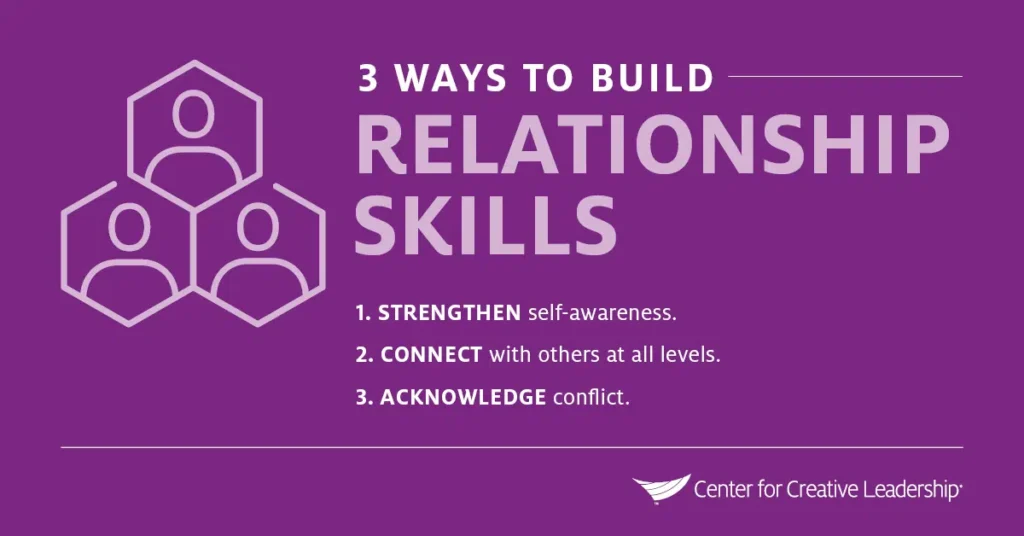
Fortunately, relationship-building skills are not immutable traits; they are learnable behaviors that can be honed through focused leadership development initiatives. The journey begins with practical self-assessment and a commitment to consistent practice.
1. Fortifying Self-Awareness:
The initial step toward forging more effective relationships involves a candid assessment of one’s current capabilities. Increasing self-awareness can be initiated by paying close attention to daily interactions with colleagues. Leaders should observe their own reactions to others and carefully note the verbal and non-verbal responses they elicit. A crucial aspect of self-awareness for relationship building involves evaluating one’s listening efficacy. Research from the Center for Creative Leadership indicates that employees perceive their leaders as being listened to twice as effectively when the leader not only listens but also takes visible action in response. Listening without subsequent action can be perceived as mere performance, rather than genuine engagement. Leaders should ask themselves: When a team member raises a concern or shares an idea, what is the immediate follow-up action? The answer to this question offers significant insight into one’s relational skills. This initial assessment provides a baseline for understanding one’s standing with employees and colleagues. Once this awareness is established, consistent steps can be taken to address weaknesses and amplify existing strengths.
2. Forging Connections Across All Tiers:
Cultivating relationships that span across different functions, hierarchical levels, and geographical locations provides leaders with a more accurate and nuanced understanding of organizational dynamics. This proactive engagement surfaces potential problems before they escalate into crises and builds the essential foundation of trust that enables swift and decisive action when needed. It is impossible to involve individuals in strategic initiatives if they are not known and understood. Similarly, aligning people requires an investment in building rapport and understanding. This investment is realized through consistent, meaningful attention and active listening, not only in formal settings but also in the myriad of everyday exchanges. When leaders have established these robust connections, navigating difficult situations becomes considerably easier. Tough decisions are met with greater understanding when those affected trust that their perspectives have been heard and considered. Disagreements, when they arise, become more productive when there is sufficient goodwill to absorb them. As research on workplace connection highlights, these bonds not only enhance job satisfaction but also significantly elevate leadership effectiveness at every level of an organization.
3. Navigating Conflict with Relational Integrity:
Conflict is an inherent byproduct of any organization comprised of committed individuals striving for shared outcomes. The critical question then becomes: do leaders possess the relational foundation necessary to navigate these inevitable disagreements without eroding the trust they have painstakingly built? Leaders with strong relational skills recognize that conflict and connection are not mutually exclusive. In fact, healthy working relationships are the very bedrock upon which productive disagreement is built. When relationships are tenuous, conflict tends to bifurcate into two undesirable paths: polite avoidance, where dissent simmers beneath the surface, or entrenched positions, where individuals defend their departmental interests rather than collaborating for the collective good. Leading through conflict effectively involves maintaining a posture of curiosity rather than defensiveness, addressing tension directly rather than allowing it to fester, and viewing disagreement as valuable information rather than a personal threat. Leaders who consistently employ this approach not only resolve conflicts but also strengthen relationships in the process, as collaboratively overcoming challenges builds a deeper, more resilient form of trust than smooth, superficial collaboration alone can achieve.
4. Investing in Feedback as a Relational Act:
Feedback is a high-leverage tool for relationship building, but its efficacy is contingent on its delivery. When dispensed without care or consideration, it can damage the very relationships it was intended to strengthen. Conversely, when delivered thoughtfully, it signals a profound investment in the recipient’s professional growth and development. The crucial shift in perspective is to treat feedback as a relational act, distinct from a purely evaluative one. This means being specific about the observable behavior, rather than making pronouncements about the individual’s character. It also entails delivering feedback in close proximity to the relevant event, ensuring its timeliness and impact. Furthermore, follow-up is essential, as feedback that leads to no discernible change or action can inadvertently signal a lack of genuine listening. Frameworks like the Situation-Behavior-Impact (SBI) model provide leaders with a structured and reliable approach to delivering and receiving feedback in a manner that demonstrably builds trust.
The Enduring Foundation of Effective Leadership
The practice of building relationships in the workplace is an ongoing, dynamic process that permeates every conversation, decision, and moment of organizational pressure. Leaders who excel in this domain are inherently intentional: they are acutely aware of their impact, they invest deeply in the people around them, and they prioritize interpersonal connection as a strategic imperative. In an era increasingly defined by AI-driven acceleration and the prevalence of distributed teams, these relational habits are not only relevant but essential, demanding a deliberate and sustained effort to cultivate. The encouraging news is that relationship-building skills are accessible to individuals at all career stages, and the return on this investment compounds over time, leading to stronger teams, more effective decision-making, and a resilient leadership culture.
Charting the Path Forward: Strategic Investment in Relational Skills
Organizations that recognize the critical importance of relationship-building skills in today’s complex work environment are strategically investing in their leaders’ development. By partnering with expertise in leadership education, companies can craft tailored learning journeys designed to enhance these vital competencies. This includes modules focused on collaboration and teamwork, conflict resolution, emotional intelligence and empathy, self-awareness, and a range of other critical leadership topics, all grounded in robust research and proven methodologies. This proactive approach ensures that leaders are equipped not only with the technical and strategic knowledge required for their roles but also with the profound interpersonal skills necessary to inspire, align, and motivate their teams in an ever-evolving professional landscape.