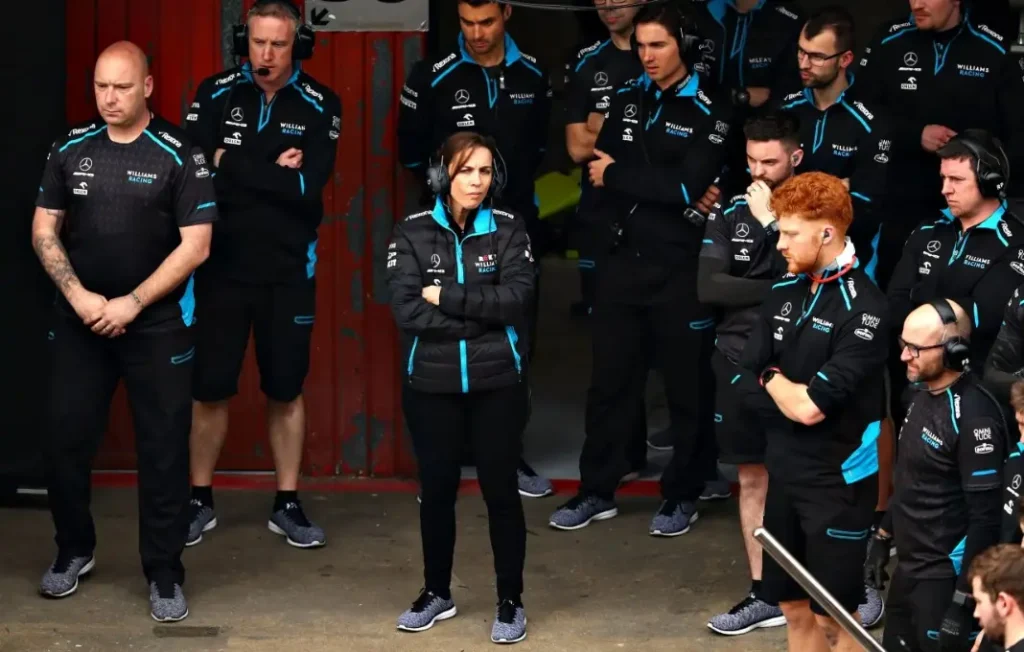
In a world where business increasingly resembles the pit wall—fast, visible, and unforgiving—Claire Williams’ lessons resonate far beyond motorsport. Her tenure as Team Principal of Williams Racing, from 2013 to 2020, was a masterclass in navigating extreme pressure, complex challenges, and the relentless pursuit of performance. This period, marked by significant team achievements and ultimately the transition to new ownership, offers a compelling case study for leaders across all sectors, revealing that the most profound insights often emerge from the most demanding environments. Williams, a pivotal figure as only the second woman to lead a Formula 1 team, demonstrated a leadership philosophy grounded in clarity, humility, and a deeply human understanding of performance, principles that hold universal value.
The inherent nature of Formula 1 is one of split-second decisions made under immense scrutiny, often with incomplete information and irreversible consequences. For Claire Williams OBE, this was not a theoretical construct but the daily fabric of her professional life. Leading one of motorsport’s most storied franchises through an era characterized by intense competition, financial headwinds, and rapid technological evolution, she steered the team to notable successes, including two third-place finishes in the Constructors’ Championship and 15 podiums. Her leadership also coincided with the intricate process that led to the sale of the family-owned team, a significant turning point in its storied history. Under constant public and internal examination, Williams’ approach to leadership provides invaluable takeaways for business leaders seeking to cultivate resilience and effectiveness in their own organizations.
The Power of Pre-Defined Clarity: Making Decisions at Race Speed
The pit wall, as described by Williams, is "probably one of the scariest places in sport." It is the crucible where critical decisions are forged at the breakneck pace of a Grand Prix. "You’re expected to make split-second decisions with very limited information," she explained, "in a very fast-moving environment where the variables can change at any moment, and you constantly have a camera in your face." This high-stakes environment demands an approach that transcends reactive firefighting.
Williams’ strategic solution was remarkably straightforward: establishing crystal-clear decision criteria before the pressure mounted. For Williams Racing, a paramount filter governed these instantaneous choices: "Whatever consequence a decision was going to have on our constructor’s position, that was king. That was all that mattered." This singular focus on the ultimate goal—the team’s standing in the championship—provided an unwavering compass amidst the chaos.
This approach aligns with behavioral science research. A study from Medical School Berlin highlighted that under time pressure, leaders tend to shift from analytical reasoning to heuristics, or faster, simpler strategies. When these heuristics are not pre-defined, individuals may develop them on the fly, leading to inconsistent or emotionally driven choices. Williams’ method exemplifies the antidote: establishing the rules of engagement before the pressure cooker environment takes hold, ensuring that actions are aligned with overarching objectives, even under duress.
Navigating the Signal vs. Noise: When Data Isn’t the Sole Answer
Formula 1 is intrinsically data-driven; indeed, "data is the heartbeat of Formula 1," as Williams acknowledged. "Without it, the sport wouldn’t exist." However, she was equally astute about its limitations, emphasizing, "We mustn’t forget that we still have brains as humans." This nuanced perspective proved crucial in overcoming the potential pitfalls of over-reliance on technology.
A compelling anecdote from Williams’ tenure illustrates this point vividly: weather forecasting. Despite significant investment in sophisticated meteorological systems, Williams often found herself relying on a more rudimentary, yet remarkably effective, method: a team member stationed miles away, observing the sky from a van for hours. This seemingly low-tech approach often yielded more reliable insights than complex data streams. In one instance, while engineers poring over screens insisted it wasn’t raining, drivers on the track and team members in the garage could clearly see otherwise. The most seasoned engineers, Williams noted, would simply extend a hand from the pit wall canopy to feel the rain. "It’s a brilliant example of not allowing ‘because the computer’s saying it’ to override human judgment," she stated.
This observation resonates with research from the University of Illinois, which reinforces the dangers of information overload. Studies indicate that excessive data can lead to delayed decision-making, diminished decision quality, and heightened stress levels. Elite performers, rather than becoming overwhelmed by data, possess the critical ability to step back and re-anchor their judgment in situational awareness, integrating quantitative insights with qualitative observations and intuitive understanding.
Risk Management: Context, Courage, and Protecting the Downside
Contrary to the popular image of Formula 1 as a sport driven by reckless gambling, Williams identified herself as fundamentally risk-averse. This instinct profoundly shaped her leadership approach. When Williams Racing was performing well, her priority was to safeguard existing points rather than pursue overly ambitious, high-risk strategies. "The jeopardy was always too high," she explained, recognizing that a failed gamble could trigger cascading financial repercussions throughout the organization. Conversely, when the team was facing significant challenges, her risk appetite expanded. "We had nothing to lose," she stated plainly.
This adaptive risk profile underscores a crucial leadership principle: risk tolerance is not static but context-dependent. Williams’ approach mirrors the adaptive frameworks found in decision-velocity models such as the OODA Loop (Observe-Orient-Decide-Act). This model emphasizes the importance of speed and adaptability over the pursuit of perfect foresight, recognizing that circumstances dictate the optimal level of risk. The ability to calibrate risk-taking based on the prevailing conditions is a hallmark of effective leadership, particularly in volatile business environments.
Learning at Race Speed: Debriefs Without Blame
Formula 1 teams are renowned for their exhaustive debriefing processes. Following every practice session and every race, lessons are meticulously extracted and immediately implemented. "It’s the only way we learn," Williams asserted. A particularly challenging moment for the team occurred in 2019 when they failed to deliver their car to pre-season testing on time, a severe setback in the F1 calendar. Instead of moving past the incident, Williams initiated a comprehensive six-month review. "Everybody in the factory was interviewed," she recalled. The objective was not to assign blame but to foster a deep understanding of the underlying causes.
"I was very clear that I wanted people to be open and honest, and there would be no negative consequence for them being so," she stated. This commitment to creating a psychologically safe environment transformed the team’s approach to failure. Over time, the organization learned that admitting mistakes and raising issues early was not only acceptable but essential for growth. This cultural shift not only improved performance but also significantly bolstered trust within the team. This commitment to learning from setbacks, without punitive measures, is a cornerstone of high-performing organizational cultures.
Communication as a Structural Imperative
When asked about the single failure that guarantees disaster in Formula 1, Williams’ answer was immediate and unequivocal: "Communication." Communication breakdowns between departments such as aerodynamics, design, manufacturing, and the race team were identified as significant detractors from performance. Williams recognized that these were not merely operational glitches but systemic failures that required practical, human-centered solutions. Her approach involved fostering direct interaction, such as bringing aerodynamicists to races to experience the reality firsthand and enabling them to speak the same language as the race engineers.
The business implications of poor communication are stark and well-documented. Research cited by Talaera estimates that miscommunication costs U.S. businesses approximately $1.2 trillion annually in lost productivity. Furthermore, Sci-Tech Today reports that 86 percent of employees identify poor communication as the primary cause of workplace failures. Williams’ experience underscores that effective communication is not a "soft skill" but a foundational, structural element critical for organizational success.
Structure with Humanity: Discipline Without Distance
Williams described Williams Racing as both highly structured and deeply familial. While clear processes and rhythms were in place, there was a deliberate absence of an "ivory tower" mentality. "No one’s more important than anyone else," she emphasized, maintaining an open-door policy that fostered accessibility and inclusivity.
This delicate balance reflects the concept of the "ambidextrous organization," as described by Harvard Business Review. Such organizations excel at both disciplined execution and fostering flexibility and humanity. This duality significantly enhances their capacity to sustain performance while simultaneously innovating under pressure. Williams’ leadership style embodied this principle, demonstrating that rigorous operational discipline can coexist with genuine care and concern for individuals.
Perhaps most powerfully, Williams’ leadership was deeply rooted in empathy and a profound understanding of her people. She prioritized knowing what motivated them, whether they were happy, and when they were struggling. "It broke my heart when people weren’t happy," she admitted. This humanity was particularly vital as she navigated leadership as a woman in a male-dominated arena. Periods of poor performance and the personal experience of motherhood intensified scrutiny. "When I feel under threat, I fight," she stated, but she also learned the critical importance of rest, recovery, and cultivating a supportive network.
Leadership Beyond the Stopwatch: Enduring Lessons for a Demanding World
Claire Williams’ journey dismantles the prevalent myth that elite performance is solely about bravado, heroic feats, or the flawless acquisition of data. Instead, her story illuminates the enduring power of clarity established before pressure arrives, the wisdom of prioritizing judgment over overwhelming data, the necessity of learning without blame, and the fundamental strength of leadership grounded in humanity.
In today’s business landscape, which increasingly mirrors the high-stakes, fast-paced, and unforgiving environment of the Formula 1 pit wall, the lessons derived from Williams’ leadership are not confined to the realm of motorsport. As Williams herself wisely observes, leadership is not about consistently being right. "It’s about how you pick yourself up and how you respond in the aftermath. That’s the most important thing." This resilient and adaptive approach to challenges may well represent the most enduring definition of elite performance in any field.