

Disagreements at work are inevitable, but what if conflict could become a catalyst for productivity rather than tension? Most of us collaborate closely with others, so conflict is unavoidable. The question is: must it always be so disruptive (and costly)? Healthy conflict is now recognized as a driver of growth, innovation, and stronger teams. Effectively managed conflict pushes teams to challenge assumptions and tackle complex problems, driving deeper understanding and often leading to more creative solutions. Ignoring or avoiding it may feel safer in the short term, but organizations that fail to address disagreements will eventually stagnate. Conflict should not always be seen as simply a failure of organizational culture—it often shows that people genuinely care about outcomes. The real failure is not giving employees the tools to handle it constructively. When approached wisely, conflict becomes an opportunity to strengthen teams and help them thrive together.
The Unseen Financial Drain: The High Cost of Unresolved Workplace Conflict
In today’s fast-paced business environments, where efficient teamwork and decisive decision-making are paramount, unresolved conflict represents a significant and often overlooked financial risk. While the immediate emotional toll is apparent, the tangible economic impact on businesses across the globe is staggering.

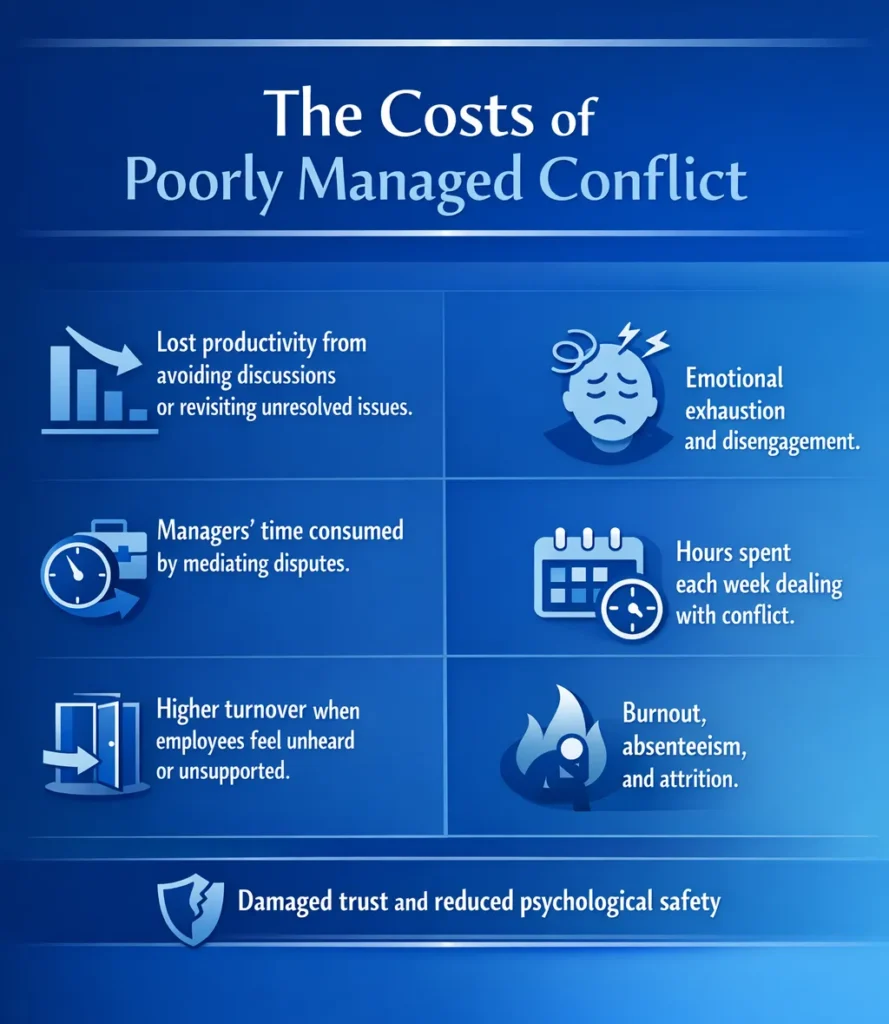
In the United Kingdom alone, the financial toll of workplace conflict is estimated to be a staggering £28.5 billion annually, translating to approximately £1,000 per employee. These substantial costs manifest in multiple, often insidious, forms: increased employee turnover, the expense of disciplinary and grievance procedures, stress-related absenteeism, and the considerable time invested by management and HR in resolving disputes. When conflicts escalate beyond initial disagreements, the financial repercussions accelerate dramatically. The departure of a single employee due to unresolved conflict can cost an organization upwards of £31,000. Furthermore, cases that proceed to formal tribunals can incur costs exceeding £44,000, a figure that can significantly impact a company’s bottom line.
Annually, an estimated 10 million individuals in the UK experience workplace conflict. The consequences are far from trivial. When teams witness disagreements being ignored or mishandled, a palpable decline in morale is often observed, trust erodes, and employees become hesitant to voice concerns or challenge existing ideas. This persistent, unresolved tension can lead to burnout, with a recent study indicating that one in three UK professionals experience burnout as a direct result. The ripple effects extend to lost earnings, stalled career progression, reduced pension contributions, and an increased burden on healthcare systems due to stress-related illnesses. According to the Chartered Institute of Personnel and Development (CIPD), employees who are involved in conflict are also twice as likely to consider leaving their jobs within the year.
Across the Atlantic, the landscape in the United States presents a similar picture. Workplace conflict affects an estimated 85% of employees, who dedicate an average of 2.8 hours per week to resolving disputes. This translates to a substantial loss of productive time and a significant drain on overall workforce efficiency.

Dr. Kimberley Best, a seasoned mediator, conflict management expert, and the founder of Best Conflict Solutions, LLC, has firsthand experience with the pervasive nature of this issue. She shared with Allwork.Space, "Workplace conflict costs U.S. employers an estimated $359 billion annually in lost productivity. Add to that increased turnover, absenteeism, disability claims, litigation, and reputational damage. Beyond the financial toll, there’s the human one: anxiety, disengagement, talented people walking away, and teams fractured by unresolved tension."
A critical driver behind these substantial losses is a pervasive lack of preparation. Data indicates that a significant 60% of workers have never received basic conflict-resolution training. This deficiency means that unmanaged conflict becomes a relentless drain on time, energy, and performance. Consequently, addressing disagreements early and equipping employees with the necessary skills to handle them constructively is not merely a matter of good practice but a crucial imperative for sustained business success.
The Neglected Discipline: Why Conflict Management Skills Remain Underdeveloped
Conflict mitigation stands out as one of the most critical workplace skills in the contemporary professional landscape. Yet, a significant number of organizations continue to overlook its importance or fail to invest adequately in its development. This oversight often stems from a deeply ingrained bias that prioritizes technical proficiencies over relational abilities, leaving professionals ill-equipped to navigate and manage disagreements constructively. While workplaces readily invest heavily in technological advancements, the crucial training of their human capital in conflict resolution often lags far behind, despite compelling evidence that effective conflict resolution can reveal critical gaps in understanding, spark creative problem-solving, and ultimately forge stronger working relationships.

Dr. Best emphasized that in the current climate, broader social and political tensions are directly influencing workplace dynamics, elevating the importance of conflict resolution skills from optional to essential. "Political polarization, social division, and heightened tensions didn’t stay outside the office door. They walked right in," she stated. "Incivility in the workplace increased. So did aggression, hostility, and in some cases, violence. Many organizations discovered that their teams lack the fundamental skills to navigate disagreement, change, and difficult conversations, and the cost has been staggering."
Whether conflict arises from the rapid adoption of artificial intelligence, debates surrounding diversity, equity, and inclusion (DEI), evolving return-to-office policies, or broader cultural shifts, the underlying issue frequently remains the same: employees lack the essential skills to navigate disagreement constructively. Leaders often err by ignoring conflict or dismissing it as a mere "people problem," failing to recognize it as a fundamental skills gap. Unaddressed tension does not dissipate; instead, it festers, escalates, and can ultimately drive valuable employees away, even when the majority of the workforce genuinely desires to collaborate effectively.
The Strategic Imperative: Why Developing Conflict Management Skills is Crucial
Understanding the profound cost of unresolved conflict is the first step; building the organizational capacity to handle it effectively is the critical next. Conflict competence—the ability to disagree constructively, repair damaged relationships, and prevent tension from compounding—is no longer a peripheral soft skill but a strategically vital component for the future of work. Despite this growing recognition, many organizations still perceive conflict management as an innate trait rather than a learnable skill that can be cultivated through dedicated training and practice.

Dr. Best underscores that in 2026, organizations must elevate the teaching of conflict management and productive engagement in disagreements to a strategic priority. Tension, she argues, is an inherent part of growth and change. However, without the requisite skills to navigate it, even the most sophisticated tools and strategies can falter when tensions inevitably rise.
She highlights five compelling reasons why building conflict competency—empowering individuals to manage and navigate disagreements productively—should be a strategic priority for organizations:
- Enhanced Innovation and Problem-Solving: Constructive disagreement challenges assumptions, encourages diverse viewpoints, and leads to more robust and innovative solutions. Teams that can openly debate ideas without fear of reprisal are more likely to uncover blind spots and develop groundbreaking strategies.
- Improved Employee Engagement and Retention: When employees feel heard and respected, even during disagreements, their engagement levels increase. Organizations that foster environments where conflict is managed healthily are more likely to retain top talent, as employees feel valued and supported.
- Stronger Team Cohesion and Trust: Navigating conflict successfully builds resilience within teams. The process of resolving disagreements collaboratively can deepen trust, improve communication, and foster a stronger sense of camaraderie and mutual respect.
- Increased Productivity and Efficiency: Unresolved conflict consumes valuable time and energy. By equipping employees with conflict resolution skills, organizations can reduce the time spent on disputes, allowing for a greater focus on core business objectives and boosting overall productivity.
- Development of Adaptable and Resilient Leaders: Leaders who can effectively manage conflict are better equipped to navigate change, foster psychological safety, and guide their teams through challenging periods. This skill set is essential for building adaptable and resilient organizations capable of thriving in dynamic environments.
Dr. Best is unequivocal: organizations that strategically pair their investments in digital tools and technological advancements with an equal focus on enhancing communication and conflict resolution skills will be far better prepared to meet the complex demands of the future workplace.
Empowering Teams to Disagree Productively
Effective conflict management is fundamentally rooted in communication skills that can be systematically taught and reinforced throughout any organization. The process begins with the practice of active listening—the discipline of fully concentrating, understanding, responding, and remembering what is being said—and the crucial ability to pause and reflect before responding. This approach significantly minimizes misunderstandings and powerfully demonstrates respect for others’ perspectives.
Recognizing and valuing different communication styles can also play a pivotal role in reducing unnecessary tension. Equally important is fostering a culture of accountability. Healthy teams are characterized by their prompt acknowledgment of mistakes, and leaders who model effective repair after conflict implicitly demonstrate that relationships can not only endure disagreement but can emerge stronger from it. Underpinning all these elements is the critical foundation of psychological safety—a workplace condition that thrives only when organizations actively welcome dissent and encourage open dialogue, rather than exclusively rewarding quiet consensus.
Traditional approaches to conflict resolution, such as role-playing exercises or HR-led interventions, have often proven insufficient in equipping individuals with the nuanced skills required for real-world scenarios. However, emerging AI tools are beginning to bridge this gap by enabling employees to practice difficult conversations in simulated environments. These technologies help develop the essential empathy and emotional intelligence required to navigate complex interpersonal dynamics effectively in actual situations.

Dr. Best emphasizes that a significant skill gap among leaders lies in their failure to recognize that they are managing people, not inanimate objects. She posits that effective leadership requires a deep understanding of conflict dynamics, the ability to listen actively and empathetically, the capacity to foster genuine accountability, the skill to facilitate difficult conversations with confidence, and the practice of servant leadership principles. To address this critical need, she developed the Best Conflict Conversation Cards—a 50-card, evidence-based tool designed to strengthen conflict resolution skills. The deck comprises twenty "Story Cards," which present realistic workplace scenarios to explore potential triggers and diverse perspectives, alongside thirty "Skills Cards" that teach practical strategies for clear communication, emotional regulation, and de-escalation. Organizations are increasingly utilizing this deck in leadership programs, team meetings, onboarding processes, and mediation preparation, effectively transforming potentially difficult conversations into valuable, practical skill-building opportunities.
Organizations that delay addressing conflict until it reaches a crisis point often incur substantial and unnecessary costs. Therefore, early intervention emerges as one of the most effective strategies, with action being taken proactively before tensions become entrenched and intractable. Mediation, in particular, proves most effective when offered as a readily available resource rather than a last resort, providing a structured, neutral space to address disagreements before they escalate into damaging disputes.
Transforming Tension: Conflict as a Catalyst, Not a Crisis
While no one actively seeks out conflict, the fundamental problem is not disagreement itself but rather how it is managed. High-performing teams have learned to leverage constructive disagreement as a powerful tool for learning, innovation, and continuous improvement. Leaders play a pivotal role in enabling this transformation by framing disagreement not as a threat, but as a signal that something meaningful is at stake and worthy of careful consideration.

When employees trust that their ideas will be heard and considered, conflict naturally transforms into a productive force. Teams can then effectively test assumptions, uncover hidden blind spots, and rigorously refine proposals. Constructive, idea-focused debate leads to demonstrably improved decision-making, accelerates the pace of innovation, and strengthens the integration of diverse perspectives into the organizational fabric. In practical terms, this translates to encouraging respectful challenge, maintaining a focus on ideas rather than personalities, and establishing clear structures that normalize healthy debate and discourse.
As Dr. Best wisely observes, "Conflict is inevitable. Dysfunction is optional." By embracing conflict as an opportunity for growth and development, organizations can unlock new levels of innovation, build more resilient teams, and foster a truly collaborative and productive work environment. The key lies not in eliminating disagreement, but in cultivating the skills and culture necessary to navigate it with wisdom and effectiveness.








