The U.S. Equal Employment Opportunity Commission (EEOC) concluded its 2025 fiscal year on September 30, 2024, recording its lowest volume of merit litigation in a decade. Despite entering the year with a robust budget and a substantial backlog of charges, the Commission filed only 93 lawsuits, a figure that reflects a dramatic shift in agency priorities and a series of unprecedented leadership changes following the transition to the Trump administration. This downward trend in enforcement activity marks a significant departure from the momentum established during the Biden administration and underscores the impact of political realignment on federal workplace oversight.
A Year of Institutional Transition and Upheaval
The 2025 fiscal year was defined by two distinct phases of agency activity, bifurcated by the presidential inauguration in January 2025. The first quarter of the fiscal year saw a continuation of the aggressive enforcement posture favored by the previous administration. However, the transition of power brought about swift and, in some cases, unprecedented changes to the Commission’s structure.
In late January 2025, President Trump elevated Andrea Lucas to the position of Acting Chair of the EEOC. In a move that tested the constitutional limits of presidential authority over independent agencies, the administration terminated EEOC General Counsel Karla Gilbride and fired Commissioners Charlotte Burrows and Jocelyn Samuels. Because Burrows and Samuels had years remaining on their appointed terms, their removal was viewed by legal scholars as a bold assertion of executive power.
These dismissals left the EEOC without a quorum, as only Acting Chair Lucas and Commissioner Kalpana Kotagal remained. Under established agency protocols, the absence of a quorum significantly restricts the General Counsel’s ability to initiate certain types of litigation. While the General Counsel retains delegated authority to file "routine" cases, they are generally barred from initiating systemic discrimination suits, pattern-or-practice cases, or litigation involving unsettled areas of law that might generate public controversy. This institutional paralysis contributed heavily to the record-low filing numbers seen in the latter half of the year.
Chronology of FY 2025 Filing Activity
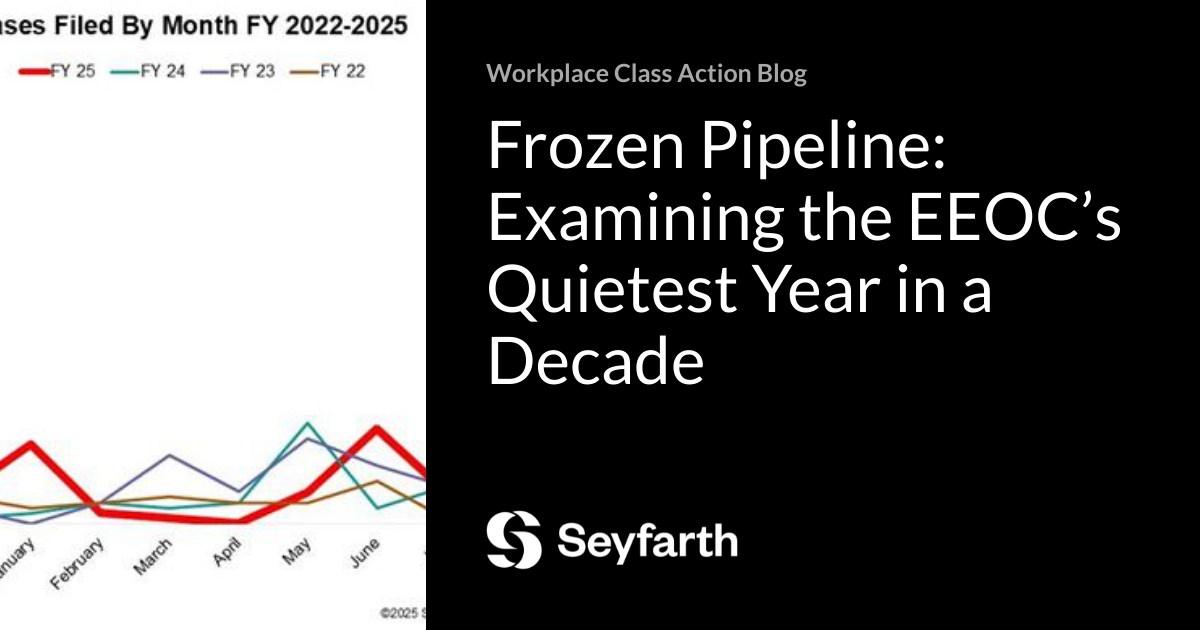
The timing of the EEOC’s filings throughout the year provides a clear map of the agency’s internal volatility.
- The Early Surge (October 2024 – January 2025): The Commission began the fiscal year with uncharacteristic speed, filing 24 lawsuits in the first four months. January 2025 alone saw 15 filings, a surge widely interpreted as an attempt by outgoing leadership to move cases into the judicial system before the change in administration.
- The Post-Transition Lull (February 2025 – May 2025): Following the leadership purge in late January, filing activity slowed as the new leadership reassessed the agency’s docket and navigated the lack of a quorum.
- The Mid-Year Rebound (June 2025): In a surprise development, the EEOC filed 18 lawsuits in June, a five-year high for that month. This indicated that the agency had established a new "routine" for case approvals under the delegated authority of the acting leadership.
- The September "Fizzle" (September 2025): Historically, the EEOC engages in a "September Surge" to exhaust its litigation budget before the fiscal year ends. While September remained the busiest month of 2025 with 35 filings, it paled in comparison to previous years. For context, the EEOC filed 71 lawsuits in September 2023 and 56 in September 2024.
Regional Variations: The Rise of the Midwest
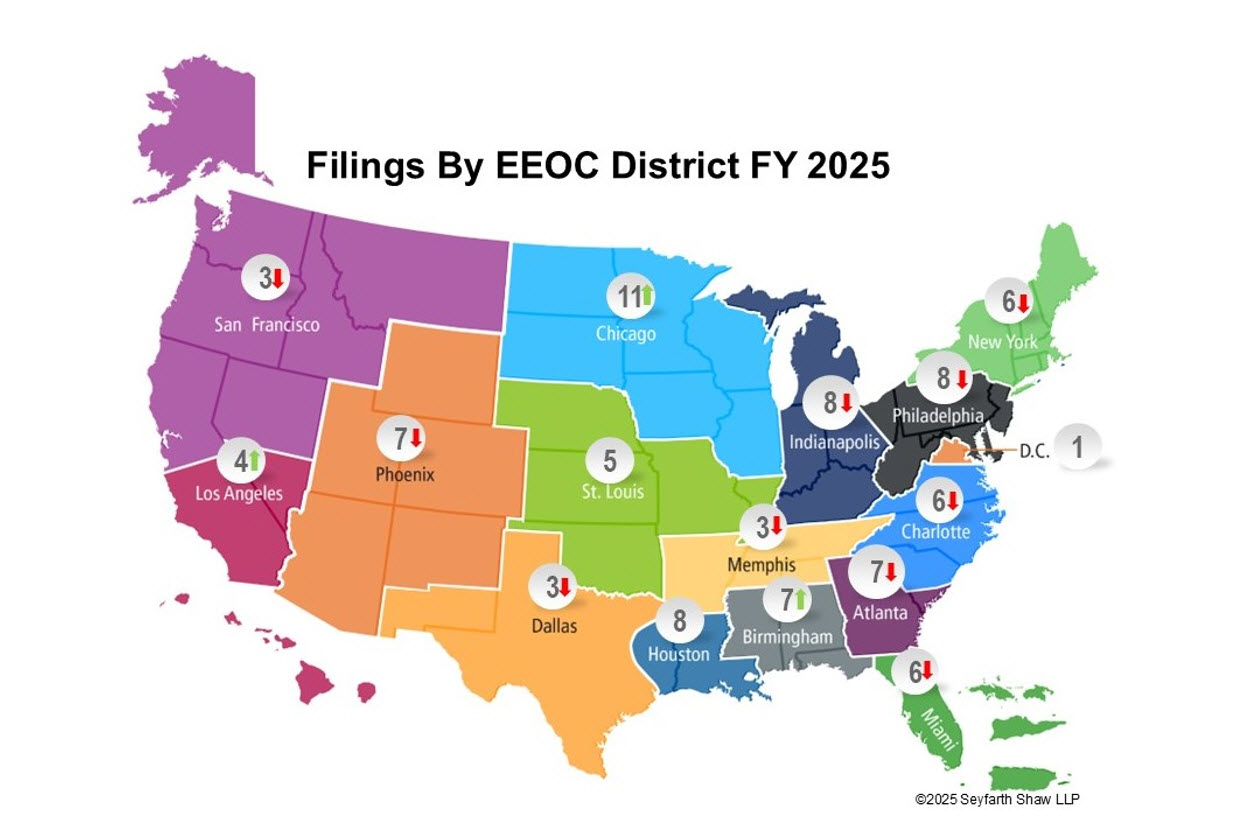
The geographic distribution of EEOC lawsuits in FY 2025 revealed a shift in where the agency is most active. The Chicago District Office reclaimed its position as the most litigious branch, leading the nation with 11 merit filings. Other active hubs included Philadelphia, Indianapolis, and Houston, each recording eight filings.
In contrast, historically active offices on the West Coast and in the Northeast remained remarkably quiet. The Los Angeles, San Francisco, and New York offices filed just four, three, and six lawsuits, respectively. This decline continues a trend observed over the last several years, where the "coastal" districts have moved away from the high-volume litigation strategies that characterized the Obama-era EEOC.

Strategic Pivot: Claims and Focus Areas
While the total number of lawsuits decreased, the nature of the claims filed provides insight into the Trump administration’s revised enforcement philosophy.
The Prioritization of Religious Freedom and "Biological Truth"
Under Acting Chair Andrea Lucas, the EEOC has pivoted toward protecting religious liberties and adhering to a traditional view of sex-based protections. In August 2025, the Commission issued a public statement touting its efforts to ensure workers are not forced to choose between "their paycheck and their faith." This resulted in 11 religious discrimination filings in FY 2025, a notable increase from the four filed in FY 2024.
Simultaneously, the agency moved to distance itself from LGBTQ-related advocacy. Following an Executive Order aimed at "restoring biological truth" to federal policy, the EEOC moved to dismiss two pending lawsuits involving transgender workers. Acting Chair Lucas clarified that the agency would focus on sex-based discrimination as it pertains to biological sex, stating that it is not harassment to acknowledge that sex is "binary and immutable."
ADA and Pregnancy Protections
The Americans with Disabilities Act (ADA) remained the most cited statute in EEOC litigation, accounting for 34 filings. The Commission continued to focus on "invisible" disabilities, including mental health conditions like PTSD, anxiety, and depression, as well as vision and hearing impairments.

Pregnancy-related discrimination also emerged as a top priority, bolstered by the newly enacted Pregnant Workers Fairness Act (PWFA). Together with the Pregnancy Discrimination Act (PDA), these claims were the subject of 10 lawsuits. When combined with general sex-based claims, this category accounted for 37 total cases, representing nearly 40% of the year’s total litigation.
The Decline of Race-Based Filings
Perhaps the most striking statistical shift was the collapse of race and national origin filings. The EEOC filed only three such lawsuits in FY 2025, down from 27 in FY 2023. Notably, two of the three filings involved theories of "reverse discrimination" or "anti-American bias," where American or non-Japanese workers alleged they were passed over in favor of foreign or minority candidates. This aligns with the administration’s stated goal of protecting American workers from what it terms "woke" corporate policies.
Implications for the Private Sector
The historically low volume of EEOC litigation should not be interpreted by employers as a signal to relax compliance efforts. Legal analysts suggest several reasons for continued vigilance:
- The "Follow-the-Leader" Effect: The private plaintiffs’ bar frequently uses EEOC filings as a roadmap for class-action litigation. Even when the EEOC pulls back, private attorneys often step in to fill the vacuum, particularly in high-stakes areas like AI-driven hiring bias and wage-and-hour disputes.
- State-Level Enforcement: In the absence of aggressive federal oversight, many "blue" state Attorneys General and state-level civil rights agencies have signaled their intent to increase enforcement of local anti-discrimination laws.
- The Impact of Systemic Investigations: Although the EEOC filed fewer lawsuits, the agency’s investigative arm remains active. A drop in filings can sometimes precede a surge in future litigation once a quorum is restored and the backlog of investigated charges is cleared for court.
- Industry-Specific Targeting: FY 2025 data shows that the healthcare industry remains a primary target for EEOC scrutiny. Companies in this sector, particularly those operating in the Midwest, face a higher statistical likelihood of federal intervention.
Analysis: The Future of Federal Enforcement
The 2025 fiscal year represents a period of consolidation and redirection for the EEOC. By focusing on a narrower set of priorities—religious liberty, pregnancy, and ADA compliance—while retreating from broader social issues and systemic race-based claims, the Commission has aligned itself with the broader deregulatory and socially conservative goals of the current administration.
However, the lack of a quorum remains a significant hurdle. Until the Senate confirms new commissioners to restore a Republican majority and a full quorum, the EEOC’s litigation arm will likely remain constrained to "routine" matters. This may lead to a continued plateau in filing numbers through FY 2026.
For employers, the takeaway is clear: the threat of a high-profile EEOC lawsuit has statistically diminished, but the legal landscape is becoming more fragmented. As the federal government narrows its focus, the burden of monitoring workplace trends and maintaining equitable standards will fall increasingly on corporate legal and HR departments, who must navigate a complex environment of shifting federal priorities and aggressive state-level enforcement.