Modern leadership is currently navigating an unprecedented convergence of technological acceleration, economic volatility, and a fundamental shift in the social contract between employers and employees. As organizations grapple with the integration of artificial intelligence, the persistence of remote and hybrid work models, and the rising demand for purpose-driven employment, the role of the executive has transitioned from simple oversight to high-stakes orchestration. Amidst this backdrop of increasing complication, organizational psychologists and leadership experts are identifying a recurring pattern: most leadership failures do not stem from a lack of technical expertise, but rather from the neglect of foundational responsibilities. A burgeoning framework known as the "Leadership Triangle," popularized by scholars such as Dr. Justin Irving, is emerging as a critical diagnostic and developmental tool for Chief Learning Officers (CLOs) and talent management professionals seeking to stabilize and scale their leadership pipelines.
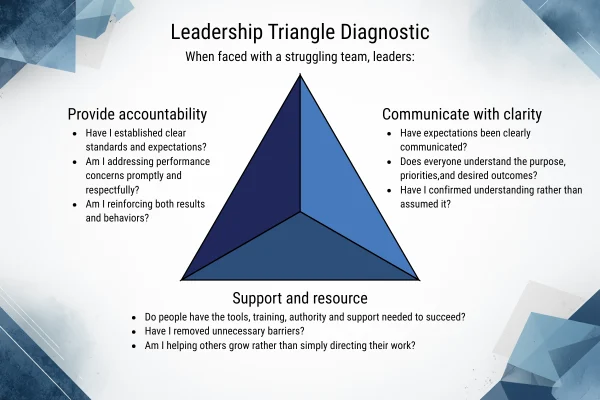
The Leadership Triangle posits that effective leadership is built upon three interdependent pillars: the ability to communicate with clarity, the commitment to support and resource followers, and the courage to provide consistent accountability. While these concepts are not new in the lexicon of management theory, their systematic application—or lack thereof—is increasingly cited as the primary differentiator between high-performing organizations and those mired in turnover and stagnation. In the current corporate climate, where "quiet quitting" and executive burnout are at record highs, this framework offers a simplified path back to functional management.
The Evolution of Leadership Frameworks: From Command to Complexity
To understand the relevance of the Leadership Triangle today, it is necessary to examine the chronology of leadership theory over the past century. The early 20th century was dominated by "Scientific Management" or Taylorism, which focused almost exclusively on efficiency and top-down control. By the mid-20th century, the Human Relations Movement began to acknowledge the social and psychological needs of workers. However, it was the late 20th-century shift toward "Servant Leadership"—a term coined by Robert K. Greenleaf—that laid the groundwork for modern frameworks like the Leadership Triangle.
Dr. Justin Irving’s research in the early 2000s further refined these concepts, moving away from the idea of the leader as a charismatic hero toward the leader as a facilitator of team success. The current era, often described as the "Complexity Era," requires a synthesis of these historical approaches. Leaders must now balance the hard metrics of the industrial age with the emotional intelligence of the human relations era, all while operating at the speed of digital transformation. The Leadership Triangle serves as a modern synthesis, providing a practical checklist for leaders who find themselves overwhelmed by the sheer volume of competing priorities.
Pillar One: The Imperative of Clarity in Communication
The first side of the leadership triangle is the responsibility to communicate with clarity. In the absence of clear communication, organizational vacuums are inevitably filled with rumors, anxiety, and misalignment. Data from Gallup consistently indicates that only about half of all employees strongly agree that they know what is expected of them at work. This lack of clarity is not merely a soft-skill deficit; it has quantifiable impacts on the bottom line. According to a 2023 report by the Harris Poll on behalf of Grammarly, poor workplace communication costs U.S. businesses an estimated $1.2 trillion annually, or approximately $12,506 per employee per year.
Effective communication in the context of the triangle is measured not by the volume of information disseminated, but by the level of understanding achieved. Leaders often fall into the trap of assuming that "speaking" is synonymous with "communicating." However, clear communication must answer four fundamental questions for every team member: What are the goals? Why do they matter? What is my specific role? How will we measure success?
For talent management professionals, this highlights a critical training gap. Leadership development programs must move beyond basic public speaking and focus on "alignment communication"—the ability to translate high-level strategy into actionable daily tasks. When leaders fail to provide this clarity, research shows a direct correlation with increased workplace stress and a decrease in employee engagement scores.
Pillar Two: Support and Resourcing as a Catalyst for Performance
Clarity alone, however, is insufficient if the workforce lacks the tools to execute the vision. The second side of the triangle—support and resourcing—shifts the focus from the leader’s vision to the follower’s capacity. This competency aligns with the core tenets of servant leadership, where the leader’s primary role is to remove obstacles.
In many modern corporate environments, there is a growing disconnect between the expectations placed on employees and the resources provided to them. This "Resource Gap" is a leading driver of burnout. Support in the Leadership Triangle framework takes several forms:

- Tangible Resources: Budget, technology, and adequate staffing.
- Temporal Resources: Sufficient time to complete tasks without constant "emergency" interruptions.
- Informational Resources: Access to the data and cross-departmental insights needed to make informed decisions.
- Emotional Support: Psychological safety and a culture where it is safe to report challenges or failures.
Dr. Irving’s research suggests that when leaders prioritize the growth and resourcing of their followers, the organization experiences higher levels of innovation and resilience. Conversely, when leaders demand results without providing the necessary support, it leads to a culture of resentment. Inferred reactions from industry experts suggest that the most successful CLOs are now integrating "resource advocacy" into their leadership curriculums, teaching managers how to fight for their teams’ needs at the executive table.
Pillar Three: The Accountability Gap and the Courage to Correct
The final side of the triangle is often the most challenging for leaders to master: accountability. In an era where empathy and "soft skills" are heavily emphasized, some leaders have mistakenly equated kindness with a lack of consequences. However, the Leadership Triangle posits that accountability is actually an act of respect and stewardship.
Without accountability, the first two sides of the triangle collapse. If expectations are clear and resources are provided, but there are no repercussions for poor performance or rewards for excellence, the high-performers in an organization will eventually disengage. A study by the American Management Association found that 17% of employees say their company’s biggest weakness is a lack of accountability.
Accountability should not be viewed as a punitive measure but as a feedback loop. It ensures that behaviors remain aligned with organizational values and goals. The most effective leaders demonstrate what is often called "carefrontation"—the ability to have difficult, candid conversations because they care about the individual’s growth and the team’s success. When accountability is applied inconsistently, it breeds a culture of favoritism and uncertainty, which can be more damaging to morale than strict, consistent discipline.
Systemic Integration: Moving Beyond Individual Behavior
One of the most significant implications of the Leadership Triangle is its ability to be integrated into an organization’s broader talent systems. For a framework to be effective, it cannot exist solely in a leadership handbook; it must be reflected in the organization’s "people architecture."
- Selection and Hiring: Interviews can be structured to assess a candidate’s history in these three areas. For instance, asking candidates to describe a time they had to provide accountability to a peer.
- Onboarding: New leaders should be introduced to the triangle as the standard by which their performance will be judged.
- Performance Management: Reviews should not just focus on "what" was achieved, but "how" it was achieved through the lens of communication, support, and accountability.
- Succession Planning: Potential leaders can be evaluated on their ability to balance these three pillars, ensuring that the next generation of executives is well-rounded.
By embedding these three competencies into the organizational culture, CLOs can create a common language that simplifies the complexities of management. This systemic approach reduces the reliance on "heroic leadership" and instead builds a robust infrastructure of capable managers at every level.
Analysis of Broader Impact and Future Implications
As we look toward the future of work, the Leadership Triangle remains highly relevant despite the rise of decentralized and autonomous workforces. In a "flat" organization, the need for clarity and accountability actually increases, as there is less traditional hierarchy to fall back on. Furthermore, as AI begins to automate many of the technical aspects of management—such as scheduling and data analysis—the "human" elements of the triangle (empathy in support, nuance in communication, and courage in accountability) will become the primary value-add of human leaders.
The broader impact of adopting such a framework extends to employee retention and mental health. In a labor market where "toxic culture" is cited as a leading reason for the "Great Resignation," the Leadership Triangle provides a roadmap for building a healthy, sustainable workplace. Leaders who master these fundamentals create environments of high trust, which is the ultimate currency in the modern economy.
In conclusion, the challenges of the 21st-century workplace are undeniably complex, but the solutions often lie in a return to fundamentals. The Leadership Triangle—Communication, Support, and Accountability—offers a timeless blueprint for navigating this complexity. By treating these three pillars not as optional skills but as essential responsibilities, organizations can foster a culture of excellence that is resilient enough to withstand the disruptions of the future. The most effective response to a complicated world is a commitment to the simple, consistent application of leadership essentials.