

TAMPERE, FINLAND – April 23, 2026 – Despite implementing no mandatory attendance policies for its office staff, Framery’s headquarters in Tampere, Finland, has become such a coveted destination that the company, now exceeding 400 employees, faces an unexpected consequence: a severe shortage of parking spaces. This logistical challenge underscores a broader trend in the post-pandemic work landscape, where employee preference, driven by the quality of the work environment, is increasingly dictating office attendance.
The phenomenon at Framery, a leading manufacturer of soundproof pods and smart office solutions, is a testament to their own product philosophy. The company utilizes its headquarters as a real-time testing ground for its innovations, a strategy that appears to have paid dividends in employee satisfaction and, consequently, their willingness to commute.
"We don’t tell people when to come in, but the data shows they’re choosing the office anyway," stated Samu Hällfors, CEO of Framery, in a recent interview. This sentiment, echoed by many companies grappling with hybrid work models, highlights the critical role of the physical office in employee engagement and retention.

Quantifying Workplace Experience: The Leesman Index
The surprising parking crunch at Framery has been independently validated by Leesman, a global leader in workplace research. Through its comprehensive workplace experience assessments, Leesman captures nuanced employee sentiments regarding the effectiveness of their work environments. These findings are then benchmarked against the Leesman Index (Lmi), a vast global database comprising over 1.5 million employee responses.
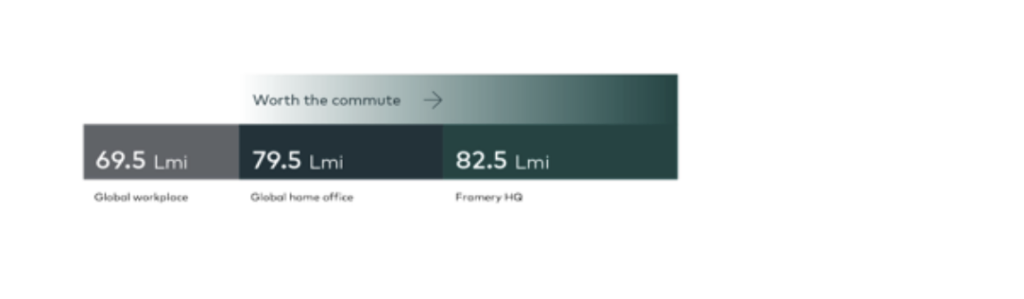
The data reveals a significant disparity between the perceived effectiveness of different work settings. The global average workplace experience score (Lmi) currently stands at 69.5. For homeworking, the benchmark (H-Lmi) is higher at 79.5, suggesting that, on average, employees find their home environments more supportive of their work needs than traditional offices.
However, Framery’s Tampere HQ has defied this trend, achieving an exceptional Lmi score of 82.5. This score not only surpasses the global average for physical workplaces but also outranks the average homeworking experience, placing Framery’s headquarters firmly in the global elite of office environments. This high score indicates that Framery has successfully created a physical workspace that employees find more conducive to their work than their home setups, thus incentivizing their presence.
Peggie Rothe, Chief Insights & Research Officer at Leesman, commented on the broader implications of such findings. "The average home, designed for living, supports the average knowledge worker better than the average office, built for working," Rothe observed. This statement encapsulates a key challenge for many organizations: their offices, designed with older paradigms in mind, are failing to meet the evolved needs of today’s workforce. Framery’s success, therefore, lies in its ability to re-engineer the office experience to be not just functional, but genuinely desirable.

Framery’s "Live Lab" Philosophy: A Commitment to Employee-Centric Design
Framery’s approach to office design is deeply rooted in its "Live Lab" philosophy. As a company specializing in soundproof pods and smart office solutions, they view their own headquarters as the ultimate testing ground. Every new product feature and office enhancement is implemented internally before being introduced to the market. This hands-on approach allows Framery to gather direct feedback and observe the real-world impact of their innovations on their own employees.
The company’s focus is on providing employees with the "right space the moment they need it." This principle is central to their product development and office strategy. By offering adaptable and functional spaces, Framery aims to eliminate common workplace frustrations and enhance productivity. The high Leesman score suggests they have mastered the art of creating such an environment.
The "Frictionless Commute": Redefining Office Appeal
Samu Hällfors articulates Framery’s strategy as one of "removing friction" to make the office commute worthwhile. This means addressing the pain points that often discourage employees from coming into the office. These can range from uncomfortable workspaces and lack of privacy to poor amenities and an overall uninspiring atmosphere.
Framery’s solutions, such as their signature soundproof pods, directly address the need for focused work and privacy in open-plan environments. These pods offer employees a sanctuary for deep work, virtual meetings, or simply a moment of quiet, thereby enhancing their ability to perform tasks effectively. Combined with other smart office solutions designed to optimize the use of space and resources, Framery’s HQ provides a highly functional and appealing work setting.
The data from Leesman’s extensive research, covering over 10,000 workplaces, consistently shows that many modern offices fall short of their primary objective: to support employee productivity and well-being. The contrast between the average office experience and the Framery HQ experience is stark.
A Timeline of Workplace Evolution and Framery’s Role
The shift in workplace dynamics has been a gradual but significant evolution. Prior to the widespread adoption of remote and hybrid work, office design was largely focused on maximizing density and accommodating traditional hierarchical structures. The advent of technology, however, began to challenge these norms, enabling more flexible work arrangements.
The COVID-19 pandemic acted as a powerful catalyst, forcing a rapid and unprecedented experiment in remote work. As companies navigated lockdowns and social distancing, many discovered that productivity could be maintained, and in some cases enhanced, outside the traditional office. This led to a widespread re-evaluation of the purpose and value of the physical office.
In this evolving landscape, companies like Framery, specializing in solutions that enhance the quality of work environments, have found themselves at the forefront. Their commitment to testing and refining these solutions within their own organization demonstrates a deep understanding of the challenges and opportunities presented by the modern workplace.
The success of Framery’s HQ can be seen as a case study in how to create an office that people want to be in, rather than one they are required to be in. This shift in employee motivation is crucial for businesses looking to foster a vibrant company culture and attract top talent in a competitive market.
Broader Implications: The Future of Office Design
The Framery story offers valuable insights for businesses worldwide grappling with the future of their office spaces. The key takeaway is that the physical office is not obsolete, but its role is fundamentally changing. It must evolve from a place of mandatory attendance to a destination that offers unique value, fostering collaboration, innovation, and a strong sense of community.
The high Leesman score achieved by Framery’s HQ suggests that investments in employee-centric design, privacy solutions, and smart technologies are not merely operational costs but strategic investments in human capital. When employees feel supported, valued, and equipped with the right tools and environments, their willingness to engage with the office increases significantly.
The parking issue, while a minor inconvenience in the grand scheme, serves as a tangible indicator of Framery’s success in creating an appealing workplace. It signifies a genuine demand for their office space, driven by the positive employee experience it provides.
For other organizations, the challenge lies in understanding what truly makes an office "worth it" for their specific workforce. This requires listening to employees, gathering data, and being willing to adapt and innovate. The Leesman Index provides a valuable framework for such assessments, allowing companies to benchmark their performance and identify areas for improvement.
As Hällfors aptly put it, "When you give people the right tools, the office becomes somewhere they want to be, not somewhere they have to be. Now we just need to sort out the parking." This concluding remark encapsulates the optimistic yet practical outlook of a company that has successfully navigated the complexities of the modern workplace by prioritizing the employee experience. The "parking problem" at Framery is, in essence, a symptom of success, a welcome challenge born from creating an office that truly works for its people.
About Framery
Framery is dedicated to enabling individuals to concentrate on their most important tasks and achieve their goals. Through its innovative soundproof smart pods and comprehensive smart office solutions, Framery transforms ordinary office spaces into environments that employees genuinely appreciate. This commitment has made Framery an integral component of successful workdays for millions of professionals across more than a hundred countries, serving a clientele that includes many of the world’s leading corporations.
About Leesman
Established in 2010, Leesman operates as a global, independent assessor of workplace experience. The firm provides organizations with critical insights into their employees’ workplace experiences, empowering them to design and cultivate environments that foster employee thriving.
Leesman employs a suite of assessment tools to gather employee feedback on the effectiveness of their work environments in supporting their needs. By evaluating organizations’ capabilities in supporting employees both at home and in the office, Leesman enables benchmarking against the largest database of its kind.
In an era where organizations are continuously adapting to rapidly evolving work cultures, Leesman’s insights equip businesses with the knowledge to make informed, forward-thinking decisions. These decisions help mitigate risks, plan effectively for the future, and cultivate workforces that are both happy and highly productive.
For further information and interview requests, please contact: [email protected], [email protected]








