GUAYNABO, PR, September 16, 2026 – A comprehensive new report from Zety®, a leading resume builder, reveals that Generation Z is entering the workforce under vastly different conditions than their Millennial predecessors. While young Gen Z adults exhibit lower labor force participation and employment rates, those who secure full-time positions are experiencing lower unemployment and earning significantly more in real terms. The "Early-Career Labor Market Report" meticulously analyzes U.S. Bureau of Labor Statistics data, comparing comparable early-career periods for Millennials (ages 20-24 from 2005-2008) and Gen Z (ages 20-24 from 2021-2024). This in-depth comparison scrutinizes labor force participation, employment, unemployment rates, and inflation-adjusted weekly earnings, painting a nuanced picture of the evolving landscape for young workers.
A Generational Shift in Labor Force Engagement
The Zety report highlights a discernible trend: a weaker connection to the traditional labor force among young Gen Z adults. From 2021 to 2024, the average labor-force participation rate for individuals aged 20-24 stood at 71.1%. This figure represents a notable decrease from the 74.5% participation rate observed among Millennials during their corresponding early-career years of 2005-2008. This 3.4-percentage-point difference signifies that a larger proportion of Gen Z adults are currently outside the labor force, meaning they are neither employed nor actively seeking employment.
This trend extends to employment figures as well. The employment-population ratio for Gen Z averaged 65.8%, compared to 67.9% for Millennials. This indicates that a smaller percentage of young Gen Z adults held jobs during the studied period, underscoring a broader pattern of reduced engagement with the formal employment sector at the outset of their careers.
Lower Unemployment for Engaged Gen Z Workers
Despite the lower overall participation and employment rates, the unemployment landscape for Gen Z presents a contrasting narrative. The average unemployment rate for Gen Z adults aged 20-24 between 2021 and 2024 was 7.5%. This is a significant improvement over the 8.9% unemployment rate faced by Millennials in the same age bracket from 2005 to 2008, representing a 1.4-percentage-point advantage for Gen Z.
It is crucial to understand the distinction between labor force participation and unemployment. The unemployment rate specifically measures the proportion of individuals within the labor force who are jobless, actively seeking work, and available to take a job. It does not include those who have opted out of the labor market altogether. Therefore, the data suggests that while fewer Gen Z individuals are entering the workforce, those who do are finding it easier to secure and maintain employment compared to their Millennial counterparts at a similar career stage. This could imply increased demand for specific skills or a more competitive job search among those actively participating.
A Significant Earnings Boost for Full-Time Gen Z Employees
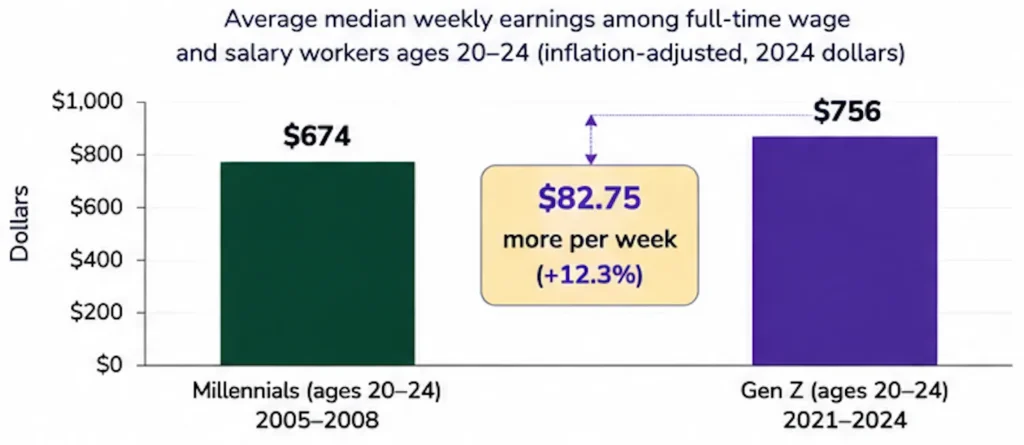
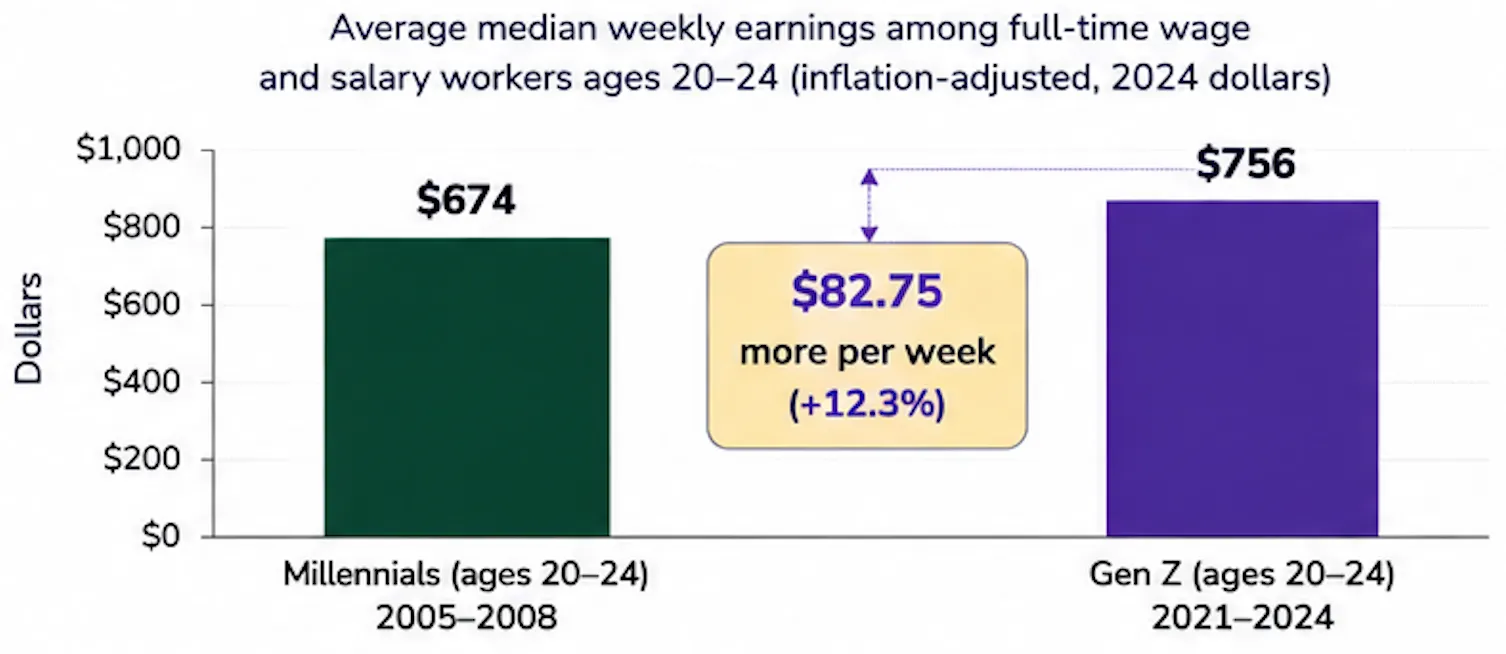
Perhaps the most compelling finding of the Zety report is the substantial earnings advantage enjoyed by full-time Gen Z workers. Inflation-adjusted median weekly earnings for full-time wage and salary workers aged 20-24 averaged $756.25 between 2021 and 2024. This stands in stark contrast to the average of $673.50 earned by Millennials during the 2005-2008 period.
This translates to approximately $83 more per week for Gen Z, a remarkable 12.3% increase in real terms. On an annualized basis, this difference amounts to roughly $39,300 for Gen Z compared to $35,000 for Millennials, a gap of approximately $4,300 per year. Importantly, this comparison is adjusted for inflation, meaning it reflects genuine purchasing power rather than simply the nominal increase in wages over time. This suggests that the early-career jobs secured by Gen Z are, on average, more financially rewarding in real terms than those available to Millennials two decades prior.

A Complex Early-Career Picture: Access Versus Reward
The Zety report concludes that the early-career experience for Millennials and Gen Z presents a mixed picture, with no definitive indication that one generation had a universally stronger start. Millennials demonstrated a higher propensity to participate in the labor force and were more likely to be employed during their early 20s. However, Gen Z labor-force participants have benefited from lower unemployment rates and, critically, higher inflation-adjusted weekly pay when working full-time.
This dynamic can be characterized as a trade-off between access and reward. A smaller segment of Gen Z has established a foothold in the workforce compared to Millennials. Yet, for those who have successfully entered and are engaged in full-time employment, the financial outcomes are demonstrably more favorable. This suggests a potential shift in the labor market where employers may be offering more competitive compensation to attract and retain the talent they seek, even as the overall pool of actively participating young workers may be smaller.
Unpacking the Reasons for Lower Gen Z Participation
The report acknowledges that the reasons behind Gen Z’s lower labor force participation remain complex and multifaceted. While the data clearly illustrates the trend, it does not definitively pinpoint the causal factors. Several potential influences are cited, including:
- Increased Educational Pursuits: A higher emphasis on advanced degrees or specialized training could lead to a delayed entry into the workforce.
- Economic Conditions: The specific economic climate during their formative early-career years, including the lingering effects of the COVID-19 pandemic and subsequent economic shifts, could play a role.
- Caregiving Responsibilities: Evolving societal expectations and family structures might mean more young adults are taking on caregiving roles for family members, impacting their availability for paid employment.
- Delayed Workforce Entry: A conscious decision to postpone entering the traditional job market in favor of other pursuits, such as entrepreneurship, gig work, or further skill development.
- Shifting Perceptions of Work: Gen Z’s generational values may differ from previous generations, with a potentially greater emphasis on work-life balance, purpose-driven careers, and flexible work arrangements that might not align with traditional full-time employment models.
The report emphasizes that these factors, individually or in combination, can influence an individual’s decision to actively seek or engage in paid employment.

Methodology and Data Integrity
The Zety report’s findings are grounded in rigorous analysis of data from the U.S. Bureau of Labor Statistics (BLS) Current Population Survey (CPS). To ensure an accurate generational comparison, the study focused on individuals aged 20-24 during distinct four-year periods that align with established generational definitions. Millennials are generally defined as those born between 1981 and 1996, while Gen Z spans those born from 1997 onwards.
The Millennial cohort’s early-career data was drawn from 2005-2008, a period when individuals aged 20-24 were born between 1981 and 1989. The Gen Z data was collected from 2021-2024, encompassing individuals aged 20-24 born between 1997 and 2005. This age-specific, time-period-matched approach allows for a more reliable comparison of early-career labor market experiences.
The analysis also noted a data anomaly due to the 2025 federal government shutdown, which impacted the BLS’s data collection for October 2025. Consequently, the 2025 annual estimates were based on 11 monthly observations. To mitigate potential biases, the researchers conducted a robustness check using five-year periods ending in 2009 and 2025, including the 2025 CPS annual estimates. This sensitivity analysis confirmed the primary directional findings: Gen Z continued to show lower labor-force participation and employment-population rates, while Millennials exhibited higher unemployment.
Limitations and Contextual Considerations
The authors of the report acknowledge crucial limitations. The study compares labor market outcomes across two distinct four-year economic periods: the onset of the Great Recession in 2008 and the post-pandemic labor market recovery commencing in 2021. It is vital to recognize that these periods were shaped by different macroeconomic forces and societal contexts. Therefore, the observed differences reflect the experiences of each generation during these specific times and do not inherently establish that generational characteristics caused these outcomes. The analysis provides a snapshot of generational experiences within their respective economic environments.

About Zety: Empowering Job Seekers
Zety, the organization behind this insightful report, is a prominent platform dedicated to assisting job seekers in their career endeavors. Their AI-powered resume builder offers a comprehensive suite of tools, including step-by-step guidance, tailored content suggestions, and a vast library of ATS-friendly resume templates. Since its inception in 2016, Zety has strived to empower professionals with data-driven career advice through its widely recognized career blog. The Zety editorial team comprises Certified Professional Resume Writers whose expertise has been featured in leading publications such as Business Insider, CNBC, and Forbes. The company actively engages with its audience across LinkedIn, Facebook, Instagram, and YouTube, sharing valuable career tips and labor market insights. Zety also encourages users to follow them on Google to personalize their search experience with workforce trends and labor market research.
The insights from Zety’s "Early-Career Labor Market Report" offer a critical lens through which to view the evolving dynamics of the contemporary workforce, highlighting both challenges and opportunities for the next generation of professionals. As Gen Z continues to shape the future of work, understanding these generational shifts in labor market participation and compensation will be crucial for policymakers, educators, and employers alike.