The corporate landscape is rapidly grappling with the transformative power of Artificial Intelligence, and in its wake, a new, often misleading, metric has emerged: the sheer number of employees trained in AI. While large, easily quantifiable, and reassuringly precise, this figure frequently offers limited insight into actual capability or productive application. An employee may diligently complete an AI course, acquire a certificate, and yet return to their daily responsibilities operating precisely as before, without integrating AI into their workflow. Global business process and technology company Genpact, with its formidable workforce of over 120,000 employees worldwide, is challenging this superficial approach, embarking on an ambitious journey to transform its entire talent pool into "AI Practitioners" by 2027. This bold initiative deliberately pivots away from mere course completion, focusing instead on deep integration, responsible application, and tangible business impact.
The Paradigm Shift: From Certification to Application
At the heart of Genpact’s strategy is a fundamental redefinition of what it means to be "AI-skilled." Shalini Modi, Senior Vice President and Global Leader for Employee Learning and Skilling at Genpact, articulates this shift with clarity: "Becoming an AI Practitioner is not about completing a certification or learning a new tool. It means building role-relevant AI capability, using AI responsibly, and applying it to real business problems." This perspective elevates the challenge from a purely educational one to a comprehensive organizational transformation. Training 120,000 individuals on the mechanics of AI is a considerable undertaking; enabling them to appropriately and effectively deploy AI across diverse functions such as finance, operations, technology, sales, and client services, represents a far more complex and impactful endeavor.
The Global Imperative: AI Adoption and Skill Gaps
The urgency behind Genpact’s strategy is rooted in the broader global acceleration of AI adoption. The past decade has witnessed AI evolve from a niche technology into a pervasive force reshaping industries, business models, and job roles. Generative AI, in particular, has rapidly moved from theoretical discussion to practical application, demanding an immediate and agile response from enterprises. According to a 2023 report by a leading consulting firm, while over 70% of global organizations are actively exploring or implementing AI, a staggering majority—nearly 88%—report feeling unprepared for the resulting workforce transformation. The World Economic Forum’s Future of Jobs Report 2023 further underscores this, identifying AI and machine learning specialists as among the fastest-growing job roles globally, while also emphasizing the increasing importance of human skills like critical thinking, creativity, and problem-solving, which are augmented rather than replaced by AI. Companies are projected to spend well over $300 billion annually on corporate training worldwide, with a significant and growing portion dedicated to digital and AI competencies. Genpact’s initiative is thus not merely an internal HR program but a strategic response to a universal business imperative, positioning itself to leverage AI not just as a tool, but as an integral part of its operational DNA.
Two Pillars of AI Talent: Builders and Practitioners
To systematically address its AI skilling objectives, Genpact has bifurcated its workforce into two distinct, yet complementary, categories: AI Builders and AI Practitioners.
AI Builders are the architects of Genpact’s AI future. This segment comprises individuals with deep technical expertise, responsible for creating, developing, and scaling AI products, platforms, and sophisticated solutions. Their roles demand proficiency in areas such as data platforms, generative AI development, solution architecture, and the design of complex agentic systems. These are the specialists who push the boundaries of AI capabilities within the organization, translating cutting-edge research into actionable enterprise tools.
AI Practitioners, representing the much larger segment of the workforce, are the end-users and integrators of AI across Genpact’s diverse service lines. Whether working in finance, operations, sales, or client services, these individuals are not expected to possess an intimate understanding of the underlying algorithms or technical complexities of an AI model. Instead, their critical mandate is to know how to effectively use AI tools, when to question their outputs, and how to exercise sound judgment around the recommendations or analyses provided by AI systems. This distinction is particularly pertinent for Genpact, whose core business involves managing complex enterprise processes where human judgment remains indispensable, especially in handling exceptions or nuanced scenarios that AI, in its current form, cannot fully automate. For instance, an AI system might flag an anomaly in a financial workflow; the practitioner’s role is to decide whether to accept the recommendation, override it based on contextual understanding, escalate it, or even suggest a process redesign.
Learning Integrated into the Flow of Work
Genpact’s most profound departure from conventional training models lies in its philosophy of where and how learning should occur. Shalini Modi emphasizes that "Learning cannot remain confined to formal courses or periodic certifications. It must be continuous, contextual, and closely connected to daily work." This vision transforms learning from a discrete event into an ongoing, embedded process.
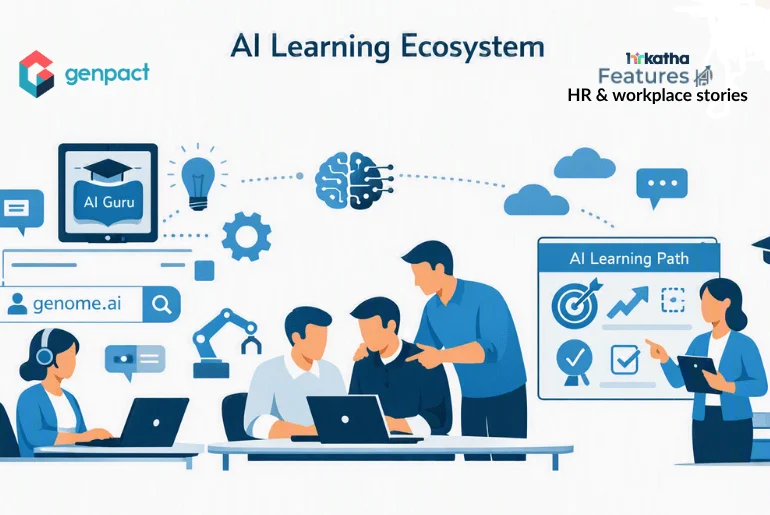
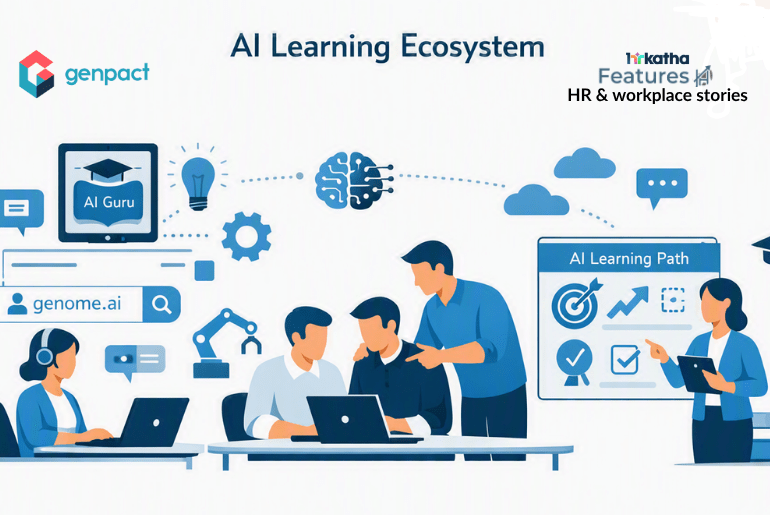
To actualize this, Genpact has developed a sophisticated ecosystem designed to weave AI learning directly into the fabric of daily operations:
- Genome.ai: An AI-powered learning platform that tailors educational content and pathways to individual roles and learning styles, ensuring relevance and engagement.
- AI Guru: A continuous coaching mechanism, likely leveraging AI itself, to provide real-time guidance and support as employees encounter AI-related challenges in their work.
- Scout: An enterprise AI assistant designed to help employees navigate and utilize the company’s internal AI tools and resources efficiently.
- AI Readiness App: A diagnostic tool that allows employees to assess their current AI preparedness and identify areas for improvement, fostering a sense of ownership over their development.
- AI Practice Labs: Browser-based environments providing a safe, sandboxed space for employees to experiment with AI tools, models, and scenarios without impacting live operations. These labs allow for hands-on learning and immediate application of concepts.
- Experiential Learning: Beyond digital platforms, Genpact integrates hackathons, simulations, immersion studios, and applied innovation challenges. These initiatives push employees to apply their nascent AI skills to solve actual business problems, fostering a problem-solving mindset and reinforcing practical application over theoretical knowledge. The principle is clear: an employee learning to manage an AI-generated exception within a real workflow develops a far more robust and applicable capability than one merely watching a module on exception management.
The scale of this continuous learning commitment is substantial. In 2025, Genpact employees collectively recorded over 12.5 million learning hours, with more than five million specifically dedicated to technology and AI. However, Genpact itself acknowledges the inherent limitation of these numbers, recognizing that learning hours measure activity, not necessarily capability or impact.
Measuring True Impact: Capability, Adoption, and Business Value
Understanding these limitations, Genpact is moving beyond traditional metrics to assess AI readiness across three critical dimensions: capability, adoption, and impact.
- Capability: This dimension evaluates whether employees genuinely possess the AI-related skills required for their specific roles. It moves beyond course completion to ascertain actual proficiency.
- Adoption: This metric scrutinizes whether the acquired skills are actively being utilized within daily workflows. It addresses the crucial gap between knowing how to use AI and actually using it.
- Impact: This is the most challenging, yet most vital, dimension. It asks the uncomfortable but essential question: has the integration of AI truly improved productivity, enhanced client outcomes, or elevated decision quality?
As Modi states, "Course completion only shows participation, but not whether people are applying what they have learned or creating business value." This focus on impact elevates Genpact’s initiative beyond a typical reskilling exercise. While completion is straightforward to count, measuring application is harder, and quantifying true impact is harder still. An employee might regularly use an AI tool but not necessarily become more productive. A team might automate parts of a workflow only to create new, time-consuming checking layers elsewhere. Faster output does not inherently equate to better output. Therefore, Genpact’s 2027 target hinges not merely on the number of employees acquiring AI skills, but on the organization’s ability to discern between mere "use" and genuinely "productive use" of AI.
Managers as Multipliers: Bridging Intent and Behavior

A critical determinant of success in Genpact’s ambitious transformation lies in the often-underestimated middle layer: its managers. Between lofty enterprise ambitions and individual employee behavior, managers serve as indispensable multipliers. Employees are unlikely to fundamentally alter their work habits solely because a learning platform dictates it. Instead, it is managers who shape the operational reality: deciding which AI tools are encouraged, which innovative experiments receive resources and time, which mistakes are tolerated as learning opportunities, and ultimately, whether AI becomes an embedded part of normal work or remains an optional, additional task.
Genpact recognizes this pivotal role. "When leaders use tools such as Scout or Chat with Data for workforce insights, AI becomes more visible as part of everyday work rather than a separate corporate initiative," explains Modi. Consequently, the company is investing heavily in equipping its managerial cohort through specialized leadership programs, AI immersion studios, and experiential learning modules. These programs, which for senior leaders include collaborations with prestigious institutions like MIT, Berkeley, and Kellogg alongside Genpact’s internal initiatives, focus less on operating AI tools and more on understanding the strategic implications of AI for business models, operating frameworks, and high-level decision-making. This focus on empowering managers is crucial, as many corporate transformation programs falter by over-emphasizing employee capability while neglecting the cultural and behavioral shifts that must be driven by leadership at all levels. If managers continue to allocate work, assess performance, and make decisions based on outdated paradigms, even the most comprehensive employee training will yield limited results.
AI and the Evolution of Talent Architecture
Genpact’s AI skilling initiative is deeply intertwined with its broader talent architecture. The company has meticulously developed detailed skill taxonomies, robust role-skill frameworks, and a comprehensive enterprise skills inventory. This infrastructure provides a granular understanding of existing capabilities within the workforce and proactively identifies emerging skill gaps. A testament to this integrated approach, more than 52% of Genpact’s staffing needs are met through internal mobility and targeted build programs. This figure underscores that skills are not merely being documented; they are being actively leveraged to move individuals into new and evolving roles.
This internal agility is particularly vital as AI rapidly reconfigures job roles, often at a pace that traditional job architectures struggle to accommodate. As work shifts from repetitive transaction processing towards the supervision of AI-enabled processes, companies face a critical choice: either recruit new talent for every evolving requirement or strategically reskill and redeploy existing employees. Genpact is making a decisive bet on the latter, recognizing the immense value in retaining institutional knowledge and fostering a culture of continuous growth. This approach not only optimizes talent utilization but also builds a resilient, adaptable workforce capable of navigating continuous technological disruption.
Overcoming the Human Hurdles: Confidence and Fatigue
The primary obstacles to achieving Genpact’s 2027 vision are unlikely to be a lack of awareness—employees are acutely aware that AI is changing the nature of work. The greater challenges lie in building widespread confidence and combating potential "digital transformation fatigue." Workforces globally have endured successive waves of digital transformation, automation, and mandatory reskilling initiatives. The prospect of yet another compulsory course is unlikely to generate enthusiasm.
Genpact’s emphasis on highly interactive and practical learning modalities—simulations, labs, hackathons, and work-based experimentation—is a deliberate attempt to position employees as active participants in the change, rather than passive recipients. This approach aims to cultivate a sense of agency and practical utility. Modi aptly describes AI capability not as "a certification earned once and treated as permanently relevant," but as "a muscle that must be strengthened continuously." This analogy perfectly encapsulates Genpact’s holistic and ongoing commitment.
Ultimately, Genpact’s 100 percent AI Practitioner target by 2027 represents more than just a numerical goal. Reaching 120,000 employees with AI learning resources is primarily a challenge of scale and logistics. However, transforming 120,000 individuals into employees who instinctively know when to use AI, when not to use it, when to critically evaluate and even distrust its outputs, and crucially, how to leverage it to produce demonstrably better work, is a profound problem of organizational behavior, cultural evolution, and sustained strategic execution. By 2027, counting the number of certified practitioners will likely be a straightforward task. Proving that they are indeed practicing, and driving measurable business impact, will be the far harder, yet ultimately more rewarding, achievement.